Addenda in Construction: Definition, Purpose, and How to Manage Them
An addendum is a formal, written modification to bid documents issued during the bidding phase — before a contract is signed, not after. That timing is the si..

Key Takeaways
An addendum is a formal, written modification to bid documents issued during the bidding phase — before a contract is signed, not after. That timing is the single most important thing that distinguishes it from a change order.
Addenda are legally binding once issued. They become part of the bid documents and, ultimately, the contract — carrying the same weight as the original drawings and specifications.
They exist to keep every bidder working from the same information. Whether triggered by an RFI, a drawing error, or a material substitution, an addendum goes to every prospective bidder simultaneously, not just the one who asked the question.
Addenda are sequentially numbered and time-stamped, and bidders are typically required to formally acknowledge receipt — often a signature or checkbox on the bid form itself. Missing an acknowledgment can technically disqualify a bid.
The practical risk isn't the addendum itself — it's inconsistent incorporation. If one subcontractor prices a job against the original drawings and another prices it against the addendum-revised set, the GC is comparing two bids for two different scopes without realizing it.
What Is an Addendum in Construction?
An addendum (plural: addenda) is a formal written document issued during the bidding phase of a construction project that clarifies, modifies, or adds to the original bid documents — drawings, specifications, or bidding instructions. It's issued by the project owner or their design representative (the architect or engineer), distributed to every prospective bidder, and becomes a legally binding part of the bid package once issued.
The core purpose is consistency: everyone bidding on the project needs to be pricing the same scope, based on the same information, at the same time. Addenda are how the owner's design team corrects that record mid-bid rather than letting inconsistent understanding turn into inconsistent, unfair proposals.
When Are Addenda Issued?
Addenda are issued after the initial bid documents go out but before the bid deadline — that window is what defines an addendum specifically, as opposed to other types of contract modifications. In practice, they're most commonly triggered by:
Responses to bidder RFIs. A contractor flags an ambiguity or gap during their takeoff; rather than answering that one bidder privately, the design team issues an addendum answering the question for everyone.
Corrections to errors or omissions. Large drawing sets and spec books inevitably contain mistakes — a dimension that doesn't match between sheets, a missing schedule, a spec section that contradicts the drawings.
Design changes made during the bid period. The owner decides on a material substitution, or the design team catches a coordination issue and revises a detail before bids are due.
Procedural changes. Extending the bid deadline, changing the bid submission format, or updating instructions to bidders.
Most public and institutional bid processes also set a minimum notice period before the deadline specifically to give bidders time to reprice — a commonly cited standard is no less than four days before bids are due, though the exact requirement varies by owner and jurisdiction. Confirm the specific rule in the project's instructions to bidders rather than assuming a standard number applies universally.
What Can an Addendum Actually Change?
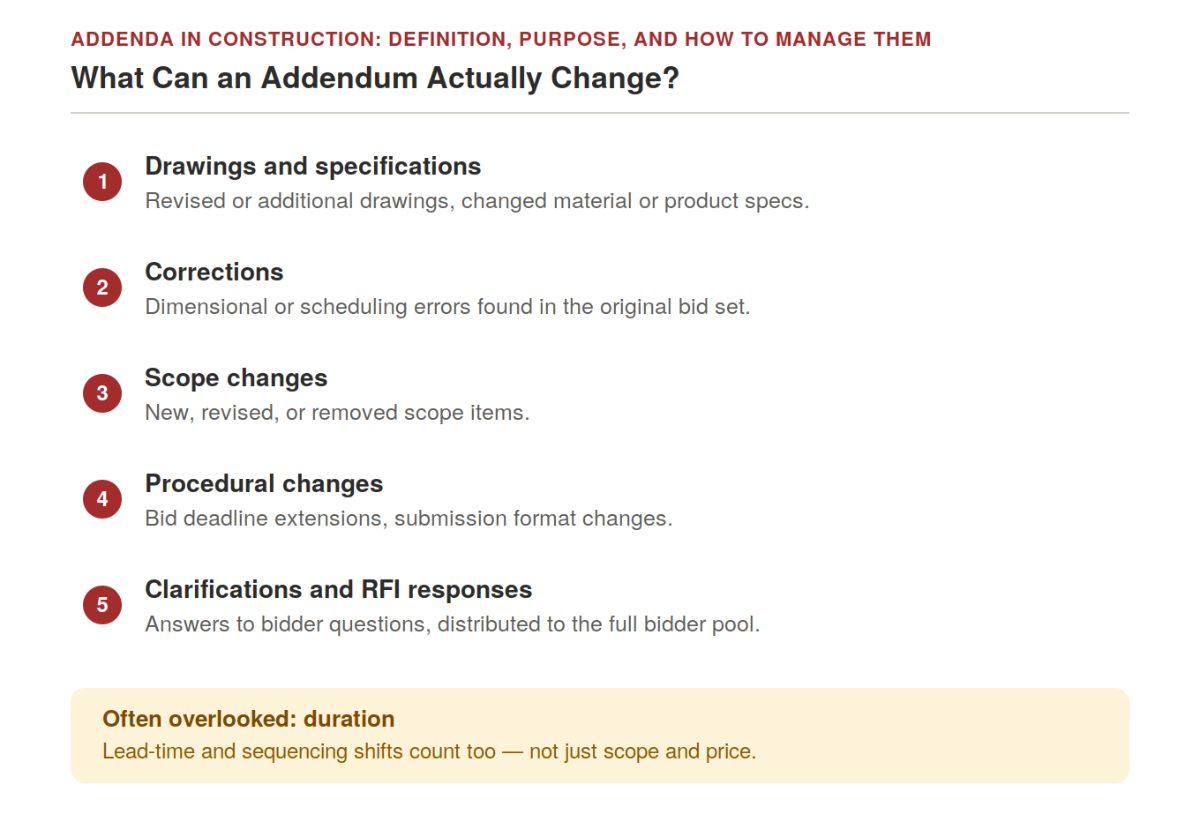
An addendum can modify nearly any part of the bid documents:
Revised or additional drawings
Changed material or product specifications
Corrections to dimensional or scheduling errors in the original set
New or revised scope items
Changes to the bid deadline or submission procedure
Clarifications to ambiguous language in the specifications or instructions to bidders
Responses to bidder questions were distributed to the full bidder pool
The common thread: anything that affects what a bidder needs to price, or how they need to submit their price, is fair game for an addendum. Anything beyond that, actual construction work already underway, is a different document entirely, covered below.
Duration is worth calling out separately from scope and price, since it's easy to overlook. A material substitution or a corrected structural detail doesn't just change what's being priced — it can change lead times, fabrication schedules, or sequencing once the project is awarded. An addendum that looks like a minor spec clarification on paper can still shift the project's overall timeline if the replacement material or system has a materially different lead time than what was originally specified.
Addendum vs. Change Order: What's the Difference?
This is the distinction almost every source on this topic exists to make, because the two terms get used loosely in casual conversation despite meaning fundamentally different things.
Addendum | Change Order | |
Timing | During the bidding phase, before contract award | After the contract is signed and work has started |
Who issues it | Owner or design team (architect/engineer) | Typically negotiated between the owner and the contractor |
What it modifies | The bid documents that every bidder is pricing from | The scope, cost, or schedule of an active contract |
Effect on price | Bidders incorporate it into their original proposal | Usually requires a separate cost/schedule negotiation |
Legal status | Becomes part of the bid package before any contract exists | Formally amends an existing, signed contract |
The practical test: if a contract hasn't been signed yet, it's an addendum. If work is already underway under an executed contract, the same kind of change is handled as a change order instead. (For a deeper look at how change orders and amendments work after permit issuance and contract award, see our guide to what happens after a permit set is submitted.)
Are Addenda Legally Binding?
Yes. Once issued, an addendum becomes part of the bid documents and, if the project proceeds, part of the resulting contract — enforceable in the same way as the original drawings and specifications. This is precisely why formal acknowledgment matters: most bid forms require the bidder to list which addenda they've received and incorporated into their price. A bidder who fails to acknowledge a material addendum can have their bid deemed non-responsive, particularly on public-sector work where bid procedures are followed strictly.
How Addenda Affect Subcontractor Bids and Estimating
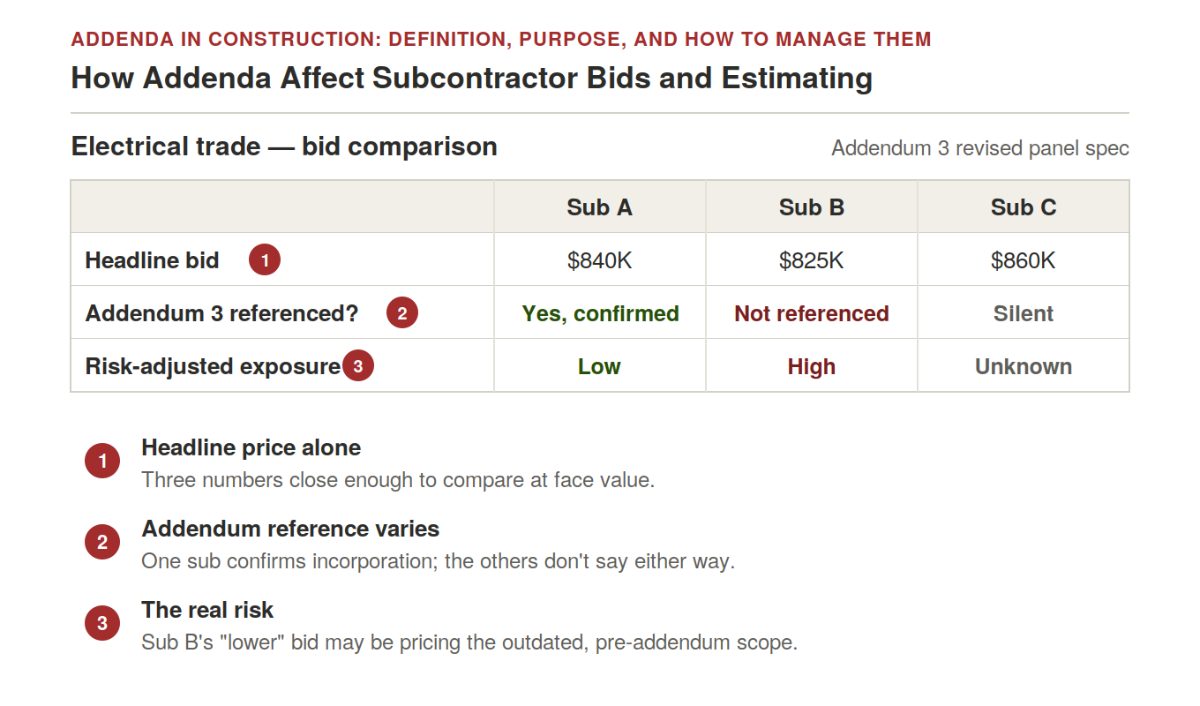
This is where addenda stop being a paperwork formality and start being a real source of risk. Every addendum issued during the bid period has to make it into every bidder's price — and in practice, it doesn't always happen cleanly. A subcontractor who priced their proposal before Addendum 3 revised a spec section is pricing a different scope than one who incorporated it, and neither the sub nor the GC comparing bids may notice the gap just from reading the headline numbers.
This is the same normalization problem covered in our guide to construction document control: a revision that isn't consistently reflected across every party's working set doesn't disappear; it resurfaces later, usually as a change order once the discrepancy is caught in the field. Version control discipline (tracking which addendum each bid reflects, not just which drawing revision) is exactly as important during the bid period as it is for drawing supersession after award.
At bid leveling time, this shows up as a specific, checkable thing: does each subcontractor's proposal explicitly reference which addenda they incorporated? A proposal that's silent on addenda isn't necessarily wrong, but it's unverified, and comparing bids without confirming everyone priced the same addendum-revised scope means comparing numbers that may not represent the same job.Melt Bid reads subcontractor proposals for exactly this kind of gap — surfacing exclusions, qualifications, and scope inconsistencies, including whether a bid reflects the current addendum set, before the award decision locks in a mismatch.
Two practical techniques estimators use to keep addenda from getting lost in a fast-moving bid period: overlaying the revised drawing digitally against the original to see exactly what changed rather than re-reading the full sheet, and tagging each addendum's impact against the specific CSI MasterFormat divisions it touches. The second habit in particular makes it possible to answer a simple but easy-to-get-wrong question at bid time — which trades actually need to reprice because of Addendum 4, and which don't.
Best Practices for Managing Addenda
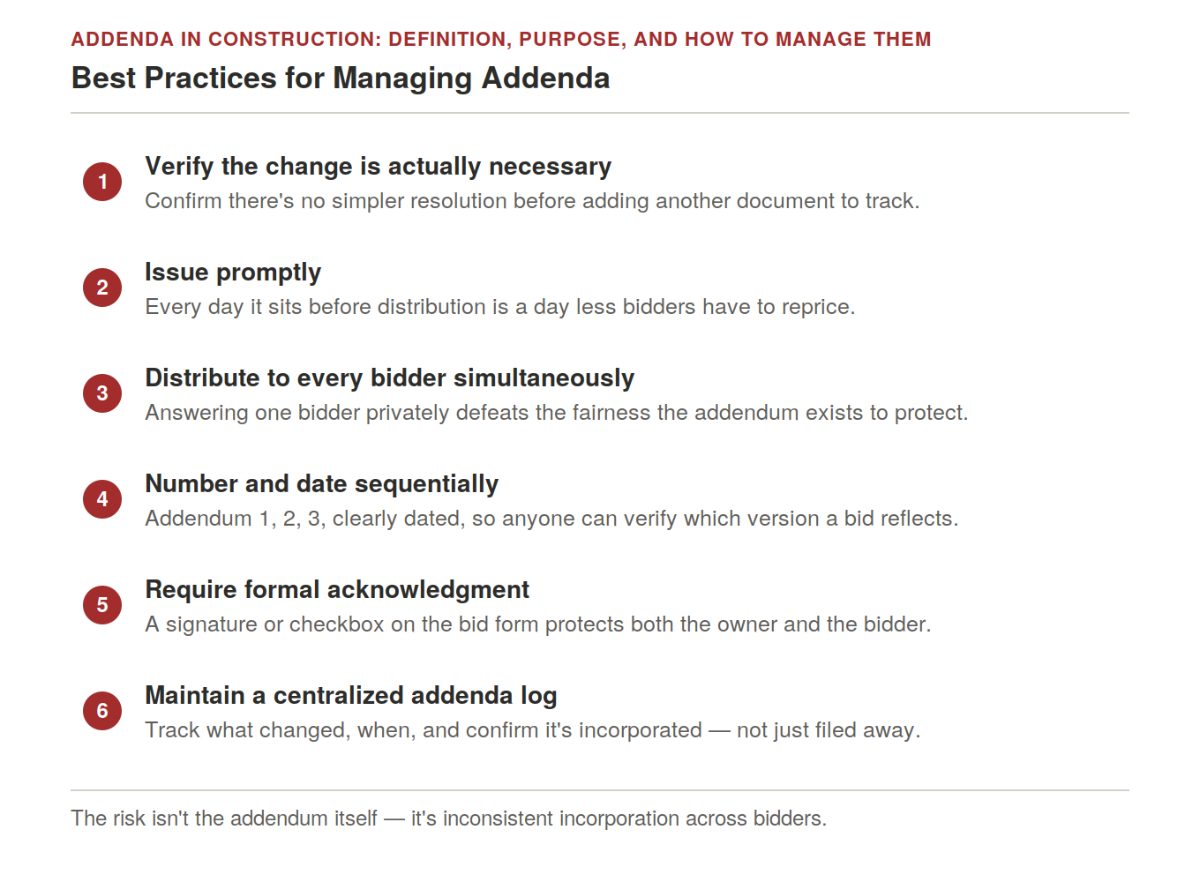
Verify the change is actually necessary before issuing. Not every question or minor discrepancy needs a formal addendum; the design team should confirm there's no simpler resolution before adding another document to the bid set for every bidder to track.
Issue promptly. The longer an addendum sits before distribution, the less time bidders have to reprice, and the more likely someone bids the outdated scope by accident.
Distribute to every bidder simultaneously. An addendum answering one contractor's question privately defeats its entire purpose; fairness in competitive bidding depends on everyone getting it at the same time.
Number and date every addendum sequentially. Addendum 1, 2, 3, in issued order, each clearly dated, this is what makes it possible to verify later which version of the scope a given bid reflects.
Require formal acknowledgment on the bid form. A signature line or checkbox listing every addendum received protects both the owner (proof of fair distribution) and the bidder (proof they priced the current scope).
Maintain a centralized addenda log. Track what each addendum changed, when it was issued, and confirm it's been incorporated into the working drawing and spec set — not just filed away as a separate PDF nobody cross-references at bid time.
Frequently Asked Questions
What is an addendum in construction?
A formal written document issued during the bidding phase that clarifies, modifies, or adds to the original bid documents — drawings, specifications, or bidding instructions. It's issued by the owner or design team, distributed to all bidders, and becomes legally binding once issued.
What's the difference between an addendum and a change order?
Timing. An addendum is issued before a contract is signed, during the bidding phase, and modifies what bidders are pricing. A change order is issued after the contract is signed and work has started, modifying the scope, cost, or schedule of an active contract.
Are addenda legally binding?
Yes. Once issued, an addendum becomes part of the bid documents and, if the project proceeds, part of the resulting contract — with the same legal weight as the original drawings and specifications.
Who issues addenda on a construction project?
The project owner, typically through their design representative — the architect or engineer responsible for the original bid documents. Addenda are not issued by contractors or bidders.
How many addenda can be issued on a project?
There's no fixed limit. Complex projects with large drawing sets commonly see multiple addenda during the bid period, particularly on projects with a longer bidding window or a high volume of bidder RFIs.
Do bidders have to formally acknowledge every addendum?
Typically yes. Most bid forms require the bidder to list which addenda they received and incorporated into their price. Failing to acknowledge a material addendum can render a bid non-responsive, especially in public bidding processes.
How close to the bid deadline can an addendum be issued?
Most bid processes set a minimum notice period before the deadline specifically to give bidders time to reprice, though the exact requirement varies by owner and jurisdiction. Confirm the specific rule in the project's instructions to bidders rather than assuming a standard number applies.
Can an addendum change the bid deadline itself?
Yes. Extending the bid submission deadline is one of the more common procedural changes made through an addendum, often issued alongside a substantive scope or drawing revision to give bidders adequate time to reprice.
Can an addendum affect the project schedule, not just the bid?
Yes, and it's easy to overlook. A material substitution or corrected detail can change fabrication lead times or sequencing once the project is awarded, even if it reads as a minor clarification at bid time. Duration, not just scope and price, is worth checking whenever a substantive addendum is issued.
Related Reading
Best AI to Generate Floor Plans: A Professional Comparison for Architects and Designers
Architectural Design Software in 2026: A Workflow-First Comparison With Per-Stage Tool Comparisons
Best Bid Leveling Software for General Contractors: 2026 Comparison
Related Building Code Resources
- Building CodesGo/No-Go Readiness Checklist for Construction Project Pursuit Decisions
- Building CodesBest Construction Document Control Software in 2026
- Building CodesBest Construction Estimating Software for Mac in 2026
- Building CodesBest Construction CRM Software for Bid Tracking and Follow-Up for General Contractors
- Building CodesBest Construction Estimating Software in the UK Compared
MeltPlan
A curated stream of preconstruction intelligence, estimating innovation, takeoff breakthroughs, workflow advancements, and expert perspectives—powered by the AI and technology shaping the future of construction.
Visit SiteDon't miss what's shaping AEC
The latest on preconstruction, codes, AEC news & trends — so you're always in the know.