Best Construction Estimating Software in the UK Compared
UK estimating software isn't just US software with the currency changed. VAT handling, CIS deductions, BCIS-linked cost data, and JCT or NEC contract compatibil..

Key Takeaways
UK estimating software isn't just US software with the currency changed. VAT handling, CIS deductions, BCIS-linked cost data, and JCT or NEC contract compatibility are genuine, non-optional requirements that a platform built for a different market often doesn't address natively.
The UK market splits by project type more than by firm size. Renovation and refurb work, new-build residential, and large QS or commercial tendering are different buying decisions, not just different budgets — a tool built for one rarely serves the others well.
Live UK merchant pricing is a genuine market-specific differentiator. Tools like EasyEstimate pull current prices directly from Jewson and Travis Perkins rather than relying on a static or generic cost database that goes stale between updates.
AI-powered, floor-plan-to-quote tools are the fastest-growing segment. They compress the traditional desktop-software workflow — manual measurement entry, a flat monthly subscription regardless of workload — that established tools like EstimatorXpress and Buildxact still largely run on.
BCIS remains the reference cost database UK quantity surveyors default to, roughly the UK equivalent of RSMeans in the US market. Most credible platforms either link to it directly or benchmark their own data against it.
Pricing spans an enormous range — from roughly £24/month for a lightweight tool to £2,400+ per license for enterprise QS platforms. Cost alone says very little without matching it to project type and tender volume.
What Makes UK Construction Estimating Genuinely Different?
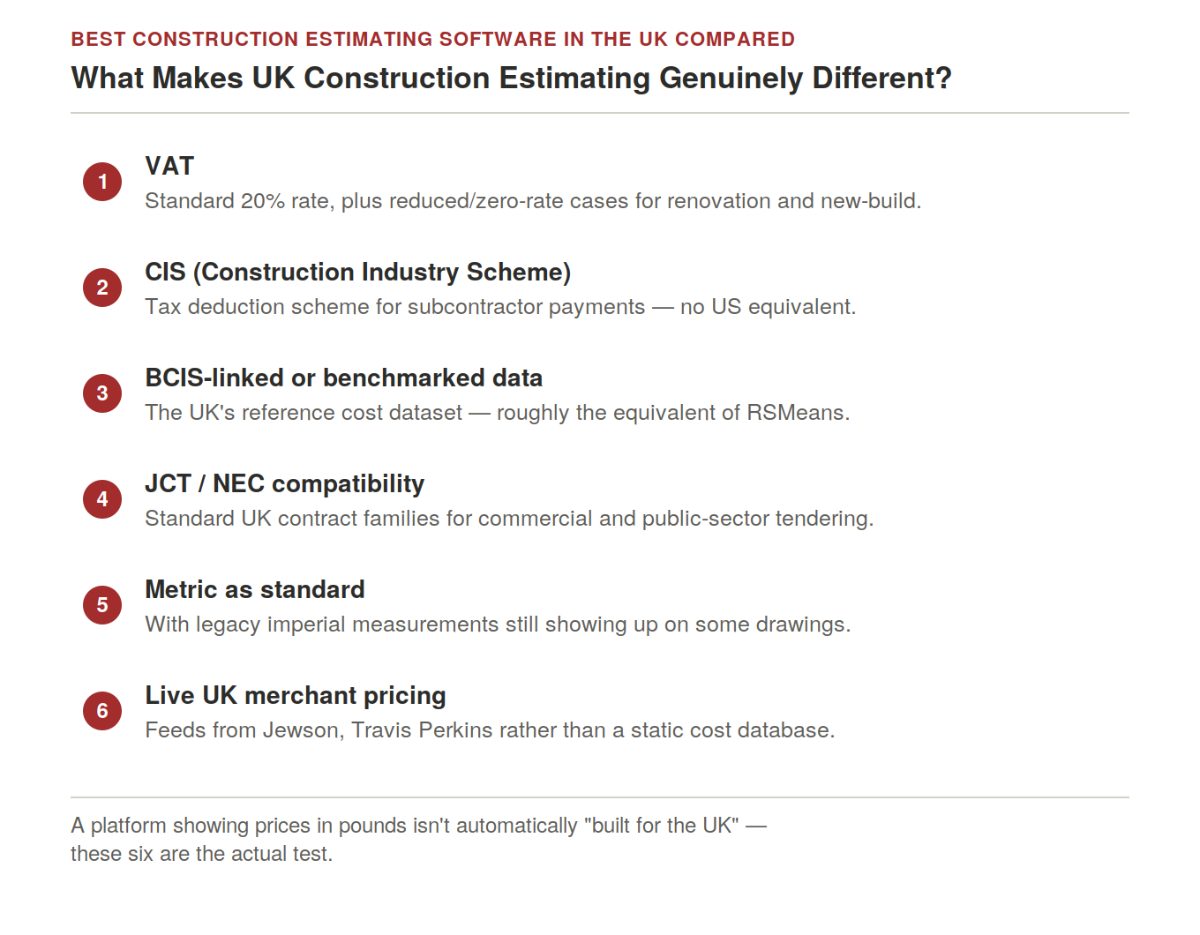
Before comparing platforms, it's worth being specific about what "built for the UK market" actually needs to mean, because it's more than a currency symbol.
VAT. UK estimates need to handle the standard 20% VAT rate correctly and clearly, including cases where reduced or zero rates apply (certain renovation and new-build work qualifies for different treatment) — a US-built tool has no reason to have solved this.
CIS (Construction Industry Scheme). The UK's tax deduction scheme for payments to subcontractors is a UK-specific compliance requirement with no equivalent in most other markets; software that ties estimating into invoicing needs to handle it correctly.
BCIS-linked or benchmarked cost data. The Building Cost Information Service is the standard UK reference dataset for construction costs — the rough equivalent of RSMeans in the US. Credible UK platforms either integrate with it directly or build their own data to be checked against it.
JCT and NEC contract compatibility. These are the standard UK contract families (Joint Contracts Tribunal and New Engineering Contract) — enterprise and QS-focused platforms need to produce output that fits these forms, particularly for tendering on commercial and public-sector work.
Metric units as standard, with the practical reality that some trades and legacy drawings still reference imperial measurements.
Live UK merchant pricing. A newer differentiator specific to this market: rather than a static cost database, some platforms pull current prices directly from major UK builders' merchants like Jewson and Travis Perkins.
Master Comparison Table
Software | Category | Best For | Key UK-Specific Feature | Starting Price |
EstimatorXpress | Established desktop | Small-to-mid builders wanting deep, familiar UK data | Long-standing UK pricing database | Custom quote |
Buildxact | Cloud estimating + job management | New-build residential, small-mid builders | Xero integration | Custom quote |
RenoCalc | AI floor-plan-to-quote | Renovation and refurb specialists | Covers 12 refurb-specific trades | From £9.99, pay-per-use |
EasyEstimate | Cloud estimating, live pricing | Sole traders through growing SMEs | Live Jewson/Travis Perkins pricing | Free tier, £39.99/mo pro |
BuildPartner | Budget cloud estimating | Cost-conscious small builders | Straightforward UK pricing | From £24/mo |
Causeway Estimating | Enterprise QS platform | Large QS firms, BIM-heavy NEC tenders | Deep BCIS links, 2D/3D takeoff | From £2,400/license |
RIB CostX | Enterprise BIM estimating | BIM-heavy commercial projects | Live-linked BIM workbooks | Custom quote |
Procore Estimating | Cloud, PM-integrated | UK teams standardized on Procore | Native Procore/Sage integration | Custom quote |
Tradify | Trade job management | Electricians, plumbers, small trade contractors | Simple quoting, not deep estimating | Custom quote |
Powered Now | Mobile trade management | Gas/electrical compliance-focused trades | Compliance certificate handling | Custom quote |
Established UK Desktop and Cloud Platforms
EstimatorXpress is the most established name specifically built around UK pricing, and it shows in its depth — it's the tool many small and medium builders have used for years. It's a genuine Windows desktop application installed per machine, not a browser-based tool, which is worth knowing going in if the team expects a cloud-native experience.
Best for:Small-to-mid builders who want deep, UK-specific pricing data and don't mind a traditional desktop install.
Tradeoff:Desktop-bound rather than cloud-native, and priced as a flat subscription regardless of how many jobs are actually quoted in a given month.
Buildxact runs as a genuine cloud platform combining takeoff, estimating, and light job management, with a Xero integration that matters given how widely Xero is used for UK small-business accounting. It's built primarily around new-build and general residential work rather than renovation-specific trade depth.
Best for: New-build residential builders and small-to-mid firms wanting cloud access plus job management in one platform.
Tradeoff: Less renovation-specific trade depth than a purpose-built refurb tool — general estimating tools built for new builds don't cover refurbishment-specific line items as thoroughly.
AI-Powered, Floor-Plan-to-Quote Tools
This is the fastest-moving segment in the UK market right now, and it's solving a specific complaint with the established tools above: significant setup time and a flat monthly cost regardless of workload.
RenoCalc was built specifically for renovation work — refurbishments, extensions, loft conversions, kitchen and bathroom fit-outs, HMO conversions — and covers roughly a dozen trades commonly involved in that kind of project, generating a materials shopping list alongside labour costs. It's priced pay-per-use from £9.99, which fits a builder doing a handful of renovation jobs a month rather than needing a flat subscription. General estimating tools built for new builds typically lack this renovation-specific trade depth.
Best for:Renovation and refurbishment specialists who want floor-plan-to-quote speed without renovation-irrelevant new-build features.
Tradeoff: Purpose-built for refurb work specifically — a firm doing primarily new-build construction gets less value from its trade-specific depth.
EasyEstimate blends live UK merchant pricing with built-in labour calculators and pre-built job templates, aimed at the wide middle of the UK market — sole traders pricing domestic extensions through growing firms tendering commercial work. The free tier makes it a legitimate starting point before committing to the £39.99/month professional version.
Best for:Builders and small contractors who want current material pricing without manually checking merchant websites, at a genuinely accessible price point.
Tradeoff:Less enterprise reporting depth than a QS-focused platform — the value is speed and current pricing, not tender-document sophistication.
Budget and Accessible Options
BuildPartner is positioned as the straightforwardly affordable UK option, starting from £24/month — a real choice for a small builder who needs structured estimating without enterprise complexity or enterprise pricing attached to it.
Best for: Cost-conscious small builders who want a step up from spreadsheets without a big subscription commitment.
Tradeoff:Lighter feature depth than the platforms built for larger firms or complex tendering.
Enterprise and QS-Focused Platforms
Causeway Estimating is built for large-quantity surveying firms, with 2D/3D takeoff, deep BCIS links, and a strength in BIM integration and NEC tender work. Pricing reflects that scale, starting from roughly £2,400 per license.
Best for: Large QS firms and commercial contractors running BIM-heavy projects and NEC tenders.
Tradeoff:Steep learning curve and enterprise pricing that's not proportionate to smaller firms' needs.
RIB CostX leads specifically on BIM-heavy accuracy, with live-linked BIM workbooks that update takeoff quantities as the model changes rather than requiring a re-measure.
Best for: Commercial and institutional projects where BIM-linked takeoff accuracy is the priority. Tradeoff: The BIM-centric workflow is only valuable if the project is actually being delivered with a coordinated BIM model in the first place.
Procore Estimatingfits UK teams that have already standardized on Procore for broader project management, keeping estimating inside the same system as scheduling, financials, and field tools rather than as a separate platform.
Best for:UK contractors already running Procore who want estimating in the same system of record.
Tradeoff:Choosing Procore for estimating alone, without the broader platform already in use, is a heavier commitment than the UK-specific tools above.
Trade-Specific Job Management Tools
Worth a brief mention because they appear constantly in UK searches for this topic, even though they're closer to job management than deep estimating: Tradify and Powered Now are built for tradespeople — electricians, plumbers, small specialist contractors — who need fast, simple quoting alongside scheduling and mobile invoicing, not detailed multi-trade takeoff. Powered Now leans stronger on gas and electrical compliance certificate handling; Tradify leans stronger on team scheduling.
Best for:Single-trade contractors and small specialist firms whose estimating needs are simple relative to a multi-trade GC or renovation specialist.
Tradeoff: Not built for complex, multi-trade construction estimating — trying to stretch either into that role will show the seams quickly.
How Does BCIS Fit Into UK Estimating Software?
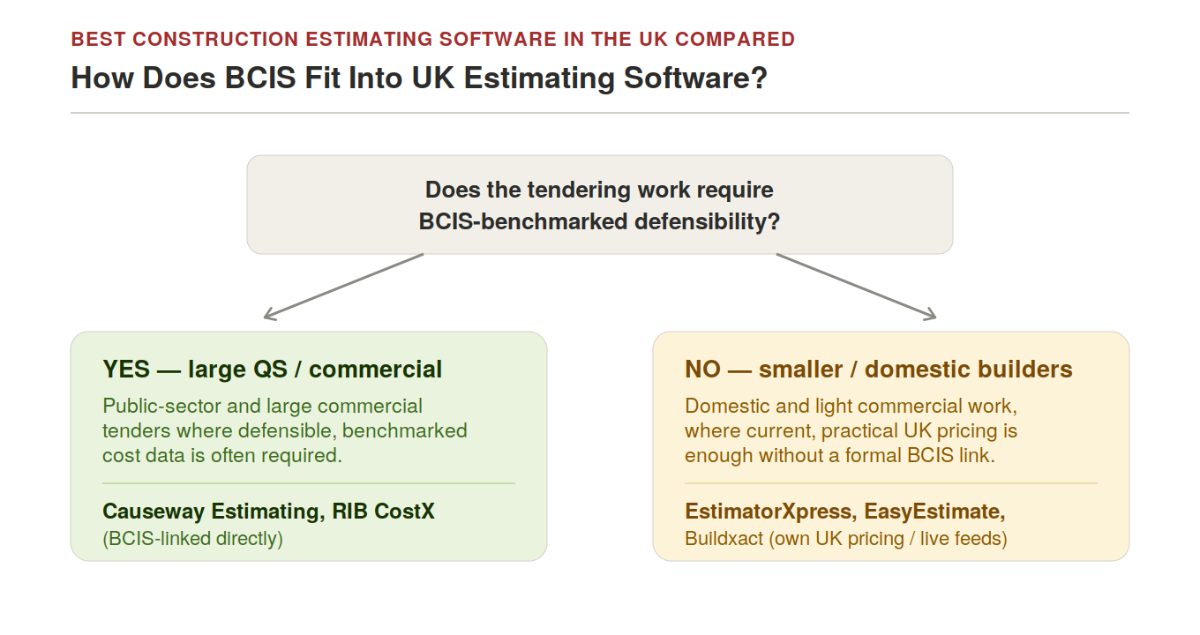
The Building Cost Information Service functions as the UK's reference cost dataset, similar in role to RSMeans in the US market — a source of benchmarked, independently maintained cost data that quantity surveyors and estimators use to sense-check their own pricing. Platforms aimed at larger QS firms and commercial tendering (Causeway, RIB CostX) tend to integrate with BCIS data directly. Smaller, builder-focused tools more commonly maintain their own UK pricing (sometimes tied to live merchant feeds, as with EasyEstimate) rather than a formal BCIS integration. Neither approach is wrong — the question is whether the firm's tendering work requires BCIS-benchmarked defensibility or whether current, practical UK pricing is enough.
How to Evaluate UK Construction Estimating Software
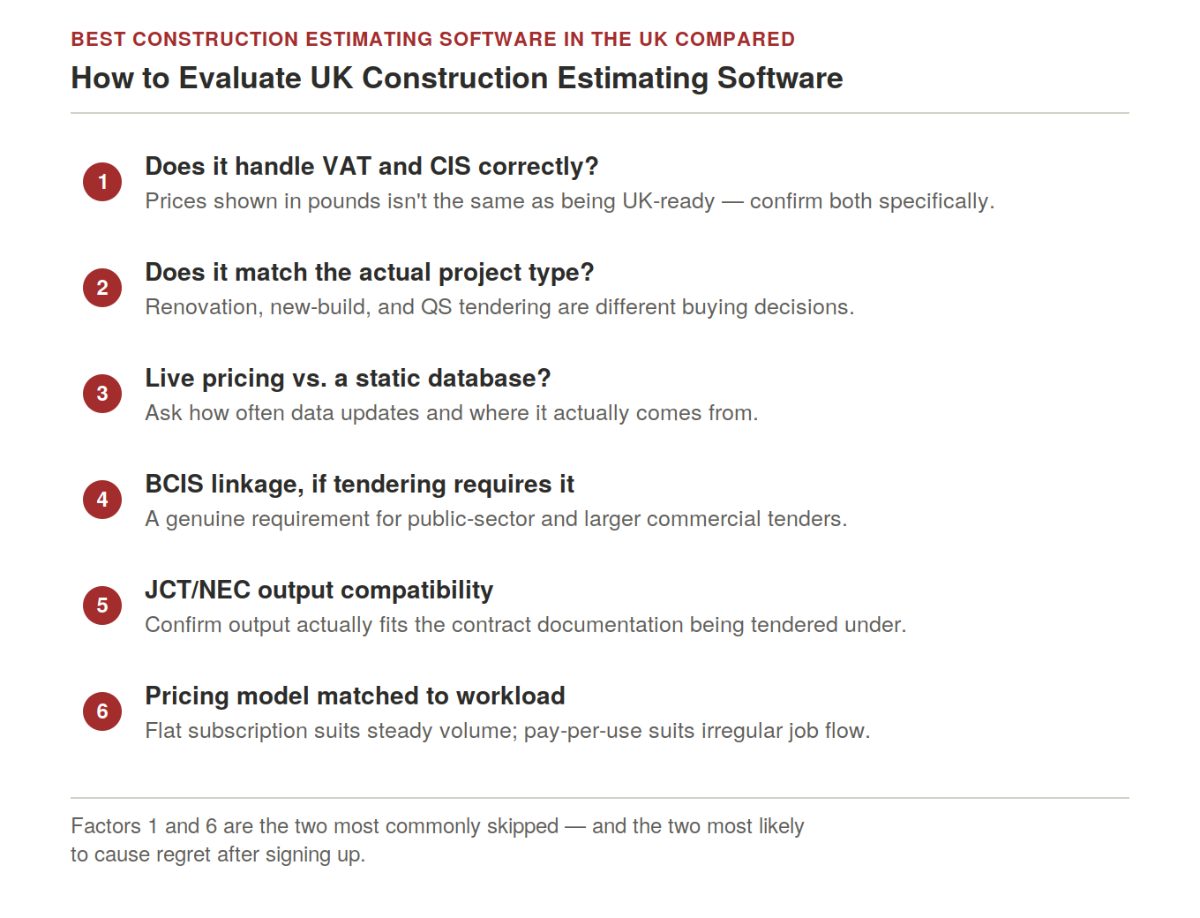
Six factors, in order:
Does it handle VAT and CIS correctly, not just currency formatting. A platform that shows prices in pounds isn't automatically UK-ready — confirm VAT treatment and CIS deduction handling specifically if invoicing flows through the same system.
Does it match the actual project type. Renovation, new-build residential, and large commercial/QS tendering are different buying decisions — a tool's trade depth needs to match the work being quoted, not just the firm's size.
Live pricing vs. a static cost database. Ask specifically how often pricing data updates and where it comes from — a live merchant feed and a database updated annually produce very different estimate reliability.
BCIS linkage, if tendering work requires it. For public-sector or larger commercial tenders, BCIS-benchmarked data may be a genuine requirement rather than a nice-to-have.
JCT/NEC output compatibility, for firms tendering on those contract forms. Confirm the platform's output actually fits the contract documentation the firm is tendering under, particularly for commercial and public work.
Pricing model matched to actual workload. A flat monthly subscription makes sense for high, steady estimate volume; pay-per-use pricing (as with RenoCalc) makes more sense for a builder doing a handful of jobs a month who'd otherwise pay for capacity they don't use.
How the Stack Looks by Builder Type
Builder Type | Recommended Platform | Notes |
Sole trader / single-trade contractor | Tradify or Powered Now | Simple quoting and scheduling over deep multi-trade takeoff |
Renovation and refurb specialist | RenoCalc | Pay-per-use fits irregular renovation job volume |
Small-to-mid new-build builder | Buildxact or EasyEstimate | Cloud access, Xero integration, live UK pricing |
Cost-conscious small builder | BuildPartner | Structured estimating without enterprise pricing |
Established SME wanting deep UK data | EstimatorXpress | Accept the desktop-only tradeoff for data depth |
Large QS firm / commercial tendering | Causeway Estimating or RIB CostX | Budget for BCIS-linked, BIM-heavy enterprise pricing |
Frequently Asked Questions
What is the best construction estimating software in the UK?
There's no single best platform — it depends on project type and firm size. EstimatorXpress and Buildxact lead for established small-to-mid builders. RenoCalc leads specifically for renovation and refurb work. EasyEstimate and BuildPartner lead for accessible, budget-conscious estimating. Causeway Estimating and RIB CostX lead for large QS firms and BIM-heavy commercial tendering.
Does UK construction estimating software need to handle VAT automatically?
Yes, and it's one of the clearest signs a platform was actually built for the UK market rather than adapted after the fact. Confirm the software correctly applies the standard 20% rate and handles reduced or zero-rate cases relevant to renovation and new-build work, not just currency display.
What is BCIS, and do I need software that integrates with it?
BCIS (Building Cost Information Service) is the UK's standard reference cost database, similar in role to RSMeans in the US. Larger QS firms and commercial tendering work typically benefit from BCIS-linked data; smaller builders pricing domestic and light commercial work are often well served by a platform's own UK pricing without a formal BCIS integration.
Is EstimatorXpress still worth using as a Windows desktop application in 2026?
For builders who value its data depth and don't need cloud access, yes — it remains one of the most established UK-specific pricing databases in the category. Firms wanting cloud access, mobile use, or a lower up-front commitment increasingly look toward Buildxact, EasyEstimate, or similar cloud-native alternatives instead.
What's the difference between RenoCalc and a general estimating tool like Buildxact?
RenoCalc is purpose-built for renovation and refurbishment work specifically, covering roughly a dozen refurb-relevant trades with pay-per-use pricing. General tools like Buildxact are built primarily around new-build residential work and carry less renovation-specific trade depth, even though both are genuinely UK-focused platforms.
Do I need a JCT or NEC-compatible platform if I'm a small residential builder?
Usually not. JCT and NEC contract compatibility matters most for firms tendering on commercial or public-sector work under those specific contract forms. A small residential builder pricing domestic extensions and refurbishments is unlikely to need that output format.
How much does construction estimating software cost in the UK?
The range is wide by design. Budget options like BuildPartner start around £24/month. Pay-per-use tools like RenoCalc start from £9.99 per quote. Mid-market platforms like EasyEstimate run £39.99/month for the professional tier. Enterprise QS platforms like Causeway Estimating start from roughly £2,400 per license.
Can I use a US-built platform like STACK or ProEst for UK estimating?
Some UK firms do, particularly larger contractors already standardized on a US-headquartered platform for other reasons, but confirm VAT and CIS handling specifically before relying on it for UK invoicing; these are UK-specific requirements a platform built primarily for the US market may not address natively.
Related Reading
How to Prequalify Subcontractors — A Step-by-Step Process for General Contractors
Construction Takeoff, Estimating, and Bid Leveling: A Complete GC Preconstruction Workflow Guide
Free Construction Unit Cost Databases: The Best Sources for Estimators in 2026
Related Building Code Resources
- Building CodesGo/No-Go Readiness Checklist for Construction Project Pursuit Decisions
- Building CodesBest Construction Document Control Software in 2026
- Building CodesBest Construction Estimating Software for Mac in 2026
- Building CodesAddenda in Construction: Definition, Purpose, and How to Manage Them
- Building CodesBest Construction CRM Software for Bid Tracking and Follow-Up for General Contractors
MeltPlan
A curated stream of preconstruction intelligence, estimating innovation, takeoff breakthroughs, workflow advancements, and expert perspectives—powered by the AI and technology shaping the future of construction.
Visit SiteDon't miss what's shaping AEC
The latest on preconstruction, codes, AEC news & trends — so you're always in the know.