Construction Bid Documents Explained: What Contractors Need to Review
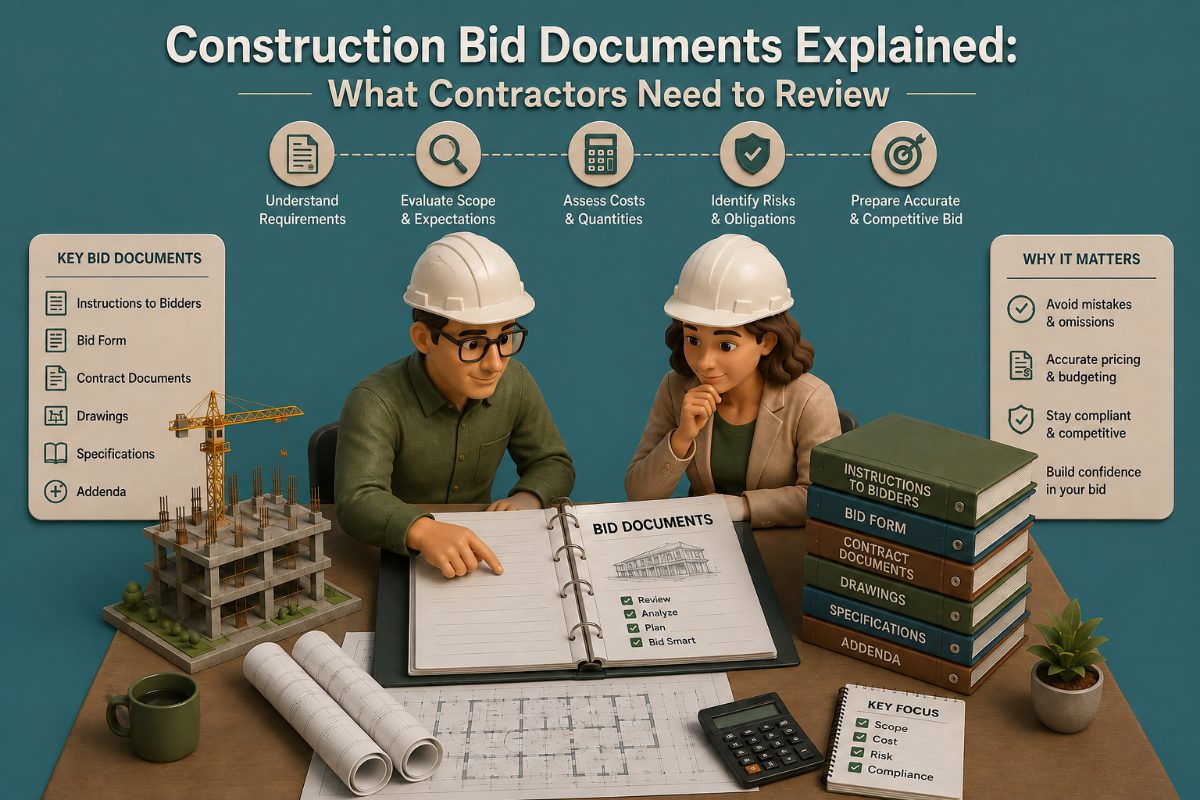
A complete bid package is six to eight distinct document types, not one file. Missing the review on any single one of them is a common, avoidable cause of a rej..
Key Takeaways
A complete bid package is six to eight distinct document types, not one file. Missing the review on any single one of them is a common, avoidable cause of a rejected or underpriced bid.
Instructions to Bidders sets the rules of the game, not just paperwork. Bid security type, insurance and licensing requirements, and submission format are all spelled out here — missing one of these can disqualify an otherwise competitive bid before price is ever compared.
Drawings and specifications answer different questions and need to be cross-checked against each other, not read in isolation. A dimension that doesn't match between the two is one of the most common, costly gaps a bid review turns up.
Addenda become part of the bid documents once issued. A bid that doesn't clearly reflect the current addendum set isn't necessarily wrong, but it's unverifiable — and inconsistent incorporation across bidders is a frequent, hidden source of scope mismatch.
Submission errors, not just pricing, sink a meaningful share of otherwise competitive bids. Industry estimates suggest a significant portion of unsuccessful bids come down to avoidable errors, missing forms, incomplete documentation, and late delivery, separate from simply being outbid on price.
The contract delivery method changes what's actually in the package. Reviewing bid documents without first confirming whether the project is design-bid-build or design-build can lead to misreading what's being asked for.
Larger and public-sector bids add real documents beyond the core package. General Conditions, a draft contract agreement, and a non-collusion affidavit are common additions with their own review requirements; missing any of them changes what a bid actually commits to, independent of price.
What Are Construction Bid Documents?
Construction bid documents are the complete set of materials a project owner (or their architect/engineer) issues to solicit competitive pricing from contractors. Collectively, they define the scope, the rules for submitting a price, and the standards a winning bid needs to meet — everything a contractor needs to price the work accurately and everything the owner needs to compare bids fairly.
It's worth distinguishing bid documents from contract documents, since the terms get used loosely. Bid documents exist to solicit and support a competitive bid before award. Once a contract is signed, many of the same documents (drawings, specifications) carry forward and become contract documents — governing the executed agreement rather than a competitive submission. The content often overlaps; the legal role it plays changes once a contract exists.
The Core Components of a Bid Package, and What to Actually Check in Each
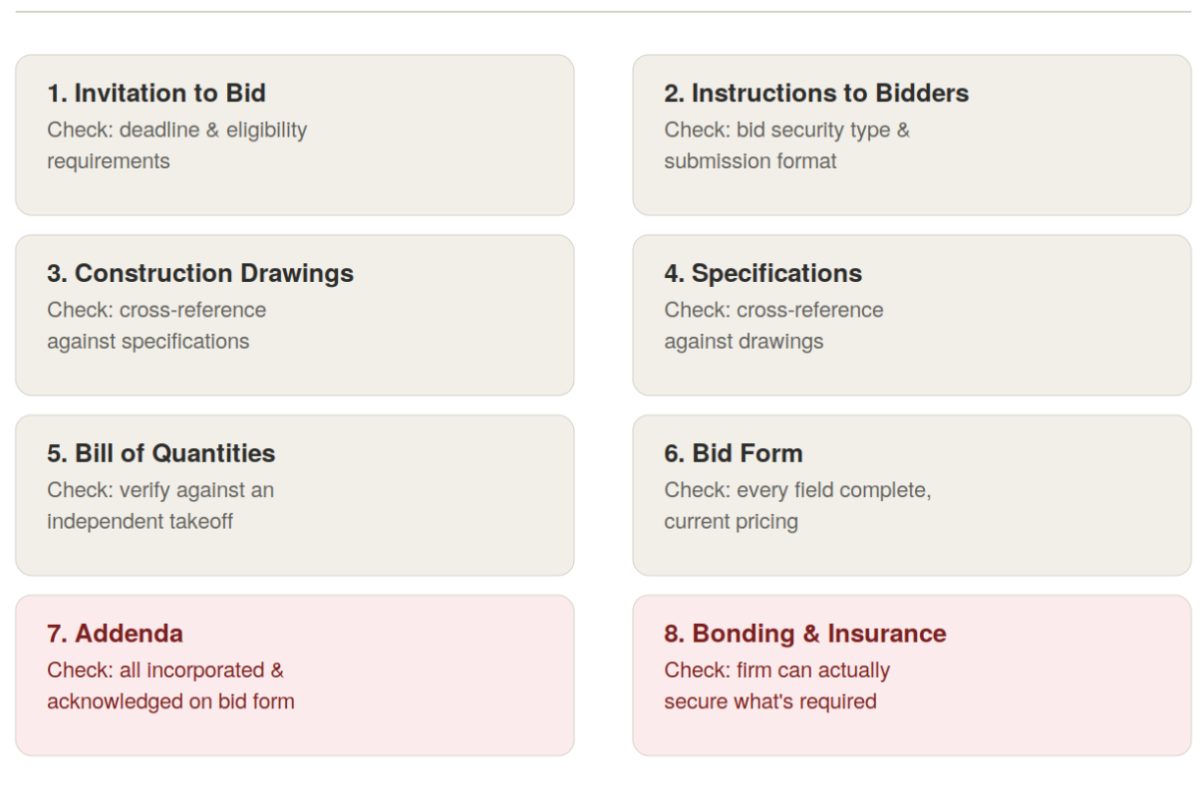
Invitation to Bid (ITB) / Invitation for Bid (IFB). The formal document announcing the opportunity and establishing where the rest of the bid documents can be obtained. Check: the submission deadline, eligibility requirements, and whether the project is publicly advertised (open bidding) or by invitation only (selective or negotiated).
Instructions to Bidders. The rulebook for the submission itself — required bid security (a bid bond, letter of credit, or cashier's check), insurance and licensing requirements, and the exact submission format. Check: this document line by line, since a technically disqualifying error (wrong bid security type, missing insurance certificate) has nothing to do with price and everything to do with following instructions precisely.
Construction drawings. The architectural and engineering plans, elevations, sections, and details that define what's actually being built. Check: drawings against the specifications for consistency — a dimension or material called out differently between the two is a common, expensive gap to miss at bid time.
Specifications. The technical requirements behind the drawings — materials, systems, quality standards, and installation methods. Check: for spec sections that conflict with the drawings, and for any performance requirement that changes labor or material cost meaningfully from what the drawings alone would suggest.
Bill of quantities (BOQ). An itemized list of the quantities of work is used as the basis for pricing each line item. Check: that BOQ quantities are reasonably consistent with what a takeoff from the drawings actually produces — BOQs are prepared by someone, and errors do make it through.
Bid form. The actual document a contractor fills out and submits — the core deliverable of the entire package. Check: that every required field is completed and that the number entered matches the detailed pricing backup, not a rounded or outdated figure.
Addenda. Formal, binding modifications to the bid documents issued during the bidding period, before contract award. Check: that every addendum issued has been incorporated into drawings, specs, and the final price, and that the bid form explicitly acknowledges every addendum received.
Bonding and insurance requirements. Separate from the bid security itself, this covers what's required if the bid is accepted — performance bonds, payment bonds, and specific insurance coverage levels. Check that the firm can actually secure the required bonding before submitting a price that assumes it can.
Prequalification materials. Company qualifications, examples of similar past projects, and financial statements are sometimes submitted alongside the bid and sometimes as a separate, earlier step. Check: that submitted qualifications are current and that referenced past projects are genuinely comparable to the project being bid, not just similar in size.
Additional Documents in Larger or Public-Sector Bid Packages
The eight documents above cover most private and small-to-mid commercial bids. Larger commercial projects and public-sector work typically add several more, each worth knowing, since missing one changes what a bid actually commits to.
General Conditions. The standard contract terms that apply broadly — rights, responsibilities, dispute procedures, and payment terms are often based on a standard form like AIA A201. Check: unfamiliar or unusually onerous terms (retainage percentage, liquidated damages, indemnification language) before pricing, since these shift real cost and risk even though they're not a line item.
Supplementary Conditions. Project-specific modifications to the General Conditions, written to override or add to the standard terms for this particular project. Check: this document explicitly for anything that changes the General Conditions' default terms; it's easy to price against the standard form and miss a project-specific override buried here.
Schedule of Values. A breakdown of the contract sum allocated across major work items or phases, sometimes required at submission and sometimes shortly after award to support progress payment applications. Check that the format required matches what the firm's accounting and billing process can actually produce without a rebuild.
Geotechnical report or site survey. Subsurface soil conditions, existing site data, and survey information, usually provided as reference information rather than a for-bid document, but directly affect excavation, foundation, and earthwork pricing. Check: the report's date and scope, a geotechnical report from years earlier or covering only part of the site is a real, common gap.
Pre-bid meeting minutes. A documented record of the questions asked and answered during a mandatory or optional pre-bid meeting or site visit, distinct from addenda, though closely related. Check that every question and answer recorded here that affects scope or pricing has also been captured in a formal addendum; meeting minutes alone often aren't binding the way an addendum is.
Unit price schedule and schedule of alternates. Common on civil and public work: unit prices for anticipated quantity variations, and add/deduct pricing for optional scope items (alternates) that the owner may or may not include. Check: that unit prices are realistic, standalone numbers, not just a lump-sum total divided arbitrarily across line items.
Draft contract agreement. The proposed contract form included in the bid package shows bidders what they'll actually be agreeing to if awarded the work, not just the price, but the terms. Check this document at bid time, not after award. Confirm that liquidated damages, retainage terms, and payment schedule are things the firm can actually live with before submitting a price built on the assumption that they will.
Non-collusion affidavit or bidder certifications. Common on public-sector work: a sworn statement certifying the bid was prepared independently, without price-fixing or collusion with other bidders. Check: that this is signed and included; its absence is a straightforward disqualification on most public bids, unrelated to price or qualifications.
How Contract Delivery Method Changes What's in the Package
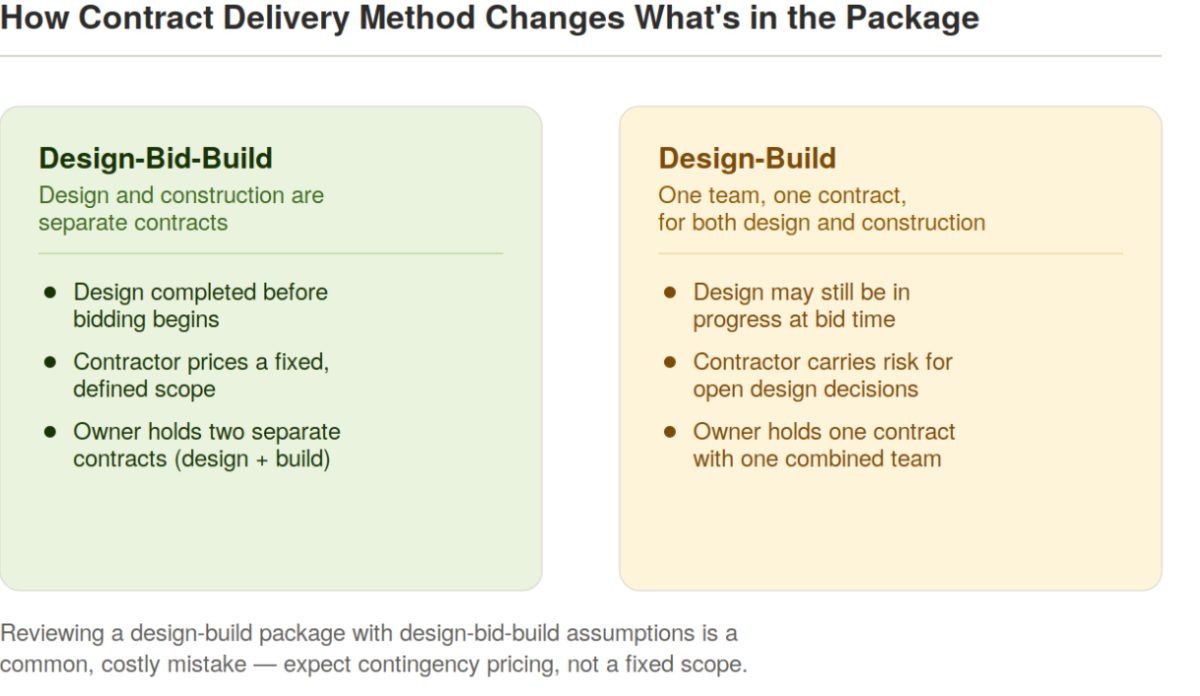
The delivery method shapes what a bid package actually contains, which is why it's worth confirming before diving into document review. Design-bid-build keeps design and construction as separate contracts, the bid package reflects a largely completed design, and the contractor prices a defined scope. Design-build combines design and construction into one contract, meaning the bid package may include less-complete design information, with the contractor's team responsible for completing design after award. Reviewing a design-build bid package with design-bid-build assumptions, expecting fully resolved drawings, for instance, leads to missing exactly the kind of open-ended scope a design-build bid needs to price with contingency instead of precision.
A Contractor's Bid Document Review Checklist
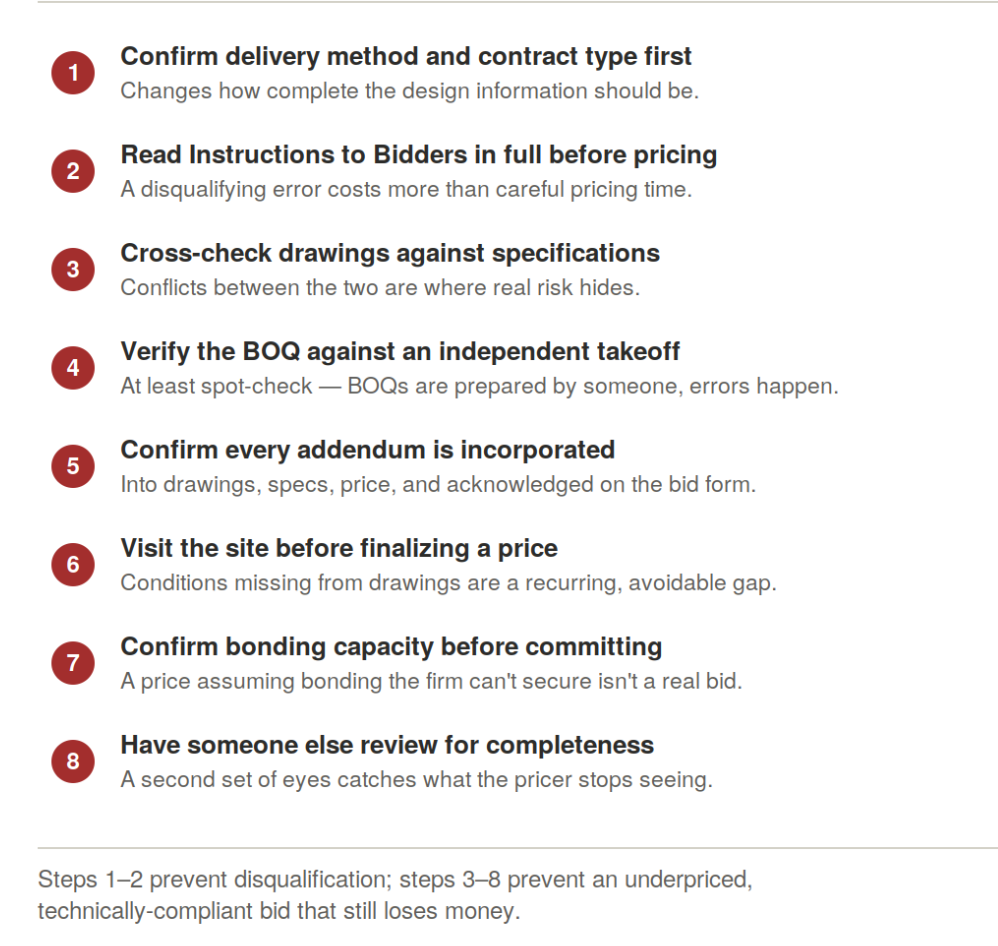
Confirm the delivery method and contract type first. It changes the level of design completeness to expect from the rest of the package.
Read the Instructions to Bidders in full before touching pricing. A disqualifying submission error costs more than the time spent pricing the job carefully.
Cross-check drawings against specifications, not just each document independently — conflicts between the two are where the real risk hides.
Verify the BOQ against an independent takeoff, at least at a spot-check level, rather than pricing quantities exactly as given.
Confirm every issued addendum is incorporated into the current drawing set, spec references, and final price, and acknowledged explicitly on the bid form.
Visit the site, if at all possible, before finalizing a price. Site conditions that don't appear in drawings are a recurring, avoidable source of underpriced bids.
Confirm bonding capacity before committing to a number. A price that assumes bonding the firm can't actually secure isn't a real bid.
Have someone who didn't write the price review review the submission for completeness — a second set of eyes catches missing forms and unacknowledged addenda more reliably than the person who's been staring at the number all week.
Common Bid Document Review Mistakes (and What They Cost)
Inadequate review of the full package. Skimming drawings and going straight to pricing skips exactly the cross-checking that catches conflicts before they become expensive.
Skipping the site visit. Conditions that a drawing set doesn't fully capture, access constraints, existing condition issues, and utility locations turn into change orders that could have been priced in from the start.
Submitting inaccurate or incomplete pricing. Rushed takeoffs and stale supplier quotes produce numbers that look complete but aren't reliable.
Bidding outside the firm's actual expertise. A technically compliant bid on an unfamiliar scope is a bid that's likely to be underpriced, whether or not the review process itself was thorough.
Submission errors that have nothing to do with price. Industry estimates suggest a meaningful share of losing bids fail on avoidable submission mistakes, a missing form, an unacknowledged addendum, a late delivery, or errors that disqualify a bid, regardless of how competitive the actual number was.
From Bid Documents to Bid Submission: What Happens Next
Once a bid is reviewed, priced, and submitted, the process doesn't end at the deadline. The owner evaluates submissions not only on price, but also on completeness, qualifications, and how well the bid demonstrates an understanding of the scope, and may enter negotiation before award.
If a bid is accepted, take the time to review the proposed contract carefully before signing, even under pressure to move fast. This is exactly why reviewing the draft contract agreement at bid time, covered above, matters; there shouldn't be major surprises in the executed contract if that document was read carefully during bid preparation, but it's worth a full re-read against the actual terms being offered, not just a skim to confirm the price matches. Don't let an owner pressure a signature on terms that haven't been fully read or agreed to; a contract signed in a hurry is far harder to renegotiate than a bid submission delayed by a day for legal review. Once contracts are signed, the contractor receives a Notice to Proceed (NTP) — the formal document authorizing work to begin.
For a GC, reviewing bid documents thoroughly is only half the challenge — the same discipline applies in reverse when soliciting bids from subcontractors for the trades on the project. A GC's own invitation to bid and instructions to bidders go out to multiple subs per trade, and the proposals that come back need the same kind of careful cross-checking this guide describes, at a larger scale and under tighter time pressure.Melt Bid automates that comparison, reading subcontractor proposals for a trade package, surfacing scope gaps and exclusions, and flagging whether each bid reflects the current addendum set, the same review discipline covered here, applied to the bids a GC receives rather than the ones a GC submits.
Frequently Asked Questions
What documents are included in a construction bid package?
A typical bid package includes an invitation to bid, instructions to bidders, construction drawings, specifications, a bill of quantities, a bid form, any addenda issued during the bid period, and bonding/insurance requirements. Prequalification materials are sometimes included or submitted as a separate step.
What's the difference between bid documents and contract documents?
Bid documents exist to solicit and support a competitive bid before a contract is awarded. Once signed, many of the same documents (drawings, specifications) carry forward and function as contract documents, governing the executed agreement rather than a competitive submission — the content often overlaps, but the legal role changes.
What should a contractor check first when reviewing bid documents?
Confirm the contract delivery method (design-bid-build vs. design-build) before anything else, since it determines how complete the design information in the rest of the package should be. After that, read the Instructions to Bidders in full; submission requirements disqualify bids independent of price.
Why do drawings and specifications need to be cross-checked against each other?
Because they can and sometimes do contain conflicting information, and each is usually reviewed by different people preparing different parts of a bid. A dimension or material specified differently between the two is a common, costly gap that only shows up when both are actively cross-checked, not read separately.
How do addenda affect bid document review?
Addenda are formal, binding modifications issued during the bid period, and every one issued needs to be incorporated into a bidder's drawings, specifications, and final price. A bid that's silent on which addenda it reflects is a bid that can't be verified as pricing the current scope. See our full guide to addenda in construction for how they differ from post-award changes.
Why do bids get disqualified for reasons unrelated to price?
Because bid documents establish binding submission requirements, required bid security, insurance certificates, formatting, and deadlines that a bid has to meet, regardless of how competitive the price is. A significant share of losing bids fail on these avoidable submission errors rather than on being outbid.
Is a site visit really necessary before submitting a bid?
Whenever it's possible, yes. Drawings and specifications capture most of what's needed to price a job, but site-specific conditions — access constraints, existing condition issues, utility locations- routinely surface only during a physical visit, and missing them turns into underpriced work or change orders later.
How does the contract delivery method change what's in the bid package?
Design-bid-build packages reflect a largely completed design, since design and construction are separate contracts. Design-build packages combine both into one contract, often with less complete design information at bid time, since the contractor's team may finish design after award. Reviewing a design-build package with design-bid-build expectations leads to missing the open-ended scope that needs to be priced with contingency, not precision.
What additional documents show up in larger or public-sector bid packages?
General Conditions and Supplementary Conditions (standard and project-specific contract terms), a Schedule of Values, a geotechnical or site survey report, pre-bid meeting minutes, unit price schedules and alternates, a draft contract agreement, and, on most public work, a non-collusion affidavit. Each carries its own review requirement, and missing one can change what a bid commits to, independent of price.
Should I review the contract before or after my bid is accepted?
Both, ideally. The draft contract agreement included in the bid package is worth reading carefully at bid time, before pricing, to avoid surprises in the terms later. Once a bid is accepted, review the actual contract offered against that draft before signing. Don't let the pressure to move quickly rush you into signing terms you haven't fully read.
Related Reading
Addenda in Construction: Definition, Purpose, and How to Manage Them
The Best CRM for Architecture Firms in 2026: AEC-Specific vs. General-Purpose Platforms Compared
Construction Takeoff, Estimating, and Bid Leveling: A Complete GC Preconstruction Workflow Guide
Related Building Code Resources
- Building CodesGo/No-Go Readiness Checklist for Construction Project Pursuit Decisions
- Building CodesBest Construction Document Control Software in 2026
- Building CodesBest Construction Estimating Software for Mac in 2026
- Building CodesAddenda in Construction: Definition, Purpose, and How to Manage Them
- Building CodesBest Construction CRM Software for Bid Tracking and Follow-Up for General Contractors
MeltPlan
A curated stream of preconstruction intelligence, estimating innovation, takeoff breakthroughs, workflow advancements, and expert perspectives—powered by the AI and technology shaping the future of construction.
Visit SiteDon't miss what's shaping AEC
The latest on preconstruction, codes, AEC news & trends — so you're always in the know.