Construction Material Costs: Key Factors Affecting Project Budgets
Material costs are no longer a stable input. Construction input prices are up more than 40% since 2020, with fabricated structural metal up over 60% in that spa..
Key Takeaways
Material costs are no longer a stable input. Construction input prices are up more than 40% since 2020, with fabricated structural metal up over 60% in that span — a baseline shift, not a temporary spike that reverts.
Tariffs are now a structural cost floor, not a passing disruption. Section 232 duties have held steel, aluminum, and copper imports at 50% of the full customs value since an April 2026 proclamation, and that rate doesn't move when a project's timeline slips.
Materials and labor are intertwined costs, not separate line items. For material-intensive trades like drywall, labor can represent roughly 70% of installed cost, so a workforce shortage amplifies a material price swing instead of offsetting it.
Regional and seasonal variation is real and measurable. Coastal metros routinely run 8–12% above Midwest and Southeast pricing for the same material, and the summer construction season concentrates demand-driven premiums.
Material selection is the one major cost factor the design team controls directly. The same scope specified in a different grade, finish, or fixture can shift installed cost meaningfully — the trade-off only works when it's a deliberate value-engineering decision, not a default.
Free sources (BLS, state DOT bid tabs, ENR, NAHB, AGC) cover most of what's needed to calibrate an estimate; paid databases like RSMeans add depth — 97,000+ line items across 970 markets — once bid volume or project complexity justifies the subscription.
A GC bidding on a project today is pricing materials in an environment where the old assumptions don't hold. Historical unit costs from even two or three years ago understate current pricing on several major categories, and the gap isn't closing. This article breaks down what's actually driving construction material costs, how to track the movement with the same data sources estimators use, and how that volatility surfaces, often invisibly, inside subcontractor bids.
What's Actually Driving Construction Material Costs Right Now?
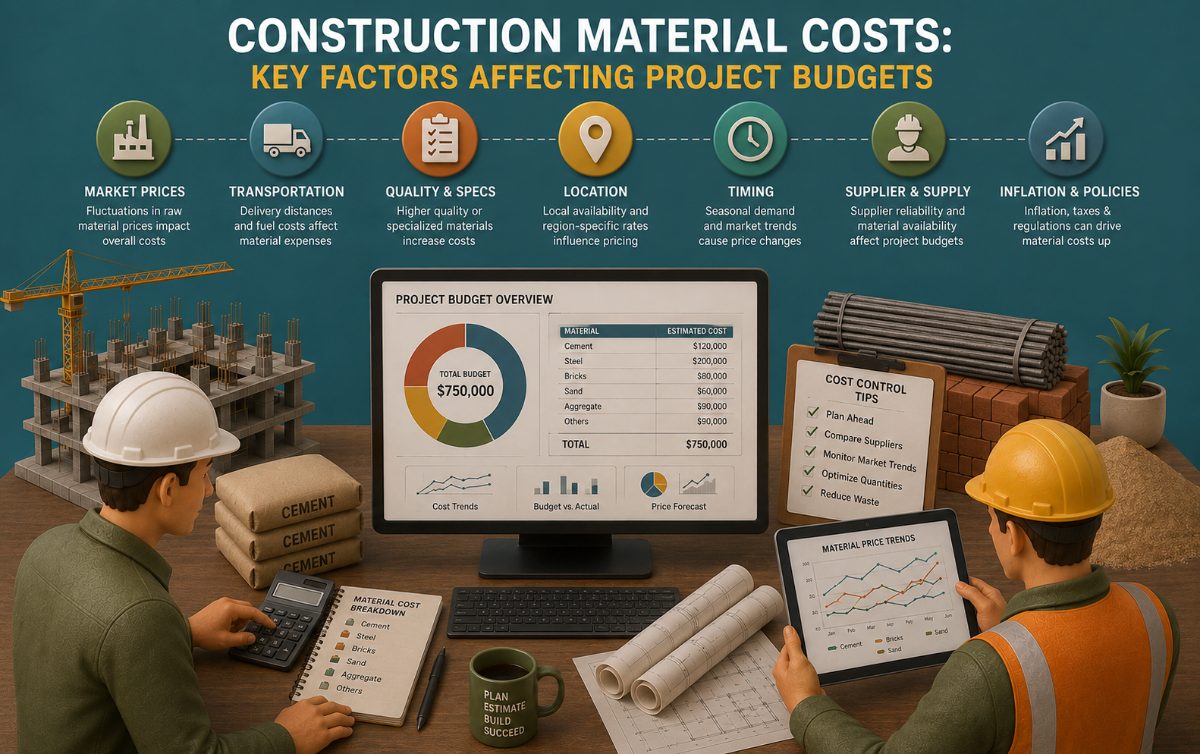
Six factors account for most of the movement in a typical project's material budget. They don't move in sync, and treating them as one undifferentiated "inflation" problem is why budgets built on last year's assumptions come in short.
Factor | What's happening | Budget impact |
Tariff policy | Section 232 duties hold steel, aluminum, and copper at 50% of the full customs value | Removes the "wait it out" option — the cost floor is policy-set, not market-set |
Producer price trend | Construction input prices up 40%+ since 2020; fabricated structural metal up 60%+ | Pre-2023 unit costs are no longer usable as estimating baselines |
Energy and transportation | Diesel and fuel prices swing 5–15% over a few months | Freight-heavy materials (aggregate, precast, concrete) see cost spikes with a lag |
Labor scarcity | Labor is roughly 70% of the installed cost for trades like drywall | Amplifies material price swings instead of offsetting them |
Regional variation | Coastal metros run 8–12% above Midwest and Southeast pricing | National averages understate true cost in high-demand markets |
Seasonal demand | Construction activity peaks in summer | Locking prices in the winter months can capture a real discount |
Material selection and spec | Design decisions set which materials, grades, and finishes are priced | The single biggest cost lever the design team controls directly |
Availability and lead time | Some materials require pre-order in specific units or packaging sizes | Mismatched packaging or a missed pre-order window can stall a schedule and force a costlier substitute |
How Do Tariffs Affect Construction Material Costs?
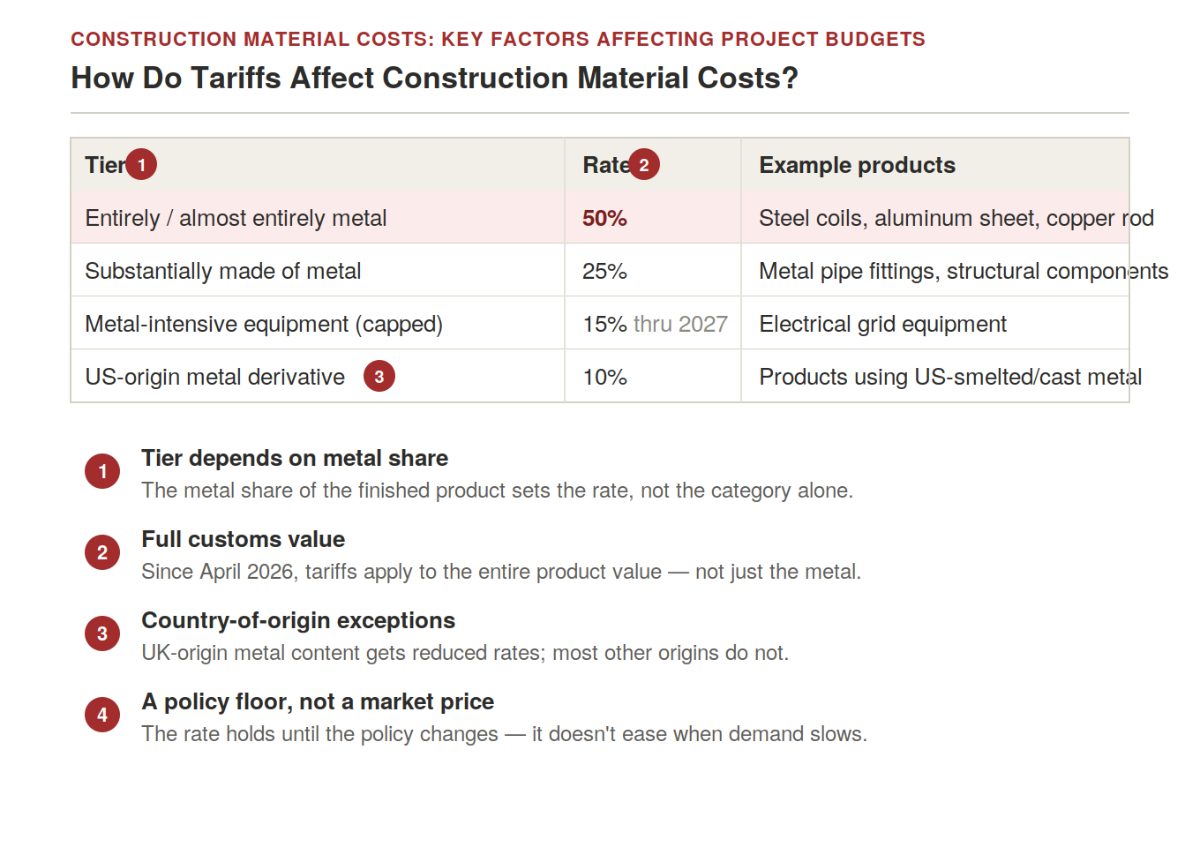
Tariffs have moved from a periodic disruption to a standing feature of the cost structure. Under the current Section 232 framework, imports of steel, aluminum, and most copper articles carry a 50% tariff applied to the full customs value of the product, not just the metal content, following an April 2026 presidential proclamation that restructured the tariff schedule into several rate tiers by product category. Copper was added to Section 232 coverage in 2025 after a Commerce Department investigation found the U.S. relies on imports for a substantial share of refined copper consumption.
The practical effect for a GC is that tariff-driven cost floors behave differently from demand-driven price spikes. A demand spike eases when projects slow down or supply catches up. A tariff-driven floor stays in place as long as the policy does, and the policy can change again, up or down, without much advance notice. That asymmetry is what makes tariff exposure harder to plan around than a normal commodity cycle.
How Much Have Producer Prices for Construction Materials Actually Risen?
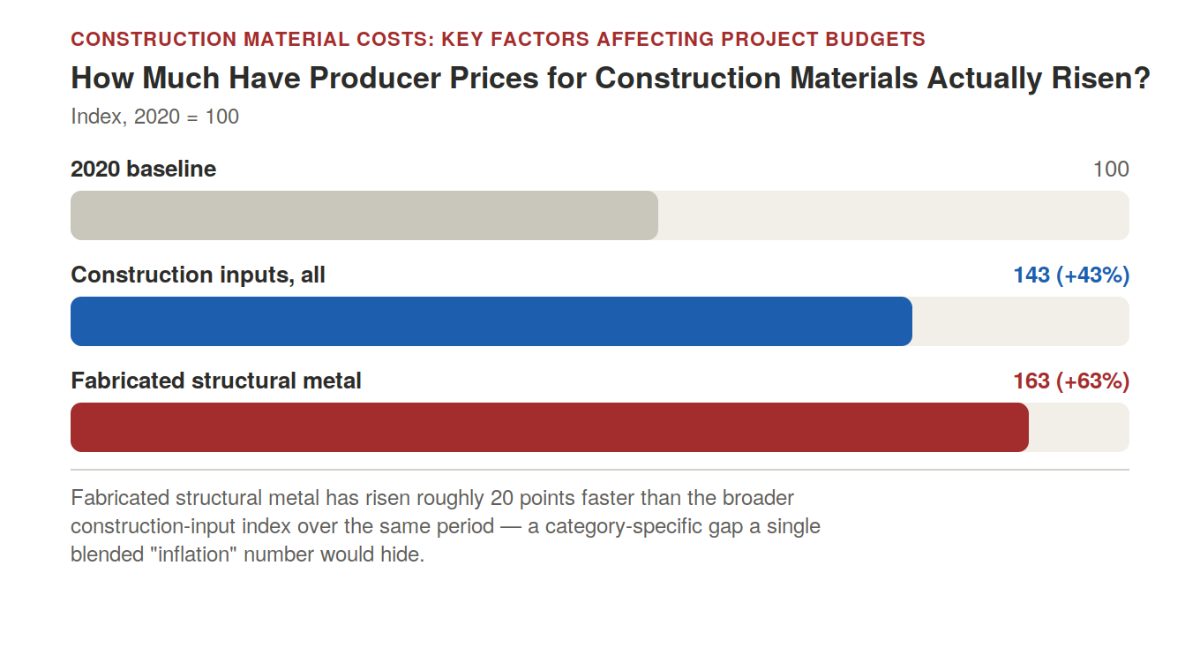
The Bureau of Labor Statistics Producer Price Index</a> is the most reliable public data source for tracking this, and it's the same index most commercial cost databases build their escalation assumptions from. Since early 2020, construction input prices have risen more than 40% by BLS measures, with fabricated structural metal products up more than 60% over the same period, categories like steel and nonferrous metals posting some of the largest gains.
The PPI updates monthly, which makes it a practical benchmark for escalation modeling even though it lags real-time supplier quotes. If the steel mill products index rises 4% year-over-year, a contractor procuring fabricated steel six months out can reasonably build in a proportional escalation allowance rather than assuming today's quote holds.
Why Do Energy and Transportation Costs Move Material Prices?
Construction materials are energy-intensive to produce and expensive to move. Steel, cement, and asphalt production all consume significant energy, so swings in oil and natural gas prices flow directly into manufacturing costs. Diesel price movements compound this on the transportation side. Freight-heavy materials like aggregate, precast concrete, and structural steel absorb fuel cost increases as they move from mill or plant to job site, and that pass-through typically shows up a month or two after the fuel price move itself, not immediately.
How Does Labor Scarcity Compound Material Cost Pressure?
Material and labor costs aren't independent line items; they interact. For material-intensive trades like drywall, labor can represent roughly 70% of total installed cost, meaning a labor shortage doesn't just add its own cost pressure; it amplifies whatever the material price is doing. A skilled-trade shortage that extends a schedule by a few months also extends the window during which the project is exposed to further material price movement, turning a labor problem into a compounded budget problem.
Why Do the Same Materials Cost More in Some Regions?
National average pricing — the kind that shows up in most published cost data — understates what a project in a high-demand coastal metro will actually pay. Regional variation of 8–12% between coastal and Midwest or Southeast markets is common for the same material, driven by local freight logistics, regional demand concentration, and labor market tightness. Estimators pricing a project from a national index without a regional adjustment are working from a number that's directionally right, but can be materially off for the specific market.
Does Timing Actually Affect Material Prices?
Yes, and it's one of the more controllable factors on this list. Construction material demand follows a seasonal rhythm — activity concentrates in the warmer months, and demand-driven price premiums concentrate with it. Procuring long-lead materials during the winter off-season, when demand eases, can capture pricing that simply isn't available once the spring construction ramp-up begins. This isn't a hedge against tariff or supply-chain risk, but it's a real, low-cost lever against the seasonal component specifically.
How Do Material Selection and Design Choices Affect Cost?
Everything above is market-driven and largely outside any single project's control. Material selection is the exception — it's the biggest cost lever the design team controls directly, and it's decided long before a subcontractor ever prices anything.
The same scope can be specified in materials whose installed cost differs by a meaningful margin: a lower-grade finish versus a durable one, a standard fixture versus a custom one, a common structural grade versus a premium one. Lower-cost materials reduce the upfront number but often carry a trade-off in durability, maintenance cost, and — on residential and light commercial work — resale perception. That trade-off is a legitimate value-engineering decision, not a shortcut, as long as it's made deliberately and documented, rather than defaulted into by whichever spec happened to be in the template.
This is also where currency exposure quietly enters the budget on imported materials and fixtures: a spec locked to a specific imported product carries exchange-rate risk on top of tariff exposure, even when the material itself isn't tariff-classified.
Why Do Availability, Packaging, and Lead Time Matter at the Estimating Level?
Beyond price, materials have to actually be available in the format the project needs, when the project needs them. Two mechanical details estimators routinely underweight:
Unit and packaging size. A material priced and estimated by the pallet, roll, or case has to match what the supplier actually ships in — pricing against a unit size the supplier doesn't stock produces an estimate that looks fine on paper and falls apart at procurement.
Pre-order windows. Some materials — custom millwork, specialty glazing, certain mechanical equipment — require ordering months ahead of installation. Missing that window doesn't just delay the schedule; it often forces a costlier substitute material sourced on shorter notice.
Both of these compounds, with the tariff and supply-chain pressure covered above, are exactly the material where a missed pre-order window is most expensive to recover from.
Where to Track Material Costs: Free and Paid Cost Databases
Understanding the factors above matters most when you can check them against real, current numbers before you price a bid. Here's where estimators actually go to track material and labor costs, free government and industry sources first, paid databases where free data hits its limits.
Source | Access | Best For |
Free | Monthly material price trend tracking by category (lumber, steel, copper, concrete) | |
Free | Current labor rates by trade and metro area | |
Free | Real contractor bid pricing for civil and public-sector unit costs | |
Free (historical) / subscription (current month) | Escalation and trend benchmarking across 20 major U.S. cities | |
NAHB Cost of Construction Survey | Free | Residential material and labor cost benchmarks |
AGC construction economics reports | Free | Industry-wide material and labor market conditions |
Paid, 30-day free trial | 97,000+ unit line items across 970 markets — the industry-reference cost database | |
Paid | Lower-cost alternative cost books, strong for residential and light commercial | |
Free tier / paid | Supplier-aggregated real-time material pricing |
How Material Cost Volatility Shows Up in Subcontractor Bids
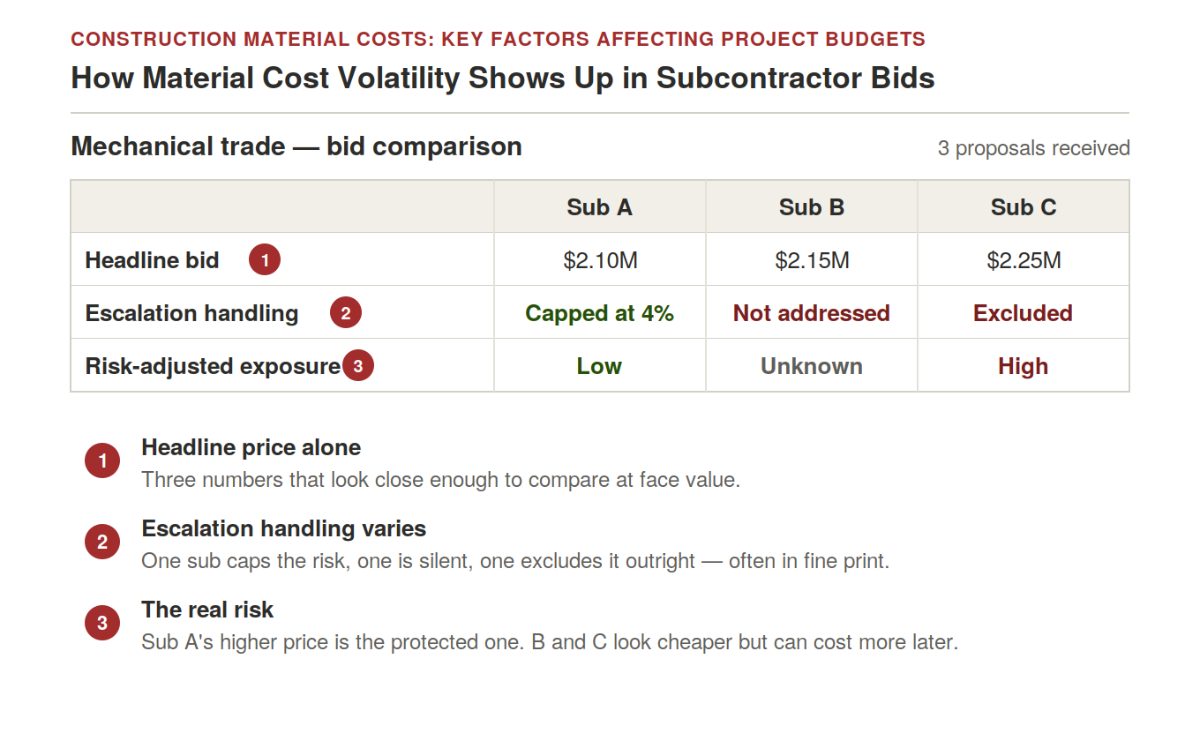
All six of the factors above eventually land in the same place: the subcontractor proposals a GC receives at bid time. And they don't land uniformly. One sub might build a 4–6% material escalation contingency directly into their number. Another might quote today's price and attach an exclusion for "material price increases beyond current market conditions" in the fine print. A third might not address escalation risk at all — either absorbing it or simply not having priced it, which is its own kind of risk to the GC who awards that contract.
The result is that comparing headline bid totals without checking each proposal's escalation assumptions isn't really comparing like for like. A "lower" bid that excludes escalation risk isn't cheaper — it's a bid where that risk has been transferred to whoever awards the contract, usually surfacing later as a change order once material prices move against the sub's original quote.
This is the same normalization problem covered in our article on Construction Document Control: Best Practices for managing project documents, i.e, scope and cost assumptions buried in inconsistent proposal language don't disappear because they weren't caught at award, they resurface at buyout or mid-project.Melt Bid reads every subcontractor proposal for a trade package and surfaces exclusions and qualifications, including escalation language — so a GC comparing three electrical bids sees not just three prices, but three different sets of assumptions about who's carrying the material cost risk.
How to Protect Project Budgets From Material Cost Volatility
Tie escalation clauses to a named index. Referencing theBLS PPI or theENR Construction Cost Index in the contract gives both parties an objective, third-party basis for adjustment instead of a dispute over "market conditions." For a full breakdown of where to pull current and historical pricing yourself, see our guide to free construction unit cost databases (insert live URL).
Procure long-lead materials early. Locking pricing once financing is secured protects against the specific window between design freeze and installation, when most schedule-driven exposure accumulates.
Diversify sourcing across suppliers and countries of origin. Single-source dependency on one mill or one import lane creates the sharpest exposure to both tariff changes and localized supply disruption.
Build an explicit contingency, not a buried one. Industry guidance for projects starting in the next two to three quarters commonly runs a 4–6% material escalation allowance; state it as a line item rather than folding it silently into overhead.
Check every bid for how escalation risk was handled before award. A proposal that's silent on material price risk hasn't avoided the risk — it's shifted it to whoever signs the contract without knowing it's there.
Frequently Asking Questions
What are the biggest factors affecting construction material costs right now?
Tariff policy, producer price trends tracked by the BLS, energy and transportation costs, labor scarcity, regional market variation, and seasonal demand cycles. They move independently, so a budget built on a single "inflation number" will miss category-specific swings.
How much have construction material costs risen since 2020?
BLS producer price data shows construction input prices up more than 40% since early 2020, with fabricated structural metal products up more than 60% over the same period. These are cumulative baseline shifts, not temporary spikes expected to revert.
How do tariffs affect construction material costs?
Current Section 232 tariffs apply a 50% duty to the full customs value of most steel, aluminum, and copper imports, following an April 2026 proclamation. Unlike demand-driven price spikes, a tariff-driven cost floor doesn't ease when project activity slows — it stays in place as long as the policy does.
Why do the same materials cost more in some parts of the country?
Regional freight logistics, local demand concentration, and labor market tightness routinely push coastal metro pricing 8–12% above Midwest and Southeast markets for identical materials. National average pricing doesn't capture this gap.
Does the timing of material procurement actually matter?
Yes. Construction material demand — and pricing — follows a seasonal cycle tied to the construction season itself. Procuring long-lead items during the winter off-season can capture pricing that isn't available once spring demand ramps up.
How can a GC protect a project budget from material cost volatility?
The most effective levers are index-tied escalation clauses, early procurement of long-lead materials, diversified supplier sourcing, and building an explicit (not buried) contingency percentage into the estimate.
How does material selection affect a construction budget?
Significantly, and it's the one major cost factor the design team controls directly. Specifying a lower-grade finish, standard fixture, or common structural grade versus a premium equivalent shifts installed cost meaningfully. The trade-off is legitimate value engineering as long as it's a deliberate decision, documented and communicated, rather than a default that happened to be in the template.
Why do unit size and lead time matter as much as price when estimating materials?
Because an estimate is only as good as its ability to be executed. Pricing against a pallet, roll, or case size, the supplier doesn't actually stock produces numbers that look right on paper and fail at procurement. Materials with long pre-order windows — custom millwork, specialty glazing, certain mechanical equipment — need to be identified and ordered early, or the project ends up substituting a costlier alternative on short notice.
Where can I find current construction material cost data?
Free sources cover most estimating needs: the BLS Producer Price Index for material trend tracking, BLS OEWS for labor rates, state DOT bid tabulations for civil unit costs, and ENR, NAHB, and AGC for trend and benchmark context. Paid databases like RSMeans Data Online add line-item depth (97,000+ items across 970 markets) once bid volume or project complexity outgrows what a free stack can support.
How does material cost volatility affect subcontractor bid comparisons?
Different subs price escalation risk differently — some build in a contingency, some exclude it explicitly, some don't address it at all. Comparing headline bid totals without checking these assumptions means comparing bids that carry very different levels of hidden risk, not true apples-to-apples pricing.
Related Building Code Resources
- Building CodesGo/No-Go Readiness Checklist for Construction Project Pursuit Decisions
- Building CodesBest Construction Document Control Software in 2026
- Building CodesBest Construction Estimating Software for Mac in 2026
- Building CodesAddenda in Construction: Definition, Purpose, and How to Manage Them
- Building CodesBest Construction CRM Software for Bid Tracking and Follow-Up for General Contractors
MeltPlan
A curated stream of preconstruction intelligence, estimating innovation, takeoff breakthroughs, workflow advancements, and expert perspectives—powered by the AI and technology shaping the future of construction.
Visit SiteDon't miss what's shaping AEC
Don't miss what's shaping AEC The latest on preconstruction, codes, AEC news & trends — so you're al
.jpg?alt=media&token=252deada-6c2c-43e9-8559-da1381686c8e)