Free Construction RFP Template for Owners and General Contractors in 2026
A well-written construction RFP is worth more than a well-written contract. The RFP is where scope gets defined, evaluation criteria get set, and the entire com..
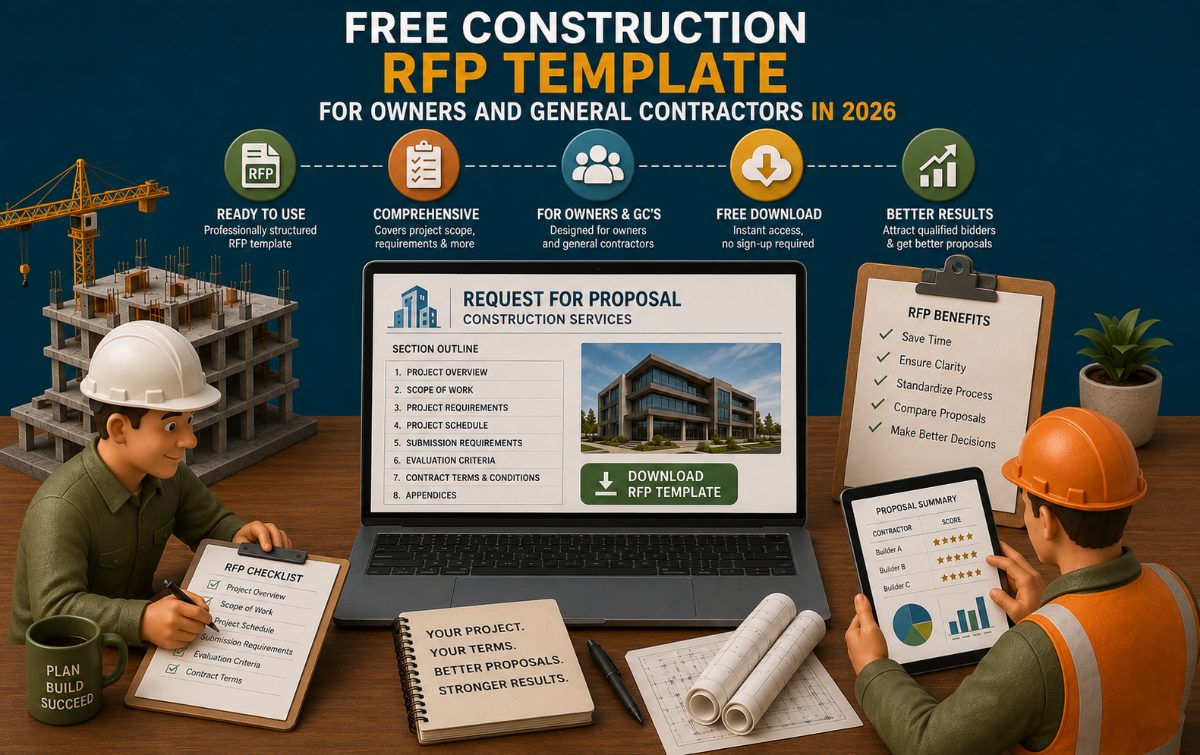
A well-written construction RFP is worth more than a well-written contract. The RFP is where scope gets defined, evaluation criteria get set, and the entire competitive dynamic that shapes bids gets established. A vague RFP produces mismatched proposals and post-award scope surprises that can add 10–20% to project cost. A specific RFP produces comparable bids, better pricing, and clean award decisions.
This article delivers a complete free RFP template — inline, no email signup, no gated download, plus honest guidance on how to adapt it for the two distinct use cases: owners writing RFPs to solicit GC proposals, and GCs writing RFPs to solicit subcontractor proposals. The templates share 80% of their structure but differ meaningfully in emphasis, contract references, and evaluation criteria. The audience is the owner, facility team, developer, general contractor, or preconstruction manager writing an RFP for a commercial, institutional, public-sector, or infrastructure project.
Key Takeaways
A construction RFP is a formal solicitation document, not a bid form. It defines scope, evaluation criteria, submission requirements, and contract terms — everything a qualified bidder needs to produce a complete, comparable proposal.
Owner RFPs and GC subcontractor RFPs share structure but differ in emphasis. Owner RFPs emphasize project vision, evaluation criteria beyond price, and contract form (AIA A101, A102, A103, ConsensusDocs). Subcontractor RFPs from GCs emphasize trade-specific scope divisions, coordination requirements, and pricing format.
The best RFPs cite standard contract documents. AIA A101-2017 (stipulated sum), A102-2017 (GMP), A103-2017 (cost-plus without GMP), A201-2017 (general conditions), and ConsensusDocs are the recognized standards. Referencing them reduces ambiguity and shortens negotiation.
Evaluation criteria must be stated up front. Contractors need to know whether the selection is low bid, best value, or negotiated. Transparent criteria produce better-tailored proposals and defend the award against protests.
The single biggest RFP mistake is leaving reusable template language in place when it doesn't fit the project. Templates are starting points; each RFP requires project-specific scope, dates, insurance requirements, and evaluation criteria before release.
What Is a Construction RFP?
A construction RFP (Request for Proposal) is the formal document a project owner or general contractor uses to solicit competitive proposals from contractors or subcontractors for a specific project. It differs from adjacent procurement documents:
RFP (Request for Proposal) — used when the project is complex enough that the selection depends on more than price. Contractors submit a full proposal covering approach, qualifications, team, schedule, and cost. Used for most commercial, institutional, and complex work.
ITB (Invitation to Bid) — used when the design is complete and the selection is based on lowest compliant bid. Common in public-sector work where competitive bidding is legally required.
RFQ (Request for Quotation) — used when scope is fully defined and the request is for price only, typically on commodity purchases (steel beams, prefabricated units).
RFI (Request for Information) — used earlier in planning to gather general information about capabilities before formal solicitation.
Most commercial construction procurement uses an RFP. Public-sector procurement often uses ITBs on complete designs and RFPs on design-build or construction management work.
The Owner-to-GC RFP vs. the GC-to-Subcontractor RFP
The same template structure serves both use cases with meaningful differences in emphasis:
Owner-to-GC RFP:
Solicits general contractor proposals for the entire project
References owner-contractor contract forms (AIA A101, A102, A103; ConsensusDocs 200; EJCDC C-520)
Emphasizes project vision, delivery method, and multi-factor evaluation (approach, experience, team, price)
Includes prequalification requirements (bonding capacity, financial statements, safety records)
Longer response documents (30-100 pages typical)
Timeline: 4-8 weeks from issue to award
GC-to-Subcontractor RFP:
Solicits subcontractor proposals for specific trade scopes (electrical, mechanical, structural steel, etc.)
References subcontract forms (AIA A401-2017, ConsensusDocs 750)
Emphasizes trade-specific scope, coordination with other trades, and schedule integration
Includes trade-specific insurance and prequalification
Shorter response documents (5-25 pages typical)
Timeline: 2-4 weeks from issue to award
The differences show up mainly in the Scope, Evaluation Criteria, and Contract Terms sections. The template below flags where each section differs.
The Complete Construction RFP Template
Use this template as a structural starting point. Every section below should be populated with project-specific content before release. If a section doesn't apply to your project, remove it rather than leave placeholder language.
SECTION 1: INVITATION AND PROJECT SUMMARY
[Project Name] — Request for Proposal
Issued by: [Owner name] / [General Contractor name] Date issued: [Date] Proposals due: [Date] at [Time] [Time zone] Submission method: [Email address / online portal / physical delivery address]
Project overview (2-3 paragraphs): Briefly describe the project — what is being built, where, why, and by when. Include:
Project type (new construction, renovation, addition, tenant improvement)
Approximate size (square feet, unit count, or scope description)
Project location
Anticipated construction start and completion dates
Delivery method (Design-Bid-Build, Design-Build, CM at Risk, CM Agency, IPD)
Estimated project value range (optional but recommended)
Owner-to-GC RFP addition: Include the owner's project vision, key project priorities (schedule, cost, quality, sustainability), and any unique constraints (occupied building, phased delivery, LEED certification, etc.).
GC-to-Subcontractor RFP addition: Include GC name, project role (prime GC, subcontractor), scope of trade being solicited, and expected schedule integration with other trades.
SECTION 2: IMPORTANT DATES AND COMMUNICATION RULES
Milestone | Date | Time |
RFP issued | [Date] | — |
Optional pre-bid meeting/site visit | [Date] | [Time] |
Deadline for questions | [Date] | [Time] |
Addenda distributed by | [Date] | — |
Proposals due | [Date] | [Time] [Zone] |
Interviews (if required) | [Date range] | — |
Award notification | [Date] | — |
Contract execution | [Date] | — |
Communication rules:
All questions must be submitted in writing to [designated contact] at [email]
Verbal answers from other parties are not binding
All addenda will be distributed to all invited bidders via [method]
Bidders must acknowledge receipt of all addenda in their proposal
No contact with owner staff or evaluation committee outside the designated contact process
SECTION 3: SCOPE, DOCUMENTS, AND SITE ACCESS
Scope of work summary: Provide a comprehensive description of the work. For owner-to-GC RFPs, this may reference the full drawing and specification set with a summary here. For GC-to-subcontractor RFPs, this should be trade-specific with detailed scope divisions.
Reference documents:
Drawings dated [date] by [architect/engineer], available at [link/access method]
Specifications dated [date], organized by CSI MasterFormat divisions [list applicable divisions]
Geotechnical report by [firm] dated [date]
Site survey by [firm] dated [date]
Any additional reference documents
Scope divisions (CSI MasterFormat): For public-sector and larger commercial projects, organize scope by CSI MasterFormat divisions. Common divisions:
Division 01 — General Requirements
Division 03 — Concrete
Division 04 — Masonry
Division 05 — Metals
Division 07 — Thermal and Moisture Protection
Division 08 — Openings
Division 09 — Finishes
Division 21 — Fire Suppression
Division 22 — Plumbing
Division 23 — HVAC
Division 26 — Electrical
Division 27 — Communications
Division 31 — Earthwork
GC-to-Subcontractor RFP addition: Specify the exact trade scope by CSI division with detailed inclusions and exclusions. Common gap areas (waterproofing at connections, fire-caulking at penetrations, low-voltage rough-in) should be affirmatively assigned to prevent post-award scope gaps.
Alternates and allowances: List any alternate scopes bidders should price separately (e.g., "Alternate #1: Upgraded roof system") and any allowances included in the base bid (e.g., "$50,000 allowance for owner-selected light fixtures").
Site access and pre-bid meeting:
Site address: [Address]
Pre-bid meeting: [Optional/Mandatory] on [Date] at [Time]
Site visit protocol: [instructions]
Access restrictions or safety requirements.
SECTION 4: PRICING STRUCTURE
Specify how bidders must present their pricing. The pricing structure signals the contract form and must align with the intended contract type.
Pricing structure options:
Lump Sum (Stipulated Sum) — fixed price for defined scope. Aligned with AIA A101-2017.
Guaranteed Maximum Price (GMP) — cost of work plus fee, capped at maximum. Aligned with AIA A102-2017.
Cost Plus Fee — cost of work plus fee, no cap. Aligned with AIA A103-2017.
Unit Price — pricing per unit of work (linear foot, cubic yard, ton). Common for civil work.
Time and Materials (T&M) — hourly rates plus materials markup. Common for change orders and small scopes.
Required pricing breakdown:
Base bid amount
Alternates (priced separately)
Allowances (as specified in scope)
Unit prices (if applicable)
General conditions breakdown
Overhead and profit disclosure (may be required for cost-plus or GMP)
Owner-to-GC RFP addition: Specify whether pricing must be presented as fee-only (for CM at Risk with open-book cost) or full lump sum. Specify if bidders must include a cost-loaded schedule of values.
GC-to-Subcontractor RFP addition: Provide a specific pricing form (Excel or PDF) that all bidders must complete. This enforces apples-to-apples comparison and simplifies bid leveling.
SECTION 5: PROPOSAL RESPONSE REQUIREMENTS
Specify exactly what bidders must include in their proposal. Every requirement should serve the evaluation criteria — if a requirement doesn't inform the selection, remove it.
Standard proposal contents:
Cover letter / Executive summary (1-2 pages)
Statement of interest and understanding of the project
Key differentiators of the firm's approach
Company qualifications (2-5 pages)
Firm history, ownership structure, and financial stability
Number of employees, offices, geographic coverage
Bonding capacity and current backlog
Insurance carrier information
Relevant project experience (5-15 pages)
Minimum [3-5] projects of similar type, size, and complexity completed within the past [5-10] years
For each project: name, owner, contract value, delivery method, key personnel, completion date, and client reference
Project team and key personnel (2-5 pages)
Proposed project team organizational chart
Resumes of key personnel: Project Executive, Project Manager, Superintendent, Estimator
Percent time commitment for each key person
Substitution policy (client approval required for key personnel changes)
Technical approach and methodology (5-10 pages)
Understanding of project requirements
Proposed sequence and phasing
Schedule with major milestones
Quality control and safety plans
Sustainability approach (if applicable)
Pricing proposal (as specified in Section 4)
Schedule (as required — often Gantt-format with critical path indicated)
Required forms and attachments:
Signed proposal cover form
Bid bond (typically 5-10% of bid amount)
Certificates of insurance (per Section 8)
License information (state contractor's license, specialty licenses)
MBE/WBE/DBE participation forms (if applicable)
Non-collusion affidavit (public-sector projects)
Debarment certification
Owner-to-GC RFP addition: May include additional prequalification items, audited financial statements (3 years), safety record (EMR, OSHA incident rates), and diversity/inclusion statement.
GC-to-Subcontractor RFP addition: May include shorter response requirements, focus on trade-specific experience, key superintendent for the trade scope, and coordination approach.
SECTION 6: EVALUATION CRITERIA
State the evaluation criteria and their relative weights. Transparent criteria produce better-tailored proposals and defend the award against protests.
Sample evaluation criteria (Owner-to-GC RFP):
Criterion | Weight |
Relevant project experience | 20% |
Project team and personnel | 15% |
Technical approach and methodology | 20% |
Schedule feasibility | 10% |
Price / Fee | 25% |
Safety record | 5% |
MBE/WBE participation | 5% |
Sample evaluation criteria (GC-to-Subcontractor RFP):
Criterion | Weight |
Price (total base bid + alternates) | 40% |
Scope completeness and clarity | 15% |
Relevant trade experience | 15% |
Project team | 10% |
Schedule commitment | 10% |
Safety record | 5% |
Financial stability and bonding | 5% |
Specify whether the selection is:
Low bid — the lowest compliant bidder wins (common on ITBs)
Best value — evaluation across criteria (most common on RFPs)
Negotiated — award to the highest-ranked proposal with negotiation on terms
Include information on interview rounds (if any) and Best and Final Offer (BAFO) stage (if applicable).
SECTION 7: CONTRACT TERMS AND REFERENCE DOCUMENTS
Reference the intended contract form. Standard contract documents:
AIA (American Institute of Architects):
A101-2017 — Owner-Contractor, Stipulated Sum
A102-2017 — Owner-Contractor, Cost Plus Fee with GMP
A103-2017 — Owner-Contractor, Cost Plus Fee without GMP
A201-2017 — General Conditions
A401-2017 — Contractor-Subcontractor
A101 Exhibit A — Insurance and Bonds
ConsensusDocs:
200 — Owner-Contractor, Lump Sum
500 — Owner-Contractor, Cost Plus Fee
750 — Contractor-Subcontractor
EJCDC (Engineers Joint Contract Documents Committee):
C-520 — Owner-Engineer for engineering work
C-700 — Owner-Contractor for the construction of infrastructure
DBIA (Design-Build Institute of America):
525 — Owner-Design Builder for lump sum
530 — Owner-Design Builder for the cost of work + fee
State clearly:
Which contract form will the successful bidder execute
Any project-specific supplementary conditions or amendments
Payment terms (schedule of values, retention percentage, timing)
Change order process
Dispute resolution (mediation, arbitration, litigation)
Warranty period
Substantial completion definition
SECTION 8: BONDING, INSURANCE, AND LICENSING
Bonding requirements:
Bid bond: [percentage, typically 5-10%] of bid amount
Performance bond: 100% of contract amount (typical for public work)
Payment bond: 100% of contract amount (typical for public work)
Bonds must be issued by sureties approved by [Treasury Department Circular 570 / other standard]
Insurance requirements (minimum coverage):
Commercial General Liability: $[amount] per occurrence, $[amount] aggregate
Automobile Liability: $[amount] combined single limit
Workers' Compensation: statutory limits
Employer's Liability: $[amount] per accident
Excess/Umbrella Liability: $[amount]
Builders Risk (if applicable): full replacement value
Professional Liability (for design-build): $[amount]
Pollution Liability (if applicable): $[amount]
Additional insured requirements, waivers of subrogation, and notice of cancellation requirements should be specified per AIA A101-2017 Exhibit A or equivalent.
Licensing:
State contractor's license (specify class if applicable)
Local business license
Specialty licenses (electrical, mechanical, plumbing, as applicable)
Prequalification with [any applicable public agencies].
SECTION 9: SUBMISSION INSTRUCTIONS
How to submit:
Submission method: [email / online portal / physical delivery]
File format: [PDF / Word / Excel for pricing]
Number of copies: [electronic/physical]
Naming convention: [format]
Maximum file size (if applicable)
Deadline enforcement:
Proposals received after the deadline will not be considered
Time zone: [specify]
Late submissions will not be evaluated, regardless of cause
Proposal validity period:
Proposals must remain valid for [60-90 days] after the submission deadline
Reservation of rights:
Owner/GC reserves the right to reject any or all proposals
Owner/GC reserves the right to waive informalities
Owner/GC is not obligated to award the contract to the lowest bidder
SECTION 10: APPENDICES
Include as attachments or references:
Full drawing set
Full specifications
Geotechnical report
Site survey
Environmental reports
Existing conditions documentation (for renovation work)
Owner's standard forms (bid form, subcontractor list, MBE/WBE forms, non-collusion affidavit)
Contract form (AIA A101, A102, A103, ConsensusDocs 200, etc.)
Supplementary conditions
Any project-specific requirements or exhibits.
How Owner RFPs and GC Subcontractor RFPs Differ in Practice
Beyond the section-by-section differences noted above, the two use cases differ in overall structure and emphasis:
Owner RFPs are longer. A commercial owner RFP with all appendices typically runs 100-500+ pages, including drawings and specifications. The response document itself is 30-100 pages.
GC subcontractor RFPs are shorter but more prescriptive on scope. A trade RFP is typically 20-50 pages with detailed CSI-organized scope divisions. The response is often just a completed bid form plus qualifications, running 5-25 pages.
Owner RFPs emphasize the multi-factor evaluation. Price is typically 20-30% of the evaluation weight; approach, experience, and team fill the rest. Owner RFPs invite the contractor to demonstrate capability, not just price.
GC subcontractor RFPs emphasize price and scope completeness. Price is typically 40-50% of the evaluation weight; scope clarity and coordination approach make up much of the rest. GCs are asking subcontractors to price a defined scope accurately, not to redesign the approach.
Owner RFPs include multi-round processes. Interviews, shortlisting, and BAFO stages are common. Owner selection may take 6-8 weeks from RFP issue to award.
GC subcontractor RFPs are typically single-round. GC award decisions on subcontractor bids typically happen within 2-4 weeks of RFP issue, driven by the GC's own bid deadline to the owner.
What Comes After the RFP: The Bid Leveling Stage
Once proposals arrive, the RFP issuer's work shifts from writing the solicitation to evaluating the responses. Every construction bid must be normalized; different bidders include different scopes, exclusions, and pricing formats, before comparison and award.
The bid leveling process typically involves:
Compliance check — verify each proposal meets minimum submission requirements
Scope normalization — align scope items across bidders so the comparison is apples-to-apples
Exclusion cataloging — surface every exclusion and qualification buried in bid notes
Price comparison — compare pricing across bidders on a normalized scope
Qualifications evaluation — score bidders on non-price criteria per the evaluation matrix
Interview / BAFO round (if applicable)
Award recommendation and contract negotiation
Manual bid leveling on complex projects can take 3-7 days of senior estimator time per trade cycle. The most common bid leveling errors originate here: missed scope gaps, missed exclusions, and apples-to-oranges comparisons that lead to post-award scope surprises.
The RFP structure directly affects bid leveling difficulty. RFPs with clear scope divisions, specified pricing forms, and defined submission requirements produce comparable bids that level quickly. Vague RFPs produce inconsistent bids that require extensive normalization work before comparison is even possible.
Common RFP Mistakes and How to Avoid Them
Five error patterns account for most avoidable RFP problems.
Error 1: Leaving reusable template language in place when it doesn't fit the project. Boilerplate insurance requirements, dated submission instructions, and scope references from previous projects accidentally carry over. Prevention: Review every reusable section before release, and explicitly delete sections that don't apply to the current project.
Error 2: Vague scope of work. "General construction services for a commercial building" produces bids ranging 40-60% in price because bidders interpret the scope differently. Prevention: Use CSI MasterFormat divisions with specific inclusions and exclusions. Assign common gap areas affirmatively.
Error 3: Unstated or ambiguous evaluation criteria. When contractors don't know how the selection will be made, they can't tailor their proposals. Prevention: state evaluation criteria and weights explicitly. If selection is negotiated rather than scored, say so.
Error 4: Making price the only deciding factor on complex work. RFPs are typically used precisely because selection depends on more than price. Reverting to lowest-bid selection on RFP work undermines the process and often produces poor outcomes. Prevention: if the intended selection is the lowest bid, use an ITB, not an RFP.
Error 5: Insufficient time for quality responses. A 2-week response window on a complex commercial project produces rushed, incomplete bids. Prevention: allow 4-8 weeks minimum for owner RFPs, 2-4 weeks for GC subcontractor RFPs, and more for complex work.
Frequently Asked Questions
What is the difference between an RFP, ITB, and RFQ in construction?
An RFP solicits a comprehensive proposal covering approach, qualifications, and price — used when selection depends on more than price. An ITB (Invitation to Bid) solicits price-only bids on a complete design when the lowest compliant bid wins. An RFQ (Request for Quotation) requests pricing on fully defined commodities.
Do I have to use AIA contract documents in a construction RFP?
No, but AIA A101, A102, A103, and A201 are the industry-recognized standards for most commercial construction work in the U.S. ConsensusDocs, EJCDC, and DBIA forms are legitimate alternatives depending on project type. Using a recognized standard reduces ambiguity, protects both parties, and shortens contract negotiation post-award.
How long should a construction RFP be?
Owner-to-GC RFPs typically run 30-100 pages excluding drawings and specifications. GC-to-subcontractor RFPs typically run 20-50 pages. The right length is whatever it takes to define scope clearly, state evaluation criteria, and specify submission requirements completely — no shorter, no longer than that.
What are the standard sections of a construction RFP?
Ten sections cover most projects: (1) Invitation and Project Summary, (2) Important Dates and Communication Rules, (3) Scope, Documents, and Site Access, (4) Pricing Structure, (5) Proposal Response Requirements, (6) Evaluation Criteria, (7) Contract Terms, (8) Bonding, Insurance, and Licensing, (9) Submission Instructions, (10) Appendices.
How long does the construction RFP process take?
Owner-to-GC RFP process typically takes 4-8 weeks from issue to award for standard commercial work; 8-12+ weeks for complex or public-sector work with multi-round evaluation. The GC-to-subcontractor RFP process typically takes 2-4 weeks. Longer response windows produce higher-quality, more complete bids from qualified contractors.
What is CSI MasterFormat, and why does it matter for RFPs?
CSI MasterFormat is the industry-standard classification system organizing construction work into 49 divisions (concrete, masonry, metals, electrical, etc.). Structuring RFP scope and pricing forms around MasterFormat produces bids that can be compared apples-to-apples. It's the shared vocabulary of commercial construction procurement.
Should I require a bid bond in my RFP?
For public-sector work, bid bonds are typically legally required by state or federal procurement law. For private commercial work, bid bonds at 5-10% of the bid amount are recommended on projects above $500K to ensure bidder commitment. Small commercial and residential work often waives bid bonds entirely.
What is the BAFO stage in construction RFPs?
BAFO stands for Best and Final Offer. After initial proposal review and shortlisting, the owner asks the top-ranked bidders to submit revised proposals with best-and-final pricing, sometimes after negotiation. Common on complex commercial and public-sector projects; less common on GC-to-subcontractor RFP workflows.
Related Building Code Resources
- Building CodesGo/No-Go Readiness Checklist for Construction Project Pursuit Decisions
- Building CodesBest Construction Document Control Software in 2026
- Building CodesBest Construction Estimating Software for Mac in 2026
- Building CodesAddenda in Construction: Definition, Purpose, and How to Manage Them
- Building CodesBest Construction CRM Software for Bid Tracking and Follow-Up for General Contractors
MeltPlan
A curated stream of preconstruction intelligence, estimating innovation, takeoff breakthroughs, workflow advancements, and expert perspectives—powered by the AI and technology shaping the future of construction.
Visit SiteDon't miss what's shaping AEC
Don't miss what's shaping AEC The latest on preconstruction, codes, AEC news & trends — so you're al