Go/No-Go Readiness Checklist for Construction Project Pursuit Decisions
A go/no-go checklist isn't the decision-maker — it's a structured way to surface risk before committing pursuit resources, not an algorithm that outputs an au..

Key Takeaways
A go/no-go checklist isn't the decision-maker — it's a structured way to surface risk before committing pursuit resources, not an algorithm that outputs an automatic answer. Not every box needs to be checked for a project to be worth pursuing.
Pursuit costs are real money, not just time. Preparing a competitive bid or proposal can run into the hundreds of thousands of dollars in staff time, overhead, and opportunity cost — exactly what a disciplined go/no-go process exists to protect.
Three outcomes, not two, is the more realistic framework. Go, Conditional Go (pursue only after a specific clarification or fix), and No-Go maps better to how these decisions actually play out than a strict binary choice.
Criteria split into what's objective and what's relationship-specific. Client reputation and financial capability are the same no matter which firm evaluates them; whether the client already knows your firm and whether there's a path to future work is specific to your relationship.
Not every firm needs a formal, weighted framework. A firm evaluating two or three opportunities a month can likely make sound judgment calls without one — the value of formalizing this process scales with pursuit volume and growth ambitions.
A checklist without a system to store and revisit the answers loses most of its value. In most construction firms, go/no-go data lives in emailed forms nobody looks at again, meaning the same red flags get missed project after project instead of informing the next decision.
Delivery method changes the risk calculus, not just the checklist categories. Design-build pursuits require heavier up-front investment before any contract exists, which makes running the readiness evaluation early, not at the same point as a design-bid-build pursuit, genuinely important.
What Is a Go/No-Go Checklist, and What Is It Not?
A go/no-go checklist is a structured set of criteria a firm evaluates before committing real time and resources to pursuing a specific project, assessing fit, risk, and likely return before a single hour of estimating or proposal work begins. A go/no-go framework is specifically designed to make one recurring, high-stakes decision faster and more consistent, rather than re-litigated from scratch every time.
It's worth being precise about what the checklist is not. It isn't the decision itself, and it isn't a pass/fail algorithm where every box has to be checked to proceed. Its job is to make sure nothing obvious gets missed, and that the person making the final call is working from complete information; the actual decision still requires judgment about how the flagged items weigh against each other for this specific opportunity. A no-go decision, correctly understood, isn't a failure either; it's the process working as intended, redirecting effort toward opportunities with a real chance of being won and delivered well.
A go/no-go framework earns its overhead precisely because this kind of decision is hard to make well under time pressure. McKinsey research on executive decision-making found that leaders spend nearly 40% of their time on decisions in general, with most believing that time is used poorly, exactly the pattern a structured, repeatable framework is built to correct for one specific, high-stakes, recurring decision.
Why This Decision Is Worth a Formal Process
Pursuing the wrong opportunities is expensive in a way that's easy to underestimate until it's tallied up. Preparing a competitive proposal or bid; estimating time, business development hours, technical staff pulled from billable work, marketing collateral- can run into the hundreds of thousands of dollars for a significant pursuit, before a single dollar of revenue is guaranteed. Every hour spent on a pursuit that was never realistically winnable, or that would have strained the firm past its actual delivery capacity if won, is an hour not spent on a better-fit opportunity.
That said, formality should scale with volume. A firm fielding two or three real opportunities a month can often make sound go/no-go calls through experienced judgment without a heavily weighted framework. The case for formalizing this process gets stronger specifically as pursuit volume grows or as a firm pushes into more aggressive growth targets — at that point, inconsistent, ad hoc decision-making starts costing real opportunity, and a structured process pays for the overhead of running it.
The Three Possible Outcomes: Go, Conditional Go, No-Go
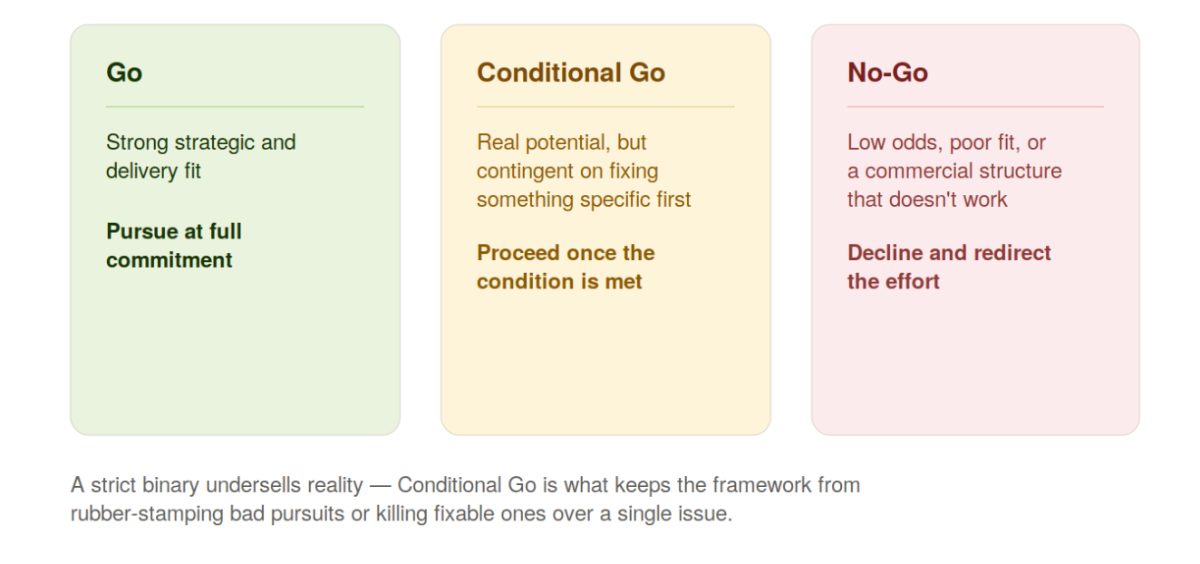
Treating this as a strict binary undersells how these decisions actually play out in practice. A more useful framework scores each criterion, commonly on a simple 1–3 or 1–5 scale — and applies weights reflecting what matters most to the firm (profitability, delivery capacity, compliance, strategic fit), with the total mapping to one of three outcomes:
Go. Strong strategic and delivery fit — pursue at full commitment.
Conditional Go. Real potential, but contingent on resolving something specific first — a scope clarification from the client, confirmation of a resource commitment, a negotiated change to unfavorable contract terms. Pursuit proceeds once the condition is addressed, not before.
No-Go. Low odds of winning, poor fit with delivery capacity, or a commercial structure that doesn't work, decline and redirect the effort.
The Conditional Go category is what keeps the framework from either rubber-stamping questionable pursuits or reflexively killing opportunities that are genuinely fixable with the right follow-up question.
The Readiness Checklist: What to Actually Evaluate
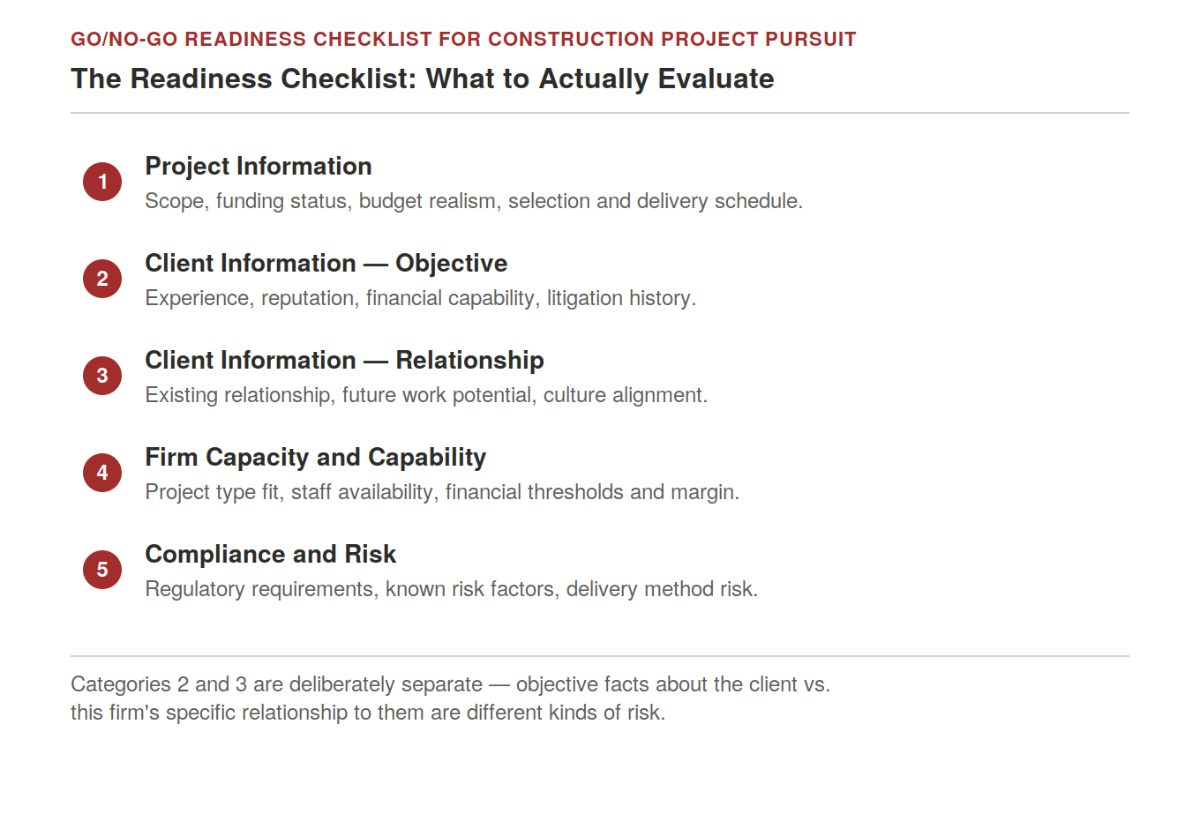
Project Information
Scope and size. Does the defined scope match what the firm can realistically deliver at this scale?
Funding source and status. Is the project actually funded, or still contingent on financing, approvals, or a bond measure that hasn't passed?
Budget. Does the stated project or construction budget appear realistic for the described scope — a mismatch here is worth investigating before committing pursuit resources.
Schedule for selection. How long is the procurement and selection process itself expected to take, distinct from the project's construction timeline, and a real cost driver on its own if the selection process is unusually long or uncertain.
Project delivery timeline. Can the project actually be completed within the required schedule given the firm's current and anticipated workload?
Client Information — Objective Factors
These would be assessed the same way regardless of which firm is doing the evaluating:
Client experience with this project type. A first-time owner on a complex project type carries different risk than an experienced repeat developer.
Client reputation. Does the client have a track record of quality, well-run projects, or a history of difficult, contentious ones?
Financial capability. Can the client actually afford to pay for what they're asking to have built?
Contract fairness and negotiability. Is the proposed contract structure reasonable, and has this client shown willingness to negotiate unfavorable terms in the past?
Litigation history. Has this client been involved in construction disputes or litigation with previous contractors or design professionals?
Client Information — Relationship Factors
These are specific to this firm's relationship with the client, not generic to the opportunity:
Existing relationship. Is this a repeat client, or a cold pursuit?
Does the client know the firm? If not an existing client, has there been any prior contact or reputation-building with this client specifically?
Future work potential. Does winning this project open the door to a longer-term relationship, or is it a one-off?
Culture alignment. Do this client's working style and expectations fit how the firm actually operates?
Firm Capacity and Capability
Project type fit. Does this fall within the firm's actual area of expertise, or does it require capabilities — a specialized delivery method, a technical scope — the firm doesn't genuinely offer?
Staff availability. Are the specific people this project would need actually available, not just technically employed by the firm?
Financial thresholds. Will this opportunity deliver an acceptable margin after accounting for the real cost of pursuing it, not just the headline contract value?
Compliance and Risk
Regulatory and governance requirements. Does the project meet every mandatory compliance standard the firm is bound by, including any internal governance policy?
Known risk factors. Bonding capacity constraints, unusual insurance requirements, or contract clauses that shift risk unusually far onto the contractor all belong in this evaluation, not as an afterthought once the pursuit is already underway.
Delivery method. A design-build pursuit carries a meaningfully different risk profile than a design-bid-build one, and the go/no-go evaluation should reflect that difference explicitly. Design-build typically requires a heavier up-front marketing and pursuit investment; the firm may be proposing design solutions before a contract exists at all, which raises the cost of a No-Go decision made too late and makes the readiness evaluation worth doing earlier in the process, not at the same point it would happen for a design-bid-build pursuit with a largely fixed scope already in hand.
Building a No-Go Triggers List
Not every opportunity needs the full checklist run against it. A short, explicit list of automatic disqualifiers — a documented history of delayed payments from this client, a delivery timeline that's unrealistic on its face, a project type genuinely outside the firm's capability- lets a team screen out the clearest non-starters in minutes rather than running a full weighted evaluation on a pursuit that was never viable. Keep this list current as a firm learns from its own pursuit history, rather than treating it as a one-time exercise.
Who Should Be Involved in the Decision?
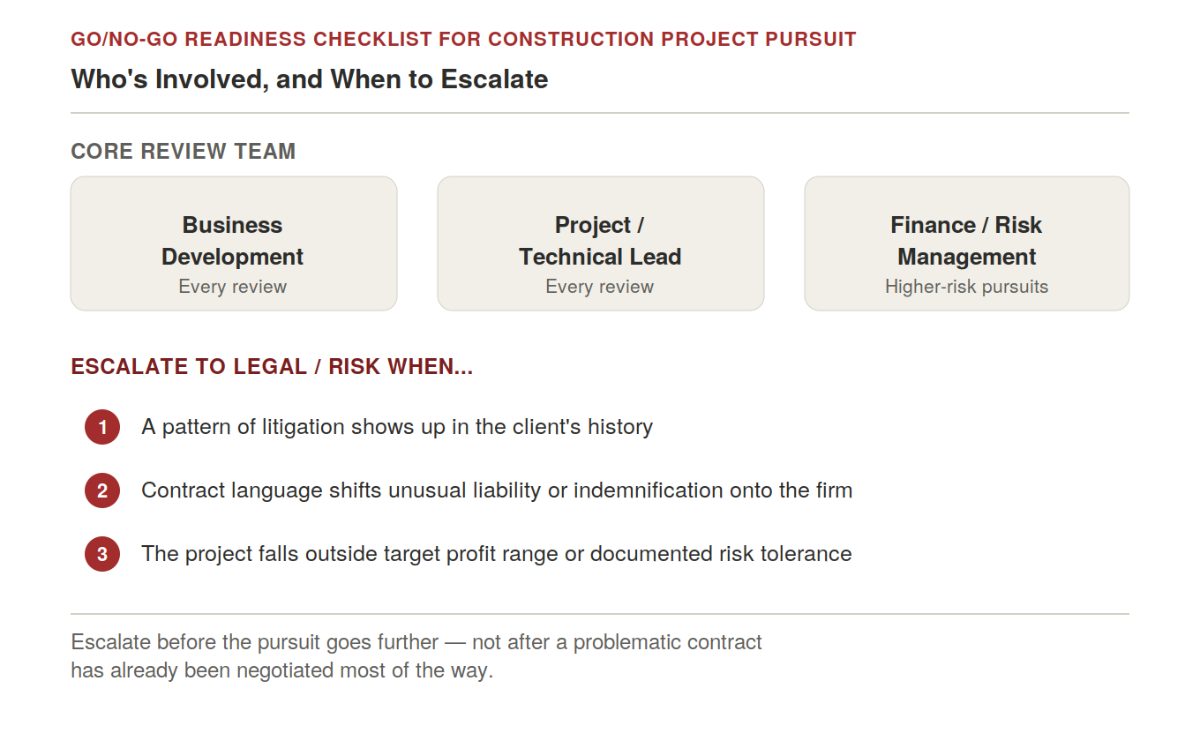
Larger pursuits rarely get decided by one person, and the go/no-go process should reflect that rather than pretending otherwise. Purchasing and partnership decisions of any real size typically involve somewhere between five and seven people across the client organization — and the firm's own go/no-go evaluation benefits from a similarly deliberate approach: business development, the project manager or technical lead who would actually deliver the work, and, for pursuits carrying real financial or legal risk, a finance or risk management representative with authority to flag concerns before commitment, not after.
Scale the formality of this group to the size of the pursuit. A small, familiar project for an existing client doesn't need the same review as a large, unfamiliar pursuit with an unfamiliar client and a complex delivery structure.
When to Escalate to Legal or Risk Management
Some findings in a go/no-go review are beyond what a business development or project team should resolve on their own. A pattern of litigation in the client's history, contract language that shifts liability or indemnification unusually far onto the contractor, or a project that doesn't meet the firm's target profit range or documented risk tolerance are all signals to bring in legal or risk management before the pursuit goes further, not after a problematic contract has already been negotiated most of the way. Training project and business development staff to recognize these triggers, rather than expecting them to resolve legal or risk questions themselves, is part of what makes the checklist useful as a risk management tool, not just a scoring exercise.
Common Mistakes That Undermine the Go/No-Go Process
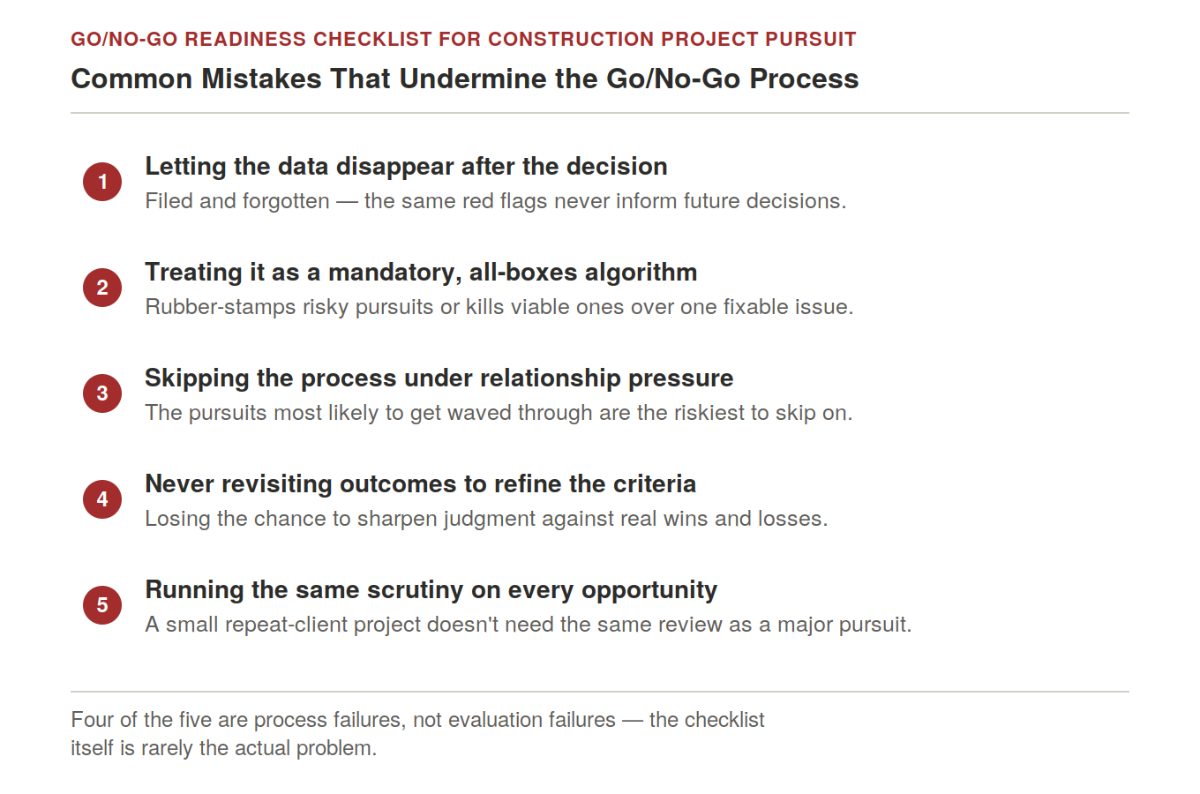
Letting the data disappear after the decision. In most firms, completed go/no-go forms get emailed around for input, then filed somewhere they're never looked at again, meaning the same red flags that should inform future decisions never actually do.
Treating the checklist as a mandatory, all-boxes-checked algorithm. A rigid pass/fail approach either rubber-stamps risky pursuits that happen to check enough boxes or kills viable ones over a single fixable issue; judgment still belongs in the loop.
Skipping the process under relationship or revenue pressure. The pursuits most likely to get waved through without real evaluation are often the ones from a long-standing client or a project that looks too good to pass up — exactly the cases where an outside perspective catches something familiarity missed.
Never revisiting outcomes to refine the criteria. A firm that doesn't compare its go/no-go decisions against actual pursuit outcomes — wins, losses, and how delivery actually went on projects that were pursued — loses the chance to sharpen its own criteria over time.
Running the same level of scrutiny on every opportunity regardless of size. A rigorous multi-stakeholder review makes sense for a major, unfamiliar pursuit; applying that same weight to a small repeat-client project mostly just adds friction.
From Go Decision to Bid: What Happens Next
Clearing the go/no-bid decision is the start of the pursuit, not the end of the risk management around it. Once a project moves to Go, the next real risk point is what happens during estimating and, for a GC, subcontractor solicitation, where the scope and terms evaluated at the go/no-go stage need to translate accurately into what's actually priced and bought out.
If the go/no-go review flagged unusual contract risk or margin sensitivity, that context is worth carrying forward into how subcontractor bids get compared, not left behind once the pursuit decision is made.Melt Bid picks up at that later stage, reading subcontractor proposals for scope gaps and exclusions once bids start coming back, the natural next checkpoint after a project has cleared go/no-go and moved into active pursuit.
Frequently Asked Questions
What is a go/no-go checklist in construction?
A structured set of criteria — covering project fit, client risk, firm capacity, financial thresholds, and compliance- that a firm evaluates before committing real time and resources to pursuing a specific project. It's a decision-support tool, not an automated pass/fail system.
Does every criterion on a go/no-go checklist need to be satisfied to proceed?
No. The checklist surfaces relevant information; the actual decision still requires judgment about how the flagged items weigh against each other for that specific opportunity. Missing one criterion isn't automatically disqualifying if the overall picture still supports pursuing the work.
What's the difference between Go, Conditional Go, and No-Go?
Go means strong fit — pursue at full commitment. Conditional Go means real potential, but contingent on resolving something specific first, like a scope clarification or a contract term negotiation, before committing further. No-Go means the fit, risk, or commercial structure doesn't support pursuing the opportunity.
Does every construction firm need a formal go/no-go process?
Not necessarily. Firms evaluating only a handful of opportunities a month can often make sound decisions through experienced judgment alone. Formalizing the process becomes more valuable as pursuit volume grows or as a firm pushes into more aggressive growth targets, where inconsistent decision-making starts costing real, measurable opportunity.
Who should be involved in a construction firm's go/no-go decision?
It depends on the size of the pursuit. Business development and the project lead who would deliver the work belong in every review; larger or higher-risk pursuits should also involve a finance or risk management representative with authority to flag concerns before commitment. Scale the group to the size and risk of the opportunity.
What should trigger escalation to legal or risk management during a go/no-go review?
A pattern of litigation in the client's history, contract language shifting unusual liability or indemnification onto the contractor, or a project that falls outside the firm's target profit range or documented risk tolerance are all signals to involve legal or risk management before the pursuit proceeds further.
Why do go/no-go processes often fail in practice, even when a checklist exists?
Most commonly because the completed checklists aren't stored or revisited anywhere useful; the same red flags that should inform future decisions get lost in emailed forms nobody looks at again, so the firm never actually learns from its own pursuit history.
What is a "no-go triggers" list, and why is it useful?
A short, explicit list of automatic disqualifiers, like a documented history of delayed payments from a specific client or a project type genuinely outside the firm's capability, that lets a team screen out the clearest non-starters quickly, without running a full weighted evaluation on a pursuit that was never viable to begin with.
Does the delivery method (design-build vs. design-bid-build) change the go/no-go evaluation?
Yes. Design-build pursuits typically require a heavier up-front marketing and pursuit investment; the firm may be proposing design solutions before a contract exists, which raises the stakes of a late No-Go decision. Running the readiness evaluation earlier in the process matters more for design-build than for design-bid-build, where the scope is typically already largely fixed by the time a firm is bidding.
Related Building Code Resources
- Building CodesBest Construction Document Control Software in 2026
- Building CodesBest Construction Estimating Software for Mac in 2026
- Building CodesAddenda in Construction: Definition, Purpose, and How to Manage Them
- Building CodesBest Construction CRM Software for Bid Tracking and Follow-Up for General Contractors
- Building CodesBest Construction Estimating Software in the UK Compared
MeltPlan
A curated stream of preconstruction intelligence, estimating innovation, takeoff breakthroughs, workflow advancements, and expert perspectives—powered by the AI and technology shaping the future of construction.
Visit SiteDon't miss what's shaping AEC
The latest on preconstruction, codes, AEC news & trends — so you're always in the know.