How Do Different Building Codes Interact With Each Other (IBC, IFC, NFPA, ADA, ASHRAE)?
Different building codes interact through a layered hierarchy of adoption, referenced standards, jurisdictional amendments, and scope boundaries. The Internatio..
Contents
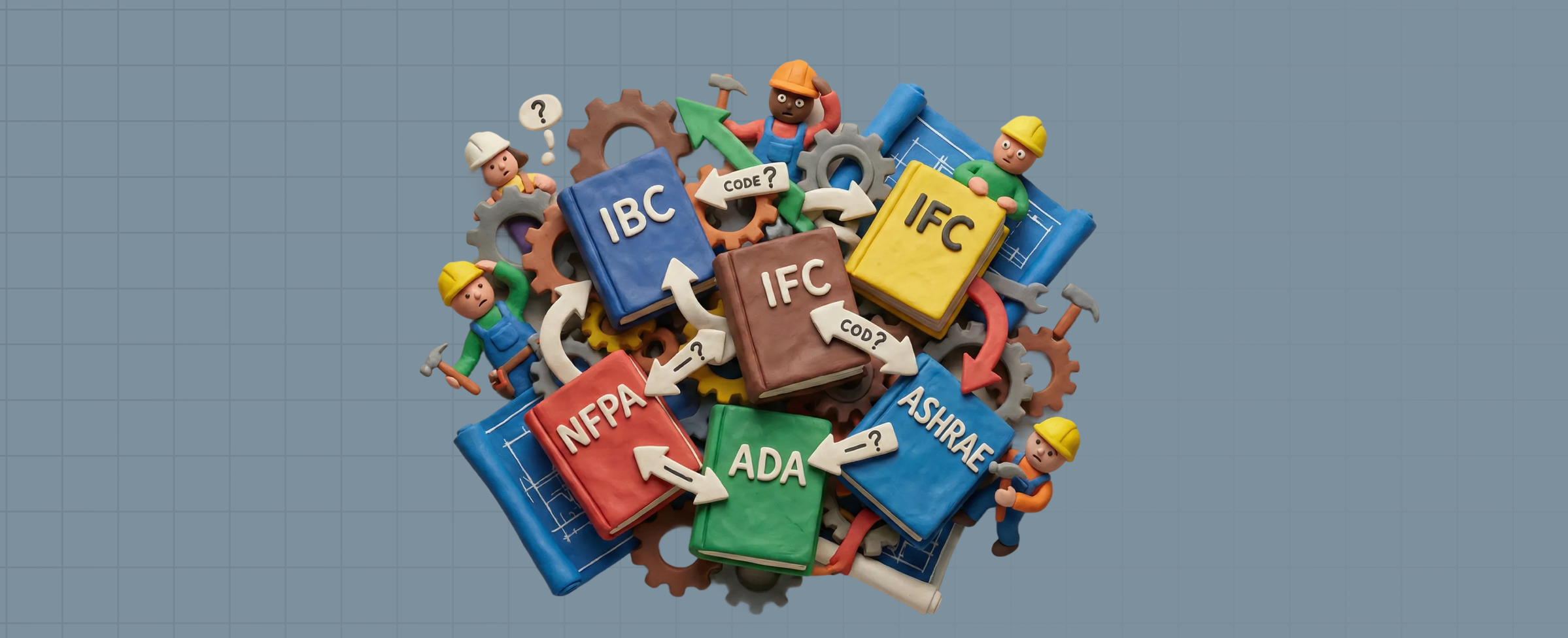
Different building codes interact through a layered hierarchy of adoption, referenced standards, jurisdictional amendments, and scope boundaries. The International Building Code (IBC) is the backbone of building design, governing occupancy, egress, fire ratings, and overall safety - but it relies heavily on other codes. The International Fire Code (IFC) modifies how fire protection systems are implemented and regulates operational fire safety for the fire department. NFPA standards - especially NFPA 13, 72, 20, and 70 (NEC) - define the technical design of sprinklers, alarms, pumps, and electrical systems that the IBC merely triggers. Accessibility compliance comes from ADA (federal law) and ANSI A117.1, both of which override or supplement IBC accessibility rules, while state-level amendments (like California CBC 11B) add stricter criteria.
Mechanical, electrical, and energy requirements are governed jointly by IBC, IMC, IECC, and ASHRAE standards (62.1 for ventilation, 90.1 for energy efficiency, 55 for comfort). These codes directly influence each other: architectural envelope decisions affect ASHRAE energy compliance, which affects mechanical design, which in turn affects electrical loads and fire-rating requirements.
Because these codes update on different cycles, are adopted unevenly across jurisdictions, and frequently conflict, multi-code reasoning is essential. For example, an egress width calculation may differ between IBC and NFPA 101, accessibility clearances often conflict between ADA and ANSI/IBC, and a mechanical room may require compliance with NEC, IMC, ASHRAE, IFC, and IBC simultaneously.
Professionals must continuously cross-reference these sources, reconcile conflicting requirements, track local amendments, meet AHJ-specific interpretations, and coordinate across disciplines. In practice, IBC tells “when” something is required; NFPA/ASHRAE tell “how” it must be designed; ADA tells “what” accessibility must achieve; IFC tells “how it must operate and be maintained.”
The interaction between these codes - overlapping scopes, cross-references, updates, and amendments - creates the core complexity of U.S. building code compliance.
This article explains how major U.S. codes interact, cross-reference, conflict, and rely on each other, and why this creates complexity for architects, engineers, contractors, and inspectors.
1. Understanding the “Code Stack”: The Layers of Interaction
1.1 Model Codes (published by ICC)
- IBC - building design, life safety, egress
- IFC - fire operations, fire department access, fire protection systems
- IEBC - renovations, existing buildings
- IRC - residential (1–2 family) homes
- IPC/IMC/IFGC - plumbing, mechanical, fuel gas
These are the backbone of the U.S. code ecosystem.
1.2 Referenced Standards
Referenced by model codes and often mandatory:
- NFPA (fire protection, alarms, sprinklers, electrical)
- ASHRAE (energy, ventilation, comfort)
- UL (product safety)
- ASTM (materials)
- ACI/AISC (structural): Model codes are not technically “complete” - they depend on dozens of these standards.
1.3 Overlaying Codes & Laws
- ADA (federal law)
- Fair Housing Act
- EPA & DOE guidelines
- Local fire marshal bulletins
- City-specific amendments
These overlays often override model code content.
2. How the IBC Interacts With (and Depends On) Other Codes
The International Building Code (IBC) is the primary code for architects, but it is heavily interlinked.
2.1 IBC + NFPA (Fire & Life Safety)
IBC determines:
- Occupancy classification
- Egress design
- Fire-resistance ratings
- Fire protection triggers
But NFPA governs:
- Sprinkler system design (NFPA 13)
- Fire alarm system design (NFPA 72)
- Fire pump requirements (NFPA 20)
- Electrical safety (NFPA 70)
- Fire extinguishers (NFPA 10)
IBC says when systems are required; NFPA says how to design them.
2.2 IBC + ADA / ANSI (Accessibility)
IBC references ICC A117.1, but ADA is federal civil rights law. Where they conflict: ADA prevails.
Example conflicts:
- Reach ranges
- Door maneuvering clearances
- Ramps/handrails
- Restroom layouts
Many jurisdictions add further amendments.
2.3 IBC + IEBC (Existing Buildings)
IEBC governs:
- Alterations
- Repairs
- Change of occupancy
- Additions
- Historic buildings
It includes three compliance paths - prescriptive, work area, performance - that directly reference IBC rules at key decision points.
2.4 IBC + IFC (Fire Department & Emergency Access)
IFC governs:
- Fire lane widths
- Fire department connections
- Operational permits
- Hazardous materials storage/handling
- Smoke control testing
- Fire command centers
IFC often modifies how IBC fire protection rules are enforced.
2.5 IBC + ASHRAE / IECC (Energy & Mechanical)
Mechanical engineers must comply with:
- ASHRAE 62.1 - ventilation
- ASHRAE 90.1 - energy performance
- ASHRAE 55 - thermal comfort
- IECC - energy code
The architect’s envelope design directly impacts MEP system sizing and compliance.
3. How the IFC Interacts With Other Codes
What can you ask? (Sample questions)
- What building code edition does my state currently enforce?
- How do state-specific amendments modify the base IBC?
- What structural design loads apply in my jurisdiction?
- What energy code requirements apply to my building type?
The International Fire Code governs fire operations and ongoing fire protection requirements.
3.1 IFC modifies IBC fire protection systems
Examples:
- Additional sprinkler requirements for certain hazardous operations
- High-piled storage rules
- Fire flow requirements
- Emergency responder radio coverage (ERRC / ERCES)
3.2 IFC + NFPA
IFC references:
- NFPA 13 (sprinklers)
- NFPA 72 (alarms)
- NFPA 20 (pumps)
- NFPA 704 (hazard identification)
In many states, NFPA codes have equal authority to the IFC.
3.3 IFC + Local Fire Marshal Guidelines
Cities such as:
- New York
- San Francisco
- Seattle
- Chicago
…have supplemental rules stricter than both IBC and IFC.
4. How ADA / ANSI Interact With Building Codes
4.1 ADA is federal law - above local code
Even if a building passes plan review, it can still violate ADA.
4.2 IBC references ICC A117.1, not ADA
This causes differences in:
- Turning radii
- Ramps
- Clear floor spaces
- Door hardware heights
- Restroom configurations
4.3 Many states have their own accessibility amendments
Examples:
- California (CBC Chapter 11B) - strictest in U.S.
- Texas Accessibility Standards
- Illinois Accessibility Code
Navigating ADA + ANSI + state amendments simultaneously is one of the hardest parts of compliance.
5. How NFPA Standards Interact With IBC/IFC
NFPA governs how to design fire protection systems.
5.1 NFPA 13 (Sprinklers)
IBC determines whether sprinklers are required.
NFPA 13 specifies:
- Pipe sizing
- Water demand
- Sprinkler spacing
- Obstruction rules
- System layout
5.2 NFPA 72 (Fire Alarms)
Covers:
- Notification appliances
- Detection
- Control units
- Wiring
- Emergency communication systems
5.3 NFPA 101 (Life Safety Code)
Adopted in:
- Hospitals
- Some jurisdictions instead of IBC
- Federal projects (e.g., VA, DoD uses UFC + NFPA)
5.4 NFPA 70 (NEC - Electrical)
The backbone of electrical design.
Impacts:
- Room clearances
- Panel spacing
- Disconnect locations
- Generator requirements
6. How ASHRAE / IECC Interact With IBC & MEP Design
Mechanical engineers must meet both prescriptive and performance-based criteria.
6.1 ASHRAE 62.1 (Ventilation)
Impacts:
- Outdoor air rates
- Exhaust
- Ventilation controls
6.2 ASHRAE 90.1 (Energy Efficiency)
Impacts:
- Envelope performance
- Fenestration
- HVAC efficiencies
- Lighting power densities
- System sizing
6.3 IECC
Often allows two paths:
- IECC prescriptive
- ASHRAE 90.1
Design teams must coordinate which path is selected early.
7. Why Multi-Code Interaction Causes Errors
7.1 Codes update on different timelines
IBC = every 3 years
NFPA = yearly
ASHRAE = yearly
ADA = rarely amended
Local amendments = anytime
7.2 Codes contradict each other
Example: ADA door clearances vs. ANSI vs. local amendments vs. IBC requirements.
7.3 Designers from different disciplines often rely on different books
Architects = IBC
Fire consultants = NFPA
MEP = ASHRAE/IECC/IMC
Contractors = NEC + AHJ policies
7.4 AHJs enforce differently
Some prioritize life safety; others accessibility; others fire suppression.
8. Real Examples of Multi-Code Conflict
8.1 Egress
IBC: occupant load × egress width
NFPA 101: different width rules
IFC: fire department access may override IBC diagrams
8.2 Accessibility
ADA turning radius vs. ANSI vs. California
IBC door maneuvering clearance vs. ADA
8.3 Mechanical rooms
NEC dictates clearances
IMC dictates ventilation
ASHRAE dictates efficiency
IBC dictates fire ratings
IFC dictates fire department access
8.4 Fire alarms
IBC says if required
NFPA 72 says how to design
IFC says how to test and commission
9. How Professionals Manage Multi-Code Complexity Today
Most rely on:
- Manual cross-referencing
- Senior staff knowledge
- Code consultants
- RFI clarification
- AHJ meetings
- Writing arguments for equivalencies/alternatives
- Creating firm-specific cheat sheets
But these processes are slow and error-prone.
FAQs
1. Why do building codes need to interact at all?
Because no single code covers all aspects of design, safety, operations, accessibility, energy, and system performance. Each code governs a different domain; projects require integrated compliance.
2. Which building code has the highest authority?
For accessibility: ADA (federal law) overrides all.
For everything else: the locally adopted state/city code has legal authority - even over model codes.
3. How do I know which edition of each code applies?
Your jurisdiction (city/county/state) determines:
- the adopted edition (e.g., IBC 2018 vs 2021)
- which NFPA standards apply
- whether IFC, IECC, ASHRAE, or local amendments supersede model rules
Always confirm with the AHJ.
4. Does the IBC include NFPA standards within it?
Yes. When IBC references NFPA standards, those standards become legally enforceable.
5. How does the IBC interact with the IFC?
IBC governs design; IFC governs operations, fire department access, and enforcement. IFC may also modify how IBC fire rules are applied.
6. Does the IBC or the IFC determine if sprinklers are required?
IBC typically determines when sprinklers are required.
NFPA 13 determines how they are designed.
IFC determines how they are tested and maintained.
7. When does NFPA overrule the IBC or IFC?
When a jurisdiction adopts NFPA standards directly or when NFPA is referenced by IBC/IFC.
In many cities, NFPA rules carry equal or stronger enforcement power.
8. How is NFPA 101 different from the IBC?
NFPA 101 (Life Safety Code) focuses more on human behavior, egress, and evacuation.
Used by hospitals, federal buildings, and some states.
9. Who designs the fire alarm system - IBC or NFPA 72?
- IBC: determines if a fire alarm is needed
- NFPA 72: dictates technical design, wiring, spacing, and testing
10. What happens if ADA conflicts with ANSI or IBC?
ADA prevails because it is federal civil rights law.
A building can pass plan review and still fail ADA compliance.
11. Why are there differences between ADA and ANSI?
They’re developed by different bodies with different goals:
- ADA: civil rights, usability
- ANSI A117.1: technical details
Jurisdictions may adopt one, the other, or both - with amendments.
12. Do states have their own accessibility codes?
Yes. Some states (e.g., California, Texas, Illinois) have stricter rules than both ADA and ANSI.
13. Do mechanical engineers follow IMC or ASHRAE 62.1?
Both.
- IMC ensures safety
- ASHRAE 62.1 ensures required ventilation
Most jurisdictions require ASHRAE 62.1 compliance.
14. What’s the difference between IECC and ASHRAE 90.1?
Both are energy codes. Most jurisdictions allow one of two compliance paths:
- IECC prescriptive path
- ASHRAE 90.1 performance path
15. How does NEC interact with IBC?
NEC (NFPA 70) governs all electrical installations. IBC references NEC, making it enforceable.
16. Why do codes contradict each other?
They update on different cycles, are written by different organizations, and prioritize different safety domains (life safety vs energy vs accessibility vs system performance).
17. How do I resolve conflicts between codes?
Use this order of precedence:
- Federal law (ADA)
- State/local adopted codes
- Local amendments or fire marshal guidelines
- Model codes
- Referenced standards
When unclear: consult AHJ or submit an Alternative Means & Methods Request (AMMR).
18. What are the most common code conflicts?
- Door clearances (ADA vs ANSI vs IBC)
- Egress width (IBC vs NFPA 101)
- Mechanical room requirements (IMC vs NEC vs ASHRAE)
- Fire protection triggers (IBC) vs system design (NFPA)
- Hazardous materials limits (IBC) vs operational permits (IFC)
19. How does the architect coordinate all these codes?
Architects typically create a Code Analysis Sheet summarizing:
- Occupancy
- Construction type
- Height/area
- Fire ratings
- Accessibility
- Egress
Then fire protection engineers, mechanical/electrical engineers, and contractors embed their corresponding NFPA, IMC, IEC, ASHRAE, and NEC requirements.
20. Why do contractors often see different requirements than architects?
Contractors use NEC, NFPA, IMC, mechanical/electrical standards, and local interpretations. Architects lean on IBC/IFC/ADA, creating differences in where information comes from.
21. How do AHJs influence code interaction?
AHJs interpret, enforce, and sometimes override certain code provisions. Fire marshals especially may require stricter-than-code installs.
22. Why do code editions matter so much?
IBC updates every 3 years; NFPA and ASHRAE update annually.
Misalignment increases conflicts and changes system design requirements.
23. How often are state or local amendments updated?
Anytime. Some jurisdictions publish ongoing bulletins, errata, and interpretations.
24. How can I track all these changes?
Monitor:
- State building standards commissions
- AHJ bulletins
- ICC, NFPA, ASHRAE release notes
- Local fire departments
- Professional organizations
References
ICC Codes, NFPA Standards, ADA Standards, ANSI A117.1, ASHRAE 62.1/90.1/55, IECC, state amendments (Title 24, FBC, NYC Code), and decades of professional practice insight.
Related Building Code Resources
- Building CodesWhat Are the Key Aspects to Consider When Analyzing Building Codes?
- Building CodesDigital Code Libraries & Search Tools: What They Fix and What They Don’t
- Building CodesWhere Traditional Building Code Research Breaks Down
- Building CodesThe Hidden Costs of Manual Building Code Research
- Building CodesTraditional Building Code Research Methods
Don't miss what's shaping AEC
The latest on preconstruction, codes, AEC news & trends — so you're always in the know.
MeltPlan
A curated stream of preconstruction intelligence, estimating innovation, takeoff breakthroughs, workflow advancements, and expert perspectives—powered by the AI and technology shaping the future of construction.
Visit Site