How Does Code Compliance Risk Impact Projects and Architecture/Engineering Firms?
Code compliance risk affects projects and A/E firms by introducing the possibility of permit delays, redesign, construction change orders, inspection failures, ..
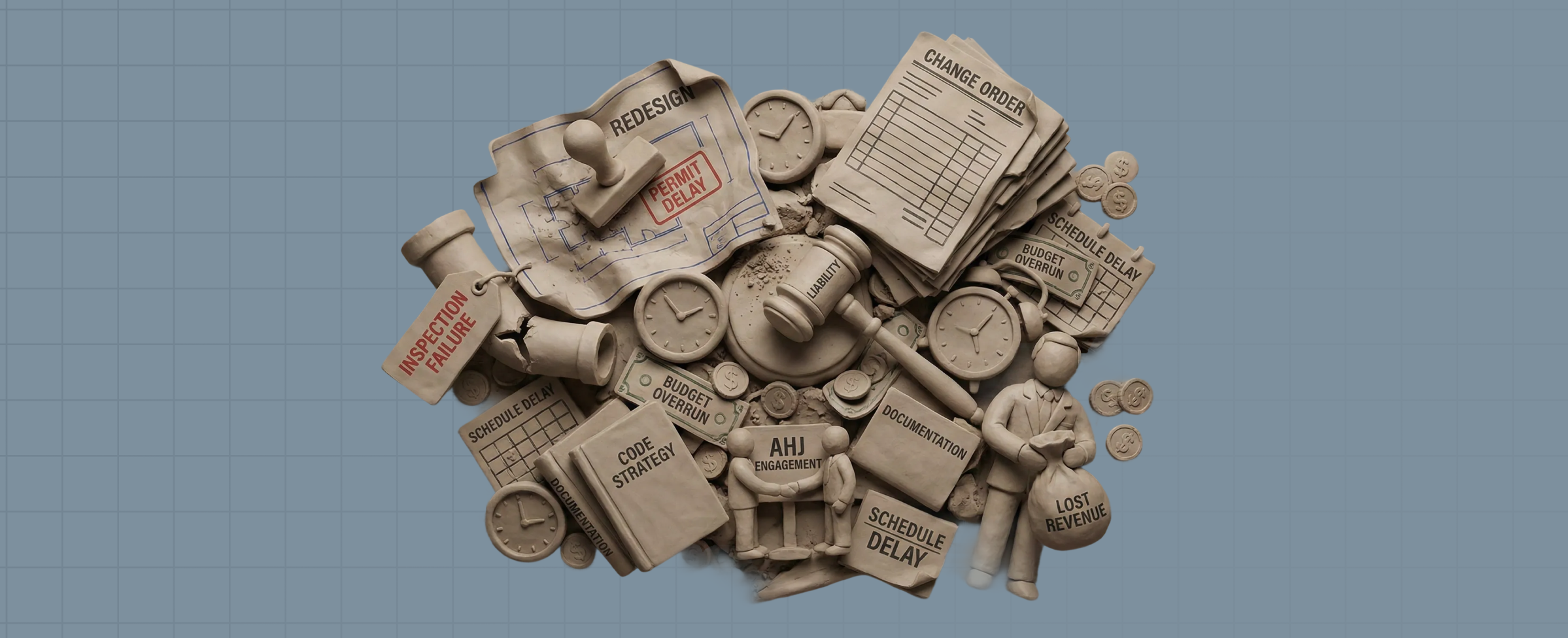
Code compliance risk affects projects and A/E firms by introducing the possibility of permit delays, redesign, construction change orders, inspection failures, budget overruns, schedule impacts, and serious liability exposure. Because building codes govern life safety, accessibility, fire protection, structural performance, egress, and mechanical systems, even small misinterpretations can cause major disruptions. When codes are misunderstood, inconsistently interpreted across jurisdictions, or applied late in the design process, projects face costly rework, increased RFI volume, contractor claims, and delayed occupancy - directly affecting owners’ revenue and project viability.
For architecture and engineering firms, code compliance risk translates into professional liability claims, E&O insurance increases, reputational damage, loss of client trust, reduced profitability, and internal burnout as senior staff become de facto “code gatekeepers.” The complexity of modern codes - combined with multi-code dependencies, fragmented documentation practices, and AHJ variability - makes effective risk management extremely difficult. Firms often rely on tribal knowledge, informal communication, and manual research across disconnected sources, increasing the likelihood of errors.
Strong code compliance practices reduce risk through early strategy, proactive multi-discipline coordination, rigorous documentation, structured QA/QC processes, consistent AHJ engagement, and the use of tools capable of handling jurisdiction-specific code logic. Mastering code compliance isn’t just a technical task - it is a core business strategy that protects project schedules, budgets, client relationships, and long-term firm resilience.
Introduction: Code Compliance Isn’t Just a Technical Issue - It’s a Risk Issue
Building code compliance is more than a checklist - it’s a core risk management discipline. Every code decision affects:
- life safety
- liability
- approvals
- insurance
- client relationships
- construction budgets
- performance outcomes
For architecture and engineering firms, failure to manage this risk can have far-reaching consequences. Code-related issues are among the top causes of rework, disputes, and claims in the built environment.
Below, we detail the ways code compliance risk impacts both projects and professional firms, and why mastering code compliance is critical for business resilience.
1. How Code Compliance Risk Impacts Projects
1.1 Permit Delays and Rejections
The #1 immediate impact of poor code compliance.
Common scenarios:
- AHJ rejects code sheets
- Egress calculations fail
- Accessibility requirements not met
- Fire protection logic unclear
- Local amendments ignored
- Code citations incomplete
Delays range from weeks to months, affecting the entire schedule.
1.2 Design Rework and Redesign Costs
When code issues are caught late, teams must:
- reroute egress paths
- redesign stairs
- modify rated assemblies
- relocate equipment
- adjust plumbing fixtures
- change mechanical room sizes
Rework eats into fee and can impact project viability.
1.3 Construction Change Orders
If code gaps surface in the field, contractors issue change orders.
Common causes:
- missing firestopping
- incorrect ADA clearances
- conflicting electrical clearances
- insufficient ventilation
- incorrect sprinkler coverage
- improper shaft construction
These changes are often expensive and non-negotiable.
1.4 Failed Inspections
Inspection failures result in:
- work stoppage
- emergency rework
- fines (in some jurisdictions)
- delayed occupancy
- extended contractor claims
AHJ interpretation variation amplifies this risk.
1.5 Schedule Slippage
Every code issue has a schedule impact.
Combined impacts of:
- redesign
- resubmittals
- RFI cycles
- re-inspections
- material reordering
can push deadlines by weeks or months.
1.6 Budget Overruns
Code-driven changes often hit the construction budget hard:
- upgrades to fire protection systems
- changes in MEP equipment
- added structural components
- thicker wall assemblies
- larger shafts or rooms
- rerouted ductwork
These costs can ripple across the entire building.
1.7 Lost Revenue / Delayed Revenue for Owners
If tenants can’t occupy due to code issues, owners lose:
- rent revenue
- operational readiness
- financing milestones
- market timing
For developers, even a one-month delay can carry major financial penalties.
2. How Code Compliance Risk Impacts Firms
2.1 Professional Liability Exposure
Code mistakes can lead to:
- lawsuits
- claims
- mediation/arbitration
- E&O insurance payouts
Any code non-compliance involving life safety (egress, fire protection, accessibility) is especially high-risk.
2.2 E&O Insurance Premium Increases
Firms with recurring code compliance issues see higher premiums and may even lose insurability for certain project types.
2.3 Reputational Damage
Clients lose trust when projects experience:
- inspection failures
- permitting issues
- rework
- non-compliance citations
This affects future project opportunities.
2.4 Loss of Client Goodwill & Relationships
Owners expect code mastery.
Repeated issues erode confidence and jeopardize long-term accounts.
2.5 Loss of Profitability Due to Rework
Firms often absorb the cost of:
- additional coordination
- redesign
- emergency consultant work
- added documentation
Margins erode quickly.
2.6 Staff Burnout & Bottlenecking
Code risk creates internal bottlenecks:
- juniors depend on seniors
- mid-levels validate everything
- seniors become exhausted “code experts”
- errors slip through due to stress
This weakens internal capacity and slows projects.
2.7 Increased RFI Volume
Code ambiguity leads to endless RFIs from contractors:
- clarifications
- conflicts
- missing detail
- inconsistent interpretations
This increases staff workload and prolongs construction.
2.8 Loss of Competitive Advantage
Firms unable to manage code complexity:
- avoid certain project types
- lose bids
- deliver slower
- appear less technically competent
Whereas firms known for code excellence win more work.
3. Key Areas Where Code Risk Is Highest
What can you ask? (Sample questions)
- What building code edition does my state currently enforce?
- How do state-specific amendments modify the base IBC?
- What structural design loads apply in my jurisdiction?
- What energy code requirements apply to my building type?
3.1 Egress
Errors in:
- occupancy classification
- width calculations
- number of exits
- exit signage
- discharge paths
carry huge safety implications.
3.2 Accessibility
ADA lawsuits are common and costly.
Even minor dimension errors → large liability.
3.3 Fire Protection
Sprinklers, alarms, smoke control - high life-safety impact and heavily enforced.
3.4 Rated Assemblies
Breaks in continuity → inspection failures, rework.
3.5 Mechanical Ventilation & Energy
ASHRAE + IMC + IECC inconsistencies are frequent sources of disputes.
3.6 Hazardous Materials
Even small errors → major safety incidents, fines, and shutdowns.
3.7 Structural Requirements
Misapplied loads or seismic rules → catastrophic risk.
4. Why Code Compliance Risk Is Hard to Manage
4.1 Codes are complex and constantly changing
Different cycles, jurisdictions, and amendments.
4.2 Interpretations vary across AHJs
No universal enforcement.
4.3 Multi-code dependencies
Design decisions require referencing multiple document sets.
4.4 Lack of documentation
No traceability for decisions.
4.5 Fragmented workflows
Research scattered across PDFs, emails, and memory.
4.6 Reliance on tribal knowledge
Senior staff carry the firm’s code command.
4.7 Limited use of automation
Most firms handle compliance manually.
5. How Strong Code Compliance Reduces Risk (What Good Looks Like)
5.1 Upfront code strategy in SD and DD
Not waiting until CDs or permitting.
5.2 Multi-disciplinary coordination early
Aligning architecture, MEP, fire protection, and structural.
5.3 Clear documentation trails
Code logs, matrices, decision records.
5.4 Proactive AHJ engagement
Pre-application meetings, clarifications, written approvals.
5.5 Internal knowledge management
Shared interpretations, checklists, and institutional memory.
5.6 QA/QC processes focused on code
Specialized reviewers, peer checks, and dedicated code experts.
5.7 Smart tools that understand jurisdiction-specific codes
Tools that handle:
- multi-code logic
- amendments
- project context
- transparent reasoning
This dramatically reduces compliance risk.
FAQs
1. What’s the biggest code-related risk for A/E firms?
Life-safety failures in egress, fire protection, or accessibility - these trigger the most severe liability and legal consequences.
2. Why do code issues cause major redesigns?
Because code requirements control spatial layout, fire ratings, structural interfaces, equipment sizing, and clearances - so corrections ripple across the entire design.
3. Can poor code compliance really affect profitability?
Yes. Rework, delays, added RFIs, and claims frequently eliminate fee margins and increase uninsured costs.
4. Do code errors frequently lead to lawsuits?
Absolutely. Accessibility violations and fire protection issues are among the most litigated areas in architecture and construction.
5. Why do projects fail inspections even when drawings were approved?
Plan reviewers and field inspectors interpret codes differently; field conditions reveal issues that paper reviews miss.
6. What’s the main reason code compliance risk is hard to manage?
Codes are complex, multi-layered, amended locally, interpreted differently by AHJs, and rarely documented consistently by design teams.
7. How do code issues impact project schedules?
Redesigns, resubmittals, re-inspections, and change orders can push schedules back by weeks or months.
8. How do code problems affect owners financially?
Delayed occupancy and construction corrections lead to lost rent, missed financing milestones, and increased holding costs.
9. Why does poor code documentation increase risk?
Without documentation, firms cannot defend decisions, justify interpretations, or resolve disputes quickly - heightening liability.
10. How can firms reduce code compliance risk?
By using early code strategy, multi-discipline coordination, formal documentation, proactive AHJ communication, strong QA/QC processes, and tools that understand jurisdiction-specific codes.
References
ICC Codes (IBC/IFC/IEBC), NFPA 13/72/101, ADA Standards, ANSI A117.1, ASHRAE 62.1/90.1, IECC, E&O case studies, construction litigation records, and extensive A/E practice experience.
Related Building Code Resources
- Building CodesWhat Are the Key Aspects to Consider When Analyzing Building Codes?
- Building CodesDigital Code Libraries & Search Tools: What They Fix and What They Don’t
- Building CodesWhere Traditional Building Code Research Breaks Down
- Building CodesThe Hidden Costs of Manual Building Code Research
- Building CodesTraditional Building Code Research Methods
MeltPlan
A curated stream of preconstruction intelligence, estimating innovation, takeoff breakthroughs, workflow advancements, and expert perspectives—powered by the AI and technology shaping the future of construction.
Visit SiteDon't miss what's shaping AEC
The latest on preconstruction, codes, AEC news & trends — so you're always in the know.