What are the Key changes in Chapter 11B Accessibility to Public Buildings & Public Housing of CBC 2025?
Chapter 11B gets a lot of surgical changes rather than giant new concepts. Main themes: Essentially, the 2025 code is cleaning up edge cases that were confusing..
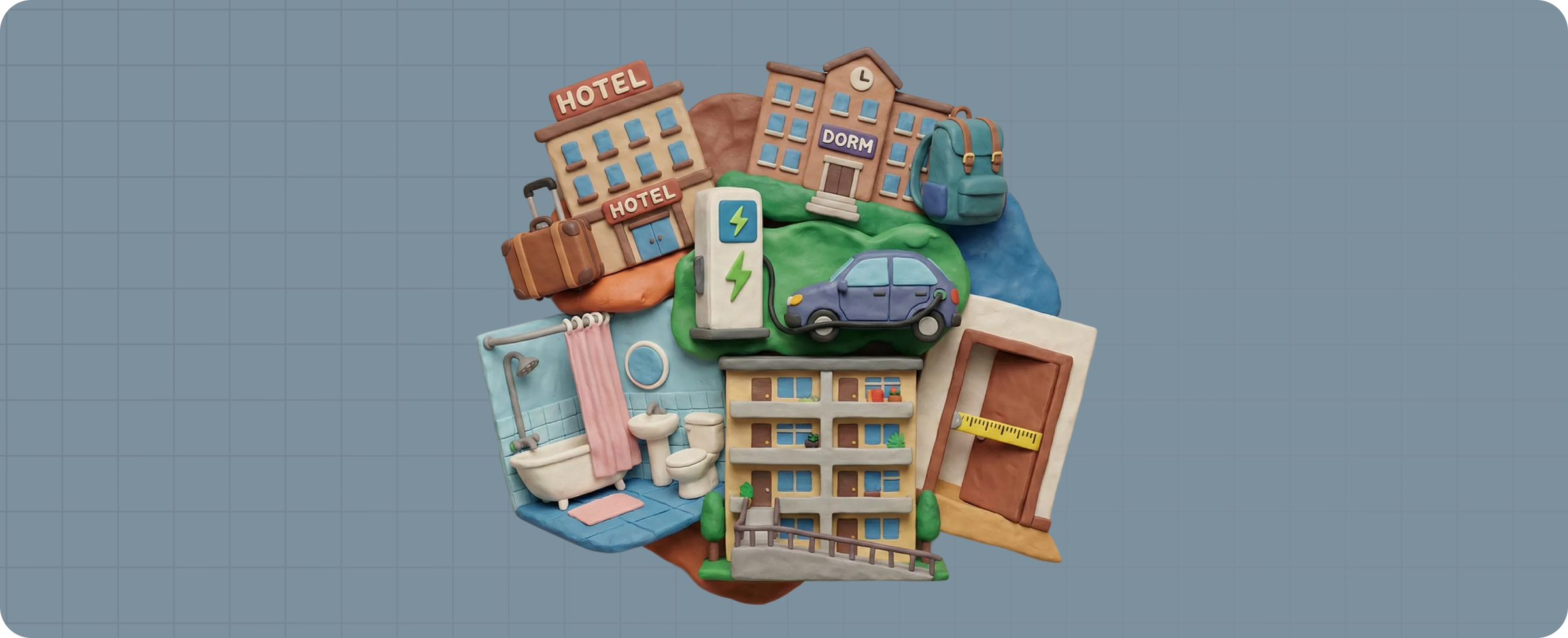
Chapter 11B gets a lot of surgical changes rather than giant new concepts. Main themes:
- Clearer separation between transient lodging vs. housing at places of education
- Sharper scoping for public housing units with mobility/adaptable features
- Clarified EV charging station scoping
- Improved clarity on blended transitions (detectable warnings), bathrooms, personal lift spaces, vanity counters, doors, and clear floor spaces at dining surfaces
Essentially, the 2025 code is cleaning up edge cases that were confusing designers and plan reviewers in the 2022 text.
2.1. Scoping & General Provisions
| Section | Topic | Description of Change | Impact |
|---|---|---|---|
| 11B-213.2 | Toilet & Bathing Rooms | Exception 5 removed from this section to eliminate duplicate language; same exception retained in §11B-603.6. | Avoids conflicting text; designers must reference §11B-603.6 for that exception. |
| 11B-224.1 | Transient Lodging, Housing at Education, Social Service Centers | Clarifies distinction between transient lodging and housing at places of education; removes “dormitories” from transient lodging. | Reduces confusion for campus projects; clarifies hotel vs. student housing requirements. |
2.2. EV Charging Stations & Public Housing
EVCS & Public Housing Scoping
| Section | Topic | Description of Change | Impact |
|---|---|---|---|
| 11B-228.3.2 | Minimum Number of EVCS | Exceptions clarified and reworded for better enforcement. | Reduces misinterpretation of EVCS counts and locations. |
| 11B-233.3 | Public Housing Facilities | Adds reference to §11B-809 for adaptable feature units. | Directs users to correct detailed requirements. |
| 11B-233.3.1.2.6.1 | Single Building w/ One Lobby | Corrects reference related to site impracticality applicability. | Fixes technical reference error. |
| 11B-233.3.1.2.6.5 | Site Impracticality | Clarifies language and corrects references in items 2 & 4. | Makes site impracticality rulings more predictable. |
2.3. Guest Rooms, Bathing Rooms, and Lodging-Specific Requirements
What can you ask? (Sample questions)
- How does ANSI A117.1 differ from ADA requirements?
- What accessible route slope maximums apply under IBC?
- When are accessibility upgrades triggered in renovations?
- What door maneuvering clearances does ANSI A117.1 require?
| Section | Topic | Description of Change | Impact |
|---|---|---|---|
| 11B-603.6 | Guest Room Toilet & Bathing Rooms | Clarifies CA-specific requirements apply only to transient lodging, not student housing. | Separates hotel vs. housing-at-education requirements. |
| 11B-806.2.3.1 | Personal Lift Device Floor Space | Applies only to transient lodging facilities. | Prevents misuse in student housing. |
| 11B-806.2.4.1 | Vanity Countertop Space | Requirement clarified to apply to both bathrooms in hotels and student housing. | Ensures consistent accessibility in both types of facilities. |
2.4. Dwelling Units with Mobility/Adaptable Features (Public Housing Context)
| Section | Topic | Description of Change | Impact |
|---|---|---|---|
| 11B-809.1 | General | Clarifies references for dwelling units with mobility features; adds reference to §11B-809.6. | Improves internal consistency. |
| 11B-809.6 | Adaptable Features | Removes “multifamily” terminology. | Prevents misinterpretation of unit-level requirements. |
| 11B-809.8 | Doors | Revises door requirements and relocates exceptions to §11B-809.8.3.1. | Easier application and cleaner code organization. |
| 11B-809.10 | Bathrooms & Powder Rooms | Replaces “toilet and bathing rooms” with defined term “bathrooms.” | Reduces ambiguity for designers. |
| 11B-809.10.6.1 | Shower Size | Spells out specific shower size requirements instead of referencing §11B-608.1. | Clearer shower design requirements. |
| 11B-809.10.6.3 | Shower Clearances | Increases clear floor space; adds figure for location relative to control wall. | Simplifies design and field verification. |
2.5. Blended Transitions & Detectable Warnings
| Section | Topic | Description of Change | Impact |
|---|---|---|---|
| 11B-705.1.2.5 | Blended Transitions | Clarifies width & depth rules for detectable warnings depending on pedestrian direction. | Reduces conflicts in curb ramps & shared streetscapes. |
2.6. Dining Surfaces & Clear Floor Spaces
| Section | Topic | Description of Change | Impact |
|---|---|---|---|
| 11B-902.2 | Clear Floor & Ground Space | Clear floor space at dining surfaces may not overlap an accessible route. | Prevents double-counting circulation space; major impact on restaurant/amenity seating layouts. |
Expert Commentary — Why These Accessibility Changes Matter
1. Public Housing & 11B
With 11A stepping back from public housing, public housing is now squarely a Chapter 11B world:
- Tighter alignment with federal ADA
- More scrutiny from enforcement agencies
- Less ambiguity for designers juggling dual requirements
2. Lodging vs. Education Housing
By separating transient lodging from housing at places of education, the code acknowledges that:
- A dorm is not a hotel
- Some items (e.g., personal lift device floor clearances) make sense in hotels, but not in dorms
- Others (vanity counter space) should apply to both
3. EV Charging Stations (EVCS)
Clarified EVCS rules are increasingly important:
- EVCS scoping is a frequent point of confusion
- These clarifications are exactly the type of “micro-interpretation” that junior staff often miss, and reviewers catch
4. Showers, Bathrooms & Adaptable Units
The changes around 11B-809.x are the bread-and-butter of accessibility conflicts:
- Shower size and clearance
- Doors in adaptable units
- Bathroom layout semantics
5. Detectable Warnings & Dining Routes
Two super practical, often-misinterpreted topics got clearer:
- Blended transitions (ramps to crosswalks, shared plaza edges)
- Dining surface clear space vs. route
These are exactly the kinds of issues that show up in punchlists and late-stage field conflicts.
FAQs
1. What are the biggest accessibility changes in CBC 2025 Chapter 11B?
CBC 2025 refines and clarifies scoping for public housing, transient lodging, housing at places of education, EV charging stations, bathrooms, showers, door clearances, blended transitions, and clear floor spaces. Most changes resolve long-standing ambiguities rather than introduce new concepts.
2. Why did the CBC separate transient lodging from housing at places of education?
Because hotels and student housing serve fundamentally different use patterns.
The 2025 update removes “dormitories” from transient lodging provisions and directs student housing to the correct subsections, preventing misapplication of hotel-specific requirements (e.g., personal lift clearances).
3. How did CBC 2025 update EV charging station (EVCS) scoping?
Section 11B-228.3.2 clarifies exceptions for EVCS counts and distribution.
The wording is rewritten for easier enforcement, reducing misinterpretation about:
- Minimum number of accessible EVCS
- Required types (standard/van-accessible)
- Distribution across parking facilities
4. What changed for public housing accessibility?
Multiple sections direct designers toward §11B-809 for mobility and adaptable features.
Highlights include:
- Corrected references for site impracticality
- Clarified scoping for adaptable units
- Revised door, bathroom, and shower requirements
These changes better align public housing with ADA and avoid conflicting interpretations.
5. What is the significance of the updates in §11B-809 for adaptable and mobility units?
These are some of the most impactful revisions in the chapter.
CBC 2025 clarifies:
- Interior door requirements
- Bathroom definitions and layout
- Shower size, configuration, and clearances
- Terminology (e.g., removing “multifamily unit”)
These changes create more predictable layouts for public housing and reduce plan-check disputes.
6. How do the new rules affect bathrooms and bathing facilities?
Several subtle but important updates:
- Exception language reorganized (e.g., §11B-603.6)
- “Bathroom” clarified as a defined term
- Shower requirements spelled out directly for adaptable units
These revisions eliminate conflicting cross-references and make bathroom design easier to document and inspect.
7. Did shower requirements change in CBC 2025?
Yes.
In §11B-809.10.6.1 and §11B-809.10.6.3:
- Shower size requirements are now explicit
- Clear floor space is increased
- A new figure clarifies the required location relative to the control wall
This gives architects more certainty when laying out small residential units.
8. What changed for interior door clearances in residential units with adaptable features?
CBC 2025 revises the requirements and relocates previous exceptions into a new §11B-809.8.3.1, making the rules more organized.
This is especially important for small units where every inch of swing, clearance, and maneuvering space matters.
9. How does CBC 2025 handle blended transitions and detectable warnings?
§11B-705.1.2.5 clarifies:
- When detectable warnings are needed
- How width and depth vary depending on pedestrian travel direction
This reduces disputes during plan check and field inspection for curb ramps, plazas, and mixed-use streetscapes.
10. What is the new rule about clear floor space at dining surfaces?
CBC 2025 explicitly prohibits overlapping clear floor space at dining surfaces with the accessible route (§11B-902.2).
This means circulation aisles cannot double as the knee/toe clearance zone for accessible seating.
11. How do these changes affect student housing projects?
CBC 2025 clarifies which 11B sections apply to:
- Transient lodging
- Housing at places of education
This prevents hotels-style requirements (e.g., lift device maneuvering spaces) from being incorrectly imposed on dormitories.
12. What should designers know about “site impracticality” updates?
Several corrected references and clarifications in 11B-233.3.1.2.6.x tighten when site impracticality can be claimed.
This affects:
- Accessible routes across steep sites
- Distribution of accessible dwelling units
- Public housing projects with challenging grades
13. Does CBC 2025 make public housing more aligned with ADA?
Yes. The revisions emphasize mobility features, adaptable features, and correct scoping—creating clearer alignment with federal ADA requirements and reducing legal exposure for jurisdictions and owners.
14. Are vanity and countertop requirements different under CBC 2025?
Yes.
§11B-806.2.4.1 now makes explicit that vanity counters apply to:
- Transient lodging bathrooms
- Housing at places of education bathrooms
This removes ambiguity that previously caused inconsistent plan-check interpretations.
15. What should architects review first when applying Chapter 11B updates?
Start with:
- Transient lodging vs. education housing distinctions
- EVCS scoping and exceptions
- 11B-809 revised bathroom/shower and door requirements
- Detectable warning rules at blended transitions
- Clear floor space rules for dining surfaces
These areas drive the most plan-check comments and field conflicts.
References
Related Building Code Resources
- Building CodesWhat are the Key changes in Chapter 14 Exterior Walls of CBC 2025?
- Fire & Life SafetyWhat are the Key changes in Chapter 10 Means of Egress of CBC 2025?
- Fire & Life SafetyWhat are the key Changes in Chapter 9 Fire Protection Systems California Building Code 2025?
- Building CodesWhat are the key changes in Chapter 5 General Building Heights & Areas of CBC 2025?
- Building CodesWhat are the key changes in Chapter 4 Special Detailed Requirements Based On Occupancy & Use of CBC 2025?
MeltPlan
A curated stream of preconstruction intelligence, estimating innovation, takeoff breakthroughs, workflow advancements, and expert perspectives—powered by the AI and technology shaping the future of construction.
Visit SiteDon't miss what's shaping AEC
The latest on preconstruction, codes, AEC news & trends — so you're always in the know.