What are the key changes in Chapter 4 Special Detailed Requirements Based On Occupancy & Use of CBC 2025?
Chapter 4 sees substantial changes, especially for high-rise buildings, atriums, care suites in I-2 occupancies, hazardous materials, and special amusement area..
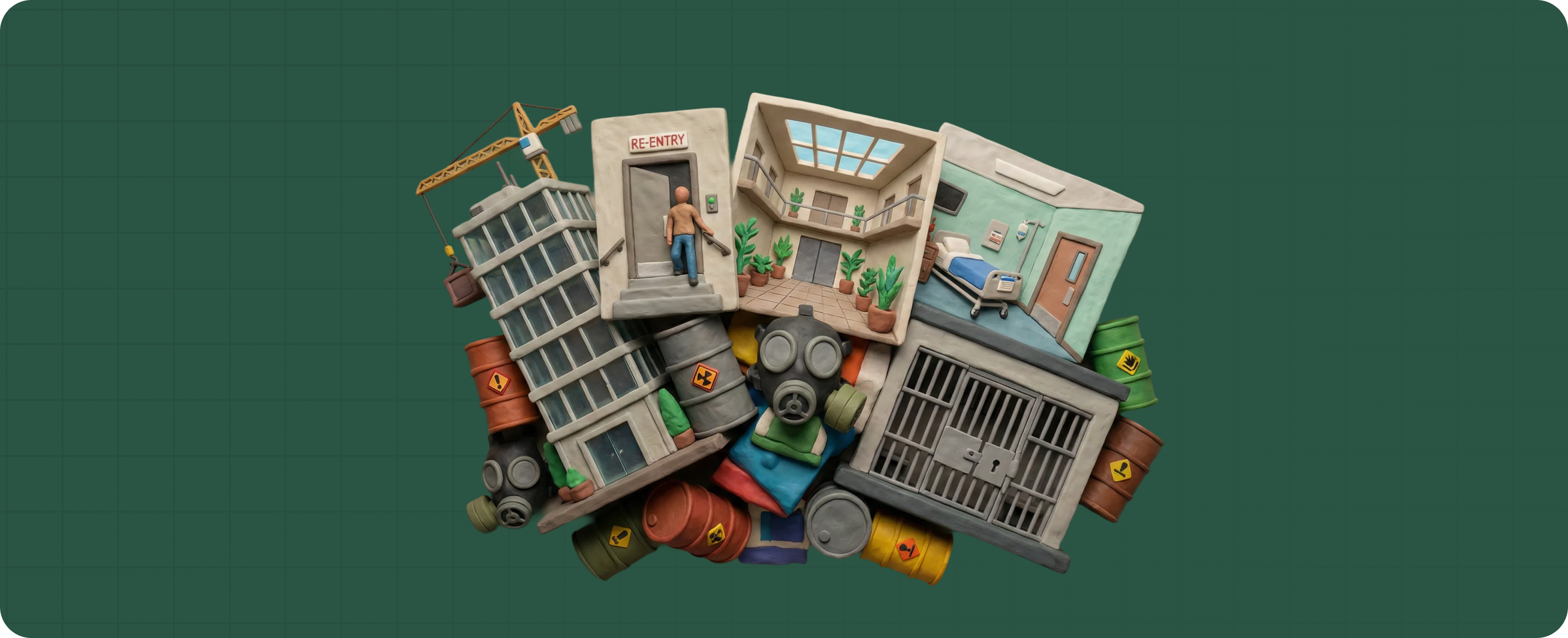
Chapter 4 sees substantial changes, especially for high-rise buildings, atriums, care suites in I-2 occupancies, hazardous materials, and special amusement areas.
The most significant changes include:
- New glass wall rules for high-rise buildings
- Revised stairway re-entry door operation requirements
- Expanded atrium enclosure exceptions (especially for I-2/R-2.1)
- New vehicle sallyport requirements for I-3
- Relocation of special amusement area alarm requirements
- Significant rewrites for care suite egress and access rules
- Updates throughout hazardous material sections
Full Detailed Table Of All Changes - Chapter 4
| Section | Topic | Description of Change | Impact |
|---|---|---|---|
| 403.2.2.1 | Wall Assembly Materials | Reorganized requirements for interior wall structural impact resistance at shafts/stairways. | Clarifies and standardizes high-rise wall assembly approvals. |
| 403.2.2.4 | Glass Walls in High-Rises | New criteria added. | Allows innovative façade/atrium glazing with safety criteria. |
| 403.3.1 | Sprinkler Risers | Now allows a single express riser for buildings under 420 ft. | Reduces cost for mid-rise/high-rise projects. |
| 403.5.3 | Stairway Door Operation | Mandatory unlocking on power failure; fire alarm; FCC signal. | Enhances firefighter access and life safety. |
| 404.6 Exception 5 | Atrium Enclosures | In I-2 and R-2.1, 3-story atriums may omit fire barriers if smoke control accounts for adjoining spaces. | Increased design flexibility in healthcare/residential care. |
| 404.10 | Exit Stairways in Atriums | New condition: discharge must comply with §1928.1. | Aligns atrium discharge with exit discharge rules. |
| 404.12 | Group I & R-2.1 Means of Egress | Egress from treatment rooms may not pass through an atrium. | Prevents unsafe reliance on atrium path for assisted-care egress. |
| 407.4.4.1 | Exit Access through Care Suites | 2022 mid-cycle amendment removed for CA; requirement struck. | Deletes conflicting/overlapping CA amendment. |
| 407.4.4.3 | Corridor Access, Group I-2 | Completely rewritten; includes: max. 100 ft travel inside suite, limits on intervening rooms, sprinkler exceptions. | Major redesign implications for I-2 patient care floors. |
| 408.13 | I-3 Windows | Updated security glazing standards. | Stronger break resistance standards for correctional facilities. |
| 408.16 | Vehicle Sallyports, I-3 | Requires NFPA 13 sprinklers + 2-hr fire barrier unless roof ≥50% open. | Raises safety for secure prisoner transport. |
| 410.2.4 | Proscenium Wall | Exception allows new rated assemblies in Type I buildings. | More flexibility for theaters/performing arts buildings. |
| 411.3 | Amusement Area Detection | Detection/alarm requirements moved from §907.12.1–§907.2.12.3. | Consolidates amusement area rules for clarity. |
| 411.4.1 | Exit Marking | Photoluminescent exit signs required. | Modernizes visual egress cueing in dark ride spaces. |
| 411.6 | Flammable Decorative Materials | Commissioned to §806 compliance. | Improves consistency across chapters. |
| 414 | Hazardous Materials | Revisions to tables and quantities. | Must re-evaluate all hazmat storage designs. |
| 420.2 | Separation Walls | Clarifies walls between sleeping units & dwelling units must also be fire partitions. | Ensures adequate vertical separation in multi-family. |
| 420.3 | Horizontal Separation | Floor assemblies separating sleeping from dwelling units must meet §711. | Strengthens sound/fire separations. |
| 422.7 | Domestic Cooking in Ambulatory Care | Building must be fully sprinklered; cooking areas must be fire-partitioned. | Reduces common fire risk in healthcare kitchens. |
| 423.4.1 & 423.5.1 | Storm Shelters | Adds design occupant capacity requirements. | Aligns CA with ICC/NSSA storm shelter standards. |
Expert Commentary - Why Chapter 4 Is Influential
1. Healthcare (I-2) sees major changes
The rewritten care suite rules fundamentally impact:
- Nurse station placement
- Corridor access
- Travel distances
- Patient room access sequences
Architects designing hospitals will need to revisit standard floor templates.
2. Atrium flexibility increased
Especially for medical and R-2.1 occupancies - a big benefit for designers wanting open, daylighted multistory spaces in care environments.
3. High-rise and tall buildings get new glazing & stair door rules
These are based on post-incident analyses and help ensure:
- Firefighter re-entry
- Reduced smoke-floor infiltration
- Safer glass failure modes
4. New sallyport rules
Correctional facilities will see stricter requirements, particularly around fire spread in enclosed vehicle transfer zones.
FAQs
1. What types of buildings are most affected by the 2025 Chapter 4 changes?
The most impacted occupancies include high-rise buildings, healthcare facilities (I-2), residential care (R-2.1), correctional facilities (I-3), and any building with atriums or hazardous materials. These groups see the largest revisions in egress, fire protection, glazing, and smoke control rules.
2. What is the biggest change for healthcare projects?
The complete rewrite of care suite egress and corridor access requirements (§407.4.4.3).
This change affects:
- Maximum internal travel distances
- Allowed intervening spaces
- Access to corridors
- Sprinkler and smoke control interactions
Hospitals and medical designers will need to re-evaluate typical floor layouts and care suite configurations.
3. How do the new high-rise glass wall rules affect design?
Section 403.2.2.4 introduces new criteria for glass walls in high-rise buildings, allowing more innovative atrium and façade glazing while applying stricter safety and performance requirements. This enables design flexibility but requires earlier structural and fire-life-safety coordination.
4. What changed regarding stair door re-entry in high-rises?
Section 403.5.3 now requires stairway doors to unlock under:
- Power failure
- Fire alarm activation
- Fire Command Center (FCC) signal
This enhances firefighter access and prevents entrapment during emergencies.
5. How did atrium design rules change?
A major new exception allows I-2 and R-2.1 buildings to omit certain fire barriers for 3-story atriums if the smoke control system accounts for the adjoining spaces. This enables more open, daylighted designs, especially in healthcare or assisted-living facilities.
6. What’s new for correctional facility vehicle sallyports?
Section 408.16 now requires:
- NFPA 13 sprinklers
- A 2-hour fire barrier
Unless the roof is at least 50% open to the outdoors. This significantly increases fire protection requirements for enclosed transfer areas.
7. Which amusement area rules were relocated?
Detection and alarm rules moved from scattered locations in 907.2.12.1–907.2.12.3 into a unified location at §411.3, making amusement area compliance easier to interpret and enforce.
8. Do the hazardous materials sections change significantly?
Yes. Chapter 4’s hazmat sections were updated with revised tables, thresholds, and classifications, requiring designers to re-evaluate maximum allowable quantities and storage room design early in the project.
9. How do the changes affect multifamily residential buildings?
Sections 420.2 and 420.3 clarify that walls between sleeping units and dwelling units must be fire partitions, and horizontal separations must comply with §711. This strengthens fire/sound separation requirements in multi-family housing.
10. Are these changes more about safety or flexibility?
Both.
- High-rise and correctional updates focus on life safety.
- Atrium and care suite revisions introduce significant design flexibility while clarifying long-confusing rules.
- Hazardous materials updates aim at consistency and modern standards.
References
What can you ask? (Sample questions)
- When does the 2025 CBC take effect and what editions does it adopt?
- What are the key California amendments to the IBC in CBC 2025?
- How do Title 24 energy requirements change in 2025?
- What accessibility changes are in Chapter 11B of CBC 2025?
Related Building Code Resources
- Building CodesWhat are the Key changes in Chapter 14 Exterior Walls of CBC 2025?
- Building CodesWhat are the Key changes in Chapter 11B Accessibility to Public Buildings & Public Housing of CBC 2025?
- Fire & Life SafetyWhat are the Key changes in Chapter 10 Means of Egress of CBC 2025?
- Fire & Life SafetyWhat are the key Changes in Chapter 9 Fire Protection Systems California Building Code 2025?
- Building CodesWhat are the key changes in Chapter 5 General Building Heights & Areas of CBC 2025?
MeltPlan
A curated stream of preconstruction intelligence, estimating innovation, takeoff breakthroughs, workflow advancements, and expert perspectives—powered by the AI and technology shaping the future of construction.
Visit SiteDon't miss what's shaping AEC
The latest on preconstruction, codes, AEC news & trends — so you're always in the know.