What are the key changes in Chapter 5 General Building Heights & Areas of CBC 2025?
Chapter 5 contains some of the most consequential changes for architects and code consultants, particularly around: Especially the new exception for roofs ≥75..
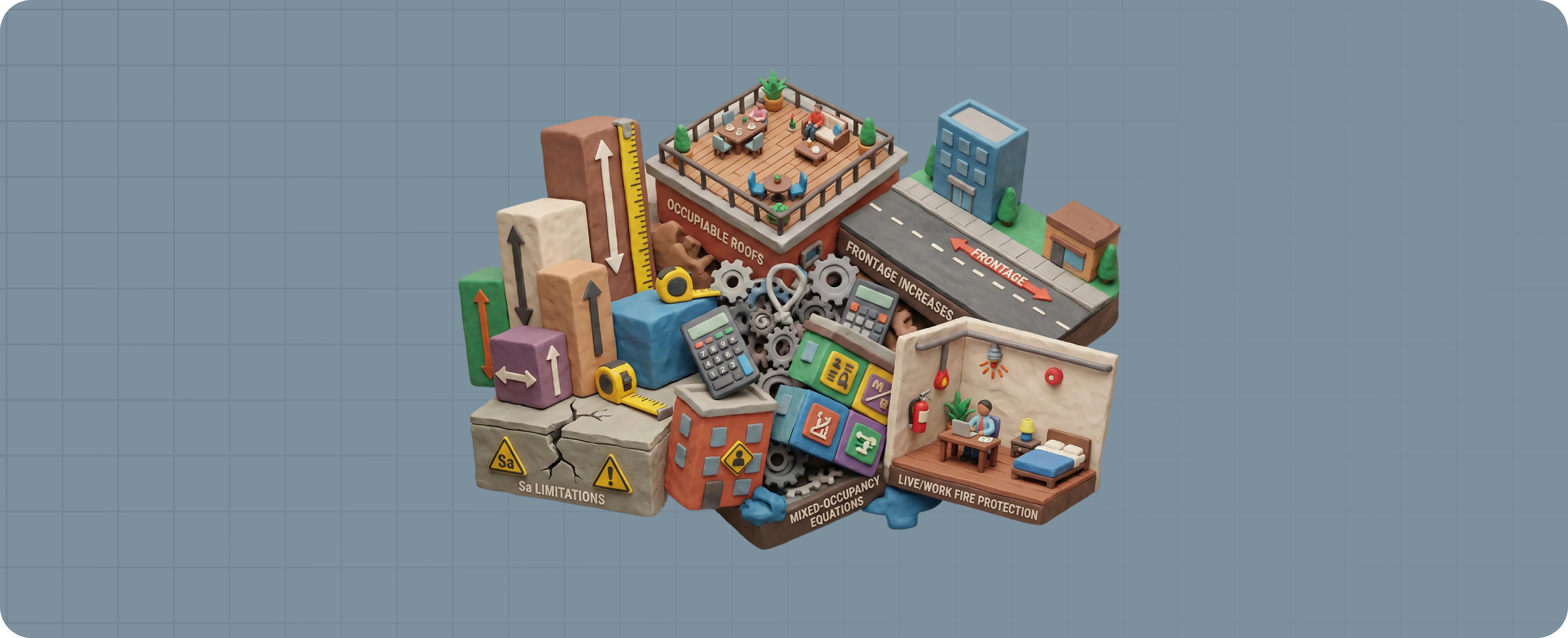
Chapter 5 contains some of the most consequential changes for architects and code consultants, particularly around:
1. California’s Restriction on the Allowable Area Equation (Sa)
- CA removes the Sa = 4 multiplier entirely.
- Sa is capped at:
- Sa = 2 for Groups A, E, H, I, L, R
- Sa = 3 for all others
This dramatically affects allowable areas for many project types.
2. Group I-2 height limitations tightened
- Group I-2 is no longer permitted in Types IIIB and VB at any height.
3. Occupiable roofs - reorganized with new exceptions
Especially the new exception for roofs ≥75 feet above fire department access.
4. Mixed-occupancy area calculation rule (Equation 5-3) lowered
- Applied to buildings >2 stories instead of >3 stories.
5. Frontage increase rules clarified
New limitations on what qualifies as a 30’ open space for frontage.
6. Live/Work units receive updated sprinkler and alarm requirements
These changes influence early feasibility studies and schematic design layouts more than almost any other chapter.
Full Detailed Table Of All Changes - Chapter 5
| Section | Topic | Description of Change | Impact |
|---|---|---|---|
| 503.1.4 | Occupiable Roofs | Section reorganized; adds new exception: enclosure elements over occupiable roofs allowed if roof deck is >75 ft above fire department access. | Allows more design freedom for rooftop amenities on tall buildings. |
| Table 504.3 | Allowable Heights | Group I-2 removed from Types IIIB & VB. Previously: 55’ & 40’. | Limits hospital/medical facilities to more fire-resistive construction types. |
| 506.2.1 | Single-Occupancy Buildings | Equation 5-2 notes revised: Sa = 2 max for State Fire Marshal; removes Sa = 4 for NFPA 13R buildings. | Reduces allowable building areas statewide. |
| 506.2.2 | Mixed-Occupancy Buildings | Equation 5-3 now applies to buildings >2 stories (previously >3). | More mixed-use buildings must use reduced allowable area calculations. |
| 506.3.3.1 | §507 Buildings - Frontage | Frontage increase now limited to smallest public way or open space ≥30 ft; table column changed to “55 or greater.” | Stricter frontage calculations reduce allowable size for many large sites. |
| 507.3 | Non-sprinklered One-Story Buildings | Clarifies this applies to any construction type. | Eliminates ambiguity; confirms wide applicability. |
| 508.2.4 Exception 4 | Occupancy Separation | Exception removed (previously allowed no separation between certain B/E/R-1 and S-2 accessory to I-3). | More separations required in mixed-institutional buildings. |
| 508.3.3 | Nonseparated Occupancies | Removes exception: “Separation required between Group I-3 and vehicle sallyports.” | Coordination with Ch. 4 (new sallyport section). |
| 508.4.4.1 | Separated Occupancies | Adds exception: thermal barrier not required at top of horizontal assemblies serving as occupancy separations. | Cost savings; simpler assemblies. |
| 508.5 | Live/Work Units | Requirements reorganized for clarity; no content change. | Easier interpretation. |
| 508.5.7 | Fire Protection (Live/Work) | Updates: NFPA 13 or 13R sprinklers; smoke alarms per 907.2.11; manual fire alarm per 907.2.9.2; CRC buildings follow CRC rules. | Clarifies life safety for mixed residential/commercial units. |
| Table 509.1 | Incidental Uses | Adds option for 1-hr construction + sprinklers for several I-2/I-3 locations. | Increased flexibility for hospitals/prisons. |
| 509.4.1.1 | Mass Timber, IV-B & IV-C | Removes thermal barrier requirement on top of horizontal assemblies serving incidental use separations. | Makes IV-B/IV-C more competitive and cost-effective. |
| 510.2 | Horizontal Separation | Clarifies wording for horizontal assemblies containing vertical offsets. | Essential for podium & multi-level offset designs. |
Expert Commentary - Chapter 5
1. The Sa restrictions are one of the biggest California-specific shifts in years
This reduces allowable building areas significantly - especially for:
- Schools (E)
- Assembly (A)
- Hospitals (I-2)
- Apartment buildings (R)
Design teams operating from IBC assumptions must re-run allowable area studies.
2. Group I-2 height restriction
This is a critical update for healthcare projects and essentially eliminates Type V hospital expansions.
3. Mixed-occupancy Equation 5-3 change
Many mixed-use multifamily podium buildings 3 stories or fewer were previously exempt - not anymore.
4. Mass timber (IV-B / IV-C) keeps gaining usability
The removal of thermal barrier requirements reduces costs and thicknesses, and keeps California aligned with national tall mass timber trends.
FAQs
1. What is the most impactful change in Chapter 5 for architects and engineers?
The biggest shift is California’s new cap on the allowable area coefficient (Sa):
- Sa = 2 max for Groups A, E, H, I, L, R
- Sa = 3 for all other groups
California also removed the Sa = 4 multiplier entirely. This dramatically reduces allowable building areas and requires teams to redo all early massing studies, especially schools, apartments, and hospitals.
2. How do the new Sa limits affect feasibility studies?
Area calculations that previously worked under IBC or 2022 CBC assumptions may no longer comply. This directly impacts:
- Site test fits
- Podium/massing diagrams
- FAR studies
- Early design packages
In many project types, especially E, A, I-2, and R, allowable area may shrink by 30–50% depending on configuration.
3. What changed for Group I-2 (Hospitals/Medical Facilities)?
A major restriction: Group I-2 is no longer allowed in Types IIIB and VB, at any height.
This means:
- No more Type V hospital wings or expansions
- No Type IIIB medical towers
- More projects will be forced into Type IIA, IIB, or Type I construction
This aligns California with stricter healthcare safety performance expectations.
4. What’s new for occupiable roofs?
Section 503.1.4 was reorganized and now includes a key new exception:
Rooftop enclosures (stairs, elevators, etc.) are allowed above occupiable roofs if the roof deck is 75 ft or more above fire department access.
Translation: tall buildings get more freedom for rooftop amenities—pools, lounges, terraces—without violating height limitations.
5. How does the new mixed-occupancy Equation 5-3 rule change affect mixed-use buildings?
The threshold for applying Equation 5-3 dropped from >3 stories to >2 stories.
This means:
- Many 3-story mixed-use podium or multifamily-over-retail buildings must now use reduced allowable areas.
- Standard assumptions for 3-over-1 and 4-over-1 models may no longer pass without design adjustments.
6. What changed in frontage increase calculations?
Section 506.3.3.1 tightens what qualifies as usable open frontage:
- Only the smallest public way/open space counts
- Open space must be ≥30 ft in width
- Table column revised to “55 or greater”
This reduces allowable area for sites relying heavily on frontage.
7. What updates affect live/work units?
Live/work requirements were reorganized for clarity, and fire protection rules updated:
- Must use NFPA 13 or 13R sprinklers
- Smoke alarms per 907.2.11
- Manual fire alarm required per 907.2.9.2
- CRC buildings follow CRC fire protection rules
This clarifies a previously confusing mix of commercial/residential triggers.
8. How did mass timber buildings benefit in this cycle?
For Type IV-B and IV-C, the CBC removes the need for a thermal barrier on top of horizontal assemblies when used for incidental use separations.
This:
- Lowers costs
- Reduces assembly thickness
- Keeps CA aligned with national tall wood code adoption trends
9. What separation rule was removed for mixed institutional buildings?
Section 508.2.4 Exception 4—which previously allowed certain B/E/R-1 and S-2 spaces accessory to I-3 without separation—was deleted.
Now, more separation is required between institutional occupancies and accessory uses.
10. Do these changes make buildings safer or just more restrictive?
Both.
- Sa limits and I-2 height restrictions strengthen life safety.
- Occupiable roof rules and mass timber allowances increase design flexibility.
- Frontage and mixed-occupancy rules clarify long-standing ambiguities.
Overall, Chapter 5 is more precise, more restrictive in key risk categories, and more permissive in areas tied to modern building types (rooftops, mass timber).
References
What can you ask? (Sample questions)
- When does the 2025 CBC take effect and what editions does it adopt?
- What are the key California amendments to the IBC in CBC 2025?
- How do Title 24 energy requirements change in 2025?
- What accessibility changes are in Chapter 11B of CBC 2025?
Related Building Code Resources
- Building CodesWhat are the Key changes in Chapter 14 Exterior Walls of CBC 2025?
- Building CodesWhat are the Key changes in Chapter 11B Accessibility to Public Buildings & Public Housing of CBC 2025?
- Fire & Life SafetyWhat are the Key changes in Chapter 10 Means of Egress of CBC 2025?
- Fire & Life SafetyWhat are the key Changes in Chapter 9 Fire Protection Systems California Building Code 2025?
- Building CodesWhat are the key changes in Chapter 4 Special Detailed Requirements Based On Occupancy & Use of CBC 2025?
MeltPlan
A curated stream of preconstruction intelligence, estimating innovation, takeoff breakthroughs, workflow advancements, and expert perspectives—powered by the AI and technology shaping the future of construction.
Visit SiteDon't miss what's shaping AEC
The latest on preconstruction, codes, AEC news & trends — so you're always in the know.