What are the key Changes in Chapter 9 Fire Protection Systems California Building Code 2025?
Chapter 9 contains substantial additions and structural changes, especially around sprinklers, fire alarms, mass notification, lithium-ion battery hazards, hybr..
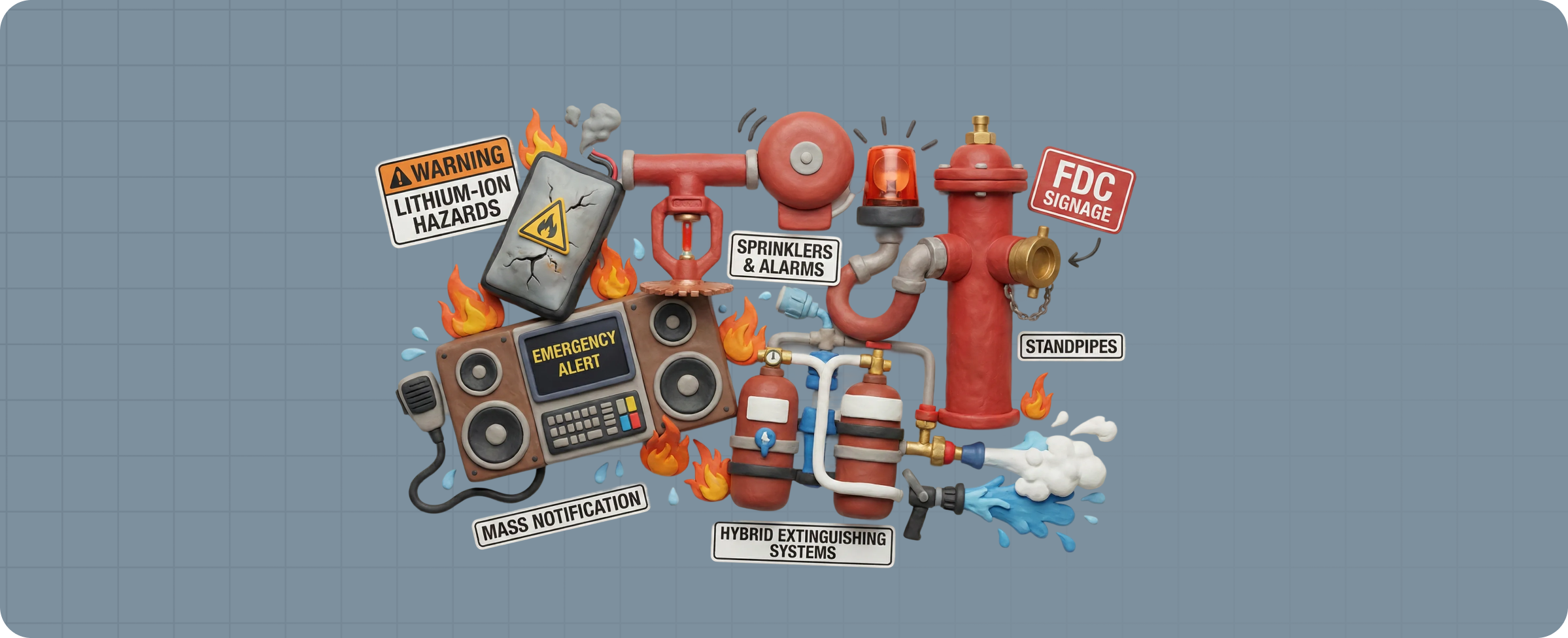
Chapter 9 contains substantial additions and structural changes, especially around sprinklers, fire alarms, mass notification, lithium-ion battery hazards, hybrid extinguishing systems, standpipes, and supervision requirements.
Major categories of changes include:
1. Lithium-Ion Batteries (biggest theme in Chapter 9)
New sprinkler triggers, fire test requirements, and alarm system requirements added for:
- Battery storage (S-1, M)
- Labs testing batteries (Group B)
- Manufacturing (Group F-1)
- Battery-powered vehicles (S-1 repair garages)
- ESS rooms
2. Sprinkler System Design & Supervision Changes
- NFPA 13R permitted in more R-2 buildings
- Removal of specific exemptions
- New sprinkler test-based design for Li-ion hazards
- New inspection requirements (not just test/maintenance)
3. Fire Alarm System Changes
- Major updates for Group A, Group B labs, lithium battery facilities
- New mass-notification risk analysis for large Group E buildings
- Relocation of amusement area alarm requirements
4. Standpipes
- New exceptions (e.g., townhouse exemption)
- New requirements for fixed-guideway transit systems
- Updated hose connection locations
5. FDC Signage
New prescriptive signage requirements added to CBC for the first time.
This is a highly consequential chapter for:
- MEP firms
- Fire protection engineers
- Battery storage designers
- Lab facilities
- Parking structure and EV garage designers
- Schools, hospitals, commercial mixed-use projects
General Fire Protection System Administration
| Section | Topic | Description | Impact |
|---|---|---|---|
| 901.6.2 | Integrated Testing | Entire section removed. | Reduces burdensome integrated test requirements where multiple systems interact (suppression + alarm). |
Automatic Sprinkler Requirements (903)
What can you ask? (Sample questions)
- When does the 2025 CBC take effect and what editions does it adopt?
- What are the key California amendments to the IBC in CBC 2025?
- How do Title 24 energy requirements change in 2025?
- What accessibility changes are in Chapter 11B of CBC 2025?
| Section | Topic | Description | Impact |
|---|---|---|---|
| 903.2 | Sprinkler Requirements | Exception revised to only exclude batteries not required to have sprinklers by CFC §1207. | Aligns CBC with new battery protections. |
| 903.2.2 | Group B | Formatting change to show ambulatory care as subsection. | No functional change. |
| 903.2.2.2 | Labs Testing Batteries | New sprinkler requirement for labs doing lithium-ion R&D. | Captures a rapidly growing building type. |
| 903.2.4 | Group F-1 | Sprinklers required if F-1 occupancy involves Li-ion battery manufacturing or equipment assembly. | Major change for EV manufacturing & robotics. |
| 903.2.7.3 | Li-ion Battery Storage (Group M) | New sprinkler trigger for rooms where required by CFC 320 or Chapter 32. | Retail battery storage areas now heavily regulated. |
| 903.2.9 | Group S-1 | New trigger for storage of Li-ion battery powered vehicles >500 sq ft. | Affects parking garages, EV fleets, dealerships. |
| 903.2.9.1 | Repair Garages | EV repair areas >500 sq ft require sprinklers. | Huge change: almost all EV repair shops must be sprinkled. |
| 903.3.1.1.1 | Exempt Locations | Eliminates exemption where sprinklers are “undesirable” due to contents. | Removes subjective loophole. |
| 903.3.1.1.3 | Li-ion Sprinkler Design | NEW: sprinkler design must be based on fire tests addressing the hazard. | Dramatic shift: custom engineering now required for battery hazards. |
| 903.3.1.2 | NFPA 13R | NFPA 13R allowed in R-2 with roof <45 ft above FD access. | Expands NFPA 13R applicability (cost savings). |
| 903.4.1 | Supervision | Expanded requirements for supervision of limited area sprinkler system valves. | Limits unmonitored sprinkler valves. |
| 903.4.3 | Alarms | Waterflow/supervisory alarms must be audible and visual. | Improves alarm visibility for the hearing impaired. |
| 903.5 | Inspection, Testing, Maintenance | Now explicitly requires inspection, not just testing and maintenance. | Aligns with NFPA 25. |
Special Hazards, Extinguishing Systems (904)
| Section | Topic | Description | Impact |
|---|---|---|---|
| 904.12 | Hybrid Fire Extinguishing Systems | New section referencing NFPA 770. | Supports new water-mist/gas hybrid systems. |
| 904.14 | Commercial Cooking | Complete rewrite; margin notations do not reflect extent. | Must fully re-review — cannot rely on 2022 CBC knowledge. |
Standpipes (905)
| Section | Description | Impact |
|---|---|---|
| 905.3 (Exception) | Townhouses exempt from standpipes. | Reduces unnecessary infrastructure in small R-use projects. |
| 905.3.4 | Removes stage standpipe requirement for stages >1,000 sf. | Impacts theaters & assembly venues. |
| 905.3.8 | Adds standpipe requirements for fixed-guideway transit, except open at-grade. | Expands standpipes to rail systems. |
| 905.4 | Connection location: in every interior or exterior exit stairway. | More consistent FDC planning. |
| 905.5.1 Group A-1 & A-2 | Hose connections only required at rear of auditorium & on balcony. | Targeted safety provision for assembly occupancies. |
Fire Extinguishers (906)
| Section | Description | Impact |
|---|---|---|
| Table 906.1 | Adds requirement for on-demand mobile fueling establishments. | Applies to fleet fueling, mobile EV chargers, etc. |
Fire Alarm & Detection Systems (907)
| Section | Topic | Description | Impact |
|---|---|---|---|
| 907.2.1 | Group A | Adds new exceptions for outdoor bleachers with PA systems and no enclosed areas. | Major relief for sports arenas, amphitheaters. |
| 907.2.2.2 | Labs | Requires detection system covering entire fire area; radiant energy–sensing or air-sampling allowed. | Significant for battery R&D labs. |
| 907.2.4.1 | Li-ion Manufacturing | New alarm requirements. | EV factories now require specialized fire detection. |
| 907.2.7.2 | Li-ion Storage | Alarm required for battery storage in Group M. | Reinforces battery hazards across all occupancies. |
| 907.10.2 | Additional Li-ion Storage Requirements | Special alarm installation triggers. | Supports CFC battery regulations. |
| 907.2.12.1–3 | Special Amusement Areas | Requirements relocated to §411. | Consolidates amusement area rules. |
| 907.5.2.1.3 | Smoke Alarms in I-1 | Must now be audible. | Benefits sleeping occupants. |
Smoke Control (909)
| Section | Description | Impact |
|---|---|---|
| 909.20.5.4 | Smoke Detection for Pressurized Stair/Vestibule – Fans must auto-shut when smoke is detected. | Ensures smoke control systems do not worsen conditions by pressurizing a smoke-filled space. |
| 909.21 | Elevator Hoistway Pressurization – Must consider interaction between multiple smoke control systems. | Prevents conflicting pressurization between hoistways, stairs, and vestibules; improves system reliability. |
Fire Department Connections (912)
| Section | Description | Impact |
|---|---|---|
| 912.5.1–912.5.3 | Signage | New mandatory FDC labeling requirements. |
Carbon Monoxide Detection (915)
| Section | Description | Impact |
|---|---|---|
| 915.1 | Moves CO detection rules from Ch. 4 to Ch. 9. | Properly categorizes CO detection under alarm systems. |
Mass Notification (917)
| Section | Description | Impact |
|---|---|---|
| 917.2 | Group E — Requires mass-notification risk analysis for schools over 500 occupants. If needed, install NFPA-72 mass communication system. | Ensures large schools have appropriate mass-notification capabilities. |
Expert Commentary — Why Chapter 9 Is One of the Biggest in the 2025 CBC
1. Lithium-Ion Batteries: The New “Sprinkler Trigger” Frontier
This is one of the largest CBC shifts in the last decade. The code now assumes:
- Li-ion = inherently high hazard
- Must be specially sprinkled
- Must be specially alarmed
- Must be specially designed based on tests
This affects:
- EV parking
- Battery retail
- ESS installations
- Labs
- Industrial manufacturing
- Postal centers and warehouses
2. NFPA 13R Expansion for R-2 < 45 ft Roof Height
This is extremely important for:
- Urban infill
- Podium mid-rise apartments
- Mixed-use residential
This change reduces construction cost significantly.
3. Mass Notification for Group E
School districts will now face:
- Mandatory risk assessments
- Potential installation of expensive systems
4. Revisions to Standpipe Requirements
Transit systems and EV garages will see changed standpipe requirements.
5. Hybrid Fire Extinguishing Systems
Opens the door for:
- Water-mist systems
- Mixed-media suppression for labs, battery rooms, server rooms
FAQs
1. What are the biggest overall changes in CBC 2025 Chapter 9?
CBC 2025 significantly expands fire protection rules in five areas:
- Lithium-ion battery hazards
- Automatic sprinkler triggers and design
- Fire alarm and mass-notification systems
- Standpipes and hose connection locations
- Hybrid extinguishing systems and FDC signage
This is one of the largest Chapter 9 rewrites in over a decade.
2. Why is lithium-ion battery protection such a dominant theme?
Because California is seeing rapid growth in EVs, energy storage, robotics, and battery-heavy retail. The code now treats Li-ion hazards as inherently high-risk, adding new triggers for sprinklers, fire alarms, detection systems, and test-based sprinkler design for battery fires.
3. What new sprinkler requirements affect battery-related spaces?
CBC 2025 adds sprinkler triggers for:
- Li-ion labs (B occupancy)
- Battery manufacturing (F-1)
- Battery retail/storage (M occupancy)
- EV repair areas (>500 sq ft)
- S-1 spaces storing battery-powered vehicles
Nearly every space handling Li-ion products must now be sprinkled.
4. How does the new fire test–based sprinkler design requirement work?
Section 903.3.1.1.3 now requires sprinkler design based on actual fire test data for lithium-ion battery hazards. This eliminates generic design curves and forces custom engineering or tested design methods.
5. Did CBC 2025 make it easier to use NFPA 13R?
Yes. R-2 buildings may use NFPA 13R if the roof is <45 ft above fire department access. This is a major cost savings for mid-rise multifamily and mixed-use projects.
6. What fire alarm updates should designers pay attention to?
Key changes include:
- New alarm requirements for battery labs, storage, and manufacturing
- Expanded detection rules (air-sampling, radiant detection allowed)
- A new mass-notification risk analysis for large Group E buildings
- Relocation of amusement area requirements to Section 411
These changes impact schools, labs, EV facilities, and assembly venues.
7. How do the mass-notification changes affect schools?
Group E buildings with >500 occupants must complete a risk analysis. If risks are present, the building must install an NFPA-72 compliant mass communication system. This will add cost and complexity for many new K–12 and higher ed projects.
8. What changed for standpipe requirements?
Major updates include:
- Townhouses are now exempt
- Fixed-guideway transit systems newly covered
- Hose connection locations clarified (stairways, balconies, auditorium rear)
These affect multifamily, transit agencies, and assembly occupancies.
9. What’s new about FDC signage?
CBC 2025 introduces the state’s first prescriptive FDC labeling requirements (Sections 912.5.1–912.5.3). Designers must now include specific, standardized signage—no more jurisdiction-by-jurisdiction guesswork.
10. What are hybrid fire extinguishing systems, and why are they now included?
Hybrid systems (referencing NFPA 770) combine water mist and gas to suppress hard-to-control fires. CBC now includes them because they’re increasingly used for:
- Battery rooms
- Labs
- Robotics
- Data rooms
This opens new pathways for non-traditional suppression systems.
11. Did the CBC change inspection and supervision requirements for sprinklers?
Yes. Changes include:
- Added requirement for inspection (not only testing/maintenance)
- Expanded supervision for limited-area sprinkler valves
- New audibility and visibility requirements for waterflow/supervisory alarms
These improve reliability and align CBC with NFPA 25.
12. How do the changes impact EV repair garages and parking structures?
CBC now requires:
- Sprinklers for EV repair areas >500 sq ft
- Sprinklers for S-1 spaces storing battery-powered vehicles
These changes will affect dealerships, municipal fleets, logistics companies, and large parking structures.
13. Who is most impacted by the 2025 fire protection changes?
The chapter heavily affects:
- MEP and fire protection engineers
- EV and battery facility designers
- Lab/R&D buildings
- Parking structures and mixed-use EV-enabled projects
- Schools and higher education
- Transit agencies
- Multifamily developers
14. Why did CBC remove the integrated testing section (901.6.2)?
Because the previous integrated testing rules were overly burdensome and unclear for typical facilities. Removing the section reduces unnecessary multi-system testing requirements unless specifically mandated elsewhere.
15. Will AHJs interpret these changes uniformly?
Unlikely. Lithium-ion, mass-notification, and hybrid systems are new territory for many jurisdictions. Expect:
- additional questions
- local amendments
- variable enforcement
This is a prime area where Melt Code can help reduce ambiguity.
References
More California Building Code Guides
- Building CodesWhat Are the Major Changes in the 2025 California Building Code Volume 2?
- Building CodesMajor changes in California Green Building Standards Code 2025 (CALGreen)
- Building CodesWhat Are the Major Changes in the 2025 California Building Code Volume 1?
- Building Codes2025 California Construction Code (Title 24) Changes and How to Prepare
- Permits & AmendmentsThe California Building Permit Process Explained: From Plan Check to Certificate of Occupancy
MeltPlan
A curated stream of preconstruction intelligence, estimating innovation, takeoff breakthroughs, workflow advancements, and expert perspectives—powered by the AI and technology shaping the future of construction.
Visit SiteDon't miss what's shaping AEC
The latest on preconstruction, codes, AEC news & trends — so you're always in the know.