What are the key Changes in Occupancy Classification & Use (Chapter 3, CBC 2025)?
Chapter 3 introduces major reclassifications in response to new risks associated with lithium-ion batteries, changes to childcare occupancy limits, residential ..
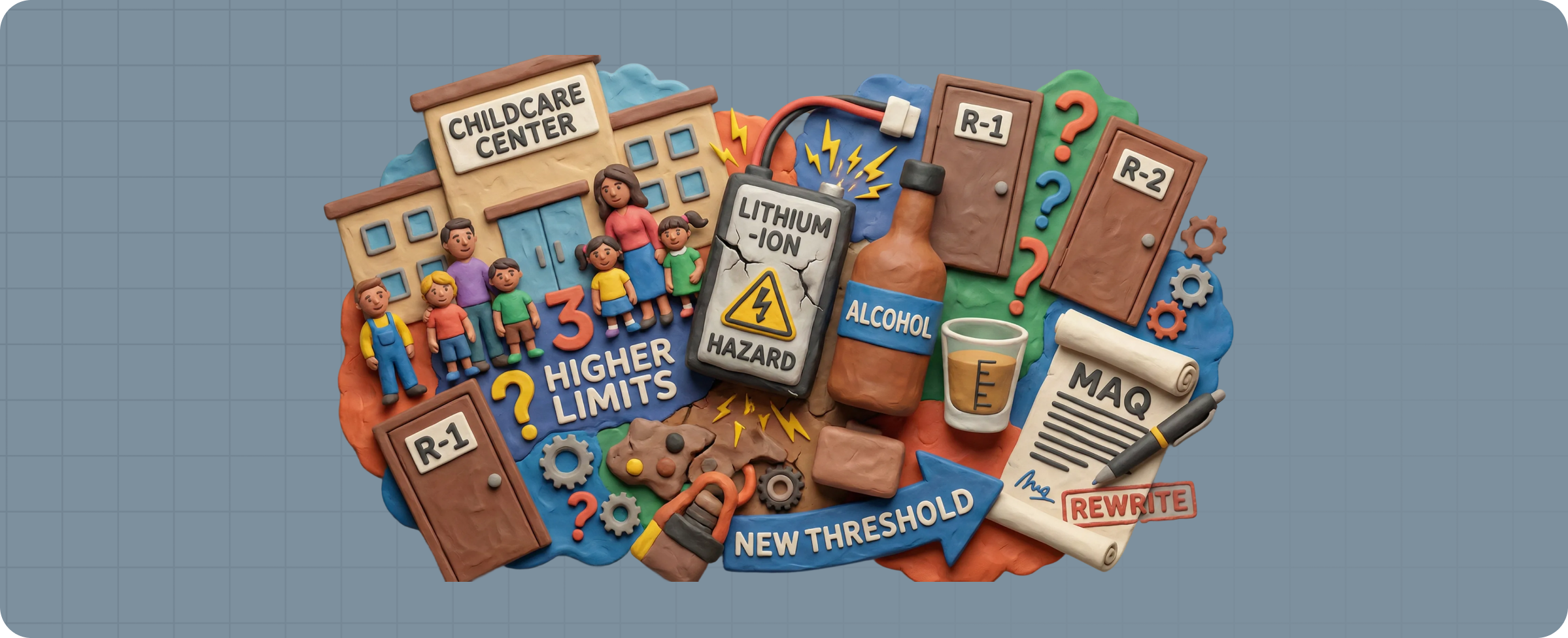
Chapter 3 introduces major reclassifications in response to new risks associated with lithium-ion batteries, changes to childcare occupancy limits, residential occupancy definitions, and expansions to storage and factory occupancies. These updates affect how buildings are classified, which in turn triggers fire protection requirements, allowable areas, egress rules, and separation requirements.
Top high-impact changes:
- Lithium-ion battery activities are now explicitly classified under Groups B, F, and S.
- Beverage alcohol thresholds raised from 16% to 20% for F, S, and storage groups.
- Group E childcare rules expanded for infants/toddlers.
- New clarity for R-1 and R-2 occupancies (transient dwellings and emergency service quarters).
- Group H rooftop storage replaces the previous “outdoor storage” terminology.
- Big update to MAQs for hazardous materials across Table 307.1(1) & (2).
Full Detailed Table Of All Changes - Chapter 3
| Section | Topic | Description of Change | Impact |
|---|---|---|---|
| 304.1 | Group B | Group B Ambulatory care facilities are no longer limited to 4+ patients. Adds “lithium-ion or lithium metal battery testing, research, and development.” | Expands when a facility falls under B instead of I-2; formalizes battery R&D as non-industrial occupancy. |
| 305.2 Exception | Group E Childcare | Removes limit of max. 5 infants in Group E childcare; now must comply with Sections 305.2.1–305.2.3 or 308.5.1. | Larger daycare centers with infants classified more consistently and safely. |
| 306.2 | Group F | Now includes beverages >20% alcohol; also includes ESS, lithium-ion batteries, and vehicles powered by Li-ion. | Expands F-1 industrial classification for battery-related manufacturing and testing. |
| 306.3 | Group F-2 | Beverages ≤20% alcohol now counted as low hazard. | Useful for breweries/cideries; lowers required protection. |
| 307.1 | Group H | Hazardous materials on roofs now termed rooftop storage (formerly “outdoor storage”). | Important for mixed-use roofs with battery equipment or fuel cells. |
| Tables 307.1(1) & (2) | MAQs | Large revisions to allowable quantities for hazardous materials. | May trigger more Group H classifications or require more control areas. |
| Table 307.1.1 | Hazardous Material Exemptions | Entirely new table. | Gives clear exemptions for micro-quantities used in labs, campuses, etc. |
| 307.3.1 | Explosives | Adds Division 1.4 explosives allowed in H-3 occupancies. | Expands storage flexibility with safeguards. |
| 308.5.1 | Group E Child Day Care | Adds model code section with CA amendments: daycare for >6 but ≤100 children under 36 months allowed at grade level with exterior exit doors. | Enables larger infant/toddler care centers with enhanced egress. |
| 310.2 | Group R-1 | Now includes buildings with 2+ dwelling units whose occupants are transient. | Many short-term rentals now fall under R-1. |
| 310.3 | Group R-2 | Adds emergency services living quarters to the category. | Impacts fire stations & emergency response housing. |
| 311.2 | Group S-1 | Adds moderate-hazard items: aerosol PA3, beverages >20% alcohol, Li-ion batteries, Li-ion vehicle repair garages. | Formalizes S-1 requirements for battery vehicles (EV repair shops). |
| 311.3 | Group S-2 | Low hazard list expanded to beverages ≤20% alcohol. | Storage classification alignment with new alcohol thresholds. |
Expert Commentary - Why These Changes Matter (Architects + Engineers)
1. Lithium-ion battery hazards now permeate OCC, F, and S groups
This is a big deal.
Battery R&D, manufacturing, storage, and even vehicles powered by lithium-ion batteries now trigger automatic Group B, F, or S occupancy classifications.
This cascades into:
- More sprinklers
- More fire barriers
- Larger fire area limitations
- New egress constraints
- New MAQs and control area layouts
2. Alcohol content bump (16% → 20%)
Impacts:
- Breweries
- Distilleries
- Retail storage
- Warehouses
This reduces regulatory burden for many beverage operations.
3. R-1 and R-2 clarifications
This directly affects:
- Hotels
- Short-term rentals
- Emergency service housing
- Student housing crossover conditions (handled later in Chapter 11B)
FAQs
1. What are the biggest occupancy classification changes in the 2025 CBC?
The largest changes involve lithium-ion battery hazards, expanded childcare rules, redefined alcohol thresholds for S and F occupancies, new rooftop hazardous material rules, and redefinitions for R-1/R-2 residential occupancies. These changes affect fire protection systems, egress, separation, and allowable area calculations.
2. How does the 2025 CBC classify lithium-ion battery activities?
Battery testing, research, development, storage, and even vehicle servicing now appear explicitly in Groups B, F, and S depending on use:
- B for battery R&D/testing
- F-1 for manufacturing or industrial processing
- S-1 for storage or EV repair garages
This removes ambiguity and increases fire/life-safety consistency.
3. Did the CBC change how alcohol content affects occupancy?
Yes. The threshold for beverage alcohol increases from 16% to 20% in F-1, F-2, S-1, and S-2 occupancies.
- ≤20% alcohol → low hazard (F-2 or S-2)
- >20% alcohol → moderate hazard (F-1 or S-1)
This shift reduces regulatory burden for breweries, cideries, small distilleries, and storage facilities.
4. How did Group E childcare rules change?
The 2025 CBC removes the old limit of “maximum 5 infants” in Group E daycares.
Instead, infant/toddler care must comply with Sections 305.2.1–305.2.3 or 308.5.1, allowing:
- Larger daycare centers with infants
- Group E childcare for infants/toddlers located at grade level
- Direct exterior exits
These changes support childcare expansion in California.
5. What is the new definition of Group R-1 transient occupancy?
Group R-1 now includes buildings with two or more dwelling units where occupants are transient, such as:
- Short-term rentals (Airbnb, VRBO)
- Boutique hotels
- Student lodging used less than 30 days
This may trigger sprinklers, alarms, corridor ratings, and egress upgrades.
6. What changed for Group R-2 in 2025 CBC?
Group R-2 now explicitly includes emergency services living quarters such as fire-station dormitories.This reduces ambiguity between institutional vs. residential classification and ensures consistent fire/life-safety protections.
7. How does the 2025 CBC handle rooftop hazardous materials?
The prior term “outdoor storage” is replaced by “rooftop storage.” Hazardous materials—including certain gases, flammable liquids, and battery systems—are now more accurately classified when placed on rooftops, affecting:
- Fire barrier requirements
- Fire department access
- Spill control
- Curbing & secondary containment
8. What changed in the Maximum Allowable Quantities (MAQs)?
Tables 307.1(1) and 307.1(2) were heavily revised.
Key updates include:
- New adjusted MAQs
- Clearer hazardous-material categories
- Revised sprinklers + control area triggers
- New exemptions via Table 307.1.1
This can push some occupancies into Group H more quickly—or offer relief through new exemptions.
9. Are EV repair garages specifically addressed in the 2025 CBC?
Yes. EV/LI-ion vehicle repair facilities are now explicitly included in Group S-1, along with new guidance on battery risks. This affects ventilation, sprinklers, and separation requirements.
10. How do these occupancy updates affect building design?
The changes significantly influence:
- Fire resistance ratings
- Separation walls
- Sprinkler thresholds
- Egress sizing
- Control area layouts
- Smoke detection & alarm systems
- Mechanical ventilation and hazardous exhaust
Architects and engineers must reassess occupancy decisions early in schematic design.
11. How do battery-related changes impact mixed-use buildings?
Battery rooms, storage spaces, and R&D labs may now fall into:
- Group B (testing, light R&D)
- Group F-1 (industrial processes)
- Group S-1 (storage or vehicle repair)
This can trigger:
- Fire barriers (1–3 hour)
- Dedicated exhaust systems
- Sprinklers
- Increased structural fire performance
12. What is the purpose of the new hazardous material exemptions table?
Table 307.1.1 clarifies when micro-quantities of hazardous materials are exempt from Group H classification—helpful for:
- University labs
- Small makerspaces
- Tech campuses
- Biotech startups
This creates a clearer pathway for low-hazard innovation spaces.
13. Do the Chapter 3 changes affect ADUs or small residential projects?
Indirectly, yes. Clarifications in R-1 and R-2 definitions impact:
- ADU classification next to transient units
- Mixed transient/permanent occupancy
- Small multifamily with short-term rental components
14. Are fire stations or emergency services buildings treated differently?
Yes.Emergency services living quarters are now explicitly Group R-2, not institutional. This simplifies design and avoids unintended triggers from I-group requirements.
15. Why is lithium-ion reclassification such a big deal?
Because lithium-ion battery hazards are causing:
- Thermal runaway events
- Intense fire loads
- Toxic gas emissions
- Explosive cell failures
The CBC now explicitly categorizes these activities into B, F-1, and S-1 to ensure appropriate safeguards (sprinklers, ventilation, fire-rated separation, etc.).
16. Do these changes increase construction cost?
In some cases, yes - especially for battery-related occupancies or changed MAQs.
But many changes reduce cost for:
- Breweries/cideries (≤20% alcohol)
- Daycares (clearer egress pathways)
- Micro labs (hazmat exemptions)
- Emergency services facilities (R-2 vs I-classification)
17. When should architects reevaluate occupancy classification under CBC 2025?
At concept design, before planning submittal.
Lithium-ion, daycare, short-term rental, and storage shifts can drastically alter:
- Sprinkler requirements
- Allowable areas
- Fire ratings
- Egress strategy
- HVAC/exhaust provisions
18. How do these changes affect mixed-use development?
Lithium-ion activities, revised beverage thresholds, and rooftop hazmat rules may require:
- Additional control areas
- New fire separations
- Rethinking tenant placements
- Rerouting egress or mechanical systems
19. Does CBC 2025 harmonize with NFPA or IFC?
Yes. Many lithium-ion and hazardous material updates align with:
- NFPA 855 (ESS)
- IFC battery provisions
- Updated MAQ logic
Improving consistency across fire/life-safety codes.
20. What should designers do first when applying CBC 2025 Chapter 3?
- Re-evaluate occupancy classifications at a system level (B, F, S, H).
- Recalculate MAQs.
- Map control areas early.
- Confirm separation & fire barrier requirements.
- Coordinate with mechanical/fire consultants before schematic design ends.
References
What can you ask? (Sample questions)
- When does the 2025 CBC take effect and what editions does it adopt?
- What are the key California amendments to the IBC in CBC 2025?
- How do Title 24 energy requirements change in 2025?
- What accessibility changes are in Chapter 11B of CBC 2025?
Related Building Code Resources
- Building CodesWhat are the Key changes in Chapter 14 Exterior Walls of CBC 2025?
- Building CodesWhat are the Key changes in Chapter 11B Accessibility to Public Buildings & Public Housing of CBC 2025?
- Fire & Life SafetyWhat are the Key changes in Chapter 10 Means of Egress of CBC 2025?
- Fire & Life SafetyWhat are the key Changes in Chapter 9 Fire Protection Systems California Building Code 2025?
- Building CodesWhat are the key changes in Chapter 5 General Building Heights & Areas of CBC 2025?
MeltPlan
A curated stream of preconstruction intelligence, estimating innovation, takeoff breakthroughs, workflow advancements, and expert perspectives—powered by the AI and technology shaping the future of construction.
Visit SiteDon't miss what's shaping AEC
The latest on preconstruction, codes, AEC news & trends — so you're always in the know.