How does ANSI A117.1 differ from ADA?
The ANSI A117.1 standard is the technical foundation for accessible design in the United States, but navigating its requirements can be complex. The standard it..

The ANSI A117.1 standard is the technical foundation for accessible design in the United States, but navigating its requirements can be complex. The standard itself is not a law; its authority comes from being adopted by building codes like the International Building Code (IBC). This adoption, however, is complicated by different versions (2009, 2017), state and local amendments, and its relationship to the federal Americans with Disabilities Act (ADA).
For design and construction professionals, understanding this hierarchy is critical for achieving compliance and avoiding costly errors.
Key Takeaways on ANSI A117.1:
- Law vs. Standard: The ADA is a federal civil rights law that mandates accessibility in public spaces. ANSI A117.1 is the technical standard that provides the detailed "how-to" specifications for dimensions and clearances. Building codes make the ANSI standard enforceable.
- Code Adoption is Key: ANSI A117.1 only becomes mandatory when a specific edition is referenced by the legally adopted building code in a given jurisdiction (e.g., the 2021 IBC references the 2017 ICC A117.1).
- Local Amendments Rule: When codes conflict, the most stringent and specific local requirement governs. A city ordinance requiring the 2017 ANSI A117.1 will override a state code that references the 2009 version.
- Applicability: The standard applies to new construction and alterations of most commercial and multi-family residential buildings. It generally does not apply to privately funded single-family homes unless a portion is used for commercial purposes.
| Aspect | Americans with Disabilities Act (ADA) | ANSI A117.1 Standard |
|---|---|---|
| Type | Federal Civil Rights Law | Technical Standard (Voluntary Consensus) |
| Enforced By | U.S. Department of Justice (DOJ) | Local Building Department / AHJ |
| Purpose | Prohibits discrimination based on disability. Sets scoping (what & how many) and technical rules. | Provides detailed technical specifications (how-to) for accessible elements. |
| Becomes Mandatory? | Is always federal law for applicable facilities. | Only when adopted by a state or local building code. |
Why the distinction between ANSI, ADA, and IBC matters?
For architects, engineers, and contractors, the distinction between the ADA, the IBC, and the ANSI A117.1 standard is not just academic - it's a fundamental aspect of project risk management and legal compliance. Misinterpreting which standard applies can lead to failed plan reviews, costly change orders during construction, denied certificates of occupancy, and potential legal action under the ADA.
This topic weaves through the entire project lifecycle:
- Schematic Design: Scoping requirements from the ADA and IBC Chapter 11 determine which building elements and spaces must be accessible.
- Design Development & Construction Documents: The detailed technical criteria from the referenced ANSI A117.1 standard dictate the precise dimensions for restroom layouts, door clearances, reach ranges, and ramp slopes.
- Permitting: Plan reviewers from the Authority Having Jurisdiction (AHJ) will check drawings for compliance with the locally adopted building code and its referenced version of ANSI A117.1.
- Construction & Inspection: Field inspectors verify that the as-built conditions match the code-compliant drawings, paying close attention to clearances and mounting heights.
A common pitfall is assuming that compliance with the building code's referenced ANSI A117.1 standard automatically satisfies the ADA. While there is significant overlap, the 2010 ADA Standards for Accessible Design is the legal benchmark. Where discrepancies exist, designers must typically meet the most stringent requirement from each.
My state has adopted the 2018 IBC which references the 2009 ICC A117.1, but my city has an amendment requiring compliance with the 2017 ANSI A117.1 for all new construction. Which standard takes precedence for determining multi-user restroom layouts and clearances?
The city amendment requiring compliance with the 2017 ANSI A117.1 takes precedence. In any code hierarchy, the most specific and stringent requirement adopted by the local jurisdiction governs the project.
The International Building Code (IBC) establishes a clear rule for resolving conflicts. IBC §102.4 states that where there is a conflict between a general requirement and a specific requirement, the specific requirement shall apply. Furthermore, where requirements conflict, the most restrictive provision - the one that ensures the highest degree of safety or accessibility - is the one that must be followed.
Here's the breakdown of the hierarchy in this scenario:
1. State Code: The state adopts the 2018 IBC. Chapter 11 (Accessibility) and Chapter 35 (Referenced Standards) of the 2018 IBC point to the ICC A117.1-2009 edition. This is the baseline requirement across the state.
2. Local Amendment: Your city, as the Authority Having Jurisdiction (AHJ), has enacted a legal ordinance to amend the state code. This amendment specifically replaces the 2009 reference with the newer 2017 ANSI A117.1 standard.
3. Precedence: This local amendment is a more specific and, in many cases, more restrictive requirement. Therefore, for your project located within that city's jurisdiction, you must design and detail all accessible features, including multi-user restroom layouts, according to the 2017 version of the standard.
For a plan reviewer or inspector in that city, the 2017 standard is the only legally enforceable technical document for accessibility.
What is the difference between the ADA and the ANSI A117.1 standard?
The ADA is the federal civil rights law that establishes the legal requirement for accessibility, while ANSI A117.1 is the private, consensus-based technical standard that provides the detailed specifications on how to achieve it. Think of the ADA as the "what and where" and ANSI A117.1 as the "how-to manual."
The Americans with Disabilities Act (ADA)
- It's the Law: The ADA is a federal law passed in 1990 that prohibits discrimination against individuals with disabilities. It is enforced by the U.S. Department of Justice.
- It Sets Scoping: The ADA's design requirements, found in the 2010 ADA Standards for Accessible Design, define the scope of compliance - for example, which entrances must be accessible, how many accessible parking spaces are required, and where accessible routes are needed.
- It Has Technical Rules: The 2010 ADA Standards also contain technical requirements for dimensions and clearances. These were largely harmonized with the 2003 edition of the ANSI A117.1 standard.
The ANSI A117.1 Standard (also known as ICC A117.1)
- It's a Technical Standard: Developed by the International Code Council (ICC) through the American National Standards Institute (ANSI) process, this document provides the granular details for designing accessible elements.
- It Becomes Code by Reference: On its own, ANSI A117.1 is a voluntary standard. It becomes a mandatory, legal requirement only when a building code, such as the IBC, adopts a specific edition by reference (e.g., IBC 2021 §1101.2).
- It's Enforced Locally: When part of the adopted building code, compliance with ANSI A117.1 is verified by the local building official or plan reviewer as part of the permitting and inspection process.
A project must comply with both the locally adopted building code (which references ANSI A117.1) and the federal ADA. If there is a difference between the two, the provision that provides greater accessibility must be followed.
Is the ANSI A117.1 code mandatory for all buildings?
What can you ask? (Sample questions)
- How does ANSI A117.1 differ from ADA requirements?
- What accessible route slope maximums apply under IBC?
- When are accessibility upgrades triggered in renovations?
- What door maneuvering clearances does ANSI A117.1 require?
No, ANSI A117.1 is not mandatory for all buildings. Its applicability is determined by the scoping provisions within the adopted building code, which generally limit its requirements to public accommodations, commercial facilities, and certain types of residential buildings.
The standard becomes a mandatory requirement when adopted by a jurisdiction's building code. The International Building Code (IBC), in Chapter 11 (Accessibility), mandates its use for most new construction and alterations.
ANSI A117.1 typically applies to:
- Public and Commercial Buildings: Nearly all buildings classified under occupancies like Assembly (Group A), Business (Group B), Educational (Group E), Mercantile (Group M), and others where the public is served.
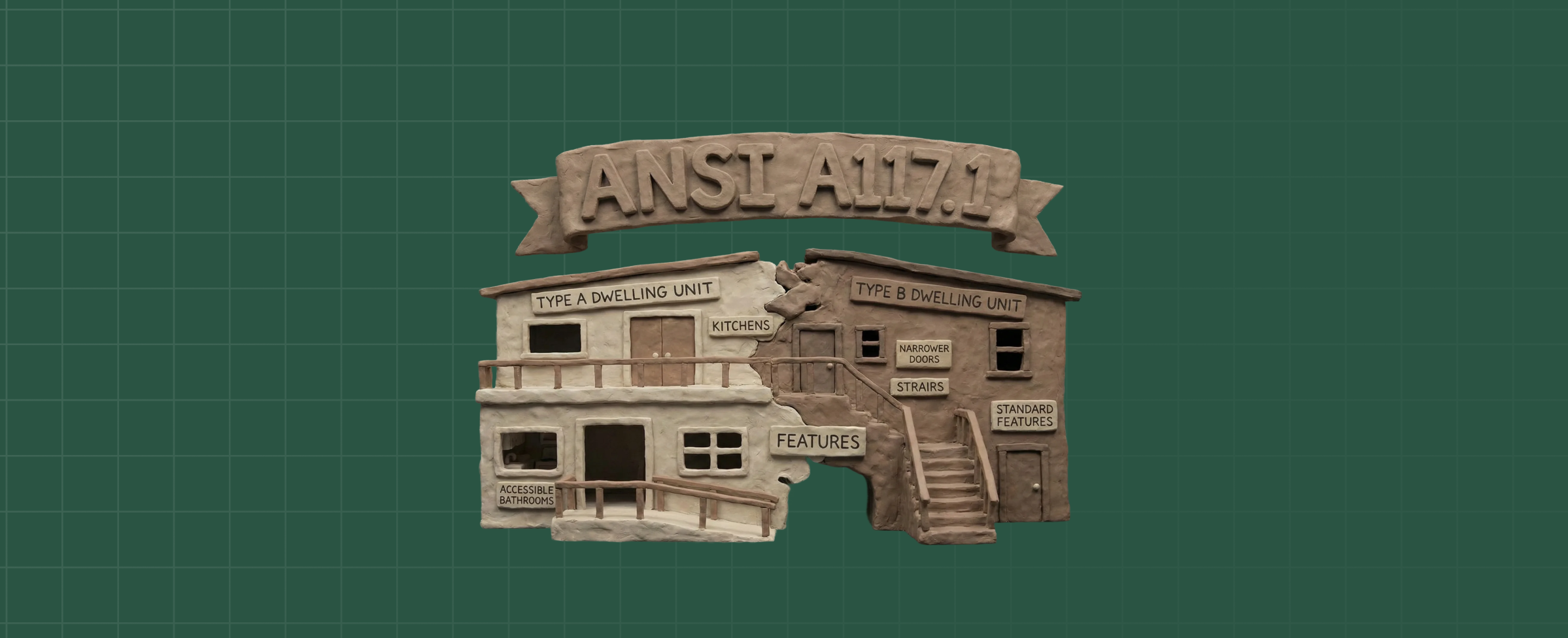
- Multi-Family Residential Buildings: Apartment buildings and condominiums (Group R-2) are required to have a certain percentage of Type A and Type B accessible dwelling units, the technical requirements for which are detailed in ANSI A117.1 Chapter 10.
- Government Facilities: Buildings owned or operated by state and local governments.
ANSI A117.1 generally does NOT apply to:
- Private Single-Family Homes: One- and two-family dwellings built with private funds and for private use are governed by the International Residential Code (IRC), which does not contain mandatory accessibility provisions.
- Specific Exemptions: The IBC lists certain exceptions, such as private garages, limited-use spaces accessible only by ladders or catwalks, and some structures with limited occupant loads (IBC §1103).
Which version of the ANSI standard applies to my project, the 2009 or the 2017 edition?
The applicable version of ANSI A117.1 is the specific edition that is referenced by the building code legally adopted by your project's Authority Having Jurisdiction (AHJ). You must always verify the state code and any local amendments.
Different versions of the International Building Code (IBC) reference different editions of the standard. This creates a direct link between the code cycle in effect and the accessibility standard you must use.
| Model Building Code | Referenced Accessibility Standard |
|---|---|
| IBC 2009, 2012, 2015, 2018 | ICC A117.1-2009 |
| IBC 2021, 2024 | ICC A117.1-2017 |
To determine the correct version for your project, follow these steps:
1. Identify the Jurisdiction: Pinpoint the city, county, and state where the project is located.
2. Find the State Code: Determine which version of the IBC or which specific state code (e.g., Florida Building Code, California Building Code) is currently in effect.
3. Check Referenced Standards: Look in the state code's Accessibility chapter (usually Chapter 11) and its Referenced Standards chapter (usually Chapter 35) to find the exact edition of ANSI/ICC A117.1 cited.
4. Verify Local Amendments: This is the most critical step. Contact the local city or county building department, or review their municipal code online, to see if they have adopted a different or newer version of the standard than what is in the state code.
Never assume the version referenced by the model IBC is the one in effect. Always verify locally.
Does my single-family home renovation need to comply with ANSI A117.1?
Generally, no. A renovation to a privately owned and funded single-family home does not need to comply with ANSI A117.1. These projects are typically governed by the International Residential Code (IRC), which does not include mandatory accessibility requirements.
However, there are important exceptions where accessibility standards would apply to a single-family home:
- Public or Commercial Use: If a portion of the home is used as a place of public accommodation - such as a home-based business, a medical office, or a daycare facility - that specific area must comply with the accessibility requirements of the locally adopted building code (IBC and ANSI A117.1) and the federal ADA.
- Government Funding: If the renovation is funded in whole or in part by a federal, state, or local government agency, it may be subject to accessibility standards like the Uniform Federal Accessibility Standards (UFAS) or Section 504 of the Rehabilitation Act.
- Voluntary Adoption: A homeowner may choose to renovate their home using ANSI A117.1 as a best-practice guide for universal design or aging-in-place, even if not required by code. This is a common practice for creating more usable and future-proofed living spaces.
What does 'clear floor space' mean in the ANSI standard?
In the ANSI A117.1 standard, 'clear floor space' refers to the minimum unobstructed area required to accommodate a single stationary wheelchair. This space is the fundamental building block of accessible design, ensuring a person using a wheelchair can approach and use building elements like sinks, doors, and drinking fountains.
As defined in ANSI A117.1-2017 Section 305, clear floor space has several key characteristics:
- Dimensions: The minimum size is 30 inches wide by 48 inches long (§305.3).
- Surface: The surface must be stable, firm, and slip-resistant, and free of level changes (§302).
- Slope: The slope of the clear floor space cannot exceed 1:48 (a 2.08% slope) in any direction (§305.4).
- Positioning: It can be oriented for either a forward approach or a parallel approach to an element.
- Unobstructed: This space must be kept clear of any obstructions, including door swings (in most cases), furniture, or stored items. While clear floor spaces for adjacent fixtures cannot overlap, ANSI A117.1-2017 §305.2 clarifies that turning space and clear floor space are permitted to overlap.
When this space is located under an element like a counter, additional knee and toe clearance must be provided as specified in ANSI A117.1-2017 Section 306.
What are the reach range limits in the 2017 ANSI A117.1?
The 2017 ANSI A117.1 standard sets specific vertical limits for operable parts - such as light switches, electrical outlets, thermostats, and hardware - to ensure they are within reach of a person using a wheelchair. These limits vary based on whether the person is approaching from the front or the side and whether an obstruction is present.
The primary requirements are detailed in ANSI A117.1-2017 Section 308 (Reach Ranges) and Section 309 (Operable Parts).
| Reach Type & Condition | Max Height | Min Height | Max Obstruction Depth | ANSI Section |
|---|---|---|---|---|
| Unobstructed Forward Reach | 48 inches | 15 inches | N/A | §308.2.1 |
| Obstructed High Forward Reach | 48 inches | N/A | 20 inches | §308.2.2 |
| Deep Obstructed High Forward Reach | 44 inches | N/A | >20 inches to 25 inches | §308.2.2 |
| Unobstructed Side Reach | 48 inches | 15 inches | N/A | §308.3.1 |
| Obstructed High Side Reach | 48 inches | 15 inches | 10 inches | §308.3.2 |
| Deep Obstructed High Side Reach | 46 inches | 15 inches | >10 inches to 24 inches | §308.3.2 |
The general rule of thumb for most common elements like light switches is a maximum height of 48 inches above the finished floor. Careful coordination between architectural drawings and electrical plans is essential to ensure all operable parts are mounted within these compliant ranges.
Common Mistakes and Coordination Pitfalls
Even experienced professionals can make mistakes when applying accessibility standards. Here are some common pitfalls to watch for:
- Overlapping Clearances: A frequent error is assuming the required clear floor spaces for adjacent fixtures (e.g., a toilet and a sink) can overlap. ANSI A117.1 §305.2 explicitly prohibits this unless specifically allowed by another provision. Each fixture must have its own dedicated, unobstructed clear floor space.
- Door Swings into Fixture Clearances: In small restrooms, designers often allow the door to swing into the required clear floor space of a fixture. This is only permitted if the room provides a clear 60-inch diameter or T-shaped turning space outside of the arc of the door swing.
- Ignoring Protruding Objects: Objects mounted on walls with leading edges between 27 and 80 inches above the floor cannot protrude more than 4 inches into the path of travel. This is a common issue with wall sconces, fire extinguishers, and some drinking fountains.
- MEP Coordination Failures: During construction, electricians or plumbers may install devices based on habit rather than the specific dimensions on the drawings. Thermostats, outlets, and alarm pulls are often installed above the 48-inch maximum reach range, leading to a failed inspection. Diligent site observation is crucial.
Jurisdictional Variations: Beyond the Model Codes
The United States has a "patchwork" of code adoption, and relying solely on the model IBC and ANSI A117.1 is not enough. Several states and major cities have their own accessibility codes that add, amend, or replace the model code requirements.
- California (CBC): The California Building Code includes Chapter 11A (for housing) and Chapter 11B (for public buildings), which are often more stringent than the ADA and IBC. Designers in California must be experts in the CBC's unique requirements for signage, restrooms, and site accessibility.
- Texas (TAS): The Texas Accessibility Standards (TAS) are a state law administered by the Texas Department of Licensing and Regulation. Many projects require a separate TAS plan review and inspection in addition to the local building permit process.
- Florida (FBC): The Florida Building Code adopts the IBC but contains a heavily amended Chapter 11 (Florida Building Code, Accessibility) with specific requirements that must be followed.
The golden rule is to always start a project by confirming the exact codes and standards in force with the local Authority Having Jurisdiction.
Frequently Asked Questions (FAQ)
What is the difference between ICC A117.1 and ANSI A117.1?
They are the same standard. The International Code Council (ICC) is the secretariat that develops the standard through the American National Standards Institute (
References
- ICC A117.1–2017: Accessible and Usable Buildings and Facilities (Official Standard – Online Viewing): https://codes.iccsafe.org/content/icca117-12017/american-national-standard
- 2021 International Building Code (IBC), Chapter 11 – Accessibility: https://codes.iccsafe.org/content/IBC2021P1/chapter-11-accessibility
- 2010 ADA Standards for Accessible Design (Official DOJ Publication): https://www.ada.gov/2010ADAstandards_index.htm
- ANSI Overview: ICC/ANSI A117.1 – Technical Standard for Accessible & Usable Building: https://blog.ansi.org/ansi/icc-ansi-a117-1-2017-accessible-buildings/
- Fair Housing Act Design Manual – Safe Harbor Guidance for Accessibility: https://www.hud.gov/program_offices/fair_housing_equal_opp/disabilities/fh_guidelines
Related Building Code Resources
- Permits & AmendmentsNavigating North Dakota Building Permits & Local Code Amendments
- Energy Code (IECC)North Dakota Energy & MEP Codes: A Compliance Guide for IECC, NEC, IMC & IPC
- Building CodesND Code for Existing Buildings: Ag Exemptions, Renovations, Pole Barns & Tiny Homes
- Fire & Life SafetyNorth Dakota Residential Code: Key IRC Requirements for Decks, Egress, Garages & Railings
- Structural DesignNorth Dakota Structural Design: Code Requirements for Snow Loads, Frost Depth & Wind
MeltPlan
A curated stream of preconstruction intelligence, estimating innovation, takeoff breakthroughs, workflow advancements, and expert perspectives—powered by the AI and technology shaping the future of construction.
Visit SiteDon't miss what's shaping AEC
The latest on preconstruction, codes, AEC news & trends — so you're always in the know.