Qualification Borrowing in Construction Bidding: Risks for General Contractors and Subcontractors
Qualification borrowing happens when an award decision leans on a subcontractor's past reputation, an old prequalification file, or capacity already committed e..

Key Takeaways
Qualification borrowing happens when an award decision leans on a subcontractor's past reputation, an old prequalification file, or capacity already committed elsewhere, instead of verifying current, project-specific capability. It's rarely a single bad decision; it's a pattern of treating qualification as settled once, rather than confirmed for this project, right now.
The failures are expensive and well documented. Industry case studies describe rework costs reaching 240% and 167% of the original subcontract value after a subcontractor's real capacity didn't match what an outdated or incomplete qualification picture suggested.
Aggregate capacity is a common, specific blind spot. A subcontractor can be genuinely qualified for a single project and still be overextended the moment a second concurrent project draws on the same bonding, workforce, and financial capacity.
In one documented case, warning signs were identified during prequalification in over a third of eventual subcontractor defaults — the data existed; it just wasn't acted on before award.
Prequalification is not a one-time gate. Industry risk consultants increasingly frame it as continuous qualification — refreshing financial, workforce, and capacity data throughout a relationship, with a common industry benchmark of requalifying active subcontractors every six months to a year.
Implementing continuous qualification takes specific process changes, not just intent — assigning ownership, building requirements into bid documents upfront, and calibrating the process so red flags actually reach the people making award decisions.
The risk runs both directions. GCs who skip reverification expose themselves to default, rework, and schedule loss. Subcontractors who let a strong reputation substitute for current, verifiable capacity carry real reputational and financial risk of their own when a project goes wrong under their name.
What Is Qualification Borrowing in Construction Bidding?
Qualification borrowing describes an award decision, by a GC evaluating subcontractors, or by an owner evaluating a GC, that relies on qualification information which is stale, incomplete, or already committed elsewhere, rather than on capacity verified for the specific project at hand. It's not a formally standardized industry term with one fixed definition; it's a pattern that shows up consistently across construction risk literature, described in slightly different language each time: prequalification treated as "one and done," award decisions made on relationship and reputation rather than current data, or bonding and workforce capacity assumed to be available when it's actually already stretched across other active work.
The common thread across all of these is timing. The qualification information being relied on was true once, at a past project, at an earlier point in the relationship, before other work came in, but it's being borrowed against a current decision without being reconfirmed.
Why This Risk Is So Easy to Miss
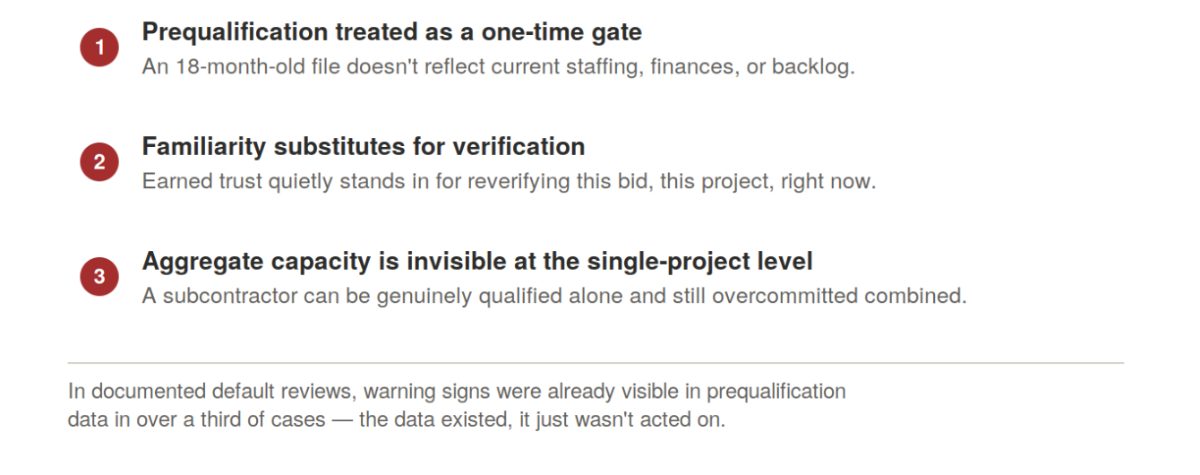
Three conditions make qualification borrowing common even at firms with a real prequalification process in place.
Prequalification gets treated as a one-time gate, not a continuous check. An 18-month-old prequalification file doesn't reflect a subcontractor's current staffing, financial position, or backlog, all of which can change meaningfully in that window, particularly during volatile labor or material markets. Industry risk consultants increasingly describe this as the difference between prequalification and continuous qualification: a mindset that treats subcontractor risk as something to keep current, not something confirmed once and filed away.
Familiarity substitutes for verification. A subcontractor a GC has worked with successfully before carries real, earned trust, but that trust can quietly stand in for reverifying whether this specific bid, on this specific project, at this specific time, still reflects that subcontractor's actual capacity. Documented case reviews of subcontractor defaults have found that warning signs were often already visible in the prequalification data itself; in one review, in over a third of eventual defaults, but weren't acted on because the award decision leaned on price or relationship instead.
Aggregate capacity is invisible at the single-project level. A subcontractor can be genuinely well-qualified for a project when evaluated in isolation, and still be effectively overcommitted the moment a second concurrent project draws on the same bonding limits, the same supervisory staff, and the same financial cushion. Single-project prequalification review doesn't catch this on its own; it requires actively checking a subcontractor's current backlog and aggregate exposure across everything they're carrying at once, not just the project being bid.
What Qualification Borrowing Actually Costs
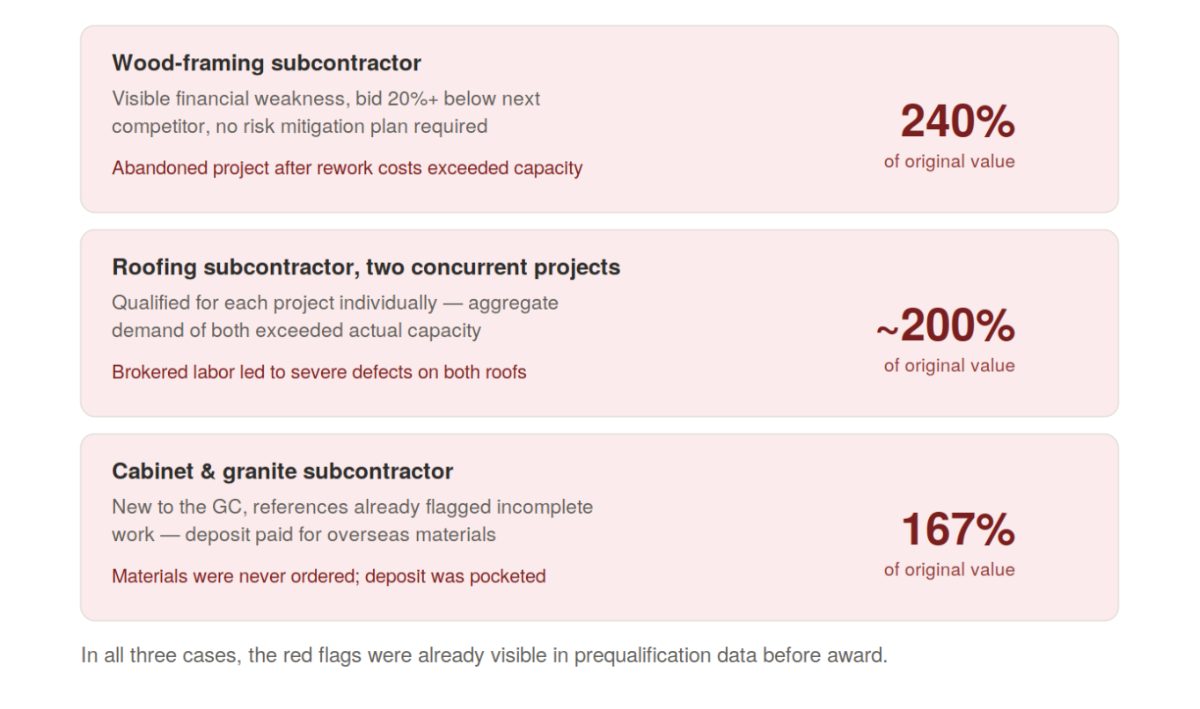
The financial impact shows up in documented case reviews, not just in theory. In one case, a wood-framing subcontractor with visible financial weakness and a bid over 20% below the next-lowest competitor was awarded a contract with no risk mitigation plan attached. Quality failures surfaced as other trades mobilized on top of the work; the subcontractor couldn't absorb the cost of rework and abandoned the project. The final cost to complete that scope reached 240% of the original subcontract value, meaning the "savings" from the low bid were not just erased but reversed several times over.
In a separate case, a GC awarded two concurrent projects to the same roofing subcontractor. Each project was within the subcontractor's capacity when evaluated individually, but the combined, aggregate demand of both at once exceeded what the GC's own prequalification analysis had calculated the subcontractor could actually carry. The subcontractor brought in brokered labor to cover the gap, and both roofs were installed with defects severe enough to require substantial tear-off and replacement, a default whose final cost was projected to double the original subcontract value.
A third case involved a subcontractor whose bid was significantly below the next competitor, who was new to the GC, and whose material supply chain ran through overseas sourcing requiring an upfront deposit. Reference checks, available before award, had already surfaced a history of incomplete work and documentation problems. The deposit was paid; the materials were never ordered. The cost to recover reached 167% of the original subcontract value.
None of these failures came from a lack of information. In each case, the data that would have flagged the risk existed before award, in financial statements, in reference checks, in aggregate capacity calculations. The failure was in acting on it.
The Risk for General Contractors
For a GC, qualification borrowing shows up as default risk that a documented prequalification process should have caught, but didn't get acted on before the award decision. The practical exposure includes:
Schedule loss when a subcontractor can't complete or has to be replaced mid-project, especially once other trades have already mobilized around their work.
Rework costs that routinely exceed the value of whatever savings drove the original award decision — the case studies above show rework reaching well over double the original subcontract value.
Aggregate exposure across a portfolio, not just a single job: a subcontractor overcommitted across several of a GC's own concurrent projects concentrates risk in a way that reviewing each project's bids independently won't surface.
Weakened leverage in a dispute, since a GC that had red-flag information in hand at award and didn't act on it has a harder position to argue from if a subcontractor default ends up in a claim or litigation.
The Risk for Subcontractors
Qualification borrowing isn't only a GC-side risk. Subcontractors carry real exposure too, particularly when their own reputation or past performance is being relied on as a substitute for a harder conversation about current capacity.
Reputational risk from stretched capacity. A subcontractor who accepts an award on multiple concurrent projects without flagging aggregate constraints is setting up a default that will affect their standing with every GC involved, not just the one where the failure surfaces first.
Financial exposure from underpriced, high-volume work. Winning on price while quietly overcommitted often means absorbing costs a healthier bid margin would have covered, the same dynamic that sank the wood-framing subcontractor in the case above.
Being excluded from future opportunities without a clear path back. A subcontractor that fails prequalification or defaults on a project may simply stop being invited to bid, without a clear explanation of what would need to change, a real cost even when it doesn't show up on a balance sheet.
The upside of being proactive. Subcontractors who keep their own qualification data current, before a GC even asks, and who are transparent about backlog and aggregate capacity when bidding concurrent work put themselves in a stronger position than those who let a strong track record go unverified.
How to Catch Qualification Borrowing Before Award
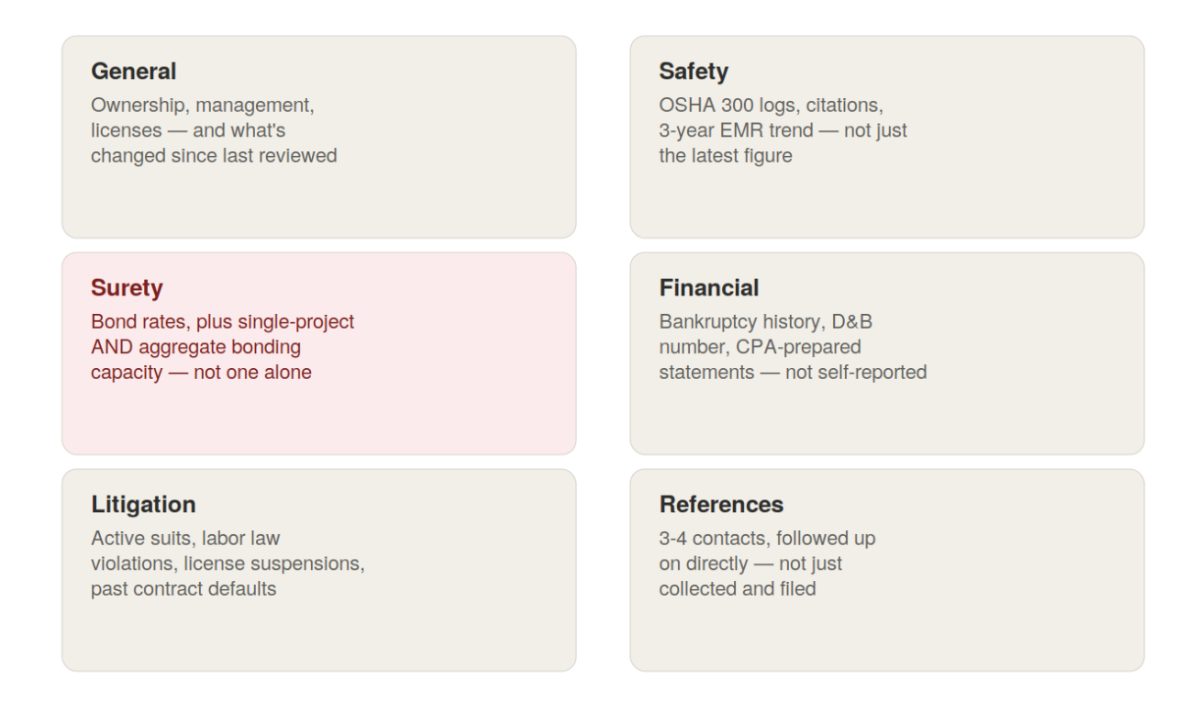
A genuine prequalification file covers several categories of information, each playing a specific role in catching qualification borrowing rather than just screening out clearly unqualified bidders:
General. Company ownership, current management, employee count, states where the firm holds active contractor licenses, and, importantly for verifying this is current, whether any of that has changed since the file was last reviewed.
Safety. OSHA 300 logs, any citations issued, and Experience Modification Rate (EMR) history over the past three years, not just the most recent figure; a rising EMR trend is a different risk signal than a stable one.
Surety. Current surety provider and agent contact, bond rates at relevant volumes, and, critically for catching aggregate overcommitment, both single-project and aggregate bonding capacity, not single-project capacity alone.
Financial. Bankruptcy history, a Dun & Bradstreet number if available, and financial statements ideally prepared by a CPA with construction industry experience; self-reported figures without independent preparation are worth less as a verification tool.
Litigation. Active litigation involving the company or its owners, labor law violations, license suspensions or revocations, and any history of contract default or termination.
References. Three to four contacts who can speak to quality, dependability, and creditworthiness, followed up on directly, not just collected and filed.
Confirm the prequalification file is current, not just on file. Financial position, workforce, and backlog can shift meaningfully in the time since a subcontractor was last reviewed; a common industry benchmark is requalifying active subcontractors every six months to a year, more frequently for subcontractors being considered for a new or larger scope than what was originally reviewed.
Check aggregate capacity across concurrent work, not just this project. Ask directly what else the subcontractor is currently carrying, and weigh single-project bonding and workforce capacity against everything else on their plate at the same time.
Treat a large bid spread as a question, not a win. A bid significantly below the next-closest competitor is worth understanding before it's worth celebrating — confirm the subcontractor has actually captured full scope and isn't bidding low out of financial pressure.
Follow up on red flags the prequalification process already surfaced. Weak financials, brokered labor, and negative references are all things a real prequalification process routinely catches; the failure point in the documented cases above wasn't missing data; it was not acting on data that was already in hand.
Put a risk mitigation plan in place when red flags can't be fully cleared. Additional supervision, more frequent inspections, joint checks, or bonded deposits are all more affordable, in the long run, than the rework and schedule cost of an unmanaged default.
Building Continuous Qualification Into the Process, Not Just the File
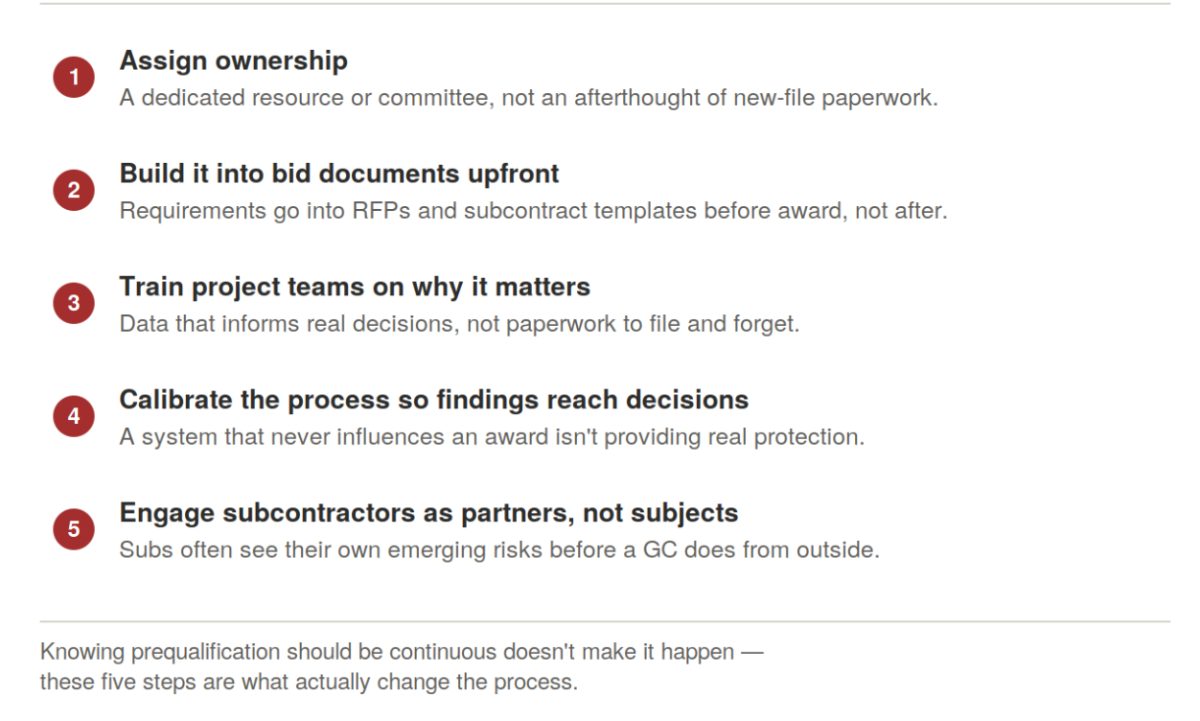
Knowing that prequalification should be continuous doesn't automatically make it happen; it requires specific process changes, not just good intentions.
Assign ownership. Continuous qualification doesn't happen without someone specifically responsible for it, a dedicated resource or committee whose job includes actively thinking about what's changing with key subcontractors, not just processing new-file paperwork.
Build it into bid documents upfront. Identify what qualification information is needed throughout the relationship, then build those requirements directly into RFPs, bidding documents, and subcontract templates, so subcontractors understand the expectation before they're ever awarded work, not after a problem surfaces.
Train project teams on why it matters, not just how to file it. A prequalification process only pays off if project teams understand that the data is meant to inform real award and risk-mitigation decisions, not paperwork to complete and set aside.
Calibrate the process so findings actually reach decisions. A well-built prequalification system that never influences an award or triggers a risk mitigation plan isn't providing the protection it was built for; build in a step that forces red flags in front of the people making the award call.
Engage subcontractors as part of the process, not just subjects of it. Subcontractors often have better visibility into their own emerging risks — supply chain exposure, workforce changes- than a GC does from the outside. Framing continuous qualification as a shared conversation, not a one-sided audit, tends to surface more accurate information.
Frequently Asked Questions
What is qualification borrowing in construction bidding?
It describes an award decision that relies on qualification information that's stale, incomplete, or already committed elsewhere, a subcontractor's past reputation, an old prequalification file, or bonding and workforce capacity already in use on other projects, rather than capacity verified for the specific project being bid.
Is qualification borrowing the same as prequalification fraud?
Not necessarily. Prequalification fraud typically involves a contractor deliberately misrepresenting their own qualifications. Qualification borrowing, as discussed here, more often describes an award decision-making failure, relying on real but outdated or overextended qualification information — though the two risks can compound each other.
How much can qualification borrowing actually cost a project?
Documented industry case reviews describe rework and default recovery costs reaching well over double the original subcontract value, 240% and 167% in two separate documented cases, after award decisions relied on outdated or unverified qualification data rather than current capacity checks.
What is aggregate capacity, and why does it matter here?
Aggregate capacity is a subcontractor's total bonding, workforce, and financial capacity across every project they're currently carrying, not just the one being bid. A subcontractor can be genuinely qualified for a single project in isolation and still be overcommitted the moment a second concurrent project draws on the same underlying capacity.
Should subcontractor prequalification be a one-time process?
No. Industry risk consultants increasingly recommend continuous subcontractor qualification, refreshing financial, workforce, and capacity information throughout a relationship rather than only before the first project awarded to a given subcontractor.
What should a GC do when prequalification data reveals a red flag?
Address it before award, not after. Options include requiring a formal risk mitigation plan (additional supervision, more frequent inspections, joint checks, bonded deposits), awarding a smaller portion of the work, or, where the risk is severe enough, not awarding the contract at all. Documented cases show the cost of ignoring a known red flag routinely exceeds the cost of managing it upfront.
How can subcontractors protect themselves from qualification-borrowing risk?
By keeping their own financial, workforce, and capacity data current and being transparent with GCs about concurrent project backlog before accepting an award that would push them past their real aggregate capacity, the same discipline that protects a GC also protects a subcontractor's own reputation and financial position.
Related Reading
How to Draw Plans for Permit of a Building: A Reference for Architects
What are the most common stair and handrail code violations?
What Are the Major Changes in the 2025 California Building Code Volume 1?
Related Building Code Resources
- Building CodesGo/No-Go Readiness Checklist for Construction Project Pursuit Decisions
- Building CodesBest Construction Document Control Software in 2026
- Building CodesBest Construction Estimating Software for Mac in 2026
- Building CodesAddenda in Construction: Definition, Purpose, and How to Manage Them
- Building CodesBest Construction CRM Software for Bid Tracking and Follow-Up for General Contractors
MeltPlan
A curated stream of preconstruction intelligence, estimating innovation, takeoff breakthroughs, workflow advancements, and expert perspectives—powered by the AI and technology shaping the future of construction.
Visit SiteDon't miss what's shaping AEC
The latest on preconstruction, codes, AEC news & trends — so you're always in the know.
.jpg?alt=media&token=252deada-6c2c-43e9-8559-da1381686c8e)