RFP in Construction Management: Meaning, Role, Process
A construction project that skips a structured RFP and picks a contractor on reputation alone often finds out the hard way that reputation doesn't cover schedul..
Contents
A construction project that skips a structured RFP and picks a contractor on reputation alone often finds out the hard way that reputation doesn't cover schedule risk, team fit, or a defensible paper trail. An RFP in construction management is the document that forces that evaluation to happen on paper, before the contract is signed, not after the first missed deadline.
Key Takeaways
An RFP in construction management refers to a formal, proposal-based selection process, not a simple price quote. An RFP (Request for Proposal) asks contractors, construction managers, or vendors to submit a full proposal covering qualifications, approach, team, schedule, and price - not just a number.
RFPs are not the same as RFQs, RFIs, or ITBs. Each serves a distinct role in construction procurement, and using the wrong one produces proposals that can't be fairly compared.
The role of an RFP in construction management goes beyond price. It puts contractor capability, methodology, and team composition on equal footing with cost, letting owners and CM firms select for best value rather than lowest bid.
RFPs govern more than GC selection. Owners use RFPs to hire construction management firms, GCs use them to solicit subcontractor proposals, and public agencies use them under formal procurement regulations like the Federal Acquisition Regulation.
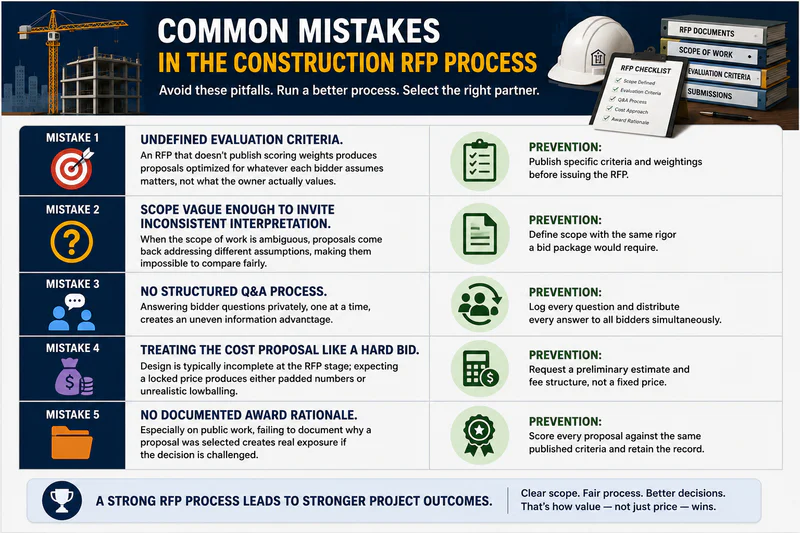
A weak RFP produces weak proposals. Vague scope, undefined evaluation criteria, and missing submission requirements are the most common reasons RFP responses come back impossible to compare.
What Is an RFP in Construction?
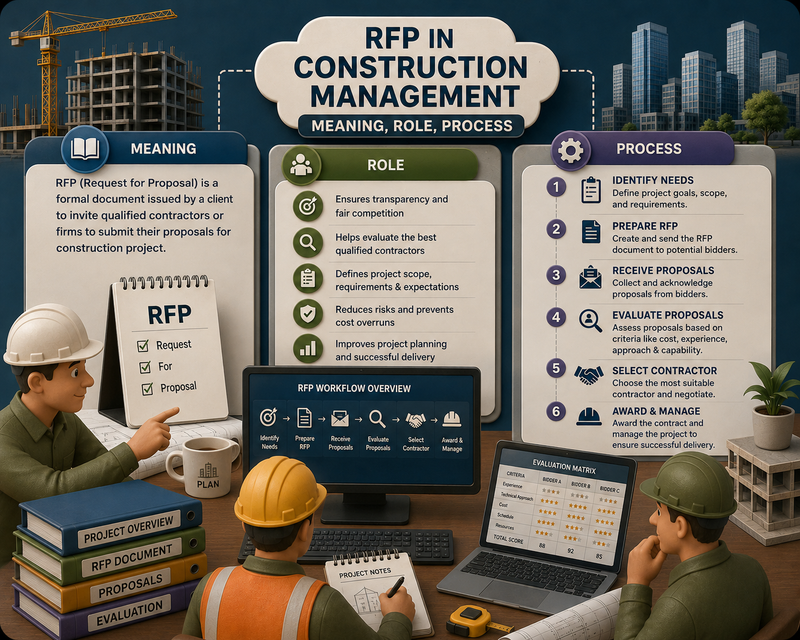
An RFP in construction is a formal document issued by a project owner, construction manager, or general contractor to solicit detailed proposals from potential contractors, subcontractors, or vendors for a specific project or scope of work.
In construction, an RFP centres on one idea: the requesting party wants more than a price. They want to understand who they're hiring, how that firm plans to execute the work, and what value the proposal delivers beyond the number on the bottom line.
RFP stands for Request for Proposal - the RFP full form in construction is identical to its meaning in every other industry that uses negotiated procurement. In construction, the acronym shows up across three main contexts: owners soliciting general contractors, GCs soliciting subcontractors, and public agencies soliciting construction management or design-build teams under formal procurement rules. A related but distinct use is the construction management software RFP, where a firm or agency solicits proposals from technology vendors rather than construction firms - covered later in this guide.
A construction RFP typically asks for a proposed methodology, a project team with named personnel, relevant past project experience, a proposed schedule approach, and a cost proposal - usually a preliminary estimate or fee structure rather than a locked hard-bid number. For a deeper breakdown of exactly what goes into a construction RFP and how the format changes between owner-to-GC and GC-to-subcontractor use cases, see our guide onwhat a construction RFP is and how it works.
RFP vs. RFQ vs. RFI vs. ITB in Construction
These four acronyms get used interchangeably in casual conversation, but each serves a distinct procurement function within construction management. Confusing them is one of the most common reasons construction procurement stalls, and it's also a frequent point of confusion for anyone new to reading a solicitation.
The RFQ vs RFP construction distinction matters most in practice, and it's the comparison people search for most often when trying to understand RFQ vs RFP in construction: an RFQ narrows a long list of firms to a qualified shortlist based on credentials alone. The RFP then goes only to that shortlist, asking for the full proposal - methodology, team, and cost - that the owner will actually score and compare.
An ITB is the simplest of the four. It assumes the scope is fully defined and asks contractors for one thing: a price. Owners use RFPs instead of ITBs when they need to evaluate more than price; contractor capability, proposed approach, and team quality all factor into the decision.
The Role of RFPs in Construction Management
The role of the RFP in construction management is best understood as a control point, not just a paperwork step. In construction management, the RFP shapes how a project gets staffed, priced, and executed before a single subcontract is signed. Its role touches four distinct parts of the management process, and getting any one wrong tends to surface much later-during execution, not during selection.
Delivery method alignment: RFPs are most common on negotiated, design-build, and Construction Manager at Risk (CMAR) delivery methods, where the owner wants to select a team based on capability, not just design-bid-build's lowest-price mechanic. The RFP format lets an owner evaluate a proposedGMP structure alongside the team that would deliver it.
Contractor and CM firm selection: The RFP is the primary vehicle for selecting a general contractor or construction management firm on any project complex enough that price alone isn't a reliable selection signal. Scored evaluation criteria - technical approach, team, past performance, cost - replace a single competitive number.
Risk allocation and scope definition: A well-structured RFP forces the owner to define scope, evaluation weighting, and contractual expectations before proposals come in. That upfront discipline is what prevents post-award disputes over what was actually included.
Procurement documentation and defensibility: On public projects, and increasingly on large private ones, the RFP process creates a documented, auditable record of how the selection was made. That record matters if a losing bidder challenges the award.
Who Uses Construction RFPs, and When
Three distinct relationships use the construction RFP process, each with a different emphasis.
Owner to general contractor or CM firm: This is the most visible use of an RFP in construction management. The owner defines the project, sets evaluation criteria, and solicits proposals from GCs or construction managers competing to lead the project.
General contractor to subcontractor: GCs issue RFPs to trade subcontractors when the scope is complex enough - speciality systems, design-assist trades, long-lead procurement - that price alone won't produce a defensible award. Our guide onhow GCs manage the subcontractor bid process from ITB to award covers where RFP-style evaluation fits alongside standard ITB pricing.
Public agency to contractor: Government agencies often use RFPs when procurement law requires a documented, competitive, negotiated process rather than sealed low-bid selection-particularly for design-build and CMAR work.
What's Inside a Construction RFP
A complete construction RFP generally includes the following sections, regardless of which of the three relationships above it serves.
Project overview and objectives. Scope, location, budget range, and the owner's project priorities.
Scope of work. What the selected firm will actually be responsible for delivering.
Delivery method and contract type. Whether the project will run design-bid-build, design-build, CMAR, or negotiated GMP.
Submission requirements. Format, page limits, required forms, and the proposal submission deadline.
Qualification requirements. Bonding capacity, insurance minimums, safety record, and relevant project experience.
Evaluation criteria and weighting. The scored factors - and their relative importance - that will determine the award.
Cost proposal format. What kind of pricing is expected: a preliminary estimate, a fee structure, or GC rates, not typically a locked hard bid.
Timeline. Key dates from RFP issuance through award, including any Q&A or clarification period.
Every requirement in the list above should serve the evaluation - a requirement that doesn't inform the selection decision just adds friction for bidders. Owners and GCs who want a ready-to-use starting point can pull from ourfree construction RFP template, which covers both the owner-to-GC and GC-to-subcontractor versions.
The Construction RFP Process, Step by Step
Every RFP in construction management follows a consistent sequence regardless of which relationship is issuing it - owner to GC, GC to subcontractor, or agency to CM firm.
1. RFP development and issuance. The issuing party drafts the RFP, defines evaluation criteria, and distributes it to a list of prequalified or invited firms.
2. Q&A and clarification period. Bidders submit questions about scope, terms, or ambiguities. The issuing party answers in writing, typically distributing responses to all bidders to keep the process fair.
3. Proposal preparation. Firms build their response - team, approach, schedule, and cost - within the submission window defined in the RFP.
4. Proposal submission and receipt. Proposals are logged as received, with late submissions typically disqualified under the RFP's stated rules.
5. Evaluation and scoring. A review team scores each proposal against the published criteria, often independently before consolidating scores to reduce bias.
6. Shortlisting and interviews. On larger or more complex projects, top-scoring firms may be invited to present or interview before a final decision.
7. Award and negotiation. The selected firm is notified, and contract terms - often including the GMP or fee structure - are finalised before execution.
Firms that don't win still benefit from a structured process: a scored RFP response, even unsuccessful, often surfaces gaps in a firm's proposal approach that improve the next pursuit.
Evaluation Criteria for Construction RFPs
Evaluation is where construction management RFPs earn their reputation for producing better outcomes than price-only bidding. The evaluation criteria and their published weighting define what the issuing party actually cares about - reading them carefully before drafting a response is the single highest-leverage step in winning an RFP.
Common construction RFP evaluation categories and typical weighting:
Technical qualifications and relevant experience - roughly 25–35% of the score
Proposed project team - roughly 20–30%, since the named PM, superintendent, and estimator matter as much as the firm's overall track record
Proposed approach and methodology - how the firm plans to sequence, staff, and manage the project
Cost proposal - a preliminary estimate, fee, and general conditions rate, evaluated for competitiveness and credibility rather than as a locked number
Past performance and references - verifiable outcomes on comparable projects
On public projects, evaluation must also satisfy statutory procurement standards. Federal Acquisition RegulationSubpart 15.203 requires that any RFP used in a negotiated federal acquisition describe the government's requirement, the anticipated contract terms, the information required in the proposal, and the factors that will be used to evaluate it - a structure most state and local public RFPs mirror even outside direct federal jurisdiction.
RFPs for Construction Management Services
A distinct and common use case is the RFP for construction management services - the document an owner issues specifically to hire a CM firm rather than a traditional general contractor.
A construction management RFP typically emphasises different qualifications than a GC RFP. Owners weigh the CM firm's preconstruction capability, cost-estimating accuracy, value-engineering track record, and ability to manage multiple trade contracts directly, since a CM-at-Risk or CM-agency firm's core value is management expertise rather than self-performed construction.
The evaluation criteria on an RFP for construction management services typically shift toward:
Preconstruction services capability - estimating, scheduling, and constructability review before design is complete
Fee structure transparency - how the CM fee is calculated and what it covers versus what's a reimbursable cost
Subcontractor management approach - how the firm plans, packages, and awards trade work
Reporting and owner communication - how budget, schedule, and risk status get communicated throughout the project
Public agencies procuring CM services - school districts, transportation authorities, and municipal capital programs among them - are the most consistent users of this RFP subtype, since agency and CMAR delivery frequently requires a documented, criteria-based selection process by statute.
Once a CM firm is selected, the same documentation discipline that shaped the RFP response tends to carry through the project: proposals, submittals, and the resulting contract records need the same version control and traceability that governconstruction document control more broadly. A CM firm that wrote a strong RFP response but manages documents loosely once awarded the work quickly loses the credibility that won it the contract.
RFPs for Construction Management Software
A separate but related use of the term appears when a firm or agency issues an RFP for construction management software rather than construction services. Public agencies in particular often formalize this as a written RFP before purchasing a new project management or document control platform.
A software RFP for construction management typically specifies functional requirements - cost tracking, document control, RFI and submittal management, mobile field access - along with technical requirements like offline functionality, audit trail logging, and enterprise-level user provisioning. Public agencies drafting a construction digital forms software RFP will often spell out these requirements explicitly, since enterprise deployments need to satisfy IT security review, procurement compliance, and multi-department rollout in ways a single-user tool purchase never has to.
Vague requirements here create the same problem as a vague services RFP: proposals you can't compare on the same basis. Defining specific, testable requirements before drafting the RFP - rather than a general feature wishlist - is what produces usable, comparable vendor responses.
Common Mistakes in the Construction RFP Process
RFPs on Public Construction Projects
Public-sector use of RFP in construction management operates under statutory procurement rules that don't apply to private work. Federal agencies follow FAR Part 15, which governs negotiated acquisitions and requires RFPs to clearly state evaluation factors and their relative importance before soliciting proposals.
State and local agencies typically follow parallel procurement codes modeled on the same principles: documented criteria, fair evaluation, and a defensible award record. This is also where thelowest responsible bidder standard intersects with RFP-based selection - on negotiated public work, "best value" evaluation under an RFP often replaces strict lowest-price award, but the responsiveness and responsibility standards still apply to how proposals are screened.
For GCs and CM firms responding to public RFPs, the practical takeaway is that documentation discipline isn't optional. Every proposal element should map back to a stated evaluation criterion, because that traceability is what a review committee - and potentially a protest process - will actually examine.
Conclusion
An RFP in construction management is more than a procurement document-it provides a structured way to evaluate contractors, construction managers, and vendors before a project moves into execution. By defining the scope, evaluation criteria, submission requirements, and expectations upfront, an RFP helps teams compare proposals on capability, methodology, schedule, cost, and overall value.
A well-managed RFP process also reduces procurement risk by creating a clear record of questions, evaluations, negotiations, and the final award decision. Whether you are selecting a GC, hiring a construction management firm, or procuring services for a public project, a clear and consistent RFP process can lead to better-informed decisions and stronger project outcomes.
Frequently Asked Questions
What does RFP stand for in construction?
RFP stands for Request for Proposal. In construction, it refers to a formal solicitation document asking contractors, construction managers, or vendors to submit a detailed proposal covering approach, team, schedule, and cost for a specific project or scope.
What is the meaning of RFP in construction management?
In construction management, an RFP is the formal process used to select a contractor, construction manager, or vendor based on a scored evaluation of qualifications, methodology, and price - not price alone. It's the primary tool for negotiated, rather than purely competitive, procurement.
What's the difference between RFQ and RFP in construction?
An RFQ (Request for Qualifications) asks only for a firm's credentials, experience, and financial standing, typically used to build a shortlist. An RFP asks that shortlist for a complete proposal - team, approach, schedule, and cost - that gets scored to make the final selection.
Is an RFP the same as a bid in construction?
No. A bid, or invitation to bid (ITB), typically asks for price alone against a complete, fixed scope. An RFP asks for a fuller proposal and is used when the owner needs to evaluate contractor capability and approach alongside cost.
When is an RFP used instead of a standard bid in construction?
RFPs are used on negotiated, design-build, and CMAR delivery methods, and on any project complex enough that the owner needs to evaluate team quality, methodology, and risk approach - not just the lowest number.
What is an RFP for construction management services?
It's a formal solicitation an owner issues specifically to hire a construction management firm, emphasizing preconstruction capability, fee transparency, and subcontractor management approach rather than self-performed construction work.
Do public construction projects require an RFP?
Many do, particularly for design-build and CM-at-Risk delivery. Federal agencies follow FAR Part 15, and state and local agencies typically follow similar procurement codes that require documented evaluation criteria and a defensible award record.
What should a contractor include in a construction RFP response?
A strong RFP response addresses every published evaluation criterion directly: relevant project experience, the proposed team with named personnel, a clear methodology, a credible preliminary cost proposal, and references that support the firm's claimed qualifications.
Don't miss what's shaping AEC
The latest on preconstruction, codes, AEC news & trends — so you're always in the know.
MeltPlan
A curated stream of preconstruction intelligence, estimating innovation, takeoff breakthroughs, workflow advancements, and expert perspectives—powered by the AI and technology shaping the future of construction.
Visit Site