The Best Cloud Construction Bidding Software for General Contractors in 2026
Construction bidding is one of the highest-leverage workflows in a GC's business — and one of the most fragmented software categories to shop for. "Cloud cons..
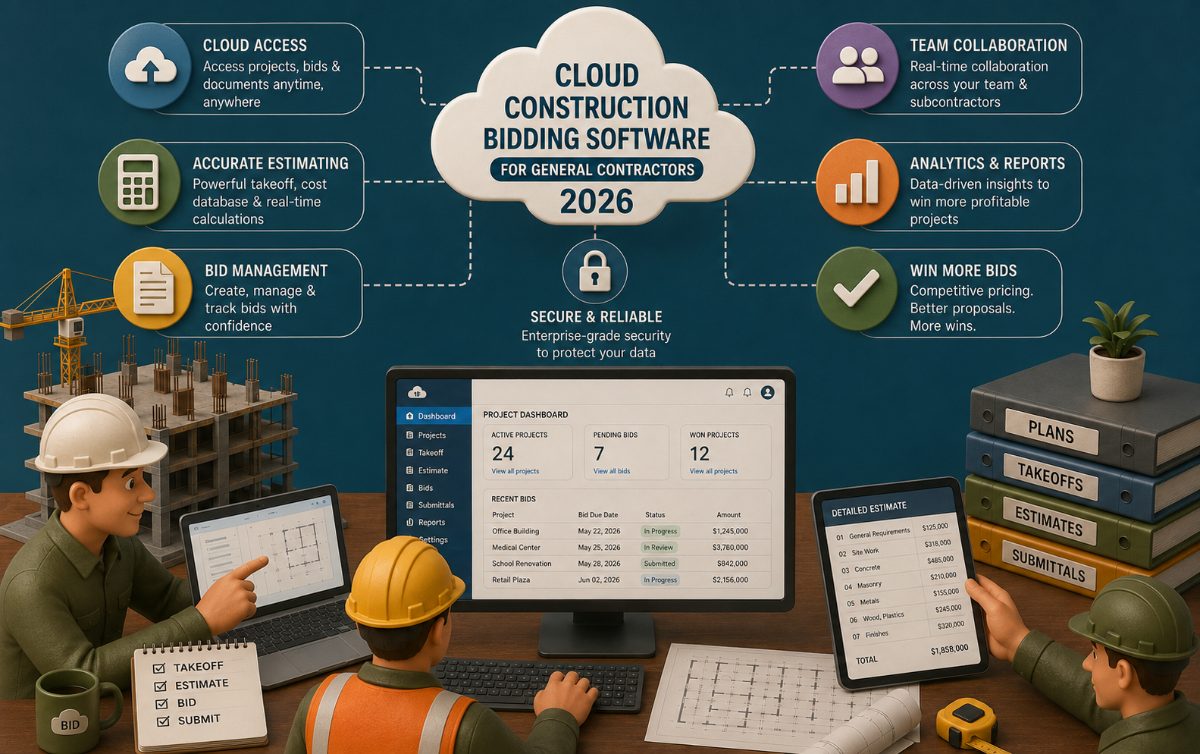
Construction bidding is one of the highest-leverage workflows in a GC's business — and one of the most fragmented software categories to shop for. "Cloud construction bidding software" returns platforms that solve genuinely different problems: bid solicitation tools that distribute ITBs to subcontractor networks, bid leveling tools that normalize proposals after they come in, and integrated preconstruction platforms that bundle bidding with takeoff and estimating. Treating them as interchangeable — the way many ranking articles do — leads GCs to buy tools that don't solve their specific bottleneck.
This article maps the cloud bidding software market as of 2026 into three subcategories, identifies which platforms lead in each, and provides head-to-head feature tables. The audience is the general contractor, project executive, preconstruction manager, or chief estimator evaluating which bidding platform (or combination of platforms) to invest in.
Key Takeaways
Three subcategories, not one. Bid management platforms (BuildingConnected, Procore Bid Management, SmartBid, ISqFt, Pantera) solicit and collect subcontractor bids. Bid leveling platforms (Melt Bid, Bidi) normalize proposals after collection. Integrated preconstruction platforms (STACK, Procore Estimating, Autodesk Construction Cloud) bundle bidding with takeoff and estimating.
The three subcategories solve different problems. Bid management platforms address the coverage bottleneck (finding and inviting enough qualified subs). Bid leveling platforms address the analysis bottleneck (reading and normalizing dozens of proposals). Integrated platforms address the workflow bottleneck (data flowing between takeoff, estimating, and bidding).
BuildingConnected leads bid management at commercial GCs with the largest North American subcontractor network and TradeTapp prequalification. Procore Bid Management leads for GCs already standardized on Procore. SmartBid is the mid-market alternative.
Melt Bid leads AI-powered bid leveling with 10× faster leveling, 95%+ accuracy, and 100% traceability to source proposals. Bidi Contracting competes in the same subcategory with bid solicitation-plus-leveling combined.
Most mid-to-large GCs use two or more tools — typically a bid management platform for solicitation plus a dedicated bid leveling tool for analysis. Single-platform coverage is the exception, not the rule.
Master Feature Comparison: Cloud Construction Bidding Platforms at a Glance
The table below covers the leading platforms across all three subcategories. Detailed per-subcategory tables follow.
Software | Subcategory | Best For | Sub Network Size | Bid Leveling Depth | Integration Ecosystem | Starting Price |
Bid leveling | GCs processing high sub-bid volume | N/A (leveling only) | Strongest (AI-powered, traceable) | Cloud or Excel | Contact for pricing | |
Bid management | Enterprise GCs, deepest sub network | Largest in North America | Moderate | Autodesk Construction Cloud | Enterprise (~$6,900+/yr GC) | |
Bid management | GCs already on Procore | Moderate (Procore network) | Basic | Procore ecosystem | $550/mo add-on to Procore PM | |
Bid management | Mid-market commercial GCs | Moderate (ConstructConnect-tied) | Basic | Procore integration native | $250–$1,500/mo (user-tiered) | |
Bid management | Commercial & government work | Strong (commercial/gov) | Basic | Standalone | Custom quote | |
Bid management | Dedicated bid management | Moderate | Strong (dedicated) | Standalone | Custom quote | |
Bid management | Small GCs, basic plan distribution | Growing | Basic | Standalone | Free tier + paid | |
Bid solicitation + leveling | GCs wanting one tool for both | Growing | Strong (AI-assisted) | Standalone | Custom quote | |
Integrated preconstruction | Cloud takeoff-plus-bidding teams | Limited | Basic | RSMeans database | ~$2,499/user/yr (Estimating tier) | |
Integrated preconstruction | Procore-native GCs wanting full stack | N/A (feeds Bid Management) | Via Bid Management | Procore ecosystem | Part of Procore full platform | |
Integrated preconstruction | Revit-native, BIM-heavy design-build | Via BuildingConnected | Moderate | Autodesk stack | Enterprise (~$10,000+/yr) |
Why Construction Bidding Software Splits Into Three Subcategories
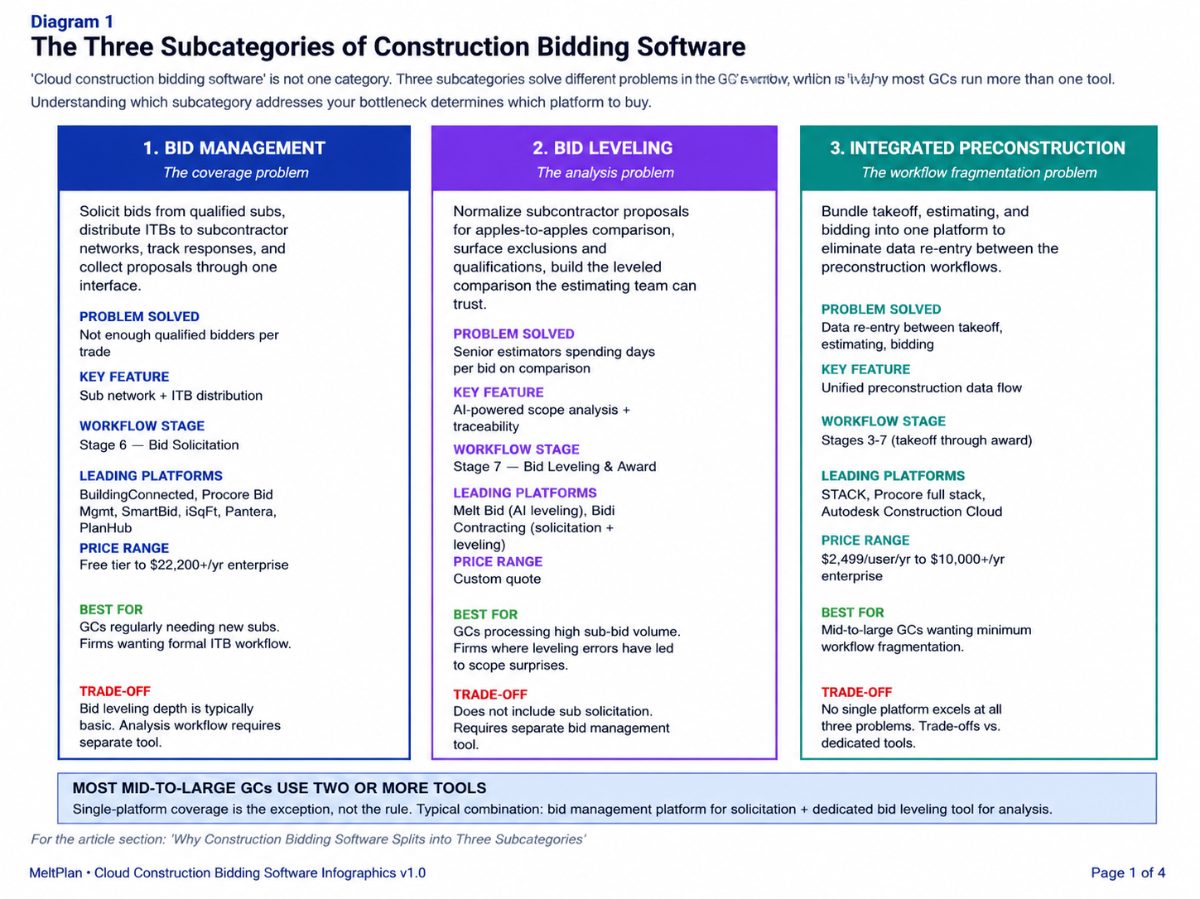
Before reading the comparison tables, it helps to understand what makes each subcategory distinct. The three subcategories solve genuinely different problems, which is why most GCs end up with more than one tool.
Bid management platforms address the coverage problem. A commercial project may require bids from 20–60 subcontractors across a dozen trade categories. Finding qualified subs, distributing ITBs, tracking who's opened the package, sending reminders to unresponsive bidders, and collecting proposals through a single interface is the workflow these platforms automate. The value is largely the network, how many qualified subs the platform gives the GC access to. BuildingConnected has the largest North American subnetwork; Procore's network is embedded in the broader Procore ecosystem; SmartBid and ISqFt/ConstructConnect operate their own networks.
Bid leveling platforms address the analysis problem. Once subcontractor proposals arrive, the GC needs to normalize scope, identify exclusions and qualifications buried in proposal notes, and build a comparison that the estimating team can trust. Manual bid leveling takes 3–7 days of senior estimator time per trade cycle on a typical commercial project, and it's where most post-award scope surprises originate. AI-powered bid leveling tools compress this from days to minutes with automatic scope-gap detection and exclusion flagging.
Integrated preconstruction platforms address the workflow-fragmentation problem. Takeoff quantities inform the estimate; the estimate structures the bid packages sent to subs; sub bids inform the final bid to the owner. When these workflows live in separate tools, GCs spend hours on data re-entry and reconciliation between systems. Integrated platforms bundle them into one data flow.
The reason most GCs run more than one tool: no single platform excels at all three problems. BuildingConnected is a strong bid management platform with moderate bid leveling. Melt Bid is a purpose-built bid leveling tool that doesn't handle sub solicitation. STACK integrates takeoff with basic bid management, but doesn't compete on sub network size. The honest expectation for a GC investing in this category is two or three tools that work together — not one tool that replaces all workflows.
What to Evaluate Before You Buy
Six factors matter when comparing platforms across these subcategories, in approximate order:
1. Where Is Your Current Bottleneck?
Sub coverage bottleneck (not enough qualified bidders per trade): a bid management platform with a large sub network. BuildingConnected leads in network size.
Analysis bottleneck (senior estimators spending hours per week reading proposals): a dedicated bid leveling platform. AI-powered leveling tools substantially compress this workflow.
Workflow fragmentation (data re-entry between takeoff, estimating, and bidding): an integrated preconstruction platform. STACK, Procore, or ACC, depending on tech stack.
Firms that don't know their bottleneck often buy the wrong tool. Bid coverage problems don't get solved by better leveling software; scope-gap problems don't get solved by more sub invitations.
2. Existing Tech Stack
Already on Procore: Procore Bid Management is the path of least resistance for solicitation. Add a dedicated bid leveling tool if analysis is the bottleneck.
Autodesk Construction Cloud user: BuildingConnected is native to ACC. TradeTapp prequalification is integrated.
STACK for takeoff: STACK's integrated bidding module keeps data in one platform, though the sub-network is smaller than dedicated tools.
No existing platform: SmartBid or PlanHub offer lower entry costs for bid management; dedicated leveling tools handle leveling regardless of what solicitation tool is used.
3. Bid Volume
Low volume (under 20 bids/year): PlanHub free tier or basic SmartBid may suffice.
Mid volume (20–80 bids/year): SmartBid or Procore Bid Management with a dedicated bid leveling tool.
High volume (80+ bids/year): BuildingConnected or ACC enterprise deployment paired with a dedicated AI leveling tool.
4. Sub Network Requirements
Working primarily with established sub relationships: Sub network size matters less. SmartBid or Procore works well.
Regularly needing new subs: BuildingConnected's network advantage becomes meaningful. TradeTapp prequalification reduces vetting time.
Federal/public-sector work: ISqFt/ConstructConnect has stronger government network coverage.
5. Bid Leveling Requirements
Bid leveling depth varies substantially across platforms:
Basic side-by-side comparison: Included in most bid management platforms (Procore, SmartBid, BuildingConnected).
AI-powered scope analysis and exclusion flagging: Dedicated tools only, this is the subcategory Melt Bid and Bidi lead.
AIA G702/G703 formal comparison: Custom template work or specialty tools required.
If bid leveling is a genuine bottleneck (senior estimators spending days per bid on comparison), the marginal cost of a dedicated leveling tool is easy to justify against the estimator time recovered.
6. Integration Requirements
Accounting integration (Sage, QuickBooks, Viewpoint): Procore's 400+ integrations lead the category.
BIM integration (Revit, Navisworks): Autodesk Construction Cloud with BuildingConnected.
Field-mobile access: All major platforms have mobile apps; Procore's mobile workflow is widely considered the strongest.
Excel workflow preservation: Dedicated bid leveling tools produce leveled outputs directly in the GC's Excel template; most bid management platforms lock outputs in proprietary formats.
The Leading Bid Management Platforms in 2026
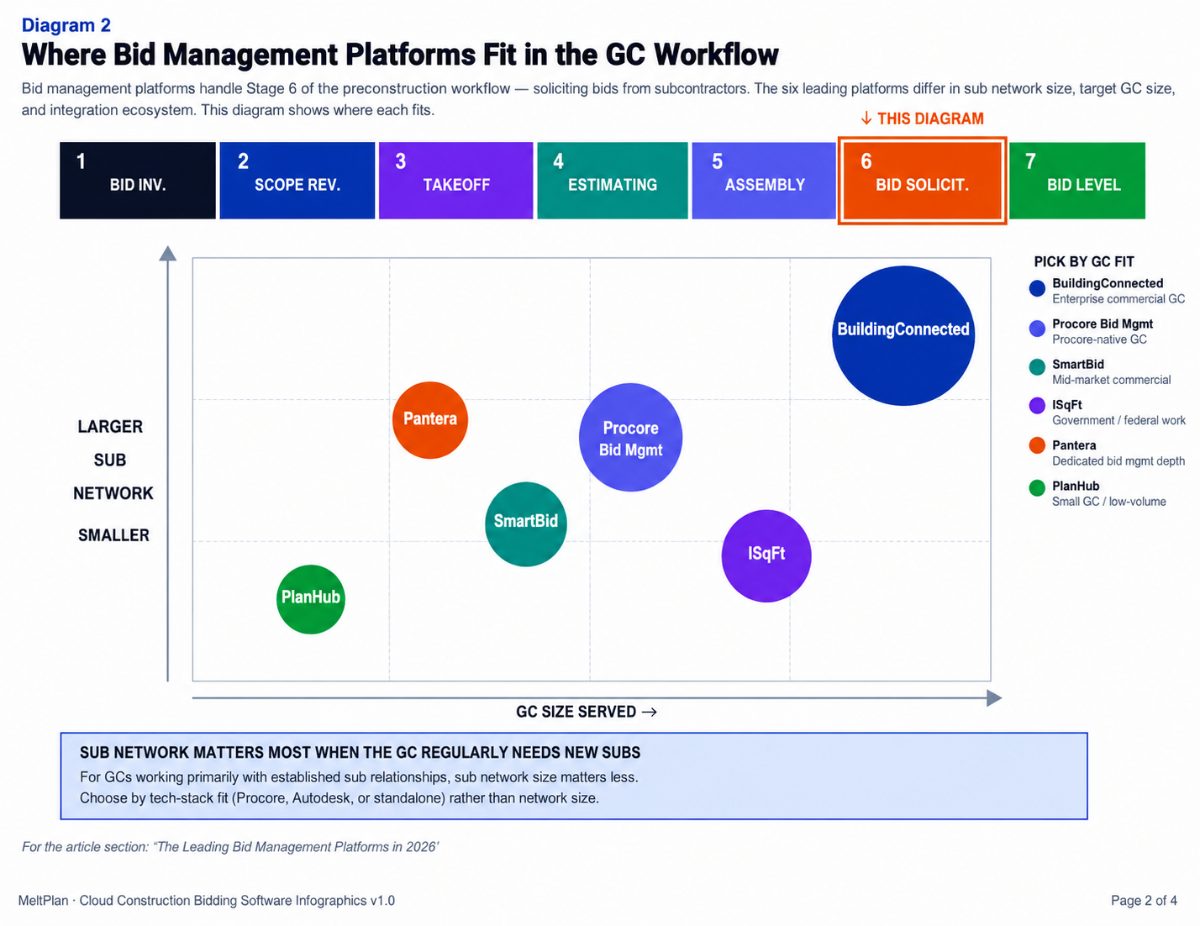
Bid management platforms are what GCs license to solicit bids from subcontractors, track responses, and collect proposals. Six platforms lead this subcategory.
Bid Management Platform Comparison
Feature | BuildingConnected | Procore Bid Management | SmartBid | ISqFt (ConstructConnect) | Pantera | PlanHub |
Vendor | Autodesk | Procore | ConstructConnect (Procore-owned) | ConstructConnect | Pantera | PlanHub |
Sub network size | Largest in North America | Moderate (Procore network) | Moderate | Strong (commercial/gov) | Moderate | Growing |
ITB distribution | Yes | Yes | Yes | Yes | Yes | Yes |
Sub prequalification | TradeTapp (deepest) | Basic | Basic | Basic | Moderate | Basic |
Sub engagement tracking | Yes | Yes | Yes | Yes | Yes | Yes |
Bid leveling | Moderate | Basic (integrated) | Basic | Basic | Strong (dedicated) | Basic |
Mobile access | Yes | Yes (strongest) | Yes | Yes | Yes | Yes |
Accounting integration | Autodesk stack | 400+ integrations | Procore native | Standalone | Standalone | Limited |
Federal / gov network | Moderate | Moderate | Moderate | Strong | Moderate | Limited |
Pricing model | Enterprise annual | Add-on to Procore PM | User-tiered | Custom quote | Custom quote | Free tier + paid |
Typical cost | ~$6,900–$22,200/yr (GC) | $550/mo add-on ($1,200+ full platform) | $250–$1,500/mo | Custom | Custom | Free (basic); paid tiers |
Best for | Enterprise commercial GCs, deepest sub network | Procore-native GCs | Mid-market commercial GCs | Commercial and gov work | Dedicated bid management depth | Small GCs, low-volume bidding |
BuildingConnected — The Enterprise Standard
BuildingConnected is the dominant bid management platform at large commercial GCs. Acquired by Autodesk in 2019 for $275 million, BuildingConnected now sits inside Autodesk Construction Cloud alongside Autodesk Takeoff and ACC Build. The strongest differentiator is the sub network, BuildingConnected has the largest North American subcontractor database, making it the default choice for GCs regularly inviting subs they don't already know.
TradeTapp — BuildingConnected's prequalification module — is the industry-leading platform for capturing financial statements, insurance certificates, safety records, and reference checks. For enterprise GCs where sub selection is a risk-management workflow as much as a coverage workflow, TradeTapp integration is a real advantage.
Best for: Enterprise commercial GCs (100+ projects annually) needing maximum sub network coverage. Firms already invested in Autodesk Construction Cloud. Projects where sub prequalification rigor matters (institutional, healthcare, mission-critical work).
Trade-off: Enterprise pricing — typically $6,900–$22,200/year for GC seats, depending on user count and features, negotiated annually with sales. Bid leveling depth is moderate, high-volume GCs typically pair BuildingConnected with a dedicated leveling tool (Melt Bid, Bidi) for analysis-heavy post-receipt work.
Procore Bid Management — The Path of Least Resistance for Procore GCs
Procore Bid Management is the natural bid management choice for GCs already standardized on Procore. It runs as a module within the broader Procore platform, sharing the user database, project data, and sub records with Procore's project management, financials, and field-management modules. When a bid becomes a subcontract, the data flows into Procore's subcontracts module without re-entry.
Procore's mobile workflow is widely considered the strongest in the construction management category. For teams where estimators and PMs review bid status from the field or after hours, Procore's mobile app is a real productivity advantage.
Best for: Mid-to-large commercial GCs already using Procore for project management. Firms want a bid workflow tightly integrated with subcontracts, financials, and field operations.
Trade-off: Sub network is smaller than BuildingConnected — Procore's network is embedded in Procore's user base rather than a purpose-built sub database. Bid leveling capability is basic; high-volume GCs typically supplement with a dedicated leveling tool. Pricing works as an add-on to Procore's PM platform, total cost for PM plus bidding runs $875–$1,750+/month.
SmartBid — The Mid-Market Alternative
SmartBid (now owned by ConstructConnect, which is part of Procore) is a construction bid management platform specifically designed for GCs. Its primary strengths are its clean, user-friendly interface and its Procore integration, the strongest interoperability with Procore of any platform outside Procore itself.
Pricing is transparent and tiered — $250/month for one user, scaling to $1,500/month for ten users. This makes it a common mid-market choice for commercial GCs who need bid management depth without enterprise pricing commitments.
Best for: Mid-market commercial GCs (10–50 users) wanting bid management with transparent pricing. Procore-adjacent firms want native integration. Teams prioritizing ease of onboarding — SmartBid's interface accelerates adoption for varied technical comfort.
Trade-off: Sub network smaller than BuildingConnected — SmartBid's marketing sometimes oversells the platform's post-receipt analysis capability, but real bid leveling depth is limited. Small GCs (under 15 bids/year) may find the cost hard to justify.
ISqFt (ConstructConnect) — The Commercial and Government Network
ISqFt is the ConstructConnect bid management platform with particularly strong commercial and government network coverage. For GCs pursuing significant public-sector work — federal, state, municipal, education, transportation — ISqFt's network coverage is a real advantage.
Best for: GCs pursuing significant commercial and government work. Firms want strong lead generation through ConstructConnect's bid data network.
Trade-off: Custom-quote pricing reduces budget predictability. Bid leveling capability is basic. Interface is less modern than SmartBid or BuildingConnected.
Pantera — The Dedicated Bid Management Specialist
Pantera positions itself as a dedicated bid management platform with stronger bid leveling depth than the general-purpose platforms. For GCs whose bid management workflow is complex enough to warrant a specialist tool, Pantera is a credible alternative to the ecosystem-integrated platforms.
Best for: GCs wanting dedicated bid management depth without committing to Procore or Autodesk ecosystems.
Trade-off: Custom pricing. Smaller sub-network than the larger platforms. Less integration ecosystem than Procore or ACC.
PlanHub — The Small-GC Entry Point
PlanHub offers a free tier for basic plan distribution and ITB workflow. For small GCs, general contractors just starting to formalize bid management, and firms with low bid volume, PlanHub provides an accessible entry point without upfront commitment.
Best for: Small GCs (under 20 bids/year), firms testing formal bid management for the first time, and low-budget deployments.
Trade-off: Feature depth is limited. Sub network is smaller than the established platforms. Growing firms typically outgrow PlanHub within a few years of adoption.
The Leading Bid Leveling Platforms in 2026
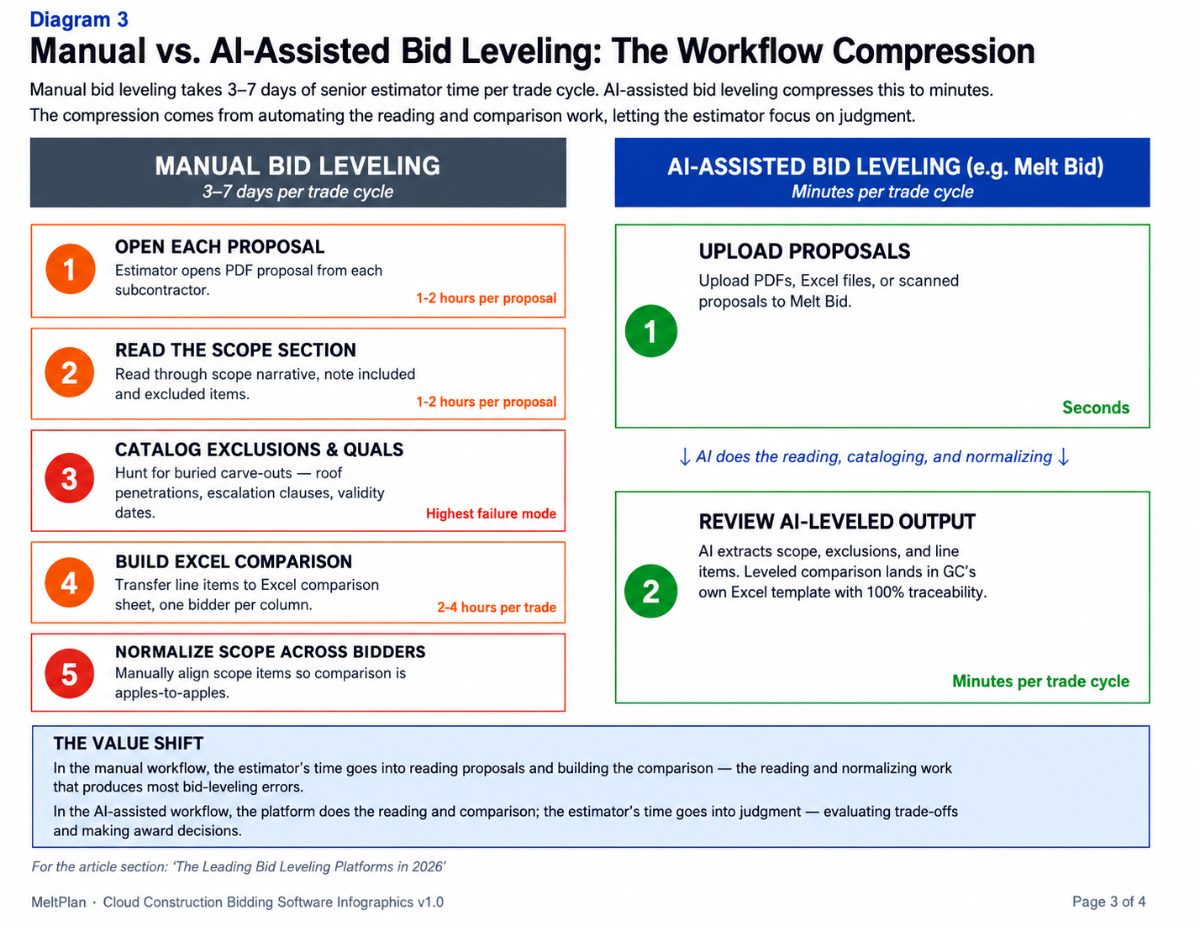
Bid leveling platforms address the workflow that starts after subcontractor bids arrive: normalizing scope across bidders, identifying exclusions and qualifications, and building the apples-to-apples comparison the estimating team can trust. Two platforms lead this subcategory.
Bid Leveling Platform Comparison
Feature | Melt Bid | Bidi Contracting |
Vendor | MeltPlan | Bidi |
Category positioning | Purpose-built AI bid leveling | AI-assisted bid solicitation + leveling |
Bid solicitation | No (leveling only) | Yes (combined workflow) |
AI leveling speed | 10× faster than manual | Strong (integrated) |
Leveled output accuracy | 95%+ | Strong |
Traceability to source proposals | 100% (every number traces to the source line in the source proposal) | Strong |
Automatic scope gap detection | Yes (surfaces line items priced by one sub, missed by others) | Yes |
Exclusions & qualifications flagging | Yes (surfaces non-obvious carve-outs — roof penetrations excluded, price valid 30 days, escalation clauses) | Yes |
Output format | GC's own Excel template OR cloud (bring your own template) | Proprietary + export |
Q&A against leveled bids | Yes (plain-language questions — "who's the lowest bidder," "what did Summit exclude," "where's the biggest spread") | Limited |
Sub network | N/A (leveling only) | Growing |
Pricing | Contact for pricing | Custom quote |
Best for | GCs processing high sub-bid volume, wanting best-in-class leveling with existing solicitation tools | GCs want one tool for both solicitation and leveling |
Melt Bid — The AI Bid Leveling Standard
Melt Bid is the purpose-built AI bid leveling platform for GCs. Rather than trying to replace bid management, Melt Bid focuses specifically on the post-receipt analysis workflow: normalizing scope across multiple sub-proposals, surfacing exclusions and qualifications buried in bid notes, and producing a leveled comparison in the GC's own Excel template. Verified capabilities:
10× faster bid leveling than manual — a leveling cycle that traditionally takes 3–7 days completes in minutes
95%+ accuracy on leveled outputs
100% traceable — every number in the leveled output traces back to the specific line in the specific proposal. No black-box AI output.
Automatic scope gap detection — surfaces line items, one sub-priced and others missed entirely
Exclusions and qualifications flagging — non-obvious carve-outs (roof penetrations excluded, price valid 30 days, escalation clauses) get surfaced automatically
Cloud or Excel workflow — leveled output lands in the GC's own template, not a proprietary format
Q&A against leveled bids — the estimator can ask plain-language questions ("who's the lowest bidder and by how much," "what did Summit exclude," "where's the biggest spread") and get answers scoped to the specific run
The design choice matters: Melt Bid does not try to replace BuildingConnected, Procore Bid Management, or SmartBid for sub solicitation. Instead, it handles the leveling stage that those platforms handle only at basic depth. The value shift is significant, in the manual workflow, the estimator's time goes into reading proposals and building the comparison. In the Melt Bid workflow, the platform does the reading and comparison; the estimator's time goes into judgment.
Best for: GCs processing high sub-bid volume where senior estimators spend days per bid on comparison work. Firms already using BuildingConnected, Procore Bid Management, or SmartBid for solicitation and wanting a dedicated leveling tool. Any GC where bid leveling errors have led to post-award scope surprises.
Trade-off: Melt Bid handles bid leveling; sub solicitation still requires a separate platform (or manual email-based workflow). For GCs wanting one tool for both, Bidi is the integrated alternative — with the trade-off that dedicated leveling tools typically outperform integrated tools on leveling depth.
Bidi Contracting — The Integrated Alternative
Bidi Contracting takes a different approach — combining bid solicitation and bid leveling in one workflow. GCs invite subs, collect proposals, and level them within the same platform. The advantage is single-tool simplicity; the trade-off is depth in each subcategory.
Best for: GCs wanting one tool for both solicitation and leveling. Firms without established preferences on bid management platforms.
Trade-off: The sub-network is smaller than BuildingConnected or SmartBid. Dedicated leveling tools typically outperform integrated tools on leveling depth.
The Leading Integrated Preconstruction Platforms in 2026
The third subcategory bundles bidding with takeoff and estimating in one platform. For GCs wanting minimum workflow fragmentation, integrated platforms consolidate the preconstruction data flow into one system.
Integrated Preconstruction Platform Comparison
Feature | STACK | Procore Estimating + Bid Management | Autodesk Construction Cloud |
Vendor | STACK Construction Technologies | Procore | Autodesk |
Category positioning | Cloud takeoff + estimating + bidding | Procore's full preconstruction stack | ACC-integrated preconstruction |
Digital takeoff | Yes (defining feature) | Yes (Procore Estimating) | Yes (Autodesk Takeoff) |
Estimating (unit pricing) | Yes (RSMeans database) | Yes | Yes |
Bid management | Basic bidding module | Procore Bid Management (add-on) | BuildingConnected (via ACC) |
Bid leveling | Basic | Basic (via Bid Management) | Moderate (via BuildingConnected) |
BIM integration | Limited | Via integrations | Native (deepest — Revit/Navisworks) |
Sub network | Limited | Moderate (Procore network) | Largest (via BuildingConnected) |
Accounting integration | Limited | 400+ integrations | Autodesk stack |
Mobile access | Yes | Yes (strongest) | Yes |
Typical cost | ~$2,499/user/yr (Estimating tier); ~$2,999/user/yr (Estimating Plus) | $1,200–$2,500+/mo full platform | Enterprise (~$10,000+/yr small team) |
Best for | Mid-market GCs wanting cloud takeoff + basic bidding | Procore-native GCs wanting the full stack | Revit-native firms, BIM-heavy design-build, enterprise |
STACK — The Cloud Preconstruction Platform
STACK combines cloud takeoff, RSMeans-integrated estimating, and basic bid management in one platform. For mid-market GCs who want their preconstruction workflow to live in the cloud without stitching together three separate tools, STACK is a credible single-platform choice.
Pricing starts around $2,499/user/year for the Estimating tier — transparent and predictable. Higher tiers add team collaboration and advanced features.
Best for: Mid-market GCs (10–100 estimators) wanting integrated cloud takeoff, estimating, and basic bid management in one platform. Firms transitioning from desktop takeoff tools (PlanSwift, On-Screen Takeoff) to cloud workflow.
Trade-off: The sub-network is smaller than dedicated bid management platforms. Bid leveling depth is basic — high-volume GCs typically supplement with Melt Bid or Bidi. BIM integration is limited compared to ACC.
Procore Estimating + Bid Management — The Procore Full Stack
Procore's preconstruction offering combines Procore Estimating (takeoff and cost modeling) with Procore Bid Management (solicitation) inside the broader Procore platform. For GCs already using Procore for project management, this is the path to consolidating preconstruction into the same ecosystem.
Best for: Procore-native GCs wanting the full preconstruction-through-execution workflow in one platform.
Trade-off: Total cost adds up — full Procore platform runs $1,200–$2,500+/month. Bid leveling depth remains basic. Sub network is Procore's, rather than a purpose-built bid network.
Autodesk Construction Cloud — The BIM-Native Integrated Platform
Autodesk Construction Cloud (ACC) combines BIM 360 (now ACC Build and ACC Docs), Autodesk Takeoff, BuildingConnected, and Assemble into a single ecosystem. For Revit-native design-build firms doing BIM-heavy work, ACC's integration depth from design through construction is unmatched — including the largest North American sub network via BuildingConnected.
Best for: Revit-native design-build firms. Enterprise GCs on BIM-heavy commercial, healthcare, and institutional work. Firms wanting the deepest BIM-to-construction data flow.
Trade-off: Enterprise pricing — typically $10,000+/year for a small team. Overkill for GCs doing primarily 2D-drawing-based work. Bid leveling capability inherits from BuildingConnected's moderate depth.
How to Choose: The Decision Tree
The right platform combination depends on four questions in order:
1. What is the firm's primary bottleneck?
Sub coverage: BuildingConnected (largest network) or SmartBid (mid-market alternative).
Bid analysis speed: A dedicated AI leveling tool as add-on to existing solicitation tool.
Workflow fragmentation: STACK, Procore full stack, or ACC depending on tech stack.
2. Existing tech stack?
Procore project management: Procore Bid Management is the path of least resistance for solicitation.
Autodesk Construction Cloud: BuildingConnected is native.
STACK for takeoff: Consider STACK's integrated bidding module.
No existing platform: SmartBid, PlanHub, or dedicated leveling tools, depending on subcategory need.
3. Bid volume?
Under 20 bids/year: PlanHub or basic SmartBid.
20–80 bids/year: SmartBid or Procore Bid Management with dedicated bid leveling.
80+ bids/year: BuildingConnected or ACC paired with a dedicated leveling tool.
4. Bid leveling requirements?
Basic comparison sufficient: Included in bid management platforms.
AI-powered scope analysis: Dedicated leveling tools become worth the marginal cost.
Excel-workflow-critical: Melt Bid delivers leveled outputs in the GC's own Excel template.
How the Bidding Stack Typically Looks at Different GC Sizes
GC size | Bid management platform | Bid leveling tool | Integrated platform | Typical annual budget |
Small GC (under 15 users) | PlanHub free tier or SmartBid entry ($250/mo) | Excel-based or dedicated AI leveling tool | Optional (STACK if takeoff needed) | $3,000–$10,000 |
Mid-market commercial GC (15–50 users) | SmartBid ($500–$1,500/mo) or Procore Bid Management | AI leveling tool for high volume | Procore full stack often replaces separate tools | $10,000–$30,000 |
Enterprise commercial GC (50–500 users) | BuildingConnected enterprise | Dedicated AI leveling tool | ACC full or Procore full | $30,000–$100,000+ |
BIM-heavy design-build firm | BuildingConnected via ACC | Dedicated AI leveling tool for post-receipt analysis | ACC full deployment | $50,000+ |
GC pursuing significant federal / gov work | ISqFt/ConstructConnect for network | Dedicated AI leveling tool | Standalone | $20,000–$60,000 |
The pattern: budget scales with bid volume and project mix complexity. A 25-person GC bidding federal work needs different infrastructure than a 100-person GC doing repetitive private-sector commercial.
Frequently Asked Questions
What is the best cloud construction bidding software for GCs in 2026?
There is no single best tool. For sub-network size, BuildingConnected leads. For Procore-native GCs, Procore Bid Management is the path of least resistance. For mid-market commercial GCs, SmartBid is the standard. For dedicated AI-powered bid leveling, Melt Bid leads. Most GCs use two or more tools.
What's the difference between bid management and bid leveling software?
Bid management platforms (BuildingConnected, Procore Bid Management, SmartBid) solicit and collect subcontractor bids. Bid leveling platforms (Melt Bid, Bidi) normalize collected proposals for apples-to-apples comparison. Bid management addresses coverage; bid leveling addresses analysis. Most GCs need both, either in one integrated tool or two dedicated ones.
Do I need separate tools for bid management and bid leveling?
Often yes. Bid management platforms typically offer basic leveling, but not the AI-powered scope-gap detection and exclusion flagging that dedicated tools provide. GCs processing high bid volume, where senior estimators spend days on comparison, typically pair a bid management platform (BuildingConnected, Procore) with a dedicated leveling tool (Melt Bid).
Is Procore Bid Management enough on its own?
For GCs already on Procore with moderate bid volume and basic leveling needs, Procore Bid Management covers the workflow. For high-volume GCs, complex commercial work, or teams where leveling errors have led to post-award scope surprises, Procore's basic leveling depth typically warrants supplementing with a dedicated AI leveling tool.
How much does construction bidding software cost in 2026?
Bid management: PlanHub free tier to BuildingConnected enterprise ($6,900–$22,200/year). Procore Bid Management runs $550/month as an add-on to Procore's PM platform. SmartBid runs $250–$1,500/month, tiered by user count. Bid leveling (Melt Bid, Bidi) is custom-priced. Integrated platforms (STACK, Procore full, ACC) range from $2,499/user/year to $10,000+/year enterprise.
Does BuildingConnected have the largest subcontractor network?
Yes, BuildingConnected has the largest North American subcontractor network. ISqFt/ConstructConnect has strong commercial and government network coverage as an alternative. Procore's network is embedded in Procore's user base rather than a purpose-built sub-database. Network size matters most for GCs regularly inviting subs they don't already know.
What is bid leveling, and why does it matter?
Bid leveling is the process of normalizing subcontractor proposals so that different bids can be compared on an identical scope. Different subs include different scopes, exclusions, and pricing units. Without leveling, GCs compare apples to oranges. Manual leveling takes 3–7 days per trade cycle; AI-powered tools compress this to minutes.
Can I use email and spreadsheets instead of bid management software?
Yes, and many small GCs do — for a while. The typical inflection point is around 15–20 bids per year, when the administrative overhead of email-and-spreadsheet workflow (tracking who's opened the ITB, chasing unresponsive subs, reconciling scope in Excel) starts consuming more estimator time than a formal platform would.
What is TradeTapp and why does it matter?
TradeTapp is BuildingConnected's subcontractor prequalification platform. It captures financial statements, insurance certificates, safety records, and reference checks from subs before bid invitation — reducing the risk of awarding to firms that can't deliver. For enterprise GCs where sub selection is a risk-management workflow, TradeTapp is a real advantage.
Related Building Code Resources
- Building CodesGo/No-Go Readiness Checklist for Construction Project Pursuit Decisions
- Building CodesBest Construction Document Control Software in 2026
- Building CodesBest Construction Estimating Software for Mac in 2026
- Building CodesAddenda in Construction: Definition, Purpose, and How to Manage Them
- Building CodesBest Construction CRM Software for Bid Tracking and Follow-Up for General Contractors
MeltPlan
A curated stream of preconstruction intelligence, estimating innovation, takeoff breakthroughs, workflow advancements, and expert perspectives—powered by the AI and technology shaping the future of construction.
Visit SiteDon't miss what's shaping AEC
Don't miss what's shaping AEC The latest on preconstruction, codes, AEC news & trends — so you're al