Top 10 Building Code Violations Found During Inspections (And How to Avoid Them)
Failing a building inspection can halt a project, inflate budgets, and derail timelines. While building codes are vast, a recurring set of common violations is ..
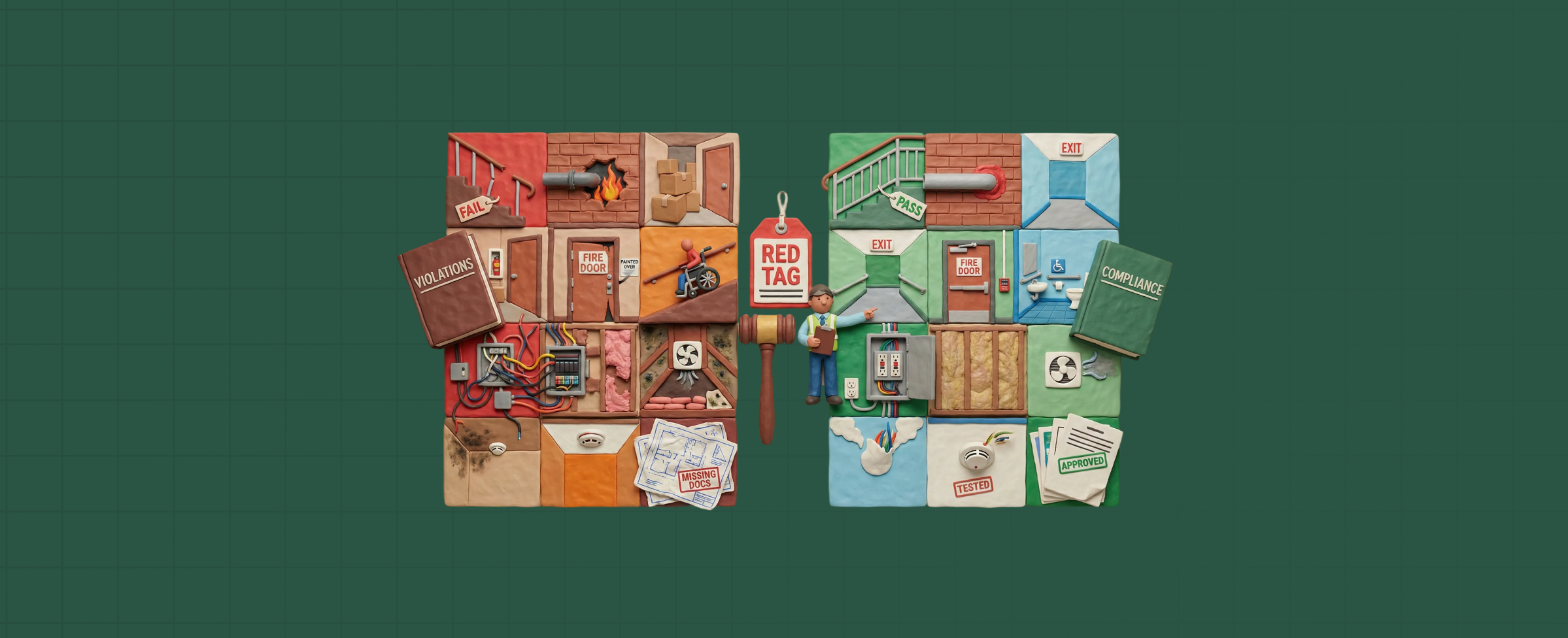
Failing a building inspection can halt a project, inflate budgets, and derail timelines. While building codes are vast, a recurring set of common violations is responsible for the majority of these "red tags." These errors typically stem not from deliberate corner-cutting, but from coordination gaps between trades, misinterpretations of prescriptive requirements, and a lack of attention to critical life-safety and accessibility details. This summary outlines the ten most frequent violations found by inspectors and the key details to watch for, providing a proactive guide for architects, engineers, and contractors to ensure a smooth, compliant, and successful build.
The most common building code violations found during inspections include:
- Handrail and Guardrail Deficiencies: As a critical life-safety element, this is one of the most cited issues. Common failures involve incorrect heights (guardrails must typically be 42" for commercial and 36" for residential; handrails must be 34-38"), improper baluster spacing that allows a 4-inch sphere to pass through, and the use of non-graspable handrail profiles.
- Missing or Improper Fire-Stopping: Fire-rated walls and floors are frequently compromised by unsealed penetrations. This violation occurs when gaps around pipes, conduits, or ducts are left open or are sealed with the wrong materials (e.g., standard caulk instead of rated fire-stopping), creating a direct path for smoke and flames. It is often a result of poor coordination between MEP and finishing trades.
- Egress Path Obstructions and Widths: Safe exit paths are non-negotiable. Violations include corridors and doorways with insufficient clear width (doors must have at least 32 inches of clear passage), doors that swing in a way that obstructs the required path width, and the placement of equipment or furniture that blocks the means of egress.
- Improperly Installed Fire-Rated Doors: A fire door is a complete, tested assembly, and every part matters. Common mistakes include excessive gaps between the door and frame (typically >1/8"), installation of non-latching or non-rated hardware, missing or painted-over certification labels, and inoperable or disconnected self-closing mechanisms.
- Accessibility (ADA) Non-Compliance: Accessibility codes are highly specific and easily violated. Frequent errors include ramps with slopes steeper than 1:12, insufficient clear floor space in restrooms (especially at sinks and toilets), incorrect placement or height of grab bars, and door hardware that is not operable with a closed fist.
- Electrical and Wiring Issues: These pose significant fire and safety hazards. Inspectors often find improperly secured cables, overloaded electrical panels, uncovered junction boxes, and a lack of required Ground Fault Circuit Interrupter (GFCI) protection in wet locations like kitchens, bathrooms, and exteriors.
- Insufficient or Incorrectly Installed Insulation: Proper insulation is key to meeting energy codes. Violations include completely missing insulation in walls or ceilings, insulation that has been compressed (which drastically reduces its R-value), and failure to seal gaps around windows, doors, and electrical outlets.
- Inadequate Ventilation: This leads to moisture buildup, mold, and poor indoor air quality. Common red tags are for missing bathroom or kitchen exhaust fans, or for fans that are improperly vented into an attic or crawlspace instead of directly to the exterior.
- Smoke and Carbon Monoxide Detector Placement: Early warning systems are crucial for life safety. Violations include failing to install detectors in all required locations (bedrooms, hallways outside sleeping areas), placing them too close to vents or corners where smoke may not reach them, and not using interconnected alarms as required by code.
- Incomplete or Inaccessible Documentation: An inspector cannot verify compliance without proper paperwork. A project can fail inspection simply because the approved set of plans, manufacturer specifications for installed equipment, or required special inspection reports are not available on-site for review.
This article isn't just a list of what goes wrong. It's a deep dive into why these issues occur and a practical guide for project teams to build a proactive compliance strategy. By understanding these common pitfalls, you can protect your project's budget, timeline, and reputation.
The Most Frequent Red Tags: A Breakdown of Common Violations
Here are ten of the most common building code violations encountered by inspectors across the country, from single-family homes to large commercial projects.
1. Handrail and Guardrail Deficiencies
This is arguably one of the most cited violations, primarily because it’s a critical life-safety component with very prescriptive requirements.
- The Violation: Common errors include incorrect guardrail height (typically must be 42 inches for commercial, 36 inches for residential), improper handrail height (34-38 inches), baluster spacing that allows a 4-inch sphere to pass through, and non-graspable handrail profiles.
- Why It Happens: A subcontractor may install a standard residential-grade product in a commercial setting, or a fabricator might misinterpret the shop drawings. Sometimes, the design itself misses a subtle requirement, like the need for handrail extensions to return to a wall or post.
- How to Avoid It:
- Detailing is Key: Architects and designers must provide clear, dimensioned details on the construction documents that explicitly call out heights, spacings, and profiles.
- Submittal Review: Scrutinize shop drawings from the railing fabricator. Don’t just check for aesthetics; verify every dimension against the governing code (e.g., IBC Chapter 10).
- Pre-Installation Meeting: Hold a brief meeting with the installer on-site to review critical dimensions before they begin work. A simple jig (like a 4-inch diameter circle cut from plywood) can be used for field verification of baluster spacing.
2. Improper Fire-Rated Penetrations
Protecting fire-rated walls, floors, and ceilings is fundamental to a building's life-safety strategy. Any pipe, conduit, or duct that passes through these assemblies must be properly sealed.
- The Violation: The most common error is using generic "fire caulk" in a penetration that requires a specific, tested UL-listed assembly. Other issues include oversized gaps around pipes, mixing incompatible materials, or damaging the fire-rated drywall during installation.
- Why It Happens: This is a classic coordination failure. A plumber or electrician cuts a hole to run their line, and the responsibility for sealing it correctly falls into a gray area. The trade contractor may not be trained in the specific requirements of the numerous UL systems.
- How to Avoid It:
- Assign Responsibility: Clearly define in the project specifications which trade is responsible for firestopping their own penetrations versus having a dedicated firestopping contractor.
- Create a Submittal Log: Require the contractor to submit the specific UL-listed assembly details for each type of penetration condition on the project.
- Educate and Inspect: Train superintendents to spot incorrect applications. Look for the UL label on the materials and ensure the installation (e.g., sealant depth, presence of mineral wool) matches the approved submittal.
3. Means of Egress Obstructions and Errors
The path out of a building in an emergency must be clear, intuitive, and properly sized. Inspectors are ruthless when it comes to egress.
- The Violation: Common issues include doors swinging in the wrong direction (e.g., into a small corridor, impeding travel), insufficient door or corridor widths (typically 36" clear for doors), improper hardware (e.g., requiring two actions to unlatch), and exit signs that are missing, unlit, or improperly located.
- Why It Happens: Field conditions can lead to last-minute changes that inadvertently impact egress. For example, a column wrap is added that reduces a corridor's width below the minimum, or an IT contractor installs a device that projects too far into the path of travel.
- How to Avoid It:
- Egress Plan: The design team should produce a clear life-safety or egress plan that is reviewed and understood by the entire construction team.
- Protect the Path: During construction, superintendents must be vigilant about keeping egress paths clear of stored materials.
- Final Walkthrough: Before the final inspection, conduct a dedicated "egress walkthrough." Open every door, measure clear widths, and test all exit signs and emergency lights.
4. ADA and Accessibility Non-Compliance
The Americans with Disabilities Act (ADA) and local accessibility codes (like ANSI A117.1) are legally mandated civil rights laws enforced through the building code. Errors here can lead not only to failed inspections but also to costly lawsuits.
- The Violation: The list is long: incorrect restroom clearances (especially around toilets and sinks), missing grab bars or improper installation height, ramp slopes that are too steep, non-compliant door thresholds, and lack of accessible signage.
- Why It Happens: The requirements are precise and unforgiving. Being off by half an inch matters. These errors often result from a lack of field-level understanding or a failure to account for finish thicknesses.
- How to Avoid It:
- Detailed Drawings: Provide fully dimensioned plans and elevations for all accessible areas, especially restrooms and kitchens. Do not leave clearances to chance.
- Blockouts and Backing: Ensure that plywood backing for grab bars is installed before the drywall goes up. Mark the locations clearly.
- Quality Control Checklist: Develop an accessibility-focused checklist for use during construction. Measure clearances after finishes are installed, not just at rough framing.
5. Missing or Improperly Installed Fireblocking/Draftstopping
This is a "hidden" violation that is critical for preventing the spread of fire through concealed spaces in combustible construction.
- The Violation: Gaps in stud cavities at floor/ceiling lines, around soffits, and at other concealed draft openings are not sealed with approved materials (e.g., solid lumber, gypsum board, mineral wool). Using spray foam not rated for fireblocking is a frequent mistake.
- Why It Happens: Fireblocking is often installed by the framing contractor, but the penetrations are made later by MPE trades, who may remove or damage it without realizing its purpose. It's an "out of sight, out of mind" problem.
- How to Avoid It:
- Timing is Everything: Schedule a specific "fireblocking inspection" with the AHJ after rough-in MPE is complete but before insulation and drywall are installed. This creates a clear checkpoint.
- Educate the Trades: During a kickoff meeting, explicitly discuss the fireblocking strategy and the rule: "If you cut it, you fix it with approved materials."
6. Electrical: GFCI/AFCI Protection and Outlet Spacing
Electrical inspections are thorough, and these two items are easy for an inspector to spot quickly.
- The Violation: Missing Ground-Fault Circuit Interrupter (GFCI) protection in required locations (kitchens, bathrooms, garages, outdoors) and missing Arc-Fault Circuit Interrupter (AFCI) protection where mandated by the NEC. Another common issue is incorrect outlet spacing along walls.
- Why It Happens: The National Electrical Code (NEC) is updated every three years, and requirements for GFCI/AFCI protection expand. An electrician may be working off outdated knowledge. Spacing errors are often simple measurement mistakes.
- How to Avoid It:
- Verify the Code Cycle: Ensure your electrical contractor is working from the NEC version adopted by your jurisdiction.
- Use a Story Pole: For outlet spacing, a simple marked stick ("story pole") can be more reliable than repeatedly using a tape measure, reducing the chance of error.
7. Improper Window Flashing and Weather-Resistive Barriers (WRB)
This violation may not be a life-safety issue, but it's a leading cause of construction defect litigation due to water intrusion and mold.
- The Violation: Incorrect lapping of the WRB (house wrap) and flashing tapes around window and door openings. A classic error is "reverse shingling," where a lower layer is lapped over a higher one, directing water into the wall assembly.
- Why It Happens: Installers may be rushed or improperly trained by the product manufacturer. Multiple subcontractors (framer, window installer, sider) may work on the same assembly, leading to confusion over responsibility.
- How to Avoid It:
- Follow Manufacturer Instructions: The manufacturer's installation details for windows and WRBs are your best defense. Include them in the submittal package and have them available on-site.
- Pre-Installation Meeting & Mock-up: Before the first window is installed, review the entire sequence with the installation crew. Consider building a small mock-up wall to demonstrate the correct technique.
8. Incorrect Structural Hardware and Fasteners
The structural integrity of a building depends on thousands of small connections being made correctly.
- The Violation: Using the wrong type of fastener (e.g., drywall screws for structural connections), missing nails in a joist hanger, or using hangers not rated for the loads or exposure (e.g., standard galvanized hangers in contact with treated wood).
- Why It Happens: A framer runs out of the specified nail and uses what's in their pouch. Or, the plans simply say "Simpson Hanger or equivalent" without specifying the exact model, leaving it to the field to decide.
- How to Avoid It:
- Be Specific: The structural engineer should call out specific hardware (e.g., "Simpson LUS28") and the required number and type of fasteners on the plans.
- Supplier Coordination: Ensure the contractor's supplier provides the specified materials. Prohibit on-site substitutions without an RFI and engineer approval.
9. Mechanical: Improper Clearances and Condensate Drainage
These are two of the most common red tags from a mechanical inspector, one related to fire safety and the other to property damage.
- The Violation: Insufficient clearance between fuel-fired appliances (like a furnace or water heater) and combustible materials. For HVAC equipment, improper slope or trapping of the primary condensate drain line, and a missing or improperly piped secondary/emergency drain pan.
- Why It Happens: Equipment is often installed in tight closets where clearances are difficult to maintain. Condensate drain issues are often an afterthought, leading to poorly routed lines that don't drain properly by gravity.
- How to Avoid It:
- Check the Cut Sheet: The manufacturer's installation manual for the appliance will specify the required clearances. Have it on-site for the installer and inspector to review.
- Water Test: Before closing up ceilings, have the mechanical contractor pour water into the primary and secondary drain pans to verify they are sloped correctly and terminate in an approved location.
10. Incomplete or Missing On-Site Documentation
This isn’t a physical building violation, but it will stop an inspection just as quickly.
- The Violation: The inspector arrives on-site and the contractor cannot produce the approved set of plans, the inspection card, relevant engineering reports (e.g., soil reports, truss drawings), or permit documents.
- Why It Happens: Poor site management. The documents are in the truck, at the office, or an outdated set is being used.
- How to Avoid It:
- Centralized Job Box: Maintain a clean, organized, and protected job box or site office where the official, stamped "Approved Set" of documents is kept.
- Digital Access: Supplement the physical set with cloud access for the entire team, but always confirm which set is the official record for the inspector.
From Reactive to Proactive: A Framework for Compliance
Avoiding these violations isn't about memorizing a list. It’s about shifting from a reactive mindset (fixing red tags) to a proactive one (preventing them).
| Phase | Proactive Action | Key Benefit |
|---|---|---|
| Pre-Construction | Conduct a formal interdisciplinary code review before finalizing permit documents. | Catches design conflicts and ambiguities before they are built. |
| Submittals & RFIs | Treat submittals (shop drawings, product data) as a critical compliance check, not just a paperwork exercise. | Verifies that specified materials meet code before they are ordered. |
| On-Site Kickoff | Hold pre-installation meetings for critical assemblies (WRB, firestopping, railings). | Aligns all parties on means, methods, and quality standards. |
| In-Progress QC | Arm superintendents with checklists for high-risk items. Perform your own “mock inspections” at key milestones. | Identifies and corrects errors when they are cheapest to fix. |
Key Takeaways
What can you ask? (Sample questions)
- What building code edition does my state currently enforce?
- How do state-specific amendments modify the base IBC?
- What structural design loads apply in my jurisdiction?
- What energy code requirements apply to my building type?
Building code compliance is not the final step in the construction process; it is an integral part of it from day one. An inspector's visit should be a confirmation of quality, not a test of luck.
By understanding the "why" behind these common violations—the coordination gaps, the knowledge deficits, the process failures—project teams can implement targeted strategies. Focus on clear documentation, rigorous submittal reviews, and proactive field communication. When you build compliance into your workflow, the red tag becomes a rarity, and the final certificate of occupancy becomes an expectation, not a hope.
Related Building Code Resources
- Building CodesWhat is a Certificate of Occupancy? The Final Step in Proving Code Compliance
- Building CodesPerformance-Based vs. Prescriptive Codes: Choosing the Right Path for Your Project
- Building CodesThe Digital Blueprint: How Technology is Revolutionizing Building Code Compliance
- Building CodesBalancing Past and Present: A Guide to Code Compliance for Historic Renovations and Existing Buildings
- Building CodesThe Role of a Building Inspector: What They Look For and How to Prepare for Inspection Day
MeltPlan
A curated stream of preconstruction intelligence, estimating innovation, takeoff breakthroughs, workflow advancements, and expert perspectives—powered by the AI and technology shaping the future of construction.
Visit SiteDon't miss what's shaping AEC
The latest on preconstruction, codes, AEC news & trends — so you're always in the know.