What Are the Major Changes in the 2025 California Building Code Volume 2?
Volume 2 of the 2025 California Building Code brings sweeping structural, materials, and construction-phase updates across Chapters 16–35 and Appendices I–Q..
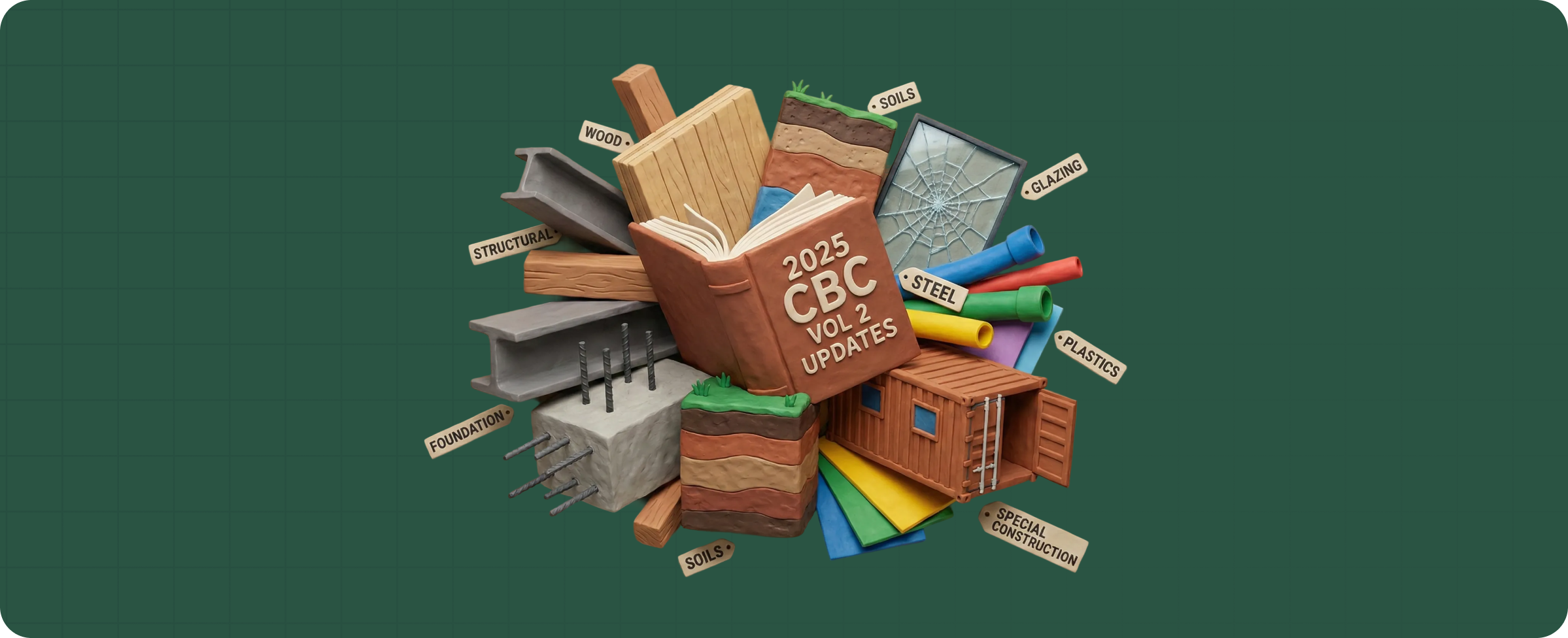
Volume 2 of the 2025 California Building Code brings sweeping structural, materials, and construction-phase updates across Chapters 16–35 and Appendices I–Q.
The most significant themes include:
1. Major Structural Design Updates (Chapter 16)
- Updated wind, snow, and tornado design criteria
- Revised risk categories (especially for I-2, I-3, and PV systems)
- Reworked seismic design categories and rainfall load calculations
- Reorganization of live load tables and load combinations
2. Strengthening of Special Inspections (Chapter 17)
- Stainless steel added as a structural material
- New inspection requirements for pre-engineered metal buildings
- Deferred submittal items must now be explicitly listed in the SI statement
3. New Foundation & Retaining Wall Safety Provisions (Chapter 18)
- New guardrail rules for site retaining walls
- New grade beam design section
- Expanded deep foundation requirements
4. Structural Material Updates (Chapters 19–26)
- Concrete seismic requirements reorganized
- New stainless steel and cold-formed steel provisions
- New hillside construction requirements in wood chapter
- Updated water-resistive barrier and gypsum panel system rules
- New foam-plastic insulation and climate-controlled structure rules
5. Large Expansion in Steel Standards (Chapter 22)
- Industrial platforms
- Boltless steel shelving
- Metal building systems
- New AISC and ANSI references
6. New Elevator Safety Provisions (Chapter 30)
- Revised hoistway door protection
- New smoke curtain options
- New provisions for private residence elevators
7. Special Construction Overhaul (Chapter 31)
- Temporary structure rules expanded
- New structural requirements and serviceability criteria
- New controlled-occupancy procedures for tsunami & reduced-load cases
8. New Site Safety Requirements During Construction (Chapter 33)
- Owners now must prepare and maintain a Site Safety Plan before permits are issued
9. New Sleeping Lofts Appendix (Appendix P)
A major new appendix covering:
- Ceiling heights
- Maximum loft area
- Exit systems
- Alternating tread devices, ships ladders, standard ladders
- Guard and smoke alarm requirements
What are the key changes in Chapter 16 Structural Design of CBC 2025
High-Impact Summary
Chapter 16 receives some of the largest structural updates in CBC 2025, including:
1. Expanded Snow, Wind & Tornado Design Criteria
- Updated loading tables
- New tornado provisions (ASCE 7-22)
- Ground snow load tables now include risk categories
2. Revised Risk Categories for Buildings
- Revisions to Risk Categories III & IV
- New risk category rules for PV installations
- Expanded criteria for designated emergency systems
3. Major Live Load Table Reorganization
- Garage loads, railing loads, helipad loads, and hotel/multifamily loads reorganized
- New loads for public restrooms, assembly roofs, and truss point loads
4. Seismic Design Category Overhaul
- New SDC tables and graphics
- Removal of legacy Ss/S1/MCE figures
- Coordination with ASCE 7-22
5. New Rain Load Formula
- dh, dp, ds redefined
- Alternate procedure removed
- Risk category designations added
6. New Rules for Temporary Structures
- Explicit reference to CBC 3103.6 subsections for seismic/wind/flood loads
7. New Conveyance System Requirements
- Elevators, escalators, etc. now explicitly required to meet ASCE 7 wind + ASCE 24 flood + ASME A17.1 seismic criteria
This chapter substantially affects all structural engineers and architects working on new construction.
Full Detailed Table of All Changes - Chapter 16
| Code Section | Topic | Description of Change | Impact |
|---|---|---|---|
| 1603.1, 1605.1 Exceptions, 1605.2 | Design Loading | Expanded criteria for snow, wind, and tornado loads. | Aligns CBC with ASCE 7-22; major structural design impact. |
| 1604.5 | Risk Category III & IV | Revises criteria for Groups I-2 and I-3; adds power-generating systems. | Hospitals, detention facilities, and critical facilities see expanded design scope. |
| 1604.5.1 | Risk Category – Multiple Occupancies | Expands shared criteria to include emergency power, MEP systems, communication systems, designated systems. | Critical for mixed-use buildings containing essential services. |
| 1604.5.2 | Risk Category – PV | Establishes risk category rules for photovoltaic installations. | Clarifies design loads for rooftop solar and ballasted PV. |
| Table 1607.1 | Live Loads | Reorganizes garage, railing, helipad, hotel, and multifamily loads; adds loads for public restrooms, assembly roofs, and truss point loads. | More precise live load assignments; improved coordination. |
| 1607.3.1 | Partial (Live) Loading | Moved and coordinated with ASCE 7-22 §4.3.3. | Updated partial loading rules. |
| 1607.5, 1607.6, 1607.13.2, 1609.3 | Partition, Helipad, Live Load Reduction, Wind Speed | Significant reorganization and language updates. | Structural designers must re-review these sections. |
| 1607.8.2 | Emergency Vehicles | Vehicle loads need not act concurrently with other uniform live loads. | Simplifies load combination scenarios. |
| 1607.9.1 | Loads on Railings & Roofs | Adds new uniform live load section; unoccupied roofs need only concentrated load. | Reduces load demand on unoccupied roofs. |
| 1607.10 | Fixed Ladders | Section relocated. | Re-indexing for consistency. |
| 1607.11–1607.12, 1607.18–1607.22 | Various Live Loads | Renumbered due to relocation of 1607.10. | Housekeeping edit. |
| 1607.15 | Crane Loads | Revised to reference ASCE 7-16 §4.9; subsections removed. | Updated crane load requirements. |
| 1608.2 | Snow Loads | Expanded cities list and incorporates risk categories. | More granular snow load mapping statewide. |
| 1608.2.1 | Ground Snow Load Conversion | Converted to ASD equation. | Aligns with ASCE approach. |
| 1609.1.1 Exception 7, 1612.2, 1613.1, 1615.1 | Temporary Structures | Requires use of CBC 3103.6.1.2–3103.6.1.6 for temp structures. | Ensures structural integrity of temporary installations. |
| 1609.6 | Roof Systems | Relocated due to new tornado section not applicable in CA. | California-specific adjustment. |
| 1609.6.3.2, 1612.2, 1613.5 | Conveyance Systems | Elevators/escalators must meet ASCE 7, ASCE 24, and ASME A17.1/CSA B44 for wind, flood, seismic. | Stronger safety standards. |
| 1611.11 | Rain Loads | New dh, dp, ds parameters; alternate method deleted; risk categories added. | Requires recalculating roof drainage design. |
| 1612.4–1.4 | Flood Documentation | Requires dry floodproofing elevation certificate at inspection. | Tightened flood compliance. |
| 1613.1 Exception 1 | Detached 1- & 2-Family Dwellings | Removes Ss short-period criteria. | Simplifies seismic design. |
| 1613.2 & Figure 1613.2(1) | Seismic Design Categories | Aligned with ASCE 7-22; new SDC figure; removes old Ss/S1/MCE figures. | Major update affecting all seismic workflows. |
| 1613.4 | Seismic – Ballasted PV | Removes SDC references; requires ASCE 7-22 Ch. 13. | Clarifies design for rooftop solar systems. |
| 1613.6 | Seismic – Automatic Sprinklers | Must comply with ASCE 7 + CBC 903.3.1.1. | Improves seismic resilience of sprinkler systems. |
Expert Commentary - Chapter 16
1. This chapter is one of the biggest structural updates in years
Structural engineers cannot rely on 2022 numbers - snow, wind, tornado, seismic, and rain load calculations all changed.
2. Risk Category revisions are huge
Hospitals (I-2), jails (I-3), PV installations, and buildings with emergency systems now fall into expanded risk-category triggers.
3. Live load table reorganizations matter in daily design
Especially for:
- Multifamily
- Hotels
- Parking structures
- Roof decks
- Assembly spaces
4. Seismic Design Categories fully rewritten
The shift to ASCE 7-22 means:
- New SDC mapping
- Old Ss/S1 figures removed
- New figure 1613.2(1) adopted
5. Temporary structures quietly became stricter
CBC now explicitly requires using 3103.6 structural criteria.
6. Conveyance systems (elevators) now have integrated wind+flood+seismic design mandates
Previously, many designers treated these loads separately - now it’s centralized and coordinated.
What are the key changes in Chapter 17 Structural Tests & Special Inspections of CBC 2025
High-Impact Summary
Chapter 17 introduces meaningful changes that clarify special inspection scope, modernize materials coverage, and expand oversight of prefabricated metal building systems.
The most notable updates include:
1. Structural stainless steel is now explicitly recognized
Multiple sections add stainless steel as a structural material requiring inspection and qualification standards.
2. Metal building systems get explicit special inspection criteria
A major update clarifies how pre-engineered metal buildings (PEMBs) must be inspected, certified, and verified.
3. Deferred submittals must be fully identified in the Special Inspection statement
This closes a loophole where omitted items caused confusion and enforcement issues.
4. Concrete and welding tables revised
New references to AWS and ACI standards.
5. New rules for proprietary systems & industrialized construction
Codified inspection pathways for nontraditional structural systems.
Full Detailed Table of All Changes - Chapter 17
| Section | Topic | Description of Change | Impact |
|---|---|---|---|
| 1704.1.2 Item 7 | Approved Fabricators | Adds structural stainless steel to list of materials requiring approved fabricators. | Recognizes stainless steel as a mainstream structural element needing QA oversight. |
| 1705.2.1 Item 3 & 1705.2.2 Exceptions 1–3 | Structural Steel | Clarifies what work requires special inspection; adds exceptions. | Eliminates misinterpretation for field vs. shop work. |
| 1705.2.4 | Metal Building Systems | New section. Clarifies inspection requirements for pre-engineered metal building systems. | Ensures QC for PEMBs, which previously had vague inspection obligations. |
| Table 1705.3 | Special Inspection – Stainless Steel | Adds stainless steel inspection requirements. | Aligns with Chapter 22’s new stainless steel design chapter. |
| 1705.4 | Cold-Formed Steel | New note explaining equipment anchorage exceptions to Item 3. | Clarifies what is exempt from inspection under cold-formed steel systems. |
| 1705.6 | Structural Aluminum | Now explicitly tied to Chapter 20 standards. | Tightens correlation between specifications and inspection. |
| 1705.8 | Soils | Editorial corrections. | Cleanup changes for readability. |
| 1705.8.2 | Site Preparation | More precise language; no meaning change. | Eliminates field misinterpretations. |
| 1705.8.5 | Fill Placement | New compaction and testing clarifications. | Improves foundation support reliability. |
| 1705.13 | Pedestrian Walkways | Now includes stainless steel. | Stainless steel elements require inspection just like structural steel. |
| 1706.1 | Designated Seismic Systems | Refers explicitly to Table 1706.2; new exception 10 added. | Clarifies triggers for seismic system inspection. |
| Table 1706.2 | Seismic Systems Reorganized | Items renumbered and aligned with ASCE 7-22. | Significant for hospitals, essential facilities, and brace systems. |
| 1707.2 | Structural Observation | Exceptions and coordination with Chapter 16 updated. | More specific triggers for required observations. |
| 1708.2.5 | Proprietary Structural Systems | New subsection. | Completes pathway for industrialized/offsite systems. |
| 1708.3.1 | Mastic & Intumescent Fire-Resistant Materials | New exception. | Modern coatings now have clarified testing pathways. |
| 1709.5 | Load Testing of Glass Walkways | Adds stainless steel guardrail and support elements. | Addresses growing popularity of glass floors and bridges. |
| 1709.5.1–1709.5.4 | Point-Supported Structural Glass | Sections renumbered for clarity. | No functional change. |
| 1710.5.2 | Welding | Editorial and reference updates; AWS standards realigned. | Training and certification must follow updated standards. |
| 1710.3 & 1710.4 | Concrete | Updates references to ACI standards (per 2024 updates). | Stays aligned with ACI 318 and 301 revisions. |
| Section 3 Definitions | New Defined Term – "Metal Building Systems" | Adds new formal definition. | Helps enforce new §1705.2.4 obligations. |
Expert Commentary - Chapter 17
1. Stainless steel is now a first-class structural citizen
This matches reality: stainless is increasingly used for exposed conditions, corrosive environments, and architectural structures. Its addition means:
- New welding certifications
- New inspection checklists
- New QA/QC procedures
2. Metal building systems (MBS / PEMBs) finally have clear requirements
For decades, PEMBs created ambiguity between:
- Who designed what
- Who inspected what
- Who certified components
CBC 2025 clarifies this with a dedicated section and definition.
3. Proprietary systems pathways matter for modern construction
Industrialized construction, prefabricated components, and proprietary seismic systems now have inspection routes.
4. More clarity for soils & foundations
Compaction and fill placement clarifications reduce inspection conflicts.
What are the key changes in Chapter 18 Soils & Foundations of CBC 2025
What can you ask? (Sample questions)
- When does the 2025 CBC take effect and what editions does it adopt?
- What are the key California amendments to the IBC in CBC 2025?
- How do Title 24 energy requirements change in 2025?
- What accessibility changes are in Chapter 11B of CBC 2025?
High-Impact Summary
Chapter 18 adds new geotechnical triggers, clarifies requirements for:
- Retaining walls and guardrails
- Grade beams
- Shallow and deep foundations
- Compaction & placement of structural fill
- Excavation safety during seismic events
While not as sweeping as Chapter 16, these updates materially affect site design, structural engineering, and civil coordination.
Full Detailed Table of All Changes - Chapter 18
| Section | Topic | Description | Impact |
|---|---|---|---|
| 1803.2 | Investigations Required | Removes excavation earthwork from the “not requiring investigation” list. | More soils reports required for small excavation scopes. |
| 1803.5.1 | Excavation Near Foundations | Updates for safety and stability; requires addressing seismic effects. | Stronger protections for adjacent buildings. |
| 1803.5.2 | Liquefaction & Settlement | Minor refinement; no meaning change. | Cleanup only. |
| 1803.5.4 | Expansive Soils | Revised list of methods to address expansive soils. | More options for mitigation. |
| 1803.6 | Reporting | Updates geotech reporting criteria. | Clarifies what must be documented in soils reports. |
| 1805.6 | Buoyancy | Clarifies wording; no meaning change. | Cleanup. |
| 1806.1 | Retaining Walls | Now references required guardrails under §1015. | Ensures retaining walls over 30" require guards. |
| 1808.2 | Foundation Materials | New note added for clarity. | Minor cleanup. |
| 1808.3 | Stepped Footings | Editorial revisions. | No meaning change. |
| 1808.4.1 | Footing Design | New: For soils of differing bearing capacities, the lesser value governs. | Critical for mixed soils conditions — more conservative design. |
| 1808.4.2 | Frost Protection | Exception added for specific regions. | Allows regional exemptions. |
| 1808.5 | Mat Footings | Expression revised structurally; no meaning change. | Cleanup. |
| 1809.2 | Foundations on or Near Slopes | New clarifying language. | Improves slope stabilization coordination. |
| 1809.4 | Embedded Posts & Poles | Note added to clarify load path requirements. | Essential for decks & small structures. |
| 1810.2.1 | Deep Foundations | Strength & stability criteria revised. | Ensures deep foundations resist lateral and axial loads under updated criteria. |
| 1810.3.2 | Materials for Deep Foundations | Material properties reorganized for clarity. | No meaning change. |
| 1810.3.3 | Concrete Piles | Clarifies pile reinforcement requirements. | Stronger structural reliability. |
| 1810.3.11 | Seismic Reinforcement for Piles | Section updated; ASCE references updated. | Aligns seismic requirements with new SDC rules. |
| 1811.2.1–2 | Lateral Support | Clarifications made; references updated. | Stronger shallow foundation lateral load criteria. |
| 1812.3 | Grade Beams | Completely new section clarifying design of grade beams. | Major design addition; resolves longstanding ambiguity. |
Expert Commentary - Chapter 18
1. Retaining walls now explicitly require guardrails where applicable
This resolves repeated plan check disputes: any retaining wall that creates a >30" fall hazard now triggers guard requirements (§1015).
2. Grade beams finally get a formal section
Instead of relying on scattered commentary, CBC creates:
- Clear load path rules
- Minimum reinforcement criteria
- Bearing/settlement expectations
3. Significant updates to deep foundation criteria
This affects:
- Pile design
- Caisson design
- Micropile criteria
- Seismic reinforcement for foundations
4. Excavation + seismic effects now explicitly tied together
CBC now requires evaluating seismic effects when excavating near existing structures.
This ensures safer urban construction and reduces collapse / soil movement risks.
What are the key changes in Chapter 19 Concrete of CBC 2025
High-Impact Summary
CBC 2025 Chapter 19 modernizes concrete provisions by:
- Updating references to the latest ACI standards
- Changing classification of slabs-on-ground
- Updating and reorganizing seismic modifications to ACI 318
- Adding coordination for glass fiber-reinforced polymer (GFRP) reinforcement
No radical changes, but many important technical updates for engineers.
Full Detailed Table of All Changes - Chapter 19
| Section | Topic | Description of Change | Impact |
|---|---|---|---|
| Ch. 19 (General) | Referenced Standards | Updates references to latest ACI standards (ACI 318-19, etc.). | Engineers must align specs with updated code editions. |
| 1906.1 | Seismic Modifications | Section reorganized for clarity; language clarified. | Easier interpretation for seismic regions. |
| 1906.2 | Structural Elements | Clarifies where seismic modifications apply and their limits. | Reduces over-application of seismic provisions. |
| 1906 (General) | Masonry Crossover | Clarifies where concrete meets masonry (e.g., podium slabs). | Helps designers in mixed structural systems. |
| Slabs-on-Ground | Classification | Slabs-on-ground now classified as nonstructural, consistent with ACI. | Affects inspection, calculations, and structural responsibility. |
| GFRP Reinforcement | New Provisions | Section reorganized; enhanced coordination with ACI 440. | Supports modern use of non-metal reinforcement. |
Expert Commentary - Chapter 19
A quiet but important modernization
Concrete designers must be aware that:
- Slabs-on-ground being nonstructural shifts liability away from structural engineers unless specifically designed.
- Seismic modifications cleanup reduces confusion on what is or isn’t subject to ACI 318 Chapter 18.
- GFRP reinforcement is increasingly used in corrosive conditions; clearer references mean easier adoption.
What are the key changes in Chapter 20 Aluminum of CBC 2025
High-Impact Summary
CBC 2025 Chapter 20 has no changes. The aluminum structural provisions are unchanged from 2022.
This chapter remains stable because aluminum structural elements are:
- Not widely used in primary structural systems
- Governed heavily by AA ADM and manufacturer specs
- Typically utilized in curtainwall systems (governed under Ch. 24)
What are the key changes in Chapter 21 Masonry of CBC 2025
High-Impact Summary
CBC 2025 Chapter 21 has no changes, similar to Chapter 20.
Masonry codes continue to rely on:
- TMS 402/602 for structural masonry
- Minimal CA amendments
This stability reduces risk of mismatches for structural engineers.
What are the key changes in Chapter 22 Steel of CBC 2025
High-Impact Summary
CBC 2025 Chapter 22 contains some of the most significant structural material updates in the entire Volume 2.
Key themes:
1. Stainless Steel Becomes a Fully Recognized Structural Material
- New section 2204
- References AISC 370 + AISC 313
- Requires stainless steel QA, design rules, and inspections
2. Cold-Formed Steel Seismic Requirements Updated
Aligns with AISI S100/S220, including:
- Collectors
- Shear walls
- Anchors
- Panel shear distribution
3. Major Overhaul for Metal Building Systems
- New references
- New design requirements
- Stronger QA & submittal alignment
- Coordinates with new Chapter 17 inspection rules
4. New Industrial Steel Platform Requirements
Per ANSI MH32.1-2021:
- Uniform loads
- Concentrated loads
- Lateral loads
- Stair & guard coordination
5. Revisions to Nonstructural Steel Element Testing
- Stainless steel
- Mechanical/chemical properties
- Bolts, welds, anchors
This chapter materially affects structural engineers in commercial, industrial, and pre-engineered building sectors.
Full Detailed Table of All Changes - Chapter 22
| Section | Topic | Description of Change | Impact |
|---|---|---|---|
| 2201 | Referenced Standards | Major updates to AISC, AISI, RCSC, AWS, and ANSI references. | Aligns CBC 2025 with the latest steel design standards. |
| 2203.1 | Identification of Structural Steel | Adds stainless steel and updates identification rules. | Stainless steel now treated equal to carbon steel. |
| 2203.2 | Welding | Updates AWS references and adds stainless welding criteria. | Ensures weld procedures match new material rules. |
| 2204 (NEW) | Structural Stainless Steel | New section referencing AISC 370 / AISC 313 for stainless steel design. | Major addition — stainless now a fully recognized structural material. |
| 2205.1 | Open-Web Steel Joists | Cleaning and updating of references and definitions. | Improves clarity. |
| 2207 | Steel-Concrete Composite Systems | Terminology and references updated. | Improves coordination with ACI + AISC standards. |
| 2208 | Cold-Formed Steel | Updated to AISI S100, S220, S400 with more detailed seismic rules. | Critical for CFS shear walls, collectors, anchors, and seismic design. |
| 2209 | Metal Building Systems | Revised engineering + QA/QC + submittal requirements. | Ensures PEMBs are properly designed and inspected. |
| 2211 (NEW) | Steel Storage Racks | New section referencing ANSI MH16.1; reorganized content. | Mandatory for warehouses & distribution centers. |
| 2212 (NEW) | Industrial Steel Work Platforms | New section referencing ANSI MH32.1-2021. | Defines loads, guards, stairs & bracing for industrial platforms. |
| Test Standards (Various) | Steel Testing | Revisions to structural & nonstructural steel testing standards. | Increases clarity in fabrication and field inspection. |
Expert Commentary - Chapter 22
1. Stainless steel becoming fully codified is huge
Prior CBC editions treated stainless steel like an accessory material.
CBC 2025 gives it:
- Full design rules (AISC 370)
- Full structural identification rules
- Welding requirements
- Special inspections
This reflects stainless steel’s growth in:
- Hospitals
- Coastal sites
- High-end architectural structures
- Corrosive industrial environments
2. Cold-formed steel seismic provisions are now far more aligned with ASCE 7-22
This is especially important for:
- Shear wall distribution
- Collector design
- Anchorage
- Light-frame multi-family
3. Metal building systems (MBS / PEMBs) now have strong accountability
This chapter + Chapter 17 together form a complete compliance workflow:
- Design → Fabrication → Special inspection → Installation
- No more ambiguity about manufacturer responsibilities
4. Industrial work platforms are finally recognized
Industrial mezzanines used to be governed by a messy mix of standards.
CBC 2025 makes them straightforward and enforceable.
What are the key changes in Chapter 23 Wood of CBC 2025
High-Impact Summary
Chapter 23 incorporates several meaningful updates related to:
1. Fire-Retardant-Treated (FRT) Wood
- Expanded scope for classification
- Clearer requirements on labeling & performance
2. Load Duration & Fire Design Coordination
- New load duration rules added
- Seismic/horizontal load criteria clarified
3. Hillside Residential Construction
- Significant clarifications for hillside anchorage, lateral loads, and framing systems
4. Wood Connector Requirements
- Major clarifications on where cold-formed steel or light-gauge connectors can be used
- Connection-specific restrictions adjusted
5. Notching, Drilling, and Cuts
- New explicit limits for sawn lumber and glu-lam members
6. New requirements for uplift hardware and tables
- Heavy uplift connectors updated
- Tables aligned with new testing standards
These additions modernize wood construction design and address common field issues.
Full Detailed Table of All Changes - Chapter 23
| Section | Topic | Description | Impact |
|---|---|---|---|
| 2303.2 | Fire-Retardant-Treated Wood | Expanded criteria for classification & labeling. | Ensures consistent FRT performance compliance. |
| 2303.3 | Glue-Laminated Timber | Editorial clarifications; better coordination with ANSI/AWC NDS. | Cleanup, but improves design clarity. |
| 2304.9.5 | Anchorage of Hillside Structures | Adds detailed anchorage, bracing, and lateral load rules for hillside construction. | Major for CA’s hillside residential market. |
| 2304.10.5 | Load Duration Factor | New explicit rules for load duration in combination with fire design. | Affects both seismic and wind design in fire-rated assemblies. |
| 2304.12.2.5 | Cutting, Notching & Drilling | Expanded limitations for sawn lumber & glue-lam beams. | Prevents improper field modifications. |
| 2304.12.2.6 | CNC-Fabricated Wood Members | New section addressing pre-cut components. | Supports advanced manufacturing. |
| 2304.12.5 | Holes in Load-Bearing Walls | New clarifying rules. | Reduces RFI and inspection disputes. |
| 2304.12.5.1 | Holes in Nonbearing Walls | Parallel rules for non-load-bearing members. | Simplifies office and adaptive reuse projects. |
| 2304.12.8 | Uplift Resistance | New section clarifying uplift hardware design. | Updated tables require coordination with manufacturers. |
| 2308.2, 2308.4 | Conventional Light-Frame Construction | New restrictions & allowances for connectors. | Affects prescriptive residential framing. |
Expert Commentary - Chapter 23
1. Hillside construction changes are a big deal for California
The new requirements reflect post-wildfire, post-landslide risk realities.
2. Notching & drilling clarifications reduce RFIs
Field inspectors have long had inconsistent interpretations - CBC 2025 resolves many of these.
3. Uplift resistance requirements better match modern hardware
Heavy uplift events (wind, seismic) are better accounted for.
4. CNC wood member section acknowledges real industry trends
Prefabricated, mass timber, and modular systems are growing - CBC now gives them a compliance pathway.
What are the key changes in Chapter 24 Glass & Glazing of CBC 2025
High-Impact Summary
Chapter 24 does not dramatically change glazing rules, but includes targeted updates:
1. Skylight Screening Section Reformatted
- No substantive change, but readability improved
2. Hazardous Locations Updated through Exceptions
- Exception 14 revised
- Exception 15 removed
- Aligns CBC with current safety glazing criteria
3. Handrail & Guard Glass Stress Limit Correction
- “2lbf” typo corrected to 200 lbf as intended
- Safety correction aligned with testing standards
These are precision updates but extremely important for façade consultants and architects.
Full Detailed Table of All Changes - Chapter 24
| Section | Topic | Description | Impact |
|---|---|---|---|
| 2404.3 | Screening of Skylights | Reformatted from bullets to numbered items. | No change in meaning; easier enforcement. |
| 2406.4 Exceptions 14–15 | Hazardous Locations | Exception 14 revised; 15 removed. | More accurate hazard zone determinations. |
| 2407.1.1 | Glass in Guards & Handrails | Corrects load from 2 lbf to 200 lbf. | Critical safety correction. |
| 2407.1.2 | Glass Panels | Clarifies load application. | Ensures proper design of structural glass guards. |
| 2407.2 | Structural Glass | Editorial, no meaning change. | Cleanup. |
The load correction (2 lbf → 200 lbf) is the most important update - the incorrect number could have resulted in catastrophic misdesign if taken literally.
What are the key changes in Chapter 25 Gypsum Panel Products & Plaster of CBC 2025
High-Impact Summary
Chapter 25 updates are meaningful for both architectural and envelope design teams:
1. Terminology Modernization
- “Gypsum board” replaced with “gypsum panel products”
- Aligns CBC with ASTM definitions
2. Water-Resistive Barriers (WRBs)
- WRB installation text rewritten
- Additional drainage requirements for dry climates (>20” rainfall exception clarified)
3. Coordination with Chapter 14 WRB/Vapor Sections
These changes unify the vertical envelope requirements across multiple chapters.
Full Detailed Table of All Changes - Chapter 25
| Section | Topic | Description | Impact |
|---|---|---|---|
| 2506 | Gypsum Board → Gypsum Panel Products | All references updated. | No technical change, but terminology now matches ASTM C11. |
| 2510.6 | Water-Resistive Barriers | WRB requirements revised; climate-based drainage logic clarified. | Ensures more predictable wall dryness performance. |
| 2512.1.2 | Wet Areas | Editorial but important clarity improvements. | Reduces misinterpretations by installers. |
Expert Commentary - Chapter 25
1. WRB updates reflect increasing building science sophistication
Drainage plane clarity is critical in mixed/dry climates and avoids mold claims.
2. Terminology unification simplifies cross-referencing
The shift to “gypsum panel products” was long overdue.
What are the key changes in Chapter 26 Plastic of CBC 2025
High-Impact Summary
Chapter 26 introduces two key updates:
1. New Insulation Sheathing Section
- Defines requirements for rigid plastic foam sheathing
- Coordinates with Chapter 14 (Exterior Walls)
- Addresses fire & moisture concerns
2. New Rules for Foam Insulation in Small Nonsprinklered Group U Structures
- Clarifies when foam plastic insulation is allowed
- Adds provisions for thermal barriers, ignition barriers, and coverings
Full Detailed Table of All Changes - Chapter 26
| Section | Topic | Description | Impact |
|---|---|---|---|
| 2610 (NEW) | Insulation Sheathing | New section detailing requirements for rigid foam sheathing. | Supports modern continuous insulation systems. |
| 2611 (NEW) | Small Nonsprinklered Group U | New section for foam insulation use in small U-occupancies. | Allows safe foam use in sheds, garages, etc. |
Expert Commentary - Chapter 26
1. CI (Continuous Insulation) growth forced these updates
Rigid insulation is now standard in high-performance walls; code finally provides clear compliance pathways.
2. Small-U occupancy foam rules simplify residential design
Historically unclear, this section ensures safer garage/shed insulation practices.
What are the key changes in Chapter 30 Elevators & Conveying Systems
High-Impact Summary
CBC 2025 includes several meaningful clarifications and expansions in Chapter 30:
1. Elevator Emergency Communication Modernized
- Text reformatted
- Operational requirements remain the same but clearer
2. Conveyance Systems Must Meet Updated Structural Load Criteria
Explicitly ties:
- Wind design → ASCE 7
- Flood design → ASCE 24
- Seismic design → ASCE 7 + ASME A17.1/CSA B44
3. Expanded Hoistway Door Protection Requirements
Especially in:
- State-owned buildings
- Institutional buildings
- Buildings with rated corridor walls adjacent to elevator doors
4. New Allowance: Smoke Curtain Assemblies
A major addition for hoistway door protection.
5. Private Residence Elevators Added
- Entirely new section
- Defines requirements for one- and two-family elevators
Full Detailed Table of All Changes - Chapter 30
| Section | Topic | Description | Impact |
|---|---|---|---|
| 3001.2 | Emergency Communication | Wording/format changed; operational requirements unchanged. | Improves clarity; no functional change. |
| 3001.6 | Structural Design | Conveying systems must meet ASCE 7 (wind), ASCE 24 (flood), ASME A17.1/CSA B44 (seismic). | Clarifies full structural load path requirements. |
| 3002.3 | Emergency Signs | “In Case of Fire…” signs now required at elevators part of accessible means of egress. | Improves evacuation clarity. |
| 3006.2 | Hoistway Door Protection | Required in 3-story buildings; also in 2-story state-owned buildings; required when hoistway door is in a fire-rated corridor wall. | Expands protections in more building types. |
| 3006.3.5 | Smoke Protective Curtain | NEW protection method approved for hoistway door openings. | Allows modern fire-rated smoke curtains. |
| 3007.6 Exception | Fire Service Access Elevators | FSAE lobby not required at an occupiable roof. | Offers design flexibility for rooftop access. |
| 3009 | Private Residence Elevators | Entirely new section added. | Brings one- and two-family elevators into CBC compliance. |
Expert Commentary - Chapter 30
1. Hoistway door protection is now significantly expanded
Especially important for:
- State facilities
- Buildings with rated corridors
- Healthcare, detention, and public buildings
2. Smoke-protective curtains becoming mainstream
This aligns CBC with recent NFPA/ICC trends and supports design flexibility in constrained spaces.
3. Private residence elevator rules fill a longstanding gap
Previously, designers relied heavily on ASME/IRC - now CBC provides explicit California guidance.
What are the key changes in Chapter 31 Special Construction
Chapter 31 in the 2025 CBC has major new content, especially around temporary structures and public-occupancy installations. This is the single largest change chapter in Volume 2.
High-Impact Summary
1. Temporary Structures Overhauled
CBC 2025 introduces new structure, organization, and requirements for tents, membrane structures, public-occupancy temporary buildings, and special event structures.
2. Temporary Structures May Now Stay in Place Longer
- Public-occupancy structures may stay up to 180 days or more, but not over 1 year, under strict conditions.
3. New Structural Requirements for Temporary Structures
CBC adds:
- Wind load requirements
- Flood load provisions
- Ice load provisions
- Tsunami-related occupancy procedures
4. New “Controlled Occupancy Procedures” Section
For public-occupancy temporary structures designed with reduced loads, or used in tsunami zones.
5. New Bleacher Requirements
- Bleachers not part of a building must comply with ICC 300
6. Shipping Containers Rules Expanded
- Stacked container structures must follow new §3114.8.4
- Seismic system revised for stacked units
Full Detailed Table of All Changes - Chapter 31
| Section | Topic | Description | Impact |
|---|---|---|---|
| 3103.1 | Temporary Structures - General | Two new exceptions allow (1) public-occupancy tents to stay 180 days–1 year, and (2) exempt certain indoor structures from §3103.6 structural requirements. | Expands allowable durations; improves flexibility. |
| 3103.1.1 | Extended Service Time | Defines conditions for temporary structures in service 180 days–1 year. | Helps manage long-term semi-permanent installations. |
| 3103.1.2.1 | Water-Filled Vessels | SFM amendment: prohibits using water-filled vessels for anchorage unless meeting manufacturer instructions. | Addresses common field safety issue. |
| 3103.5 | Bleachers | NEW section referencing ICC 300 for non-building bleachers. | Adds clear safety criteria for temporary bleachers. |
| 3103.6 | Structural Requirements | Entirely new structural requirements for temporary structures. | Critical for safety in events and large tents. |
| 3103.7 | Serviceability | New section defining serviceability limits. | Prevents unsafe deflection/drift in temporary structures. |
| 3103.8 | Controlled Occupancy Procedures | New section for temporary structures in tsunami regions or reduced-load design. | Ensures life safety during extreme conditions. |
| 3114.2 | Swimming Pool Safety Act | Multiple revisions to safety features and definitions. | Aligns with updated pool safety laws. |
| 3114.8.1.2 | Shipping Containers - Stacking | NEW. Stacked units must be designed per §3114.8.4. | Ensures safety in container-based structures. |
| 3114.8.4.2 | Seismic Design for Containers | Changes lateral load system from light-frame walls to “steel system not specifically detailed for seismic resistance.” | Critical for structural reliability of stacked containers. |
Expert Commentary - Chapter 31
1. Temporary structures are treated more like permanent buildings
Given wildfire winds, extreme weather, and large event usage, this change is overdue.
2. Controlled Occupancy Procedures = a new category of risk management
This will heavily impact:
- Stadiums
- Festivals
- Seasonal events
- Tsunami-prone coastal installations
3. Shipping container structures (popular in CA) now have clear seismic design rules
This impacts:
- Modular pop-ups
- Job-site offices
- Temporary housing
- Retail/restaurant containers
This resolves a major regulatory grey area.
What are the key changes in Chapter 32 Encroachments Into The Public Way
CBC 2025 Chapter 32 has no changes.
Designers can rely on existing public-way encroachment rules.
What are the key changes in Chapter 33 Safeguards During Construction
High-Impact Summary
Only one major change - but it is significant:
1. Owners Must Prepare a Site Safety Plan
Before a building permit is issued, the owner must submit and maintain a comprehensive Site Safety Plan covering:
- Fire protection
- Emergency access
- Hazard mitigation
- Material storage
- Onsite operations
This brings California closer to NYC DOB-style safety planning.
Full Detailed Table - Chapter 33
| Section | Topic | Description | Impact |
|---|---|---|---|
| 3302 | Owner’s Responsibility | NEW. Owner must develop, implement, and maintain a Site Safety Plan submitted prior to permit issuance. | Major procedural requirement for construction safety. |
Expert Commentary - Chapter 33
This will affect:
- Large contractors
- Developers
- Design-build teams
- Construction managers
It essentially formalizes what responsible builders already do, but enforcement will be tighter.
What are the key changes in Chapter 35 Referenced Standards
Summary
CBC 2025 updates numerous referenced standards across structural, mechanical, geotechnical, and fire safety domains.
Updating referenced standards ensures the CBC stays aligned with:
- ASCE 7-22
- ACI 318-19
- AISC 370 / 360
- AISI S100 / S220 / S400
- AWS D1.1 / D1.6
- Many others
These referenced standards contain hundreds of pages of technical content - but the CBC now formally recognizes the newest versions.
What are the key changes in Appendix I - Patio Covers
Appendix I is unchanged in the 2025 CBC.
Appendix I remains stable because patio cover standards are mature and typically controlled by prescriptive structural requirements and local zoning overlays rather than major code cycles.
What are the key changes in Appendix J - Grading
Appendix J is unchanged in CBC 2025.
This appendix already works harmoniously with Chapter 33, local grading ordinances, and CEQA requirements - so changes tend to occur only when geotechnical engineering standards change significantly.
What are the key changes in Appendix K - Flood-Resistant Construction (Central Valley Flood Protection For R3 & R3.1)
Appendix K is unchanged.
Appendix K is tied directly to Central Valley flood regulations and DWR (Department of Water Resources) mandates - which did not introduce changes requiring CBC updates this cycle.
What are the key changes in Appendix Q - Emergency Housing
Appendix Q has no changes in the 2025 CBC.
Emergency housing continues to follow state policy direction, which remained stable during this building code cycle.
What are the key changes in Appendix P - Sleeping Lofts
Appendix P brings a complete and entirely new regulatory framework for sleeping lofts - a rapidly growing design feature in compact residential units, ADUs, and micro-apartments.
High-Impact Summary
Appendix P defines minimum safety, dimensional, access, egress, guard, and fire protection requirements for sleeping lofts in Group R occupancies.
This appendix matters because:
- Sleeping lofts were previously governed only by “equivalency” interpretations.
- Many jurisdictions struggled with ADUs, micro-units, and alternative residential designs.
- The lack of clear access/egress rules created inconsistent enforcement.
CBC 2025 now brings full clarity.
Full Detailed Table of All Changes - Appendix P
| Section | Topic | Description | Impact |
|---|---|---|---|
| AP101 | General | Adds Appendix P for the design and construction of sleeping lofts. | Establishes legal framework for lofts in Group R. |
| AP102 | Definitions | Defines key terms: loft, access, loft floor area, ceiling height, clear opening, etc. | Ensures consistent interpretation. |
| AP103.1 | Location | Lofts allowed only in Group R occupancies. | Prevents lofts in commercial/industrial spaces. |
| AP103.2 | Use Limitations | Lofts may only be used as sleeping rooms or similar. Prohibits kitchens/bathrooms inside lofts. | Prevents unsafe use of low-ceiling spaces. |
| AP104.1–104.4 | Loft Dimensions | Establishes: • Max loft area: 70 sq ft or less • Min horizontal dimension: 5 ft • Min ceiling height: 3 ft over 50% of floor area | Defines minimum dimensional safety requirements for lofts. |
What are the key changes in Appendix P - Expanded Interpretation & Expert Commentary
1. Why Appendix P matters for architects & ADU designers
Small-unit housing is exploding in California - ADUs, tiny homes, micro-units, and efficiency studios. Loft sleeping areas are a cornerstone feature in these unit types.
Before Appendix P, designers had to negotiate with plan reviewers case-by-case, often resorting to:
- mezzanine rules
- alternate means & methods
- discretionary judgment
- inconsistent clearances
This appendix eliminates ambiguity.
2. Ceiling height requirement (3 ft over 50% of the area)
This is intentionally low compared to full habitable spaces, but:
- It matches IRC Tiny House provisions
- It maintains safety by requiring enough clearance for sitting, turning, and movement
- It maintains guard, alarm, and egress expectations
3. Access system flexibility is crucial
By allowing:
- Ladders
- Alternating tread devices (ATDs)
- Ships ladders
- Conventional stairs
Appendix P supports creative ADU/micro-unit layouts.
4. Emergency egress rules are strict - and necessary
Lofts cannot be blind, enclosed platforms.
CBC requires:
- Direct access to a room with an EERO, OR
- Their own dedicated opening
This balances flexibility with fire safety.
5. Loft area limits (70 sq ft max)
This cap ensures lofts remain secondary spaces and are not used to circumvent full habitable room requirements.
References
More California Building Code Guides
- Fire & Life SafetyWhat are the key Changes in Chapter 9 Fire Protection Systems California Building Code 2025?
- Building CodesMajor changes in California Green Building Standards Code 2025 (CALGreen)
- Building CodesWhat Are the Major Changes in the 2025 California Building Code Volume 1?
- Building Codes2025 California Construction Code (Title 24) Changes and How to Prepare
- Permits & AmendmentsThe California Building Permit Process Explained: From Plan Check to Certificate of Occupancy
MeltPlan
A curated stream of preconstruction intelligence, estimating innovation, takeoff breakthroughs, workflow advancements, and expert perspectives—powered by the AI and technology shaping the future of construction.
Visit SiteDon't miss what's shaping AEC
The latest on preconstruction, codes, AEC news & trends — so you're always in the know.