What are the key changes in Chapter 7 Fire & Smoke Protection Features of CBC 2025
Chapter 7 of the 2025 CBC is one of the most technically significant updates in the entire code cycle. While no single “headline” change dominates the chapt..
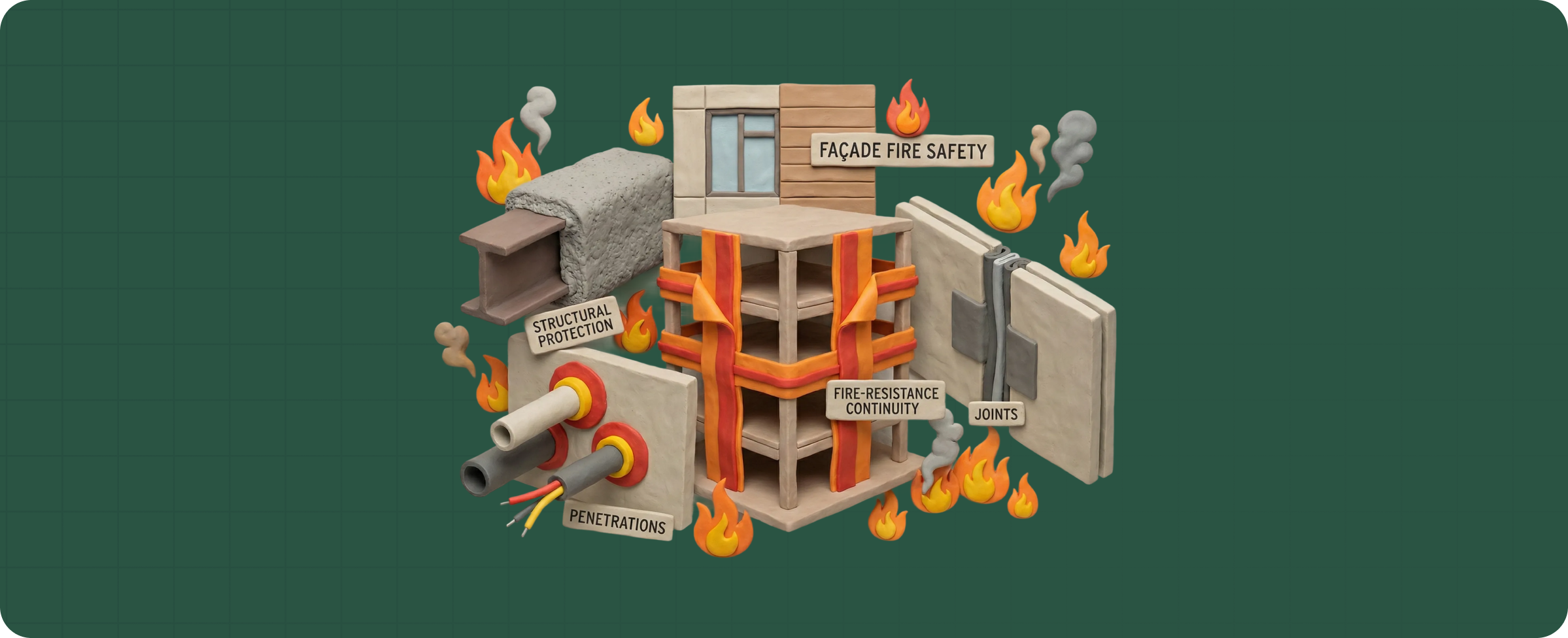
Chapter 7 of the 2025 CBC is one of the most technically significant updates in the entire code cycle. While no single “headline” change dominates the chapter, collectively these revisions reshape how architects and engineers design compliant, constructible, and verifiable fire-resistance-rated systems.
Major takeaways:
1. Structural Member Protection Significantly Clarified or Expanded
- Requirements for supporting construction and column encasement have been rewritten for continuity and transparency.
- Columns must now maintain continuous fire protection through ceilings, with only specific exceptions.
- Protection of secondary structural members is reorganized for clarity.
2. Exterior Wall Fire-Resistance Continuity Strengthened
- Exterior walls must extend full height to the underside of roof sheathing or rated assemblies depending on fire separation distance.
- Parapet language tightened with required parapet clarifications.
3. Penetrations, Openings, and Joints Undergo Major Revision
- Multiple new exceptions for penetrations, shaft enclosures, and curtain wall intersections.
- Firestop and joint system installation rules expanded to distinguish listed system installation vs. approved material installation.
4. Special Occupancies Get Important Changes
Particularly I-2 and I-3:
- New exceptions for fire barrier continuity.
- Updated security glazing standards in I-3.
- Revised rules for care suites and other healthcare separations (ties into Ch. 4 but affects Chapter 7’s continuity rules).
5. New and Updated Exceptions that Change Real-World Construction Detailing
Including:
- Exceptions for penetrations in parking garages.
- Exceptions for elevator hoistway door protection.
- Updated rules for where latching devices are required.
Given the nature of fire and smoke protection, even small text changes create major real-world consequences, making this chapter one of the most important for designers to read deeply.
Below is every change, line by line, in organized table format.
Structural Member Protection & Fire-Resistance Requirements
| Section | Topic | Description of Change | Impact |
|---|---|---|---|
| 704.1.1 | Supporting Construction | Supporting construction FRR requirements added; exemptions allow flexibility for non-load-bearing walls, shorter structures, and certain columns. | Clarifies when structural members supporting rated assemblies need equivalent protection. |
| 704.2 | Protection of Primary Structure | Requires continuous encasement protection for columns through ceilings; provides defined exceptions. | Ensures no weak link at column-ceiling intersections. |
| 704.3 | Protection of Secondary Members | Merges 704.2 & 704.3 into one consolidated section. Permits membrane-based protection. | Streamlines fire-resistance continuity rules. |
| 704.5.1 | Secondary Attachments | Formatting changes. | No functional difference, but improves consistency. |
| 704.12 | Sprayed Fire-Resistive Materials | Word “resistant” corrected to “resistive.” | Editorial but important for consistency with ASTM E119 language. |
Exterior Wall Continuity & Parapets
| New? | Section | Topic | Description | Impact |
|---|---|---|---|---|
| X | 705.2.3.1 | Balconies & Projections | Exception updated to specify Type IV-HT. | Aligns balcony protection with mass timber rules. |
| X | 705.6 | Continuity | Exterior wall assemblies must extend to underside of roof/floor above or rated assembly; parapet requirements clarified. | Strengthens fire containment at exterior walls. |
| X | 705.7.1 | Structural Stability | New section for Type III floor assemblies. | Ensures stability during fire exposure. |
| X | 705.9 | Exterior Wall Openings | Note G updated to clarify applicability to open parking garages in accordance with §406.5. | Prevents misuse of open-parking allowances. |
| X | 705.11.1 | Parapet Construction | Language strengthened: “Required parapets shall…” | Removes ambiguity around optional vs. required parapets. |
Fire Walls, Fire Barriers, Smoke Barriers
What can you ask? (Sample questions)
- When does the 2025 CBC take effect and what editions does it adopt?
- What are the key California amendments to the IBC in CBC 2025?
- How do Title 24 energy requirements change in 2025?
- What accessibility changes are in Chapter 11B of CBC 2025?
| Section | Topic | Description | Impact |
|---|---|---|---|
| 706.1.2 | Fire Walls - Deemed to Comply | NFPA 221-compliant fire walls accepted, subject to §102.4 limits. | Aligns with national best practices. |
| 706.6 | Vertical Continuity | Clarifies Exception 2 conditions. | Prevents misinterpretation of continuity breaks. |
| 707.3.11 | Horizontal Separation Offsets | Fire barrier vertical offsets must comply with §510.2. | Important for podiums, transfer slabs, offsets. |
| 707.5 | Barrier Continuity Exceptions 3, 4, 5 | Adds floor sheathing as termination point. | Clarifies acceptable barrier termination conditions. |
Smoke Partitions & Smoke Barriers
| Section | Topic | Description | Impact |
|---|---|---|---|
| 708.4.1 | Smoke Partition - Elevator Lobbies | Must terminate into a fire barrier, smoke partition, or outside wall. | Prevents rated partitions from ending into unrated assemblies. |
| 709.4.2 | Smoke Barriers - Areas of Refuge & Elevators | Removes requirement for smoke/draft doors at hoistways with protected lobbies. | Simplifies design of protected elevator lobbies. |
| 709.5 Exception 1 | Openings | Positive latching not required. | Eases hardware costs. |
| 710.4 | Smoke Partition Continuity | New exception for I-2. | Provides healthcare design flexibility. |
| 710.4.1 | Smoke Partitions - Elevator Lobbies | Must terminate properly at rated assemblies. | Aligns requirements with §708 for consistent fire/smoke protection. |
Curtain Walls, Floor Intersections & Joints
| Section | Topic | Description | Impact |
|---|---|---|---|
| 712.1.3.2 | Automatic Shutters | Requirements reorganized into numbered list. | Improves enforceability. |
| 713.4 | Shaft Enclosures | Adds exception for high-rises. | Supports modern high-rise design with alternative methods. |
| 713.8.1 | Penetrations | Clarifies use of fire barriers/horizontal assemblies. | Key for multi-story risers & shafts. |
| 713.13.4 | Chute Discharge Rooms | Fire rating must follow Tables 716.1(2) & (3). | Aligns chute rooms with updated fire door/table standards. |
Firestop, Penetrations & Through-Penetrations
| Section | Topic | Description | Impact |
|---|---|---|---|
| 714.3 | Sleeves | Must follow manufacturer instructions or listing. | Prevents field-fabricated noncompliant sleeve assemblies. |
| 714.5.1 | Through Penetrations | Adds Exception 4 for penetrations in concrete floors/ramps in parking garages. | Reduces overregulation in low-risk conditions. |
| 714.5.1.2 | Through-Penetration Firestop | Adds Exception 4 for steel, ferrous, copper conduits through single concrete floors. | Acknowledges low-risk penetrations in monolithic slabs. |
Joint Systems, Curtain Wall Intersections
| Section | Topic | Description | Impact |
|---|---|---|---|
| 715.2 | Joint & Void Installation | Split into two subsections: listed systems vs. approved materials. | Major clarity improvement; prevents misinterpretation. |
| 715.4 | Curtain Wall–FR Floor Intersections | Adds exceptions where fire containment not required. | Critical for certain high-rise façade systems. |
| 715.5 | Curtain Wall–Non-FR Floor Intersections | Similar exceptions added for non-FR assemblies. | Expands applicability to non-rated floor conditions. |
| 715.6 | Fire Barrier–Non-FR Roof Intersections | More specific requirements written. | Important for large open roof spans, atriums, etc. |
Opening Protectives & Fire Doors
| Section | Topic | Description | Impact |
|---|---|---|---|
| 716.2.2.1.1 | Smoke & Draft Control | Adds exception for elevator hoistway opening protection. | Gives flexibility for fire service access elevators (FSAE). |
| 716.2.6.1 | Door Closing | Adds exception for fire doors. | Simplifies select hardware requirements. |
Mechanical, Electrical, Plumbing Intersections
| Section | Topic | Description | Impact |
|---|---|---|---|
| 717.2.4 | Controls | MEP controls may not be installed in air duct systems. | Important for HVAC design; avoids equipment inside ducts. |
Fireblocking & FR Assembly Tables
| Section | Topic | Description | Impact |
|---|---|---|---|
| 718.2.1 Exception 10 | Fireblocking Materials | Allows 19/32” FRTW structural panel. | Expands acceptable fireblocking materials. |
| 721.1(2) | Fire Resistance Table | Adds item for 2×6 studs at 24” o.c. | Updates wall FR assemblies for modern framing layouts. |
| 721.1(3) | FR for Floor/Roof | Adds wood I-joist assemblies. | Critical for engineered wood framing. |
| 722.2.1.4 | Concrete Walls with Gypsum | Clarifies text. | Improves assembly validity. |
| 722.2.1.4(1) | Multiplying Factors | Specifies applicability to concrete or CMU. | Eliminates ambiguity. |
| 722.2.1.4(2) | Time Assigned to Finish | Adds new footnotes for finish materials on exposed face. | Enhances accuracy of FR calculations. |
| 722.6.2(1) | Membranes on Wood Frame | Table clarification. | Critical for modern wall assemblies. |
| 722.6.2(3) | Exterior Face Membrane | Adds insulated vinyl siding & polypropylene siding. | Supports envelope changes in Ch. 14. |
Expert Commentary - Why Chapter 7 Matters So Much
Chapter 7 rarely gets headlines - but it is one of the highest-liability chapters for architects and engineers. It dictates the fire-resistance backbone of the building:
- How far fire can spread
- How rated assemblies behave under structural load
- How shafts and openings behave
- How mass timber interacts with compartmentation
- How exterior walls and curtain walls must be detailed
- How exits, lobbies, and high-rise systems contain smoke
For architects
This chapter influences:
- Wall section details
- Podium slab and transfer slab detailing
- Curtain wall anchors
- Parapet and coping details
- Corridors and separation layouts
- Healthcare floor planning
For structural engineers
It clarifies:
- Column protection
- FR continuity through mezzanines and multiple levels
- Protection of secondary framing
- Mass timber protections
For MEP engineers
New penetrations and control restrictions directly impact:
- Riser strategies
- Shaft design
- Mechanical rooms
- Electrical room construction methods
This chapter is one of the “silent killers” of budgets if misunderstood - because the detailing costs (firestopping, joint systems, slab edge protection) can balloon quickly.
FAQs
1. What are the most significant fire and smoke protection changes in CBC 2025?
CBC 2025 Chapter 7 introduces major updates to structural fire protection, exterior wall continuity, penetrations, fire barriers, smoke barriers, parapets, joint systems, and curtain wall intersections. These revisions significantly affect detailing, constructibility, and enforcement.
2. How did the CBC change requirements for protecting structural members?
Columns must now maintain continuous fire protection through ceilings, except for clearly defined exceptions. The rules for primary and secondary structural members are consolidated and clarified, reducing ambiguity about when encasement or membrane protection is required.
3. What changed for exterior wall fire-resistance continuity?
Exterior walls must now extend all the way to the underside of the roof or rated assembly. Parapet requirements are tightened, and new provisions address Type IV-HT balconies, exterior wall stability, and open-parking garage allowances.
4. Are parapet requirements different under CBC 2025?
Yes. New language clarifies that required parapets shall be provided—removing ambiguity that previously let some designers interpret parapets as optional. Several detailing exceptions are also clarified.
5. How did penetrations and firestopping rules change?
CBC 2025 adds new exceptions for penetrations—especially in parking garages and elevator hoistways—and creates sharper distinctions between:
- Listed firestop systems
- Approved materials allowed without full listings
This distinction directly affects submittals and inspections.
6. What’s new for joint systems and curtain wall intersections?
Joint and void installation rules are reorganized into two pathways:
- listed systems and
- approved materials.
Curtain wall–floor intersections also gain new exceptions for conditions where fire-containment systems aren’t required.
7. Did Chapter 7 change fire barrier or smoke barrier continuity rules?
Yes. Multiple continuity exceptions were modified or added—especially for:
- Healthcare facilities (I-2)
- Detention facilities (I-3)
- Areas of refuge
- Elevator lobbies
These directly impact corridor layouts, care suites, and protected lobby configurations.
8. What changed for I-2 and I-3 occupancies?
Healthcare and detention occupancies receive new flexibility:
- Updated glazing standards in I-3
- New exceptions for fire barrier continuity
- New smoke partition relief in I-2 elevator lobbies
- Revised rules supporting care-suite designs
These changes align with modern practice and reduce over-prescription.
9. How are elevator lobby requirements different in CBC 2025?
Two major updates:
- Smoke partitions in elevator lobbies must now terminate into a rated assembly (no “floating” partitions).
- Smoke/draft control doors at hoistways are no longer required when a compliant protected lobby is present.
10. Are there new rules for shafts and risers?
Yes. Several shaft enclosure changes are added:
- A new high-rise exception in §713.4
- Clarified rules for penetrations in shaft walls
- Updated chute discharge room requirements
These affect multi-story risers and high-rise mechanical strategies.
11. Did CBC 2025 update requirements for fire doors or opening protectives?
Yes. Notable changes include:
- New exceptions for elevator hoistway opening protection
- Updated rules for latching requirements
- Additional clarity in smoke & draft control door standards
12. How do the new rules impact MEP coordination?
CBC 2025 explicitly prohibits certain controls or equipment from being installed inside duct systems, revises penetration exceptions for garage slabs, and clarifies firestopping for MEP sleeves—meaning MEP engineers must coordinate earlier with architects and fire consultants.
13. What changed in the fire-resistance tables?
Several major updates:
- New assemblies for 2×6 wood studs at 24" o.c.
- Updated I-joist rated assemblies
- Clarified multiplying factors for concrete/CMU walls
- New siding materials added for exterior wall membranes
These updates influence wall sections, pricing, and UL-equivalent designs.
14. Why is Chapter 7 considered a “high-liability” chapter?
Because errors in fire-resistance design can cause:
- Failed inspections
- Costly field fixes
- Change orders
- Rejected submittals
- Post-occupancy liability
Chapter 7 determines how fire spreads through assemblies, shafts, facades, roofs, floors, and structural systems.
15. What should architects and engineers review first when applying CBC 2025 Chapter 7?
Start with:
- Structural fire-resistance continuity
- Exterior wall and parapet continuity
- Penetration and firestop exceptions
- Curtain wall–slab edge details
- Barrier continuity exceptions in I-2/I-3
- Updated FR tables for assemblies
These areas drive the biggest design and cost implications.
References
Related Building Code Resources
- Permits & AmendmentsNavigating North Dakota Building Permits & Local Code Amendments
- Energy Code (IECC)North Dakota Energy & MEP Codes: A Compliance Guide for IECC, NEC, IMC & IPC
- Building CodesND Code for Existing Buildings: Ag Exemptions, Renovations, Pole Barns & Tiny Homes
- Fire & Life SafetyNorth Dakota Residential Code: Key IRC Requirements for Decks, Egress, Garages & Railings
- Structural DesignNorth Dakota Structural Design: Code Requirements for Snow Loads, Frost Depth & Wind
MeltPlan
A curated stream of preconstruction intelligence, estimating innovation, takeoff breakthroughs, workflow advancements, and expert perspectives—powered by the AI and technology shaping the future of construction.
Visit SiteDon't miss what's shaping AEC
The latest on preconstruction, codes, AEC news & trends — so you're always in the know.