What Are the Most Common Code-Related Coordination Failures in Building Design (Across Architecture, Structure, and MEP)?
The most common code-related coordination failures in building design occur because architecture, structure, mechanical, electrical, plumbing, and fire protecti..
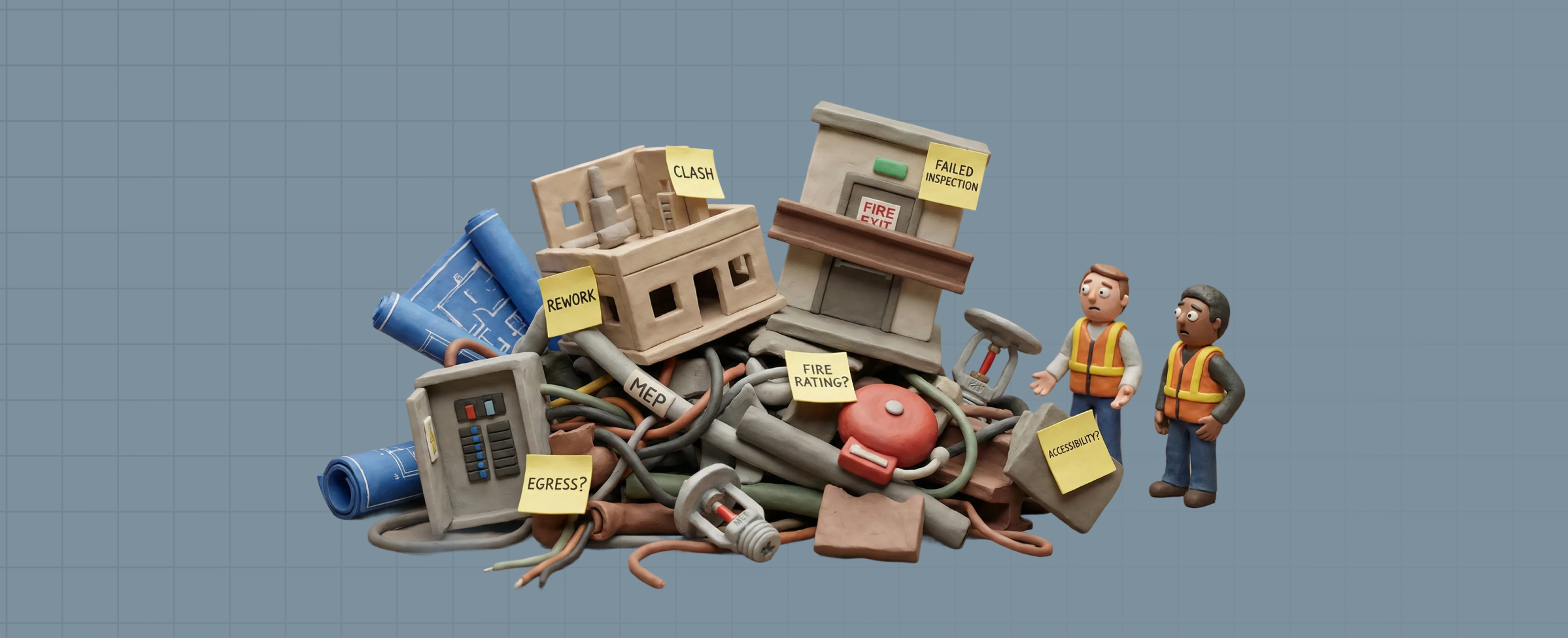
The most common code-related coordination failures in building design occur because architecture, structure, mechanical, electrical, plumbing, and fire protection teams each rely on different codes, standards, and interpretations - and they rarely integrate those requirements early enough or consistently enough. Code compliance is fundamentally a multi-disciplinary coordination challenge, not a single-discipline knowledge challenge. Every discipline works from its own code framework (IBC for architecture; IMC, IPC, NEC, ASHRAE for MEP; NFPA for fire protection; ASCE/ACI/AISC for structure), and misalignment between these frameworks produces clashes in BIM, conflicts in field installation, and failures during inspections.
The most common failures center around egress (door swings, dead ends, stair geometry), fire-rated assemblies (MEP penetrations, damper miscoordination, ceiling interruptions), mechanical/electrical room sizes and clearances (due to NEC, IMC, and ASHRAE requirements), sprinkler and alarm coordination (device spacing, obstructions, mounting heights), accessibility (ADA/ANSI/state amendment conflicts), structural and envelope interfaces (shear walls obstructing egress, roof-to-wall continuity), and plumbing systems (fixture clearances, waste/vent penetrations, floodplain conflicts).
Most coordination failures do not stem from someone “not knowing the code” - they stem from different disciplines interpreting overlapping rules differently, from late integration of MEP/FP systems, from BIM models that capture geometry but not code logic, and from the absence of centralized documentation for code decisions across projects. Local amendments, conflicting standards (IBC vs NFPA vs NEC vs ADA), and AHJ-specific enforcement styles add more complexity, often resulting in rework, redesign, failed inspections, and costly delays.
Ultimately, code-related coordination failures happen because building design is an interconnected web of multi-code requirements - and without early alignment, shared code context, and consistent communication with AHJs, even well-designed projects can fall out of compliance once systems converge.
Introduction: Code Compliance Is a Multi-Disciplinary Coordination Problem
Most code violations don’t happen because a designer “didn’t know the rule.”
They happen because discipline-specific interpretations weren’t aligned.
Architecture uses the IBC.
MEP engineers follow IMC, IPC, NEC, ASHRAE, NFPA.
Fire protection uses NFPA 13 and 72.
Structural teams follow ASCE/ACI/AISC.
Contractors build based on details - not code text.
Inspectors enforce based on AHJ interpretation.
This creates thousands of potential coordination gaps, most of which fall into predictable categories.
Below are the most common coordination failures, why they happen, and how they derail projects.
1. Egress & Circulation Misalignment
Egress is the epicenter of multi-discipline conflicts.
1.1 Door Swings Into Egress Paths
- Architect sets door swing for program needs
- Accessibility requires certain clearances
- Fire code requires door swing direction based on occupant load
- Contractor installs hardware that affects clear width
- Electrical team adds hold-open devices requiring power & compliance with NFPA 70
Result: corridor clearance violations at inspection.
1.2 Exit Access Dead Ends
- Floor plans evolve
- MEP adds shafts or chase walls
- Structural bracing alters corridor geometry
Dead ends > 20 ft (or 50 ft in sprinklered areas) go unnoticed.
1.3 Stair & Elevator Misalignment
- Structural grid conflicts with stair geometry
- MEP equipment intrudes into required clearances
- Fire damper or duct routing obstructs egress path
Result: last-minute redesign or AHJ rejection.
2. Fire-Rated Assemblies Broken by MEP Penetrations
One of the most widespread coordination failures in the industry.
2.1 Rated Wall Not Continuous Due to MEP Routing
Common offenders:
- ductwork
- VAV boxes
- piping
- conduit runs
- cable trays
- plumbing stacks
These create penetrations needing firestopping that is often:
- not detailed
- not compliant
- not permitted in certain assemblies
- installed incorrectly
2.2 Fire Dampers & Smoke Dampers Not Properly Coordinated
- Architect specifies rated shaft
- Mechanical routing violates damper requirements
- Structural struts conflict with damper installation
- Fire inspector rejects system
2.3 Rated Ceilings Broken by Lighting or Equipment
NFPA 13, UL fire-rated ceiling assemblies, and IBC continuity rules are rarely aligned early enough.
3. Mechanical/Electrical Room Size and Clearance Conflicts
What can you ask? (Sample questions)
- Where do I find the applicable energy code for my jurisdiction?
- What IMC requirements apply to commercial HVAC systems?
- How do IPC plumbing fixture count requirements work?
- What NEC electrical code provisions apply to my building type?
3.1 NEC Clearance Rules Ignored During Early Design
Electrical rooms require:
- 36–48 inches working clearance
- clear access to panels
- designated egress pathways
- fire separation depending on voltage
Architects often design rooms too small → requiring redesign.
3.2 Mechanical Rooms Don’t Meet IMC or ASHRAE Requirements
Conflicts include:
- insufficient ventilation
- inadequate working space
- equipment too close to walls
- no space for duct transitions
- access panels obstructed by architectural features
3.3 Fire Protection Equipment Not Integrated
Fire pump rooms require:
- specific access
- clearances
- power requirements
- environmental controls
Coordination usually happens too late.
4. Sprinkler & Fire Alarm Coordination Failures
Sprinkler and alarm systems follow NFPA 13 and 72, which are often overlooked until late DD/CD.
4.1 Sprinkler Heads Conflicting With Lighting Layouts
- Lighting designer adds decorative fixtures
- Architect adjusts ceiling heights
- NFPA 13 spacing rules are violated
- Contractor must reroute piping
4.2 Alarm Devices Installed at Incorrect Heights
ADA, ANSI, and NFPA have conflicting mounting height rules.
Electrical teams often miss these until inspection.
4.3 Sprinkler Obstructions From Ceiling Features
- Soffits
- Beams
- Decorative elements
NFPA obstruction rules are extremely precise - and often missed.
4.4 Fire Alarm Pull Stations in Wrong Locations
- Egress paths misunderstood
- Door swing changes
- Furniture layouts obstructing access
AHJs frequently flag these during field inspections.
5. Accessibility Coordination Failures
Accessibility is one of the greatest sources of rework.
5.1 ADA vs. ANSI vs. State Amendments Conflicts
Examples:
- California CBC 11B stricter than ADA
- Texas Accessibility Standards differ from ANSI
- NYC has unique accessibility rules
Design teams must reconcile multiple documents.
5.2 Blocking Accessible Clearances With Furniture or Equipment
Architectural: restrooms, doors
MEP: water heaters, ductwork
Electrical: panels
Interior design: furniture layouts
All affect compliance.
5.3 Incorrect Slopes at Ramps or Accessible Routes
Structural floor pitches
MEP pipe trenches
Slab depressions
Door thresholds
All can unintentionally create non-compliant slopes.
6. Envelope & Structural Coordination Failures
6.1 Rated Wall-to-Roof Assembly Breaks
Coordination gaps between:
- structural trusses
- roof penetrations
- mechanical rooftop units
- insulation assemblies
6.2 Seismic Bracing Interfering With Architectural Layout
- MEP equipment bracing
- light fixtures
- fire sprinkler bracing
Often discovered late due to lack of early coordination.
6.3 Egress Impacts from Structural Shear Walls
Shear walls may:
- restrict doorway placement
- conflict with egress windows
- limit corridor routing
- obstruct accessible routes
7. Plumbing & Sanitary Coordination Failures
7.1 Fixture Locations Not Aligned With Accessibility Requirements
- toilets placed too far from walls
- lavatories not meeting knee clearance
- urinals too high
- clear floor spaces obstructed
7.2 Waste & Vent Routing Violates Fire-Rated Assemblies
Stack penetrations often compromise rated walls or shafts.
7.3 Floodplain or stormwater requirements overlooked
Civil engineers and architects sometimes misalign:
- drainage
- sump pumps
- flood barriers
Leading to code compliance issues.
8. BIM Model Problems That Amplify Coordination Failures
8.1 Discipline Models Not Linked Early Enough
Architectural + Structural + MEP + FP often integrate too late.
8.2 Wrong Level of Detail (LOD)
Low LOD during early phases leads to massive adjustments later.
8.3 Clashes Discovered After CDs
- duct-to-beam clash
- sprinkler-to-lighting clash
- rated wall broken by mechanical chase
8.4 Model Not Reflecting Actual Code Requirements
Models often show geometry, not compliance logic.
9. Why These Coordination Failures Happen
9.1 Multi-code ecosystem creates cross-discipline contradictions
Each discipline uses different code books.
9.2 Roles interpret code differently
Design vs. engineering vs. construction vs. inspection.
9.3 Late integration of fire protection and MEP
Often added after architectural decisions are locked.
9.4 Lack of clear communication with AHJs
Different reviewers → different interpretations.
9.5 BIM limitations
BIM detects geometric clashes but not code compliance clashes.
9.6 No centralized documentation of past code decisions
Teams redo the same research each project.
FAQs
1. What is the single most common code-related coordination failure?
MEP penetrations through fire-rated walls and ceilings - either missing firestopping, using non-compliant assemblies, or routing equipment where rated continuity is required.
These failures occur across nearly every project and are frequently caught during inspections.
2. Why do egress and circulation issues show up so late in design?
Because architecture, structure, and MEP all modify egress geometry:
- Structural shear walls adjust corridor widths
- MEP shafts alter exit access routes
- Door hardware and electrical devices change clear widths
- Ceiling systems interfere with required headroom
These overlaps only surface once all disciplines integrate - often at the end of CDs.
3. Why do accessibility violations happen so frequently?
Because design teams must reconcile:
- ADA (federal law)
- ANSI A117.1
- IBC accessibility provisions
- State/local amendments (e.g., CBC 11B, TAS, NYC Local Laws)
Conflicts are common, and accessibility clearances can be unintentionally blocked by:
- Mechanical units
- Electrical panels
- Plumbing fixtures
- Interior design elements
- Structural constraints
Small dimensional differences (½"–1") often cause failures during inspection.
4. Why do electrical and mechanical room size errors keep occurring?
Because early floor plans often:
- Do not account for NEC working clearances
- Ignore IMC/ASHRAE equipment space requirements
- Fail to allocate room for duct/pipe transitions
- Provide insufficient access for service or replacement
- Leave no path for emergency egress within the room
These issues are usually discovered too late, requiring redesign or room enlargement.
5. Why do sprinkler and fire alarm conflicts happen late in the project?
Because fire protection systems governed by NFPA 13 and NFPA 72 are often:
- Designed late
- Coordinated after ceiling layouts
- Not integrated into architectural feature designs
- Affected by decorative lighting, soffits, beams, and ducts
Spacing, obstruction rules, and mounting heights frequently conflict with architectural and MEP layouts.
6. How do structural systems cause code-related coordination failures?
Structural elements, especially:
- Shear walls
- Braced frames
- Trusses
- Penetration restrictions
- Roof structure depth
…can interfere with:
- Egress continuity
- Accessible routes
- Shaft locations
- Rated wall continuity
- Mechanical routing
When structural decisions are locked early, they often constrain late-stage code compliance.
7. Why do plumbing/waste/vent systems create code compliance issues?
Common reasons:
- Waste stacks penetrating rated shafts
- Plumbing chases breaking rated assemblies
- Fixture placement not aligned with accessibility dimensions
- MEP trenches creating non-compliant slopes or thresholds
- Floodplain rules overlooked until late coordination
These issues cause major redesigns once civil, plumbing, and architectural models align.
8. Why does BIM fail to catch code-related coordination problems?
Because BIM tools detect geometric clashes, not code logic.
BIM does not inherently understand:
- Egress rules
- Accessibility clearances
- Fire-rated continuity
- Device spacing
- Mechanical/electrical service clearances
- NFPA obstruction rules
Thus, BIM = geometry detection
But code compliance = reasoning across standards.
9. What is the root cause behind most cross-discipline code conflicts?
The multi-code ecosystem:
- Architecture → IBC
- Fire protection → NFPA
- Mechanical → IMC + ASHRAE
- Electrical → NEC
- Plumbing → IPC
- Structure → ASCE/ACI/AISC
Each code has its own definitions, exceptions, clearances, and thresholds.
Conflicts are built-in because the documents were never written to perfectly align.
10. How can teams reduce code-related coordination failures?
Key strategies:
- Early multi-discipline coordination (architecture + structural + MEP + FP)
- Code-aware BIM workflows that integrate requirements (not just geometry)
- Project-specific code matrices shared across teams
- Regular meetings with AHJs to clarify interpretations early
- Centralized documentation of code decisions and past project precedents
- Jurisdiction-specific code datasets that include amendments and standards
When all teams work from the same code truth, errors drop dramatically.
References
ICC Codes (IBC/IFC/IEBC/IPC/IMC), NFPA 13/72/101/70, NEC, ADA Standards, ANSI A117.1, ASHRAE 62.1/90.1, UL/ASTM/AISC/ACI standards, field inspection reports, permitting processes, and decades of cross-disciplinary industry experience.
Related Building Code Resources
- Building CodesWhat Are the Key Aspects to Consider When Analyzing Building Codes?
- Building CodesDigital Code Libraries & Search Tools: What They Fix and What They Don’t
- Building CodesWhere Traditional Building Code Research Breaks Down
- Building CodesThe Hidden Costs of Manual Building Code Research
- Building CodesTraditional Building Code Research Methods
MeltPlan
A curated stream of preconstruction intelligence, estimating innovation, takeoff breakthroughs, workflow advancements, and expert perspectives—powered by the AI and technology shaping the future of construction.
Visit SiteDon't miss what's shaping AEC
The latest on preconstruction, codes, AEC news & trends — so you're always in the know.