What are the NEC rules for specific installation methods like junction box sizing and MC cable support?
Understanding specific installation requirements is critical for any electrical project's success, safety, and compliance. From sizing large pull boxes to corre..
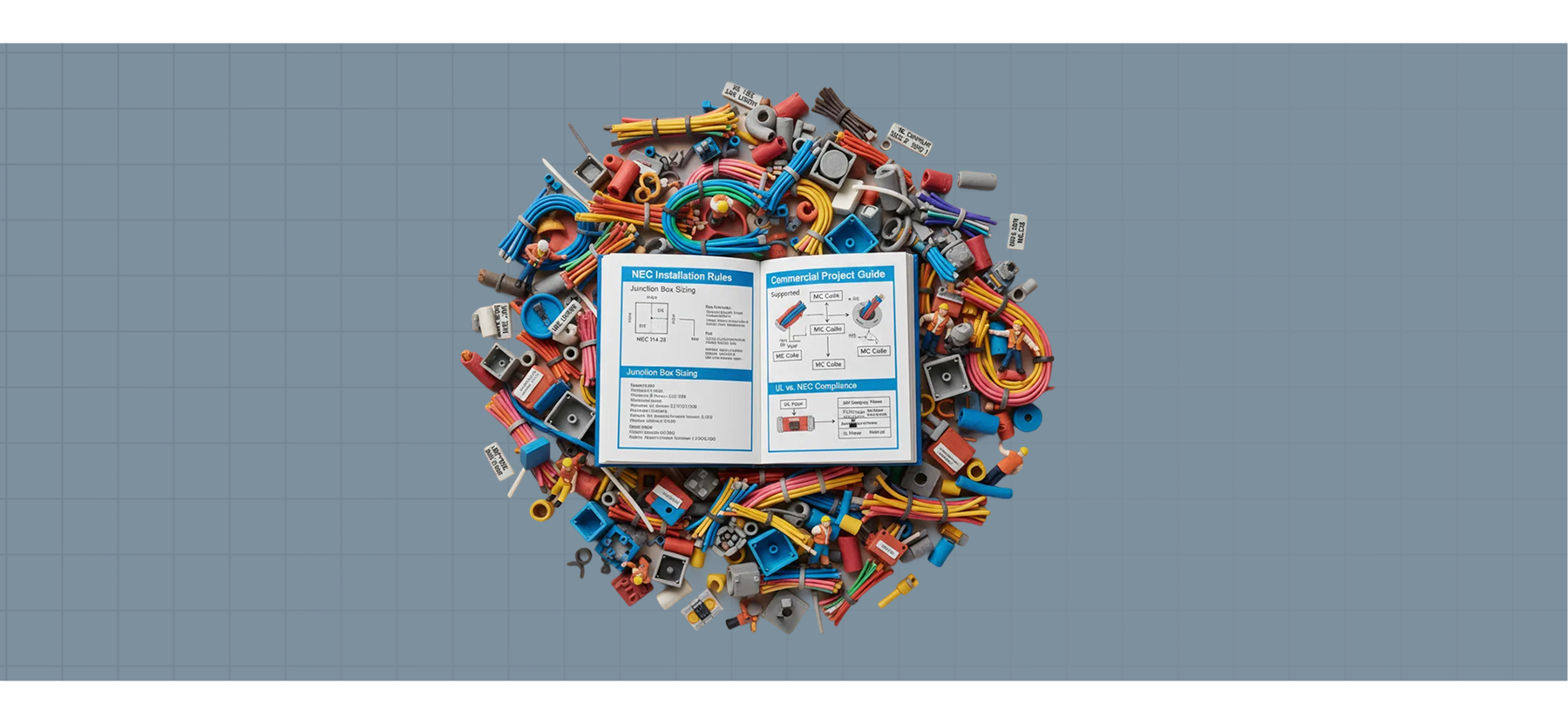
Understanding specific installation requirements is critical for any electrical project's success, safety, and compliance. From sizing large pull boxes to correctly interpreting product listings, the National Electrical Code (NEC) provides detailed rules that designers and installers must follow. Here are the key takeaways for some of the most common and complex installation scenarios:
- Large Junction Box Sizing (NEC §314.28): For conductors 4 AWG or larger, box sizing is not based on wire fill. Instead, it's determined by the size and arrangement of the raceways entering the box.
- Straight Pulls: The box length must be at least eight times (8x) the trade size of the largest raceway.
- Angle or U Pulls: The distance between a raceway entry and the opposite wall must be at least six times (6x) the trade size of the largest raceway, plus the sum of the diameters of all other raceways on the same wall.
- MC Cable Support (NEC §330.30): Metal-Clad (MC) cable must be supported and secured at specific intervals to prevent damage and stress.
- Maximum Spacing: Secure and support MC cable at intervals not exceeding 6 feet.
- Near Terminations: Secure the cable within 12 inches of every box, cabinet, or fitting, with certain exceptions for fished installations.
- UL Listing vs. NEC Compliance: A UL Listing certifies that a product meets a specific safety standard. However, it does not guarantee NEC compliance. Compliance is only achieved when the listed product is installed and used according to both the NEC's installation rules and the manufacturer's instructions included with the listing (NEC §110.3(B)).
- Local Amendments Matter: The NEC is a model code. States and local jurisdictions frequently adopt it with amendments. For example, the New York State Electrical Code expands tamper-resistant receptacle requirements in commercial buildings beyond what the base NEC mandates. Always verify local requirements.
- Melt Cide?L
Why These Specific Rules Are Crucial for Design and Permitting
Seemingly minor details in the National Electrical Code (NFPA 70) can have a major impact on project safety, cost, and inspection outcomes. Misunderstanding rules for junction box sizing, cable support, or local amendments can lead to failed inspections, costly rework, and unsafe conditions. These issues bridge the gap between design theory and field reality, impacting every stage of a project:
- Design & Engineering: Architects and engineers must account for the physical space required by large, code-compliant pull boxes. They must also specify correct support methods and materials on construction documents.
- Permitting & Plan Review: Plan reviewers are trained to spot common violations. Incorrectly specified box sizes or support details can result in plan rejection, delaying the permit.
- Installation & Field Work: Electricians rely on these rules daily to perform safe and efficient installations. Proper MC cable support prevents sagging and damage, while correct box sizing ensures conductors can be pulled without damaging their insulation.
- Inspections: The Authority Having Jurisdiction (AHJ) will verify these requirements in the field. A violation of NEC §314.28 or §330.30 is a clear-cut reason for a failed inspection.
Understanding the interplay between the NEC (installation standard), UL (product safety standard), NFPA (fire and life safety standards), and local amendments is the hallmark of a knowledgeable professional.
For a large junction box containing 4 AWG conductors, what are the calculation requirements under NEC 314.28(A)(2) for sizing the box when there are multiple angle or U pulls?
For junction boxes housing conductors 4 AWG or larger, the sizing requirements are dictated by NEC 2023 §314.28(A), which focuses on providing adequate space for pulling and bending conductors without damaging their insulation. The calculation for angle or U pulls is more complex than for straight pulls and is based on the raceway diameters, not the number of conductors.
The rule in NEC §314.28(A)(2) states that the distance between each raceway entry inside the box and the opposite wall of the box must be at least six times (6x) the trade size (diameter) of the largest raceway in that group, plus the sum of the trade sizes of all other raceways on the same wall and in the same row.
Here is a breakdown of the calculation process:
- Identify the Largest Raceway: For each wall where raceways enter, determine the largest raceway size.
- Calculate the "6x" Dimension: Multiply the trade size of the largest raceway by six.
- Sum Remaining Raceways: Add the trade sizes of all other raceways entering on that same wall and row.
- Determine Box Dimension: The sum from steps 2 and 3 gives you the minimum required dimension (length or width) from that wall to the opposite wall. This calculation must be performed for each direction of pull (e.g., horizontally and vertically).
Example Calculation:
Imagine a junction box with two raceways on the left side and one on the top, all containing conductors making a 90-degree bend (an angle pull).
- Left Wall: One 3-inch conduit and one 2-inch conduit.
- Top Wall: One 4-inch conduit.
Calculation for the Box Width (Left to Right Pull):
- Largest raceway on the left wall is 3 inches.
- Six times the largest raceway: 6 x 3" = 18"
- Sum of other raceways on that wall: + 2"
- Minimum Box Width = 18" + 2" = 20"
Calculation for the Box Height (Top to Bottom Pull):
- Largest (and only) raceway on the top wall is 4 inches.
- Six times the largest raceway: 6 x 4" = 24"
- Sum of other raceways on that wall: + 0"
- Minimum Box Height = 24" + 0" = 24"
In this scenario, the junction box must be at least 20 inches wide and 24 inches tall.
Additionally, NEC §314.28(A)(2) requires that the distance between raceways enclosing the same conductor not be less than six times the trade size of the larger raceway. This ensures adequate bending space between the entry and exit points of a U pull.
What are the requirements for securing and supporting MC cable in a commercial building? Specifically, what is the maximum spacing between supports per NEC Article 330?
What can you ask? (Sample questions)
- What are the minimum stall dimensions for accessible restrooms?
- How do ADA and IBC restroom clearance requirements differ?
- What door swing clearances are required for accessible stalls?
- Do ambulatory accessible stalls have different dimension rules?
The primary requirement for securing and supporting Metal-Clad (MC) cable is found in NEC 2023 §330.30. The code mandates that MC cable must be supported and secured at intervals not exceeding 6 feet (1.8 meters).
Beyond this general rule, there are several key details and exceptions that apply in commercial installations:
- Securing Near Terminations: According to NEC §330.30(C), MC cable must be secured within 12 inches (300 mm) of every outlet box, junction box, cabinet, or fitting. This prevents the cable from pulling away from the connector and exposing conductors.
- Acceptable Support Methods:NEC §330.30(A) permits the use of staples, cable ties listed and identified for securement and support, straps, hangers, or similar fittings designed and installed so as not to damage the cable. The choice of support often depends on the installation environment (e.g., running along framing members vs. suspended from a ceiling).
- Key Exceptions to the Rules:NEC §330.30(D) provides several important exceptions where the standard spacing and securing rules do not apply:
- Fished Cable: When MC cable is fished through concealed spaces in finished buildings (walls, floors, or ceilings), support is not required.
- Short Runs: For runs not exceeding 6 feet from the last point of support to equipment or a luminaire, securing within 12 inches of the connection is not required. This is common for fixture whips.
- Accessible Locations: In accessible ceilings, MC cable for luminaires or equipment can be unsupported for up to 6 feet from the last point of support.
Properly supporting MC cable is essential for protecting its metallic sheath and internal conductors from physical damage during and after construction.
The New York State Electrical Code has an amendment regarding tamper-resistant receptacles. Does this apply to all locations in a commercial office building, or only specific areas like childcare facilities?
This applies to a much broader range of locations in a commercial office building than what the base National Electrical Code requires. The New York State Uniform Code Supplement amends NEC Article 406 to significantly expand the mandate for tamper-resistant (TR) receptacles in commercial and public settings.
Here’s a breakdown of the differences:
- Base NEC Requirement (2020/2023 §406.12): The model NEC requires TR receptacles in specific locations, including dwelling units, hotel/motel guest rooms, and childcare facilities. For a typical commercial office, the base NEC would only mandate them in a dedicated childcare or daycare area.
- New York State Amendment: The NYS amendment to NEC §406.12 expands this requirement to include 15- and 20-ampere, 125- and 250-volt nonlocking-type receptacles in public-use areas of commercial buildings. This includes, but is not limited to:
- Lobbies, waiting rooms, and lounges
- Corridors and hallways accessible to the public
- Auditoriums and meeting rooms
- Cafeterias and break rooms
- Restrooms
- Retail spaces
In a commercial office building, this means that while private, locked offices might be exempt, any area where clients, visitors, or the general public might be present (such as the main reception area, conference rooms, or hallways) would require TR receptacles. This is a critical distinction that designers and contractors working in New York must know to pass inspection.
What is the difference between NFPA 701 Test Method 1 and Test Method 2, and what types of fabrics or materials are they applicable to for demonstrating fire resistance?
NFPA 701, Standard Methods of Fire Tests for Flame Propagation of Textiles and Films, provides two distinct test methods to evaluate how a fabric resists ignition and flame spread. The primary difference between Test Method 1 and Test Method 2 is the type and weight of the material they are designed to test.
This standard is often referenced by the International Building Code (IBC §807) and International Fire Code (IFC) for curtains, draperies, and other decorative hangings used in public assembly, educational, and institutional occupancies.
- NFPA 701 Test Method 1:
- Applicability: This method is for materials that are less dense. It is used for single-layer fabrics, light-transmitting materials, and films with a mass per unit area of less than 21 oz/yd² (700 g/m²).
- Procedure: A small, single-layer sample of the fabric is exposed to a standardized flame for a short period.
- Pass/Fail Criteria: The material passes if, after the flame is removed, the char length is within specified limits, it self-extinguishes within 2 seconds, and it does not drip flaming material onto the test chamber floor.
- NFPA 701 Test Method 2:
- Applicability: This method is for heavier and more complex textile assemblies. It is required for fabrics with a mass per unit area of more than 21 oz/yd² (700 g/m²). It is also used for multi-layered materials like lined curtains, tents, tarps, and fabric banners with plasticized backings.
- Procedure: A larger, folded sample is tested in a larger chamber, exposing it to a more intense flame for a longer duration. This simulates how a heavier, draped material would react to fire.
- Pass/Fail Criteria: The pass/fail criteria are similar to Test Method 1 but adjusted for the larger scale. The material must self-extinguish quickly, have a limited char length, and not produce flaming drips.
In summary, if you are specifying a lightweight, single-layer decorative fabric, it will likely be tested to Test Method 1. If you are specifying heavy, blackout-lined drapery for a theater, it must pass Test Method 2.
Does a UL listing for an electrical component automatically mean it complies with the National Electrical Code?
No, a UL Listing does not automatically mean a component or its installation complies with the NEC. This is a critical and often misunderstood concept. The UL Listing and the NEC serve two different but related purposes.
- UL (or other NRTL) Listing: This is a product safety certification. Underwriters Laboratories (UL) or another Nationally Recognized Testing Laboratory (NRTL) tests a product against a specific, published safety standard (e.g., UL 489 for Molded-Case Circuit Breakers). A UL Listing signifies that the product, when used as intended, has been evaluated for foreseeable risks of fire, electric shock, and other hazards.
- National Electrical Code (NEC): This is an installation standard. The NEC provides the minimum requirements for the safe installation of electrical wiring and equipment. It tells you how and where to install the UL-listed product.
The connection between the two is found in NEC 2023 §110.3(B), one of the most important sections in the entire codebook: "Listed or labeled equipment shall be installed and used in accordance with any instructions included in the listing or labeling."
This means that NEC compliance is a two-part process:
- The component itself must be listed for the application (NEC §110.2).
- The installer must follow both the NEC's installation rules and the manufacturer's specific instructions that are part of the UL Listing.
Example of Non-Compliance with a Listed Product:An installer uses a UL-Listed circuit breaker in a panelboard. However, the panelboard's own listing specifies that only breakers from the same manufacturer are permitted for use in that panel. Even though the breaker is listed, the installation violates NEC §110.3(B) because it goes against the panel's listing instructions, creating a non-compliant and potentially unsafe assembly.
Common Mistakes and Misinterpretations
- Confusing Box Fill with Box Sizing: For boxes with 4 AWG and larger conductors, installers sometimes mistakenly apply conductor fill calculations from NEC §314.16 instead of the raceway-based sizing rules in NEC §314.28. This can result in a box that is far too small.
- Improper MC Cable Supports: Using supports not designed for cables, such as plumbing hangers or unlisted zip ties, is a violation of NEC §330.30(A). Another common mistake is failing to secure the cable within 12 inches of a box, especially in busy ceiling spaces.
- Relying on Outdated Local Amendments: Jurisdictions like New York, California, and Chicago regularly update their amendments. A designer or installer must always work from the currently adopted code cycle and its specific local supplements, not a previous version.
- "Listed" means "Approved for Everything": A common error is assuming a product's listing makes it suitable for any environment. For example, using a luminaire listed only for "Dry Locations" in a damp or wet location is a direct violation of its listing and NEC §410.10.
Navigating Jurisdictional Variations
The NEC is a model code published by the NFPA, but it only becomes law when adopted by a state, county, or city. This adoption process almost always includes amendments.
- State-Level Adoptions: States like California (California Electrical Code - CEC), Texas, and Florida adopt a specific NEC cycle and publish a package of amendments. These can range from minor clarifications to major new requirements, like California's unique rules for PV systems and EV charging.
- Local (City/County) Amendments: Major cities often add another layer of rules. The Chicago Electrical Code, for instance, famously has more restrictive requirements for conduit use than the base NEC.
- Best Practice: Before beginning any project, always confirm the adopted code with the local Authority Having Jurisdiction (AHJ). This can usually be done by checking the building department's website or calling the plan review office. Never assume the model NEC is the final word.
Frequently Asked Questions (FAQ)
What is the difference between "listed" and "labeled"?
In practice, they are very similar. Per the NEC Article 100 definitions, "Listed" means the equipment is on a list published by a recognized testing lab (like UL). "Labeled" means the equipment has the lab's mark or symbol physically attached to it. Essentially, labeled equipment is a type of listed equipment.
How often is the National Electrical Code updated?
The NEC is updated on a three-year cycle. The most recent versions are the 2017, 2020, and 2023 editions. States and cities adopt these new cycles at their own pace.
Can I use Romex (Type NM cable) in a commercial building?
It depends on the building's construction type. NEC §334.10 restricts the use of Nonmetallic-Sheathed Cable (NM) based on the fire-resistive rating of the structure. It is generally prohibited in commercial buildings of Type I and II construction but may be allowed in certain wood-frame (Type III, IV, V) commercial structures.
What is the difference between the NEC (NFPA 70) and NFPA 70E?
The NEC (NFPA 70) is a standard for the safe installation of electrical systems to protect people and property from electrical hazards. NFPA 70E is the Standard for Electrical Safety in the Workplace and addresses safe work practices for employees who interact with energized electrical equipment (e.g., lockout/tagout, arc flash protection, PPE).
Is it a code violation to ignore the instructions that come with a UL-listed device?
Yes. NEC §110.3(B) explicitly requires that all listed equipment be installed and used according to its instructions. Ignoring these instructions is a direct code violation.
Where in the NEC are support requirements for electrical conduit?
Support requirements are found within the specific article for each conduit type. For example:
- EMT: Article 358
- Rigid Metal Conduit (RMC): Article 344
- PVC: Article 352
Are the California Electrical Code (CEC) and the NEC the same?
No. The CEC is based on the NEC, but the State of California adds, deletes, and modifies numerous sections to create its own enforceable code. It is critical to use the CEC, not just the NEC, for any project in California.
Related Building Code Resources
- MEP CodesUtah's Key Amendments to Mechanical, Electrical, and Plumbing (MEP) Codes
- Residential Code (IRC)Utah Residential Code (IRC) Guide for Home Construction & Remodeling
- Wildfire / WUI CodesAdvanced Utah Code: Existing Buildings (IEBC) and Wildland-Urban Interface (WUI)
- Commercial Code (IBC)Utah Code Guide to Building Height, Area, and Occupancy Separation
- Structural DesignStructural Design in Utah: Seismic, Snow Load, and Foundation Code Requirements
MeltPlan
A curated stream of preconstruction intelligence, estimating innovation, takeoff breakthroughs, workflow advancements, and expert perspectives—powered by the AI and technology shaping the future of construction.
Visit SiteDon't miss what's shaping AEC
The latest on preconstruction, codes, AEC news & trends — so you're always in the know.