What are the requirements for Type IV Heavy Timber (HT) construction?
Type IV Heavy Timber (HT) construction is a unique classification in the International Building Code (IBC) that relies on large, solid wood members with inheren..
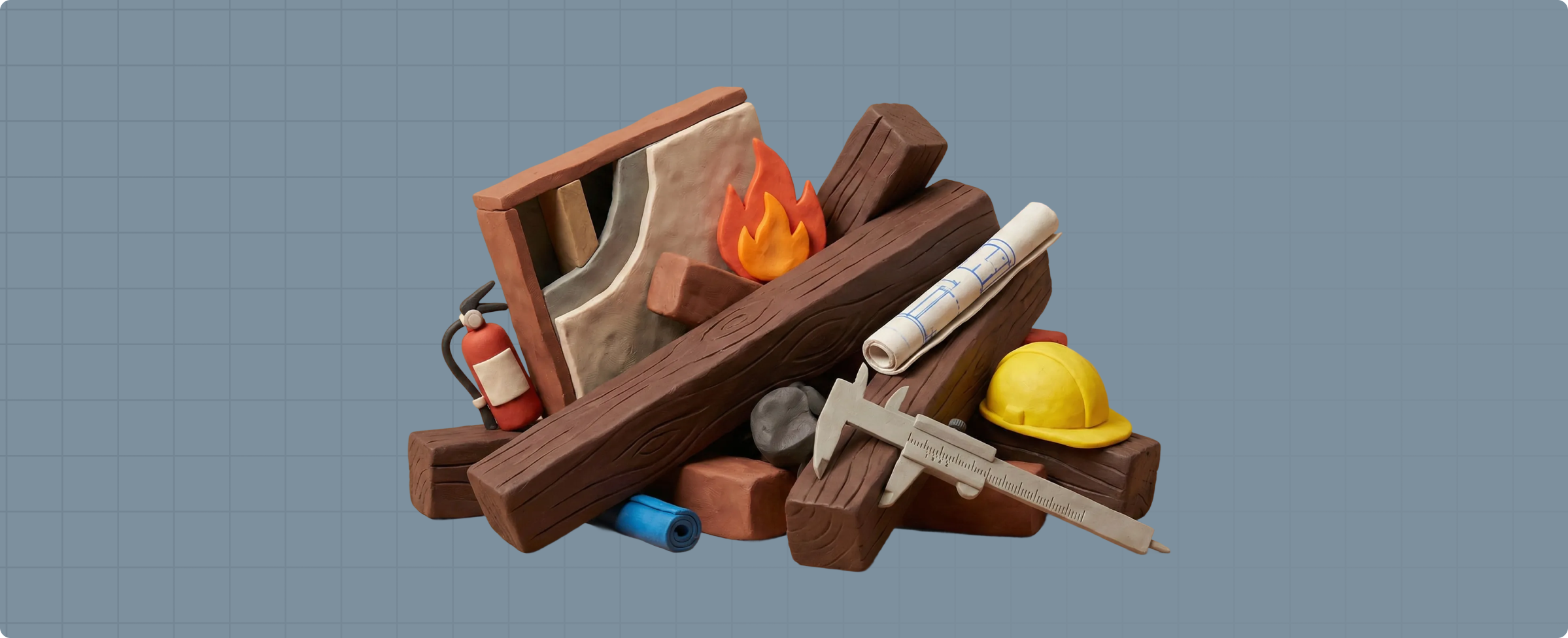
Summary of Type IV-HT Construction Requirements
Type IV Heavy Timber (HT) construction is a unique classification in the International Building Code (IBC) that relies on large, solid wood members with inherent fire-resistance. Instead of being protected by materials like gypsum, the massive wood is allowed to be exposed, as it chars at a slow and predictable rate during a fire. This char layer insulates the remaining wood, allowing the structure to maintain its integrity for a longer duration.
To be classified as Type IV-HT, a building must meet specific prescriptive requirements defined in the IBC.
Key Requirements for Type IV-HT:
- Minimum Member Dimensions: All wood columns, beams, girders, trusses, arches, and decking must meet minimum nominal dimensions to ensure they have sufficient mass to achieve the required fire performance.
- Noncombustible Exterior Walls: Exterior walls must be constructed of noncombustible materials. The interior surfaces of these walls may have heavy timber or noncombustible finishes.
- Limited Concealed Spaces: The fundamental principle is to avoid concealed combustible spaces where fire can spread undetected. Concealed spaces are strictly prohibited within the structural elements.
- Material Types: Materials can include solid-sawn lumber, glued-laminated timber (glulam), structural composite lumber (SCL), or cross-laminated timber (CLT), provided they meet the dimensional criteria.
Fire-Resistance Ratings: The building elements must meet the fire-resistance ratings specified in IBC Table 601. For Type IV-HT, this typically requires a 2-hour rating for the primary structural frame and a 1-hour rating for floor construction. These ratings are achieved through the prescriptive member sizes, not through applied finishes.
Minimum Nominal Timber Dimensions (IBC §2304.11)
| Structural Element | Minimum Nominal Dimension |
| Columns | 8 x 8 inches |
| Beams & Girders (Floor) | 6 x 10 inches |
| Beams & Girders (Roof) | 6 x 6 inches |
| Arches & Trusses (Floor) | 8 x 8 inches |
| Arches & Trusses (Roof) | 4 x 6 inches or 6 x 6 inches |
| Floor Decking | 3-inch T&G or 4-inch laminated |
| Roof Decking | 2-inch T&G or 3-inch laminated |
Context + Why This Topic Matters
Type IV, or Heavy Timber (HT), construction occupies a special place in the building codes. Unlike most construction types that achieve fire safety by encapsulating structural members (e.g., steel beams wrapped in gypsum), Type IV-HT leverages the inherent fire-resisting properties of large-dimension wood. This allows for the structural wood to be left exposed, creating the aesthetic warmth and character many designs seek, while still providing a high degree of life safety.
Understanding the specific rules for Type IV-HT is critical for architects, engineers, and contractors because it is a prescriptive building type. Failure to meet any of the specific requirements—from minimum member sizes to the prohibition of concealed spaces—can result in the building being reclassified, typically to a more restrictive type like Type III or Type V, which can have significant impacts on allowable height, area, and occupancy.
Common pitfalls include:
- Failing to meet the minimum nominal dimensions for all structural members.
- Using combustible exterior walls, which are not permitted.
- Introducing prohibited concealed spaces for MEP runs.
- Confusing traditional Type IV-HT with the newer Mass Timber construction types (IV-A, IV-B, IV-C) introduced in the 2021 IBC, which have different rules and allow for taller buildings.
Properly applying the Type IV-HT provisions allows for the creation of safe, durable, and aesthetically expressive buildings that celebrate their wooden structure.
What is Type IV Heavy Timber construction?
Type IV Heavy Timber (HT) construction is a building classification defined in IBC Chapter 6 where the primary structural frame and floor/roof systems are made of solid or laminated wood members with specified minimum dimensions. The governing principle, established in IBC §602.4, is that these massive wood elements possess sufficient bulk to char at a slow, predictable rate in a fire, thereby maintaining structural capacity without the need for external fire-protection like gypsum board or spray-applied fire-resistive materials.
The performance of heavy timber in a fire is well-documented. When exposed to flame, the outer layer of wood combusts and forms a layer of char. This char layer acts as an insulator, protecting the unburnt wood core. The rate of charring is approximately 1.5 inches per hour for common softwoods, a rate that engineers can use to calculate the residual structural capacity of a member after a given duration of fire exposure.
This contrasts sharply with other construction types:
- Type I & II: Noncombustible materials (steel, concrete).
- Type III: Noncombustible exterior walls with a combustible interior structure (often light-frame wood) that is typically concealed and protected to achieve a fire-resistance rating.
- Type V: Combustible construction throughout (e.g., light-wood framing), which is the most restrictive type.
Type IV-HT offers a unique combination of a combustible structural material used in a manner that provides significant inherent fire resistance, allowing it to be used for larger and taller buildings than standard light-frame construction.
What specific conditions must be met to classify a building as Type IV-HT (Heavy Timber)? Detail the minimum dimensional requirements for wood columns, beams, and floor/roof decking.
To classify a building as Type IV-HT, a project must strictly adhere to the prescriptive requirements outlined in IBC §602.4 and the detailed wood requirements in IBC §2304.11. The conditions are not flexible; if any are not met, the building cannot be classified as Type IV-HT.
Core Conditions for Type IV-HT Classification:
- Fire-Resistance Ratings: The building elements must meet the ratings specified in IBC Table 601. For Type IV-HT, this includes:
- Primary Structural Frame: 2-hour rating (achieved via member size).
- Exterior Bearing Walls: 2-hour rating (must be noncombustible).
- Floor Construction: 1-hour rating (achieved via member size).
- Roof Construction: 1-hour rating (achieved via member size).
- Minimum Element Dimensions: All wood members must meet the minimum nominal dimensions specified in IBC §2304.11. This is the most critical aspect of the classification. These dimensions apply to sawn lumber, glued-laminated timber (glulam), and other approved wood products like cross-laminated timber (CLT) and structural composite lumber (SCL).
Table of Minimum Nominal Dimensions for Heavy Timber (per IBC §2304.11)
| Element | Minimum Nominal Size (inches) | IBC Reference | Notes |
| Columns | 8 x 8 | §2304.11.2.1 | Supporting floor or roof loads |
| Floor Beams, Girders, Trusses & Arches | 6 x 10 | §2304.11.2.2 | Members supporting floor loads |
| Roof Beams, Girders, Trusses & Arches (> 8 ft o.c.) | 6 x 8 | §2304.11.2.3 | Roof loads only |
| Roof Beams, Girders, Trusses & Arches (≤ 8 ft o.c.) | 6 x 6 | §2304.11.2.3 | Roof loads only |
| Framing into Walls | 6 x 6 | §2304.11.2.4 | Members framing into walls |
| Floors (Sawn or Glulam) | 3" T&G or 4" laminated | §2304.11.3 | Laminated floors set on edge |
| Floors (CLT) | 4" thick (5-ply minimum) | §2304.11.3 | Must be covered with wood flooring or WSP |
| Roofs (Sawn or Glulam) | 2" T&G or 3" laminated | §2304.11.4 | Decking must be self-supporting |
| Roofs (CLT) | 3" thick (3-ply minimum) | §2304.11.4 | Must be covered with approved roof covering |
- Exterior Walls: Exterior walls must be constructed of noncombustible materials such as concrete, masonry, or steel studs (IBC §602.4.1). Wood framing is not permitted for the exterior walls of a Type IV-HT building.
- Partitions and Concealed Spaces:
- Interior bearing walls must be heavy timber or noncombustible construction.
- Nonbearing partitions are permitted to be of any material allowed by the code (IBC §602.4.4).
- Crucially, concealed spaces are not permitted within the heavy timber structural elements (IBC §602.4.5).
In a Type IV-HT building, what are the specific restrictions on concealing MEP systems within floor or wall assemblies, and can gypsum board be used to create shafts without violating the 'exposed wood' intent?
The restrictions on concealing MEP systems are fundamental to the safety principle of Type IV-HT construction. The code strictly limits concealed spaces to prevent the hidden spread of fire. The primary restriction is found in IBC §602.4.5, which states that concealed spaces shall not be constructed.
This means that routing MEP (mechanical, electrical, plumbing) systems within heavy timber floor or roof assemblies is prohibited. For example, you cannot build a 12-inch deep heavy timber floor and then run ductwork or conduit in a 4-inch void space between the timber and a finished ceiling. All structural wood must be solid.
Permitted Exceptions and Strategies:
- Surface Mounting: The most common approach is to surface-mount conduits, pipes, and smaller ducts directly to the exposed wood structure.
- Noncombustible Furring:IBC §602.4.5 allows for a noncombustible finish to be applied over the timber, creating a small concealed space, provided it is filled with a noncombustible material or fire-blocked as required.
- Dropped Ceilings: It is possible to create a dropped ceiling (e.g., acoustical tile or gypsum board) below the heavy timber structure to create a zone for MEP systems. However, this assembly must comply with fire-blocking and draft-stopping requirements in IBC Chapter 7, and it negates the primary aesthetic benefit of exposing the wood.
- Interior Partitions: MEP can be routed within non-load-bearing partitions, which are permitted to be light-frame construction (IBC §602.4.4).
Using Gypsum Board for Shafts:
Yes, gypsum board can be used to create shafts without violating the 'exposed wood' intent of Type IV-HT. The prohibition on concealed spaces applies to the structural elements themselves, not to the necessary enclosure of vertical openings.
Shaft enclosures are governed by IBC §713. This section requires vertical openings connecting stories to be enclosed with fire barriers that have a fire-resistance rating corresponding to the number of floors they connect (typically 2 hours). These shaft walls are almost always constructed from materials like gypsum board on steel studs or concrete masonry units (CMU).
The use of a gypsum shaft wall does not conflict with Type IV-HT rules because:
- It is not creating a concealed space within a heavy timber element.
- It is a specific life safety feature mandated by IBC Chapter 7 to prevent vertical fire and smoke spread.
- The primary structural frame (columns, beams, floors) surrounding the shaft must still meet all the dimensional and material requirements of Type IV-HT.
Does the IBC permit the use of an exposed mass timber floor/ceiling assembly in a Type III-A building if the assembly itself provides the required 1-hour fire-resistance rating without a separate gypsum ceiling?
This is a complex question that touches on the intersection of prescriptive code requirements and performance-based design. The short answer is generally no under the prescriptive path, but it may be possible as an alternative means and methods request (AMMR).
Here's the breakdown:
- Type III-A Requirements: According to IBC Table 601, Type III-A construction requires floor construction to have a 1-hour fire-resistance rating. Exterior walls must be noncombustible, while interior structural elements are permitted to be of any material allowed by the code, including wood.
- Prescriptive Interpretation: Historically, the 1-hour rating for wood-framed floors in Type III-A construction has been achieved by protecting the combustible framing (e.g., wood joists) with a layer of rated gypsum board. The code tables for fire-resistive assemblies (found in IBC §721 or listings from UL) are based on this concept of protection.
- Mass Timber Performance: A mass timber panel, such as a 5-ply Cross-Laminated Timber (CLT) panel, can be designed and tested (per ASTM E119) to provide a 1-hour fire-resistance rating on its own, without any protective covering. The charring of the exposed face provides the necessary insulation for the required duration.
The conflict arises because the prescriptive language of the IBC was not originally written with exposed, fire-rated mass timber in mind for Type III construction. A plan reviewer or building official may interpret Table 601 as requiring a protected assembly, regardless of the inherent rating of the mass timber panel itself.
Pathways for Approval:
- Alternative Means and Methods Request (AMMR): The most likely path to approval is to submit an AMMR under IBC §104.11. This would involve providing technical documentation to the authority having jurisdiction (AHJ) that demonstrates the exposed mass timber floor assembly provides equivalent or superior performance to a prescriptively compliant 1-hour rated assembly. This documentation would typically include:
- Fire-resistance calculations based on methods in the AWC's Technical Report 10 (TR10).
- Third-party testing reports (e.g., ASTM E119) for the specific mass timber product.
- A detailed engineering analysis.
- New Mass Timber Construction Types (IBC 2021/2024): The introduction of Types IV-A, IV-B, and IV-C in recent code cycles was specifically intended to address this issue. These types provide clear, prescriptive paths for building taller with exposed mass timber, defining the required fire-resistance ratings and the allowable percentage of exposed wood surfaces. For example, Type IV-C is very similar in height/area to Type III-A and explicitly permits the use of exposed mass timber ceilings that provide the required 1-hour rating. For new projects, designing to one of these new types is the most direct and code-compliant path.
In summary, while using an exposed mass timber ceiling in a Type III-A building is not prescriptively allowed, it is often approved through an AMMR. However, the cleaner, modern approach is to use the new mass timber construction types.
Additional Supporting Sections
Type IV-HT vs. Modern Mass Timber Types (IV-A, IV-B, IV-C)
The 2021 IBC introduced three new construction types to provide a clear regulatory framework for taller mass timber buildings. It's crucial not to confuse traditional Type IV-HT with these new classifications.
| Feature | Type IV-HT (Heavy Timber) | Type IV-C | Type IV-B | Type IV-A |
| Governing Principle | Prescriptive minimum timber sizes | Mass timber with limited encapsulation | Mass timber with partial encapsulation | Fully encapsulated mass timber |
| Primary Frame Fire-Resistance Rating | 2 hours | 2 hours | 2 hours | 3 hours |
| Floor Assembly Fire-Resistance Rating | 1 hour | 1 hour | 2 hours | 2 hours |
| Exposed Wood Ceiling | Permitted by default | Permitted by default | Permitted with area limits | Not permitted |
| Typical Maximum Height (IBC) | ~85 feet (e.g., Group B) | ~85 feet (e.g., Group B) | Up to 12 stories | Up to 18 stories |
| Key Characteristic | Char depth provides fire resistance | Refined HT rules | Hybrid protected approach | Treated similar to Type I-B |
Common Mistakes & Plan Review Hotspots
When designing or reviewing a Type IV-HT project, watch for these common errors:
- Undersized Members: Using a 6x6 beam for a floor or a 4x6 member for a column. The minimum dimensions in IBC §2304.11 are absolute.
- Combustible Exterior Walls: Specifying wood-stud exterior walls. Type IV-HT requires noncombustible exterior walls.
- Improper Connections: Using unprotected steel plates or fasteners that could fail prematurely in a fire. While IBC §2304.11.1 allows for steel connections, they must be detailed to ensure they are sufficiently protected by the surrounding wood mass.
- Prohibited Concealed Spaces: Detailing floor or roof assemblies with built-in voids for MEP. This violates IBC §602.4.5 and requires a redesign.
- Misclassifying CLT: Assuming any CLT panel is acceptable. The CLT must meet the minimum thickness and ply requirements of IBC §2304.11.3 and §2304.11.4.
Coordination Considerations for Design and Construction
- Architectural & Structural: The structure is the finish. Early coordination on member sizing, spacing, and connection details is essential to achieve the desired aesthetic and meet the strict dimensional requirements.
- MEP Integration: MEP engineers must be brought in early. The strategy for routing utilities must prioritize surface-mounting or routing within non-structural partitions. Planning for large ductwork or mains may require designated soffits or chases outside the primary heavy timber frame.
- Penetration Detailing: All penetrations through rated heavy timber floor and roof decks must be protected in accordance with IBC Chapter 7. This requires careful detailing of firestopping systems (e.g., collars, sealants) compatible with wood construction.
Frequently Asked Questions (FAQ)
1. What is the actual fire-resistance rating of a Type IV-HT building? The fire-resistance rating for the structural elements is prescribed in IBC Table 601. For Type IV-HT, this is typically a 2-hour rating for the primary structural frame and 1-hour for floors and roofs. This rating is achieved by meeting the minimum member dimensions, not by an hourly rating from a test like ASTM E119.
2. Can I use steel connectors in a Heavy Timber frame? Yes. IBC §2304.11.1 permits steel connectors. However, they must be detailed such that they are protected from fire. This is often achieved by embedding plates within the wood or ensuring bolts have sufficient wood cover to be insulated from heat.
3. Are sprinklers required in Type IV-HT buildings? Sprinkler requirements are based on occupancy group, area, and height as defined in IBC Chapter 9, not the construction type alone. However, providing an NFPA 13 sprinkler system can allow for significant increases in allowable building height and area for Type IV-HT, just as it does for other construction types.
4. Can Cross-Laminated Timber (CLT) be used in Type IV-HT construction? Yes. The IBC explicitly recognizes CLT as a material for heavy timber construction, provided the panels meet the minimum thickness and ply requirements listed in IBC §2304.11. For example, a floor deck requires a minimum 4-inch thick, 5-ply CLT panel.
5. What is the difference between nominal and actual wood dimensions? The code specifies minimum dimensions in nominal terms (e.g., 8x8). A nominal 8x8 is actually 7.5" x 7.5" when dressed. For code compliance, the nominal dimension is used. For structural engineering calculations, the actual dimensions must be used.
6. Can I build interior partition walls with light-wood framing in a Type IV-HT building? Yes. IBC §602.4.4 permits non-load-bearing interior partitions to be constructed of any material permitted by the code, including light-wood framing, provided they are not required to have a fire-resistance rating.
7. How are penetrations for pipes and ducts treated in heavy timber floors? Penetrations through the heavy timber floor or roof decks must be protected in accordance with IBC Chapter 7 to maintain the required 1-hour fire-resistance rating of the assembly. This involves using listed firestop systems around the penetrating items.
8. Can the inside face of the noncombustible exterior walls be finished with wood? Yes. While the exterior walls themselves must be noncombustible, IBC §602.4.1 permits the interior side to be surfaced with wood siding or heavy timber members, provided the members meet the minimum dimensional requirements.
Related Building Code Resources
- Building CodesWhat is a Certificate of Occupancy? The Final Step in Proving Code Compliance
- Building CodesPerformance-Based vs. Prescriptive Codes: Choosing the Right Path for Your Project
- Building CodesThe Digital Blueprint: How Technology is Revolutionizing Building Code Compliance
- Building CodesBalancing Past and Present: A Guide to Code Compliance for Historic Renovations and Existing Buildings
- Building CodesThe Role of a Building Inspector: What They Look For and How to Prepare for Inspection Day
MeltPlan
A curated stream of preconstruction intelligence, estimating innovation, takeoff breakthroughs, workflow advancements, and expert perspectives—powered by the AI and technology shaping the future of construction.
Visit SiteDon't miss what's shaping AEC
The latest on preconstruction, codes, AEC news & trends — so you're always in the know.