What Are the Standard Bathroom Stall Dimensions and Code Requirements?
Bathroom stall dimensions in the U.S. are regulated mainly by the ADA Standards, ICC A117.1, the IBC, and the IPC. A compliant restroom includes: Fire safety ad..
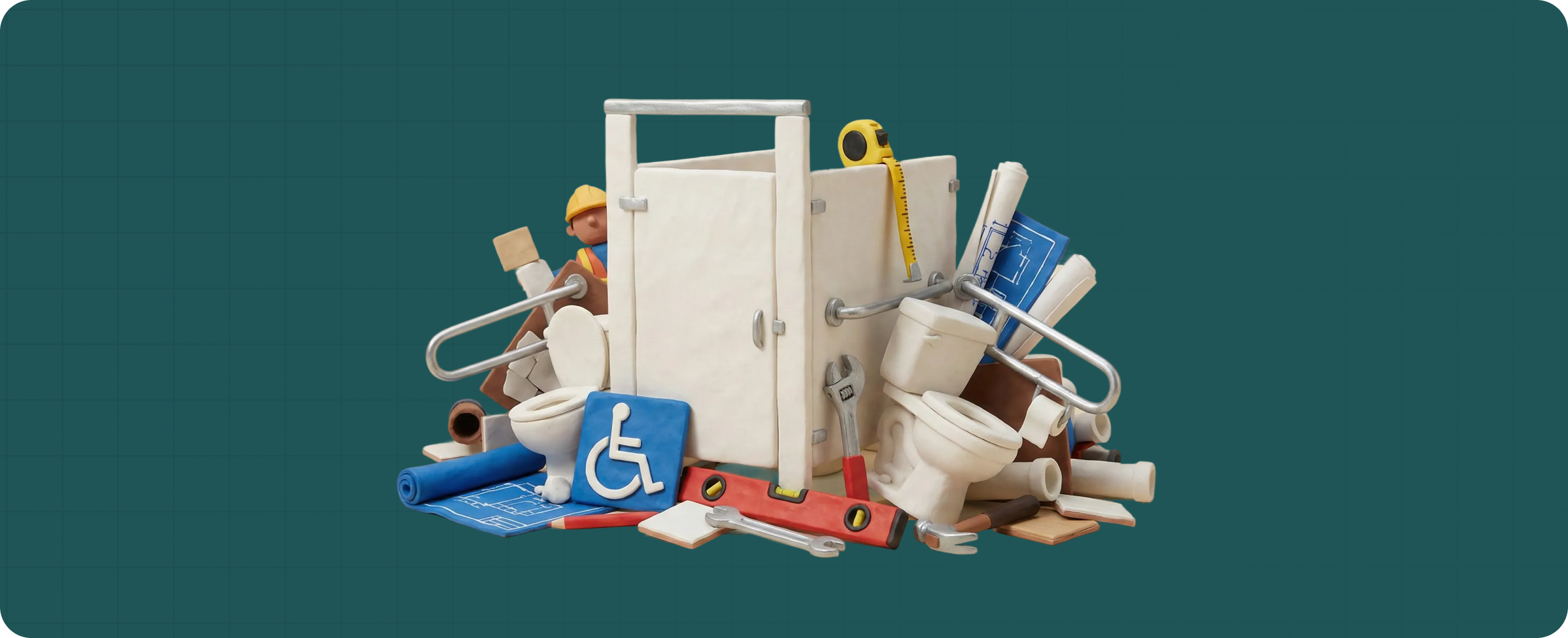
Bathroom stall dimensions in the U.S. are regulated mainly by the ADA Standards, ICC A117.1, the IBC, and the IPC. A compliant restroom includes:
- Standard stalls around 30–36 inches wide and 60 inches deep
- At least one ADA wheelchair stall, 60 inches wide and 56–59 inches deep
- An ambulatory-accessible stall 35–37 inches wide
- Doors providing at least 32 inches of clearance
- A 60-inch turning radius within ADA stalls
- Correct grab bar placement at 33–36 inches high
- Proper toe clearance beneath partitions
- An accessible route connecting the stall to the rest of the building
Fire safety adds another layer: stalls must not encroach on egress pathways, create dead ends, or interfere with travel distances. Installation challenges, local jurisdictional variations, and frequent field errors make stall compliance one of the most scrutinized aspects of restroom construction.
Standard Bathroom Stall Dimensions
Standard stalls in most buildings range from roughly 30 to 36 inches in width and are generally about 60 inches deep. These are acceptable for typical users but are not sufficient for accessibility.
Accessible restroom stalls, however, must be significantly larger. The ADA mandates a minimum width of 60 inches and a depth of 56 inches for wall-mounted toilets or 59 inches for floor-mounted toilets. These larger dimensions accommodate wheelchairs and provide room for turning, transferring, and maneuvering.
Ambulatory stalls—a third type—are used by individuals who walk with crutches or walkers. These are narrower than wheelchair stalls but must still be wider than a standard stall, typically 35 to 37 inches, with grab bars on both sides to offer stability.
These foundational dimensions set the stage for nearly every design, installation, and inspection decision that follows.
Read more: Standard Bathroom Stall Dimensions
Where Stall Dimension Requirements Apply in Building Codes
Bathroom stall size rules apply across almost all U.S. occupancy types regulated by the IBC, including assembly spaces (like theaters and stadiums), schools, hospitals, office buildings, industrial facilities, and multifamily buildings with shared restrooms. If a building serves the public or employees, stall dimension requirements almost always apply.
There are a few exceptions. Private dwelling bathrooms under the IRC are not required to meet commercial stall dimensions. Temporary structures, agricultural buildings not open to the public, and certain mezzanines are also exempt.
When existing buildings undergo renovations, code compliance kicks in. Even if the original restroom predates accessibility standards, any meaningful alteration typically triggers the requirement for at least one fully ADA-compliant stall.
Read more: Scope of Stall Dimension Requirements
Core Spatial Requirements for Restroom Stalls
What can you ask? (Sample questions)
- What are the minimum stall dimensions for accessible restrooms?
- How do ADA and IBC restroom clearance requirements differ?
- What door swing clearances are required for accessible stalls?
- Do ambulatory accessible stalls have different dimension rules?
Bathroom stall standards are not just about width and depth—they also include a network of clearances and approach zones that define usable space around the toilet, door, and partitions.
The ADA requires a full 60-inch turning radius inside accessible stalls or a compliant T-shaped turning space. This is one of the most commonly misunderstood and overlooked requirements. Doors leading into these stalls must provide a clear opening of at least 32 inches, and their swings cannot interfere with required maneuvering room.
Grab bars must be placed at specific heights and locations: typically along the side wall and behind the toilet, mounted between 33 and 36 inches above the finished floor.
Accessible routes to and from stalls must remain unobstructed, with floor slopes kept very shallow—no more than 1:48—to prevent tipping hazards.
These spatial requirements ensure not only accessibility but also comfort and safety during use.
Read more: Core Spatial Requirements for Stall Dimensions
How Stall Dimensions Interact With Fire Safety & Accessibility
Bathroom stalls must be designed so they do not interfere with life safety regulations. Stalls themselves are not fire-rated components, but restrooms are often placed near corridors, stair enclosures, or spaces that do require fire-resistance.
A major fire safety concern is the relationship between stall partitions and egress paths. Stall doors must not block required corridor widths, and restrooms must not create dead-end corridors, which can trap occupants during emergencies. Every restroom must also be planned so that its occupants have safe, clear passage to exits without exceeding allowed travel distances.
From an accessibility perspective, the ADA shapes nearly every aspect of the stall layout. Stall doors, maneuvering zones, turning spaces, grab bars, and clearances must work together without conflicting with egress or life safety requirements.
Sprinkler systems can relax certain fire-related corridor width requirements—but never ADA stall dimensions, which remain consistent nationwide.
Read more: Fire Safety Integration for Stall Dimensions
Installation Requirements for Bathroom Stalls
Even when drawings are perfect, installation errors frequently lead to noncompliance. Bathroom stall dimensions must be preserved after finishes, tile, trim, and partitions are installed.
Partitions must be installed plumb, aligned, and anchored without drifting into required clearances. A half-inch deviation can cause a failed inspection. Doors must offer full clearance when opened, and their hardware must be operable without tight grasping—typically requiring lever- or push-type handles.
Equally important is coordination with mechanical, electrical, and plumbing trades. Pipes, valves, conduit, sprinkler heads, lighting, and even janitorial equipment must remain outside required clear floor areas.
Finally, where stalls border fire-rated walls, firestopping must be applied to seal any penetrations, per IBC fire protection rules.
Read more: Stall Installation Codes
Inspection & Testing Requirements for Stall Dimensions
Bathroom stalls undergo strict plan review and field inspection processes.
During plan review, inspectors confirm that restroom layouts meet accessible route requirements, that stall sizes meet minimum dimensions, and that door swings do not intrude into maneuvering space or egress corridors.
During field inspections, they measure:
- stall widths and depths,
- door clearances,
- grab bar heights,
- toe clearance under front and side partitions,
- floor slopes,
- and accessible routes into and out of stalls.
Hardware must be operable with minimal force, and signage identifying accessible stalls must meet tactile and visibility standards.
In certain buildings—such as healthcare, assembly venues, or facilities with fire-rated corridors—special inspections may also be required for firestopping, smoke control, or emergency lighting.
Read more: Stall Inspection Requirements
How Stall Dimensions Vary Across U.S. Jurisdictions
While ADA and national model codes remain largely consistent, several states and local jurisdictions introduce additional requirements due to environmental or life-safety conditions.
- High-rise jurisdictions may enforce stricter corridor and lobby dimensions, indirectly affecting restroom layouts.
- Hurricane-prone states like Florida often require reinforced stall partitions and impact-rated doors or openings.
- WUI zones in states like California may alter adjacent corridor widths or require specific restroom locations to meet fire separation rules.
- Seismic zones such as California and the Pacific Northwest require stronger anchorage for partitions and grab bars to resist lateral forces.
- Climate codes may introduce vestibules or airlocks that affect restroom circulation, though ADA stall sizes remain unchanged.
Local amendments may also increase stall widths, require additional grab bars, or modify installation methods.
Read more: Jurisdictional Variations for Stall Dimensions
Common Failures and Enforcement Challenges
Bathroom stalls are among the most commonly cited accessibility violations in commercial buildings. Typical failures include:
- stalls built narrower than required,
- door swings blocking maneuvering clearances,
- toilets positioned too close to side walls,
- missing or misaligned grab bars,
- inconsistent stall sizes across a facility,
- and mechanical or plumbing obstructions intruding into ADA clearances.
Many failures occur because field installers do not account for finish materials, imprecise partition alignment, or misunderstandings of ADA technical criteria.
These errors frequently result in expensive rework, delayed occupancy, and, in many cases, legal action—particularly for public-facing buildings.
Read more: Stall Dimension Failures & Enforcement Challenges
FAQs
1. What is the standard width of a typical bathroom stall?
Most standard stalls fall between 30 and 36 inches wide, depending on layout efficiency.
2. How wide is an ADA wheelchair stall?
ADA requires a minimum clear width of 60 inches, wall to wall.
3. How deep must an ADA stall be?
Depth must be 56 inches for wall-mounted toilets and 59 inches for floor-mounted models.
4. Do all public restrooms need an ADA stall?
Yes. Every restroom serving the public or employees must include at least one wheelchair-accessible stall.
5. What is the turning radius inside an ADA stall?
A 60-inch turning circle or compliant T-turn is required.
6. Can the stall door swing inward?
Yes, so long as it does not obstruct required maneuvering clearances.
7. What is an ambulatory stall?
A stall for users with mobility aids, 35–37 inches wide, featuring grab bars on both sides.
8. How far from the wall must the toilet be installed?
The toilet centerline must sit 16 to 18 inches from the side wall.
9. What height must grab bars be installed?
Between 33 and 36 inches above the finished floor.
10. Can local codes require larger stalls?
Yes—cities like NYC or Chicago may impose stricter stall dimensions.
11. Do sprinklers reduce ADA stall size requirements?
No. ADA requirements are federal and remain unchanged regardless of fire protection systems.
12. What floor slope is allowed inside stalls?
A maximum 1:48 slope to maintain wheelchair stability.
13. Are stall partitions required to be fire-rated?
No—but restroom rooms themselves may require rated walls depending on adjacency.
14. What is the most common stall installation error?
Installing partitions too close to the toilet, reducing required clearance.
15. Can MEP elements intrude into stall spaces?
No. Nothing may project into required ADA clearances.
16. Do existing non-ADA stalls have to be upgraded?
Only when the restroom is altered or renovated—at that point, compliance becomes mandatory.
17. What are typical jurisdictional modifications?
Stronger anchorage for seismic regions, additional bracing in hurricane areas, or increased clearances in high-rise buildings.
18. Is toe clearance always required?
Yes—ADA mandates 9-inch-high and 6-inch-deep toe clearances.
19. Who is responsible for compliance?
Architects design compliant layouts; contractors install them correctly; inspectors verify final conditions.
20. How often do bathroom stalls fail inspection?
They are one of the most frequently cited ADA issues—especially for dimensions, door swing, and grab bar placement.
References
- IBC: https://codes.iccsafe.org/codes/ibc
- IPC: https://codes.iccsafe.org/codes/ipc
- ADA Standards: https://www.ada.gov/resources/2010-ada-standards/
- ICC A117.1: https://codes.iccsafe.org/codes/icc-a117-1
- NFPA 101: https://codesonline.nfpa.org
- ASCE 7: https://www.asce.org
Related Building Code Resources
- MEP CodesUtah's Key Amendments to Mechanical, Electrical, and Plumbing (MEP) Codes
- Residential Code (IRC)Utah Residential Code (IRC) Guide for Home Construction & Remodeling
- Wildfire / WUI CodesAdvanced Utah Code: Existing Buildings (IEBC) and Wildland-Urban Interface (WUI)
- Commercial Code (IBC)Utah Code Guide to Building Height, Area, and Occupancy Separation
- Structural DesignStructural Design in Utah: Seismic, Snow Load, and Foundation Code Requirements
MeltPlan
A curated stream of preconstruction intelligence, estimating innovation, takeoff breakthroughs, workflow advancements, and expert perspectives—powered by the AI and technology shaping the future of construction.
Visit SiteDon't miss what's shaping AEC
The latest on preconstruction, codes, AEC news & trends — so you're always in the know.