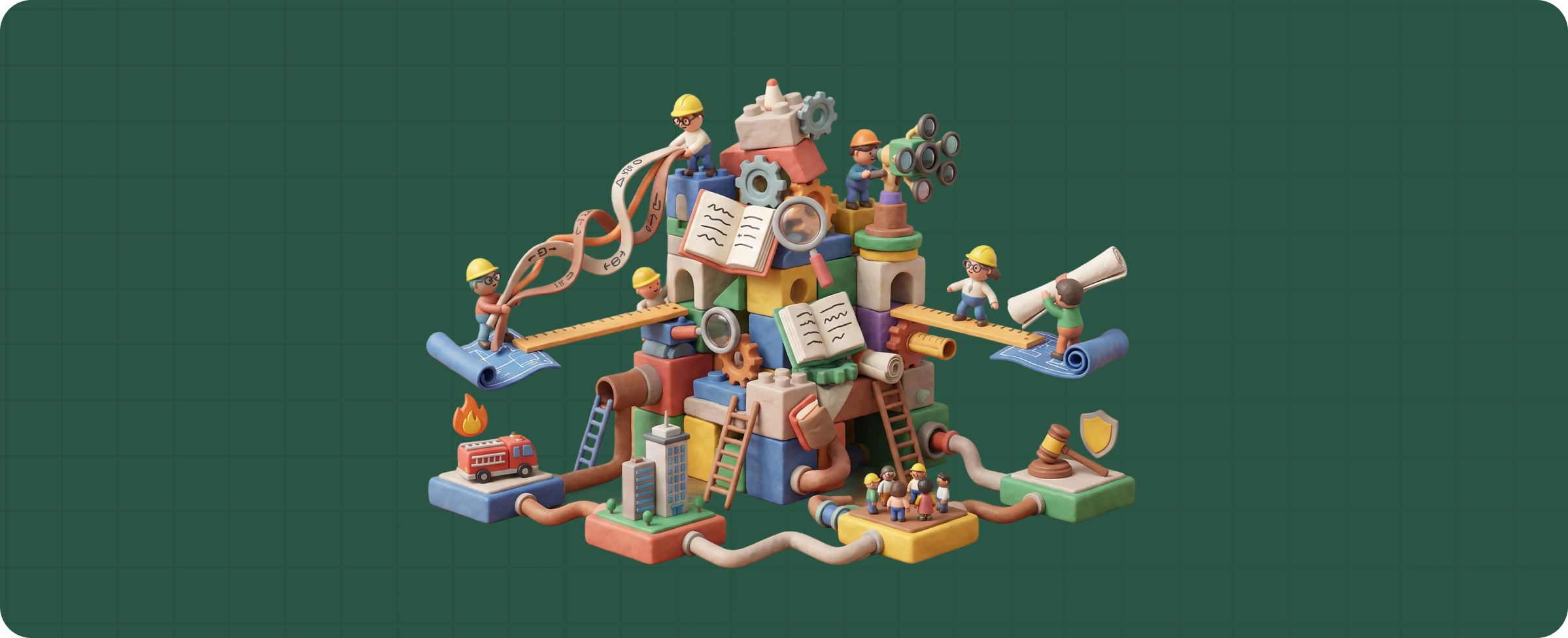
What is Building Code Compliance? A Complete Guide for Owners, Contractors, and Designers
Building code compliance is the essential, non-negotiable process of ensuring a building’s design, construction, and eventual occupancy adhere to a minimum se..
Building code compliance is the essential, non-negotiable process of ensuring a building’s design, construction, and eventual occupancy adhere to a minimum set of standards established to protect public health, safety, and general welfare. Far more than a bureaucratic hurdle, it is the foundational framework that ensures structures are safe from hazards like fire and structural collapse, while also promoting accessibility, energy efficiency, and long-term durability. For owners, designers, and contractors, mastering this process is the key to delivering a successful, legal, and responsible project.
- The Purpose and Players: Building codes exist primarily for safety. Compliance is a collaborative effort managed by a team of key players, including owners, architects, engineers, contractors, and the official building inspectors who represent the local jurisdiction.
- Code Development and Structure: The codes themselves are not written by local governments but are developed by organizations like the International Code Council (ICC). These model codes are then adopted and sometimes modified by state and local authorities. The two primary codebooks to know are the International Building Code (IBC) for commercial structures and the International Residential Code (IRC) for one- and two-family homes.
- The Compliance Process: The path to compliance follows a structured process, beginning with the submission of plans to obtain a Building Permit. Throughout construction, a Building Inspector will conduct a series of mandatory inspections at critical stages (e.g., foundation, framing, electrical) to verify work matches the approved plans and code.
- Methods of Compliance: There are two main approaches to meeting code requirements. Prescriptive codes provide a clear, rule-based "recipe" that must be followed exactly. In contrast, performance-based codes define the safety outcome that must be achieved, allowing for more innovative and flexible design solutions, especially in complex or unique projects.
- Common Challenges and Special Cases: Navigating compliance means avoiding common violations related to fire safety, structural integrity, and accessibility. Special considerations and challenges frequently arise in projects like historic renovations, where balancing preservation with modern safety standards is critical.
- The Finish Line: The ultimate goal of the process is to receive a Certificate of Occupancy (CO). This official document is issued only after all inspections have been passed, and it legally certifies that the building is safe and ready to be occupied.
- The Future of Compliance: Technology is rapidly changing the landscape. Digital plan reviews, drone inspections, and Building Information Modeling (BIM) are increasingly being used to streamline the process, reduce errors, and improve efficiency for all parties involved.
This guide will demystify the world of building code compliance. We will break down the entire ecosystem, from who writes the codes to the final Certificate of Occupancy. Whether you're designing a skyscraper, managing a job site, or investing in a new property, this article will serve as your definitive resource for navigating the critical path to compliance.
Table of Contents
- The "Why" Behind Building Codes: More Than Just Rules
- The Key Players in the Code Compliance Ecosystem
- Who Writes the Building Codes?
- The Building Permit Process Explained
- IBC vs. IRC: Understanding the Core Codebooks
- Avoiding Pitfalls: 10 Common Building Code Violations
- The Role of a Building Inspector
- Special Challenges: Code Compliance for Historic Renovations
- The Future is Here: How Technology is Streamlining Compliance
- Prescriptive vs. Performance-Based Codes: Choosing Your Path
- The Finish Line: What is a Certificate of Occupancy?
- Key Takeaways: Building Compliance as a Process, Not a Hurdle
The "Why" Behind Building Codes: More Than Just Rules
At its heart, building code compliance is a public safety mandate. The codes we follow today are the direct result of lessons learned from historical tragedies—fires, earthquakes, and structural failures that led to loss of life.
The primary goals of building codes are to protect:
- Life Safety: Ensuring occupants can safely exit a building during an emergency (e.g., proper egress paths, fire alarms, sprinkler systems).
- Structural Integrity: Preventing building collapse under normal loads, as well as environmental pressures like wind, snow, and seismic activity.
- Public Health and Welfare: Requiring adequate sanitation, light, ventilation, and energy efficiency to create healthy indoor environments.
- Accessibility: Providing equal access to buildings for people with disabilities, as mandated by laws like the Americans with Disabilities Act (ADA).
Viewing compliance through this lens transforms it from a bureaucratic obstacle into a professional responsibility to protect the people who will live, work, and gather in the spaces we create.
The Key Players in the Code Compliance Ecosystem
Achieving compliance is a team sport, requiring coordination between multiple stakeholders, each with a distinct role and perspective.
- Design Professionals (Architects & Engineers): They are responsible for interpreting the code and translating its requirements into a buildable set of construction documents (drawings and specifications). Their expertise is the first line of defense against non-compliance.
- Owners & Developers: They are ultimately responsible for funding a compliant project. Their key challenge is balancing budget and schedule with the non-negotiable requirements of the code.
- General Contractors & Subcontractors: They are responsible for executing the design according to the approved plans. They face the daily challenge of ensuring work in the field matches the code-compliant documents.
- Authority Having Jurisdiction (AHJ): This is the official body (usually a city or county building department) tasked with adopting, administering, and enforcing the codes. This group includes plan reviewers who check the drawings and building inspectors who verify construction in the field.
Understanding the pressures and priorities of each role is crucial for a smooth compliance journey.
Who Writes the Building Codes?
Contrary to what some might think, there isn't a single "national" building code in the United States. The system is a complex partnership between international organizations and local governments.
Summary
The vast majority of building codes used in the U.S. are "model codes" developed by organizations like the International Code Council (ICC), which produces the I-Codes (e.g., IBC, IRC), and the National Fire Protection Association (NFPA), which produces codes like the NEC (National Electrical Code) and NFPA 101 (Life Safety Code). These model codes are not law on their own. They only become enforceable when a state, county, or city government formally adopts them, often with specific local amendments to address regional concerns like hurricanes, seismic activity, or unique soil conditions.
Why This Matters in Real-World Code Compliance
A designer in Florida cannot assume that the fire-rated construction requirements are the same as in Colorado. A contractor moving a project from one county to the next might find different setback or energy code requirements. The most critical first step in any project is to identify the exact code edition and any local amendments adopted by the specific Authority Having Jurisdiction (AHJ). Assuming the standard model code applies is one of the most common and costly early-stage mistakes.
The Building Permit Process Explained
What can you ask? (Sample questions)
- What building code edition does my state currently enforce?
- How do state-specific amendments modify the base IBC?
- What structural design loads apply in my jurisdiction?
- What energy code requirements apply to my building type?
A building permit is the official permission from the AHJ to begin construction or demolition. It certifies that the proposed project has been reviewed and found to be in compliance with the governing building codes.
Summary
The permit process is a formal workflow that typically involves:
- Application Submittal: The design team or contractor submits a permit application along with detailed construction documents.
- Plan Review: Officials at the building department (plan reviewers) scrutinize the drawings and specifications to check for compliance with all applicable codes—structural, mechanical, electrical, plumbing, fire safety, zoning, and more.
- Comments and Revisions: The AHJ often issues comments or a correction list. The design team must address these comments and resubmit revised plans.
- Permit Issuance: Once all comments are resolved, the AHJ approves the plans and issues the building permit.
- Inspections: Construction can begin, but it is subject to a series of mandatory inspections at key project milestones.
Why This Matters in Real-World Code Compliance
The permit process is a major project timeline component and a critical bottleneck if not managed properly. Incomplete submittals, slow responses to comments, or unresolved code issues during plan review can delay a project by weeks or even months before a single shovel hits the ground. A proactive, well-documented approach to the permitting process is essential for keeping a project on schedule and on budget.
IBC vs. IRC: Understanding the Core Codebooks
While there are many codes, two stand out as the primary documents governing most building construction: the International Building Code (IBC) and the International Residential Code (IRC).
Summary
The fundamental difference lies in their scope:
- The International Building Code (IBC) applies to almost all types of new construction, including all commercial buildings (offices, stores, factories) and residential buildings with three or more dwelling units (apartment buildings, dormitories).
- The International Residential Code (IRC) is a standalone code that applies only to one- and two-family dwellings (houses and duplexes) and townhouses of not more than three stories.
The IBC is more complex, addressing requirements for high-rise buildings, complex fire-suppression systems, and accessibility for the public. The IRC is more prescriptive and tailored to the unique construction methods of conventional wood-frame housing.
| Feature | International Building Code (IBC) | International Residential Code (IRC) |
|---|---|---|
| Scope | All building types except 1- & 2-family homes | 1- & 2-family homes and townhouses (≤ 3 stories) |
| Accessibility (ADA) | Fully integrated and mandatory | Limited requirements (e.g., adaptable units) |
| Fire Protection | Detailed requirements for sprinklers, alarms, fire-rated construction | Simplified requirements; sprinklers often required by local amendment |
| Structure | Covers steel, concrete, masonry, etc. | Primarily focused on prescriptive wood-frame construction |
| Complexity | High; often requires licensed architects/engineers | Moderate; designed to be more user-friendly for builders |
Why This Matters in Real-World Code Compliance
Applying the wrong code is a catastrophic error. A designer attempting to use the IRC's simpler framing tables for a four-story apartment building would be fundamentally non-compliant. Understanding which code governs your project from day one dictates everything from the type of materials you can use to the complexity of your egress system and the overall cost of construction.
Avoiding Pitfalls: 10 Common Building Code Violations
During both plan review and field inspections, certain issues appear time and time again. Being aware of these common stumbling blocks can save significant time and money on rework.
Summary
While specific violations vary by project type, a few common themes consistently cause failed inspections. These often relate to egress (e.g., improper door hardware, incorrect exit sign placement), fire safety (e.g., incomplete fire-stopping in rated walls, improper fire extinguisher placement), accessibility (e.g., incorrect ramp slopes, non-compliant restroom layouts), and basic construction safety (e.g., missing guardrails, improper stair riser heights).
Why This Matters in Real-World Code Compliance
A failed inspection means a "red tag," which halts work on that portion of the project until the violation is corrected and a re-inspection is passed. This creates a domino effect of schedule delays, frustrates subcontractors, and adds direct costs for rework and re-inspection fees. Proactively designing and building to avoid these common violations is one of the most effective ways to ensure a smooth construction phase.
The Role of a Building Inspector
The building inspector is the on-the-ground representative of the AHJ. Their role is often misunderstood, leading to friction on the job site.
Summary
A building inspector's job is not to manage the project's quality control or to act as a consultant for the contractor. Their sole function is to verify that the work being put in place matches the approved construction documents and meets the minimum safety standards of the adopted building code. They perform a series of required inspections at critical stages (e.g., foundation, framing, rough-in MEP, insulation) before work is concealed.
Why This Matters in Real-World Code Compliance
Treating the inspector as an adversary is a recipe for a difficult project. The most successful contractors view the inspector as a key project partner. Preparing for an inspection by ensuring work is complete, plans are available on-site, and access is clear shows professionalism and respect for their time. A positive working relationship can lead to clearer communication and more efficient problem-solving when unforeseen issues inevitably arise.
Special Challenges: Code Compliance for Historic Renovations
Applying modern building codes to existing, and especially historic, buildings presents a unique set of challenges. A rigid application of new construction rules could destroy the very character that makes a building worth preserving.
Summary
To address this, the code provides specific pathways for work on existing buildings, primarily through the International Existing Building Code (IEBC). The IEBC offers three primary compliance methods: a prescriptive method, a work area method, and a performance-based method. These approaches allow for more flexibility, acknowledging that it may be impossible to make a 100-year-old building meet every modern standard. The focus shifts to providing an equivalent level of safety without requiring a complete gut renovation.
Why This Matters in Real-World Code Compliance
Without the IEBC, renovating historic buildings would be economically and practically impossible. Owners and designers must understand these alternative compliance paths to successfully navigate projects involving additions, alterations, or changes of use. A failure to engage with the IEBC early can lead to design dead-ends where the AHJ demands compliance levels that are simply not feasible for the existing structure.
Read the full deep-dive → Navigating Code Compliance for Historic Renovations and Existing Buildings
The Future is Here: How Technology is Streamlining Code Compliance
For decades, the code compliance process was defined by rolls of paper drawings, red pens, and physical job site visits. Technology is rapidly changing this landscape, introducing new levels of efficiency and accuracy.
Summary
Key technological advancements are revolutionizing the compliance workflow. Building Information Modeling (BIM) allows for automated "clash detection" and even rule-based code checking during the design phase. Digital plan review platforms are replacing paper submittals, allowing for faster, more transparent reviews and collaboration between designers and plan reviewers. On the construction side, mobile apps streamline inspection scheduling and reporting, and virtual inspections using video technology are becoming more common for minor check-ins.
Why This Matters in Real-World Code Compliance
These technologies are not just conveniences; they are powerful risk-mitigation tools. Catching a code issue in a digital model before construction begins costs a fraction of what it costs to tear out and replace concrete or steel in the field. Digital submittals shorten permit wait times, and streamlined inspections reduce project downtime. Embracing these tools is becoming a competitive advantage for firms looking to deliver projects faster and with fewer errors.
Prescriptive vs. Performance-Based Codes: Choosing Your Path
Most of the building code is written in a "prescriptive" manner, providing a clear recipe for compliance. However, for unique or innovative projects, another option exists.
Summary
- Prescriptive Path: This is the "cookbook" approach. The code tells you exactly what to do (e.g., "Studs shall be spaced no more than 16 inches on center," or "Provide a 1-hour fire-rated wall here"). If you follow the recipe, you are compliant. This path is straightforward and easy for both designers and inspectors to verify.
- Performance-Based Path: This approach focuses on the goal, not the method. The code states the required outcome (e.g., "The wall assembly must prevent fire spread for one hour"). It is up to the design team, typically through advanced fire engineering and modeling, to prove that their unique design achieves that level of performance.
Why This Matters in Real-World Code Compliance
The prescriptive path is the default for 95% of projects. However, for complex buildings with innovative materials, large atriums, or unique architectural features, the prescriptive requirements may be impossible or limiting. The performance-based path provides the flexibility needed for cutting-edge design, but it requires a much higher level of engineering analysis, documentation, and close collaboration with the AHJ to gain approval.
The Finish Line: What is a Certificate of Occupancy?
After all the designs, permits, construction, and inspections, one final document marks the official completion of the code compliance journey.
Summary
A Certificate of Occupancy (CO or C of O) is a formal document issued by the building department after the final inspection. It certifies that the building has been constructed in accordance with the approved plans and is in full compliance with the building code. It officially declares the building safe and fit for its intended use. For commercial projects, a Temporary Certificate of Occupancy (TCO) may be issued to allow parts of a building to be occupied while minor remaining work is completed.
Why This Matters in Real-World Code Compliance
The Certificate of Occupancy is the ultimate gatekeeper. Without it, an owner cannot legally occupy the building, a business cannot open its doors to the public, tenants cannot move in, and permanent utility services may not be turned on. It is the culmination of the entire process and the final proof that the project team has successfully fulfilled its responsibility to build a safe, compliant structure. All project schedules and financial projections must account for the time and steps needed to secure this critical document.
Key Takeaways: Building Compliance as a Process, Not a Hurdle
Navigating the world of building codes can be daunting, but it doesn't have to be a battle. By understanding the "why" behind the rules and the roles of everyone involved, we can shift our perspective.
Think of code compliance not as a final exam to be passed, but as an ongoing process of collaboration and quality assurance that begins at the first design sketch and ends only when the final occupant is safe inside.
For every professional in the architecture, engineering, and construction industries, a proactive, knowledgeable, and collaborative approach to code compliance is not just good practice—it is the foundation of our license to build.
Related Building Code Resources
- Building CodesWhat is a Certificate of Occupancy? The Final Step in Proving Code Compliance
- Building CodesPerformance-Based vs. Prescriptive Codes: Choosing the Right Path for Your Project
- Building CodesThe Digital Blueprint: How Technology is Revolutionizing Building Code Compliance
- Building CodesBalancing Past and Present: A Guide to Code Compliance for Historic Renovations and Existing Buildings
- Building CodesThe Role of a Building Inspector: What They Look For and How to Prepare for Inspection Day
MeltPlan
A curated stream of preconstruction intelligence, estimating innovation, takeoff breakthroughs, workflow advancements, and expert perspectives—powered by the AI and technology shaping the future of construction.
Visit SiteDon't miss what's shaping AEC
The latest on preconstruction, codes, AEC news & trends — so you're always in the know.