What materials are permitted for each construction type under the IBC?
The International Building Code (IBC) classifies buildings into five main types of construction based on the fire-resistance and combustibility of their structu..
Key Requirements for IBC Construction Types
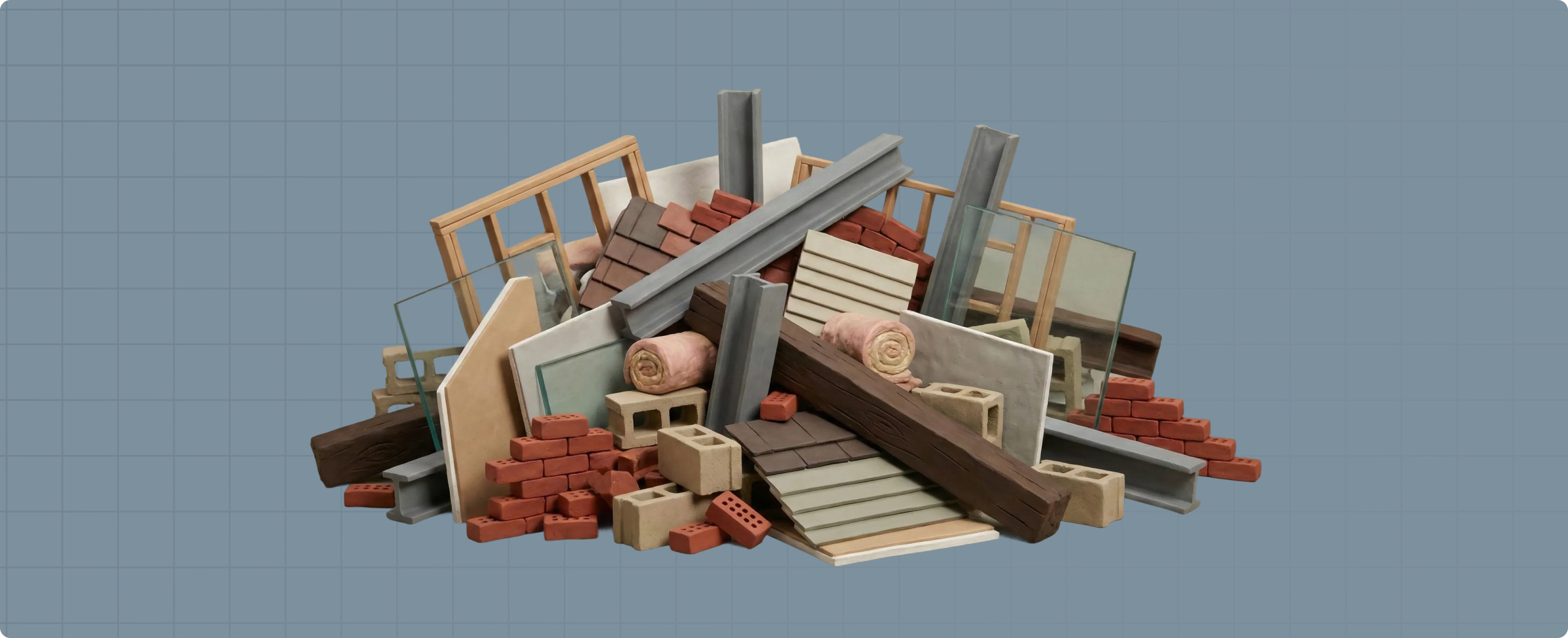
The International Building Code (IBC) classifies buildings into five main types of construction based on the fire-resistance and combustibility of their structural elements. This classification is a foundational design decision that dictates allowable building materials, impacting everything from structural systems and wall assemblies to interior finishes and roofing.
At its core, the distinction is between non-combustible materials (like steel, concrete, and masonry) required in Types I and II, and combustible materials (primarily wood) permitted in Types III, IV, and V.
Key Takeaways:
- Type I & II Construction: These types require primary structural elements to be of non-combustible materials. The primary difference is the level of fire-resistance rating required for these elements, with Type I being the most stringent.
- Type III Construction: Known as "ordinary" construction, it features non-combustible exterior walls but permits combustible interior elements, including wood framing.
- Type IV Construction (Heavy Timber / Mass Timber): This type uses large-dimension wood members or mass timber panels for structural elements. While the material is combustible, its mass provides inherent fire resistance.
- Type V Construction: This is the most common type for single-family homes and smaller structures, permitting combustible materials (wood-frame) throughout the building.
Here is a summary of the fundamental material requirements based on IBC Chapter 6:
| Construction Type | Primary Structural Frame | Bearing Walls (Ext / Int) | Nonbearing Walls (Ext / Int) | Floor & Roof Construction |
|---|---|---|---|---|
| Type I-A & I-B | Non-combustible | Non-combustible | Non-combustible | Non-combustible |
| Type II-A & II-B | Non-combustible | Non-combustible | Non-combustible | Non-combustible |
| Type III-A & III-B | Any permitted by code | Non-combustible (Exterior) / Any permitted (Interior) | Non-combustible (Exterior) / Any permitted (Interior) | Any permitted by code |
| Type IV (HT / MT) | Heavy Timber / Mass Timber / Non-combustible | Heavy Timber / Mass Timber / Non-combustible | Any permitted by code | Heavy Timber / Mass Timber |
| Type V-A & V-B | Any permitted by code | Any permitted by code | Any permitted by code | Any permitted by code |
Note: The "A" and "B" subdivisions primarily relate to the required hourly fire-resistance ratings of the elements, with "A" being more stringent (protected) and "B" being less stringent (unprotected).
Why Construction Type Classification Matters
Choosing a building's construction type is one of the first and most critical decisions in the architectural design process. Governed by IBC Chapter 6, this classification directly influences a project's scope, cost, and life safety features. It is fundamentally linked to the allowable height and area of a building, as detailed in IBC Chapter 5.
A building classified as Type I-A, the most fire-resistive type, can be built to unlimited height, whereas a Type V-B building has significant height and area restrictions. This decision has cascading effects:
- Architectural Design: Dictates the primary structural grid, wall assemblies, and aesthetic possibilities.
- Structural Engineering: Determines the choice between steel, concrete, masonry, or wood structural systems and the required level of fire protection (e.g., spray-on fireproofing, intumescent paint, gypsum board).
- MEP Engineering: Affects specifications for plenum-rated cables, fire-rated penetrations, and the types of piping and insulation allowed in concealed spaces.
- Permitting & Plan Review: A building's construction type is one of the first items a plan reviewer verifies. An incorrect classification can trigger a complete redesign, leading to costly delays.
Common misunderstandings often arise from the nuance between "non-combustible" and "fire-resistance-rated." A wood-frame wall (combustible) can have a 2-hour fire-resistance rating, but it can never be used where a non-combustible element is required. Understanding these fundamental rules is essential for code-compliant design.
How does the choice between Type III-B and Type III-A construction fundamentally impact material selection for exterior walls, interior bearing walls, and floor assemblies, especially regarding the use of fire-retardant-treated wood (FRTW)?
The choice between Type III-A and Type III-B construction creates a significant difference in material requirements for interior elements, while the exterior wall requirements remain consistent. The key distinction is that Type III-A ("protected") requires fire-resistance ratings on its interior structural elements, which allows for the strategic use of fire-retardant-treated wood (FRTW), whereas Type III-B ("unprotected") does not require these ratings.
According to IBC 2024 §602.3, both Type III-A and III-B require exterior walls to be of non-combustible materials. However, the code provides a critical exception:
- Exterior Walls: In both III-A and III-B, FRTW is permitted for studs within the exterior walls, provided the required fire-resistance rating is maintained and the exterior sheathing is also FRTW if the building is over two stories (IBC §2304.11.3). The exterior veneer itself must still be non-combustible.
The fundamental impact on material selection is most evident in the interior framing and floor assemblies:
- Interior Bearing Walls:
- Type III-A: Requires a 1-hour fire-resistance rating (IBC Table 601). This assembly can be constructed with FRTW framing, as FRTW is permitted for bearing walls where a 1-hour or less rating is required (IBC §603.1(3), Exception 2.1).
- Type III-B: Has a 0-hour rating requirement for interior bearing walls. Therefore, standard untreated wood framing (e.g., dimensional lumber) is permitted.
- Floor Assemblies:
- Type III-A: Requires a 1-hour fire-resistance rating (IBC Table 601). This assembly is typically achieved with combustible wood joists or trusses protected by a layer of gypsum board on the underside to meet the rating.
- Type III-B: Has a 0-hour rating requirement. This allows for exposed, unprotected wood joists and decking, a common feature in this construction type.
In summary, selecting Type III-A forces the inclusion of fire-resistance ratings for the interior structure, making FRTW a viable and common option for achieving those ratings in wall assemblies. In contrast, Type III-B allows for unprotected, combustible interior framing, offering more flexibility with standard wood materials but with greater limitations on building height and area compared to Type III-A.
Explain the limitations on combustible materials within concealed spaces (attics, plenums) for a Type I-B building versus a Type II-A building. How does this affect insulation, piping, and cabling specifications?
The limitations on combustible materials in concealed spaces for Type I-B and Type II-A buildings are nearly identical, as both construction types require all major building elements to be non-combustible. The rules are primarily governed by IBC 2024 §603.1, which lists specific, limited exceptions where combustible materials are permitted in buildings of Type I and II construction.
For concealed spaces like attics, interstitial spaces, and plenums used for environmental air, the requirements are very strict:
- Insulation:
- Both Type I-B and II-A permit combustible plastic foam insulation (e.g., spray foam, rigid boards) only when it is protected by a thermal barrier, typically 1/2-inch gypsum board, and meets specific flame spread and smoke-developed index requirements under testing (IBC §2603).
- Non-combustible insulation, such as mineral wool or fiberglass, can be used without a thermal barrier.
- Cellulose insulation (combustible) is generally not permitted in Type I or II construction.
- Piping:
- Combustible piping (e.g., PVC, ABS, PEX) is heavily restricted. It is generally permitted only when the building is equipped with an automatic sprinkler system and the piping meets specific criteria outlined in IBC §603.1(1.3) and the mechanical/plumbing codes.
- In plenums, IMC §602.2.1 is more restrictive, generally requiring piping to be non-combustible. Exceptions exist for certain sprinkler piping and small-diameter combustible pipes that meet stringent fire and smoke characteristic requirements (e.g., UL 2043 testing for flame spread index ≤ 25 and smoke-developed index ≤ 50).
- Non-combustible piping like copper, steel, or cast iron is always permitted.
- Cabling:
- In plenums, all wiring and cabling must be "plenum-rated" as required by NEC 2023 Article 800 (for communications) and other relevant articles. Plenum-rated cables (e.g., Type CMP) have low-smoke and low-flame-spread characteristics.
- In non-plenum concealed spaces, "riser-rated" (Type CMR) or general-purpose cables may be used, but installing all cables in non-combustible raceways (like metal conduit) is the most common and robust approach in Type I and II construction to avoid any ambiguity.
The primary difference between a Type I-B and a Type II-A building is the fire-resistance rating of the structural frame (2 hours for I-B vs. 1 hour for II-A). However, this does not change the fundamental rule from IBC Chapter 6 that both types must be constructed of non-combustible materials. Therefore, the exceptions and limitations in IBC §603.1 apply equally to both, and material specifications for insulation, piping, and cabling in concealed spaces are effectively the same.
In a Type II-A building, can non-bearing interior partitions be framed with FRTW studs under the exceptions in IBC Section 603.1, and does this apply to partitions used for corridor walls?
Yes, in a Type II-A building, non-bearing interior partitions can be framed with fire-retardant-treated wood (FRTW) studs under a specific exception in the code. However, this exception generally does not apply to partitions that are required to be fire-resistance-rated, such as most corridor walls.
The governing code section is IBC 2024 §603.1(3), which lists materials permitted in otherwise non-combustible construction. Exception 2 states that FRTW is permitted for:
- "Nonbearing partitions where the required fire-resistance rating is 2 hours or less."
- "Nonbearing exterior walls where fire-resistance-rated construction is not required."
- "Roof construction... where a fire-resistance rating is not required."
For typical non-bearing interior partitions that do not require a fire rating (e.g., office demising walls not on a property line), FRTW studs are explicitly allowed.
The critical issue arises with corridor walls. In most occupancies, corridor walls are required to have a fire-resistance rating, typically 1 hour, as specified in IBC 2024 Table 1020.2. While Exception 2 of §603.1(3) seems to permit FRTW for partitions with a rating of 2 hours or less, there is a crucial nuance often debated by code officials:
- The Intent: The primary intent of Type I and II construction is non-combustibility. Many jurisdictions interpret the allowance for FRTW in non-bearing partitions to apply only to those partitions that are not part of the building's required fire-resistance-rated enclosure system (like corridors, shaft walls, or fire barriers).
- Corridor as an Egress Element: Because corridors are critical egress components, plan reviewers and inspectors often hold them to a stricter standard, favoring non-combustible framing (steel studs) to maintain the integrity of the egress system. While a rated assembly can be built with FRTW, the preference in Type I/II buildings is to minimize combustible fuel load within protected egress paths.
Therefore, while a literal reading of IBC §603.1(3) might suggest FRTW is permissible for a 1-hour rated corridor wall, the conservative and most widely accepted application is:
- Permitted: Use FRTW for non-rated, non-bearing interior partitions.
- Not Recommended/Often Disallowed: Do not use FRTW for rated corridor walls or other fire barriers in Type I and II construction. Always use non-combustible steel studs for these critical assemblies. Confirmation with the local Authority Having Jurisdiction (AHJ) is essential before specifying FRTW for any rated wall in a Type II-A building.
Clarify the specific conditions under which combustible exterior wall coverings or veneers are permitted on a building of Type I-B construction.
Combustible exterior wall coverings or veneers are permitted on a Type I-B building, but only under very specific and limited conditions outlined in IBC 2024 Chapter 14 (Exterior Walls) and Section 603.1. Because Type I-B is a non-combustible construction type, any introduction of combustible materials on the exterior is treated as an exception and is subject to strict limitations regarding height, fire separation distance, and material properties.
The key conditions are:
- Fire-Retardant-Treated Wood (FRTW):
- FRTW is permitted as a veneer where it is installed over a non-combustible backing. It is subject to height limits and must comply with the fire separation distance requirements of IBC Table 602. For a Type I-B building, this usually means it can't be used where a fire-resistance rating is required due to proximity to a lot line (IBC §1404.5).
- Metal Composite Materials (MCM):
- MCM panels with a combustible plastic core are permitted up to certain heights depending on their fire performance when tested in accordance with NFPA 285. IBC §1406.11 requires MCM systems on Type I buildings over 40 feet in height to be tested and pass the NFPA 285 full-scale assembly fire test.
- High-Pressure Laminates (HPL):
- Similar to MCM, HPL systems are permitted on Type I buildings over 40 feet if they successfully pass the NFPA 285 test (IBC §1406.14).
- Exterior Insulation and Finish Systems (EIFS):
- EIFS incorporating combustible plastic insulation is permitted on Type I buildings, provided the system passes the NFPA 285 test when the building is over 40 feet high (IBC §1407.10).
- General Combustible Veneers (Other than FRTW):
- Combustible veneers like untreated wood, fiber-cement with wood composites, or plastics are severely restricted. IBC §1405.1.1 allows them on Type I and II buildings only under these conditions:
- The building is fully sprinklered per NFPA 13.
- The veneer is limited to the first two stories above grade.
- The veneer is attached to a non-combustible backing.
- Combustible veneers like untreated wood, fiber-cement with wood composites, or plastics are severely restricted. IBC §1405.1.1 allows them on Type I and II buildings only under these conditions:
In all cases, the fire separation distance is critical. As the distance to the property line decreases, the code becomes more restrictive about allowing any combustibles on the exterior face of the wall.
For a Type II-B building, are combustible materials permitted for roof blocking, cants, and nailers, or must all elements of the roof assembly be strictly non-combustible?
Yes, combustible materials are explicitly permitted for certain minor elements within a roof assembly of a Type II-B building. While the primary structural frame, walls, floors, and roof deck of a Type II-B building must be non-combustible (IBC Table 601), the code recognizes that complete non-combustibility is impractical for some components.
IBC 2024 §603.1 provides a list of exceptions where combustible materials can be used in Type I and II construction. The relevant exceptions for roof elements include:
- Exception 2.3: Allows fire-retardant-treated wood (FRTW) to be used for "roof construction, including girders, trusses, framing and decking." This is a broad allowance, but a more specific one is often used for blocking and nailers.
- Exception 3: Allows "Blocking and nailers of untreated wood." This is the most direct and commonly used exception.
- Exception 4: Allows "Wood furring strips... applied over noncombustible framing and backed by a noncombustible surface."
- Exception 10: Allows "Combustible roofing and siding." This refers to the membrane and insulation, which are governed by IBC Chapter 15.
Therefore, for a standard roof assembly on a Type II-B building, the typical application is as follows:
- Structural Deck: Must be non-combustible (e.g., steel deck, concrete).
- Insulation: Combustible foam plastic insulation is permitted as part of a tested roof assembly that meets fire classification standards (e.g., UL Class A, B, or C) under IBC §1505.
- Roof Membrane: Combustible membranes (e.g., TPO, EPDM, modified bitumen) are permitted as part of a classified roof covering assembly.
- Blocking, Cants, and Nailers: Untreated wood is explicitly permitted by IBC §603.1(3) for these components to facilitate the attachment of roofing membranes and edge metal.
In practice, it is standard detailing to use pressure-treated wood (for durability) for blocking and nailers at parapets and roof edges on a steel-framed Type II-B building. This is a practical and code-compliant approach.
What is the difference in fire-stopping requirements (e.g., UL systems, ASTM E814) for a pipe penetration through a rated concrete floor in Type I-A construction versus a rated wood-frame floor in Type III-A construction?
The fundamental fire-stopping requirements are the same for both scenarios: the penetration must be protected by a listed firestop system tested to ASTM E814 (UL 1479) that restores the hourly fire-resistance rating of the floor-ceiling assembly. The difference lies in the specific UL-listed system that must be used, as the system is tested and approved for use with specific types of assemblies (combustible vs. non-combustible) and penetrating items.
Key Differences in Firestop System Selection:
- Assembly Type:
- Type I-A (Concrete Floor): This is a non-combustible assembly. The firestop system must be listed for use in a concrete floor of a specific thickness (e.g., min. 4.5-inch normal weight concrete). The UL system designation will typically start with "F-A-" (Floor-Wall) or "C-A-" (Ceiling-Floor) for concrete. Example: UL System C-A-1234.
- Type III-A (Wood-Frame Floor): This is a combustible assembly. The firestop system must be specifically tested and listed for use in a rated wood-joist or wood-truss floor-ceiling assembly. These systems are designed to handle the charring and consumption of wood during a fire. The UL system designation will typically start with "F-C-" (Floor-Ceiling) for wood frame. Example: UL System F-C-2345.
- Annular Space and Sealant:
- The type and depth of firestop sealant (e.g., intumescent, elastomeric) and the requirements for mineral wool packing in the annular space will be different.
- In a wood-frame assembly, an intumescent firestop is often required. It expands when heated to crush the melting plastic pipe (if applicable) and fill the void left by the burning wood structure, preventing smoke and flame passage.
- In a concrete assembly, a non-intumescent (endothermic or ablative) sealant might be sufficient depending on the penetrating item.
- "F" vs. "T" Ratings:
- F-Rating: The time in hours that the firestop system prevents the passage of flame. This is required for all rated penetrations.
- T-Rating: The time in hours until the temperature on the unexposed side of the penetration rises more than 325°F above ambient. The "T" rating is not always required by the IBC, but it is mandatory for penetrations through fire-resistance-rated horizontal assemblies (IBC §714.5.1.2), unless the penetrating item is insulated for the full story height. This applies to both the concrete and wood-frame floor. The chosen UL system must carry both an F and a T rating equal to the floor's rating.
In conclusion, you cannot use a firestop system listed for a concrete floor in a wood-frame floor, or vice versa. The contractor and inspector must verify that the installed system (e.g., Hilti, 3M, STI) exactly matches a UL-listed detail for the specific floor construction, penetrating item (e.g., copper pipe, PVC pipe, conduit), and required rating.
Can a building with a steel primary frame (non-combustible) but with wood-infill exterior walls be classified as Type III-B, or does the steel frame force it into a Type II classification?
A building with a non-combustible steel primary frame and combustible wood-infill exterior walls cannot be classified as Type II. It must be classified as Type III-B (or III-A, if interior elements are rated). The classification is determined by the materials used in all major building elements, not just the primary frame.
Here's the code-based breakdown:
- Type II Construction Definition (IBC §602.2): Requires all building elements listed in Table 601—including the primary frame, bearing walls (interior and exterior), nonbearing walls, floors, and roofs—to be of non-combustible materials. The presence of combustible wood-infill exterior walls immediately disqualifies the building from being classified as Type II.
- Type III Construction Definition (IBC §602.3): Requires exterior walls to be of non-combustible materials, but permits interior building elements to be of any material permitted by the code (including combustible wood).
- The Critical Exception: While Type III requires non-combustible exterior walls, it contains an important exception in IBC §2304.11 that allows for fire-retardant-treated wood (FRTW) framing within those exterior walls. However, if the infill is standard, untreated wood, it violates the basic premise of Type III. A common modern interpretation involves using steel studs for the exterior wall framing (satisfying the non-combustible requirement) and then using combustible elements for the interior framing.
Therefore, the building described aligns best with the logic of Type III construction, where the primary vertical structure and exterior skin are robust and non-combustible, while the interior can be combustible. If the primary frame is steel and the exterior walls are non-combustible (e.g., CMU or steel studs with non-combustible sheathing), but the interior framing is wood, the building is correctly classified as Type III. A steel frame does not force a Type II classification; rather, the presence of any major combustible element (where not permitted by an exception) forces the building into a less fire-resistive classification like Type III or V.
Does the use of intumescent paint on structural steel to achieve a 2-hour rating in a Type I-B building have different inspection criteria than a traditional spray-on fireproofing (SFRM) application?
Yes, the inspection criteria for intumescent fire-resistive materials (IFRMs), commonly known as intumescent paint, are significantly different and often more rigorous than those for spray-applied fire-resistive materials (SFRMs). Both are subject to special inspection under IBC 2024 Chapter 17, but the methods and critical checkpoints vary.
SFRM (Spray-On Fireproofing) Inspection: The inspection for SFRM, governed by ASTM E605, primarily focuses on:
- Substrate Condition: Ensuring the steel is clean, free of oil, loose scale, and any priming that is not compatible with the SFRM.
- Thickness: The special inspector performs multiple thickness measurements using a depth gauge to ensure the applied thickness meets or exceeds that specified in the UL design for the required rating.
- Density: Samples are taken from the structure to verify that the in-place density of the material meets the minimum specified in the UL design.
- Bond Strength: A bond strength test (ASTM E736) is performed to ensure the material is properly adhering to the steel substrate.
Intumescent Paint (IFRM) Inspection: The inspection for IFRMs, guided by standards like AWCI 12-B, is a multi-step process with tighter tolerances:
- Surface Preparation: This is the most critical step. The steel substrate must be prepared to a specific profile (e.g., SSPC-SP10 Near-White Blast Cleaning) as required by the paint manufacturer. The inspector must verify the surface profile using specialized gauges.
- Primer: The type and thickness of the primer must be verified. Using the wrong primer can lead to adhesion failure.
- Dry Film Thickness (DFT): This is the paramount measurement. The special inspector uses a calibrated electronic gauge (e.g., a Type 2 gauge) to meticulously measure the DFT of each coat (primer, base coat, top coat). The final DFT of the base coat must be within the manufacturer's specified range to achieve the required fire rating. This is a much more precise measurement than with SFRM.
- Environmental Conditions: The inspector must verify that the ambient temperature, humidity, and steel surface temperature are within the manufacturer's prescribed limits during application and curing.
- Aesthetic Finish: Since intumescent coatings are often left exposed, the quality of the finish may also be part of the inspection criteria, though this is more of an architectural concern.
In summary, SFRM inspection is more about bulk properties (thickness, density), while intumescent paint inspection is a highly controlled, technical process focused on surface science, precise film thickness, and environmental control. Failure at any step can compromise the performance of the thin-film coating.
How do state-level amendments in California or Florida modify the IBC's base requirements for Type V-A construction in high-velocity hurricane zones or wildland-urban interface areas?
State-level amendments in California and Florida add significant layers of material and assembly requirements onto the IBC's base standards for Type V-A construction, driven by unique local hazards like wildfires and hurricanes.
California - Wildland-Urban Interface (WUI): The California Building Code (CBC) incorporates Chapter 7A, "Materials and Construction Methods for Exterior Wildfire Exposure." For Type V-A buildings located in designated Fire Hazard Severity Zones, this chapter mandates "ignition-resistant" materials and construction details. This goes far beyond the IBC's typical requirements. Key modifications include:
- Roofing: Must be a minimum Class A rated assembly. Wood shakes are prohibited regardless of treatment.
- Siding and Exterior Walls: Exterior wall coverings must be non-combustible or ignition-resistant. Materials like fiber-cement, stucco, and brick are common. Combustible wood siding is heavily restricted or must meet specific testing requirements.
- Vents: Attic and underfloor vents must resist the intrusion of embers. They must be covered with a corrosion-resistant screen with openings no larger than 1/8 inch or be a listed, ember-resistant vent design.
- Windows and Glazing: Must be a minimum of dual-pane insulating glass units. Tempered glass is required for windows in high-risk areas.
- Decking: Walking surfaces of decks, porches, and balconies must be constructed of approved ignition-resistant materials, non-combustible materials, or exterior fire-retardant-treated wood.
These CBC Chapter 7A requirements effectively transform a standard Type V-A wood-frame building into a "hardened" structure designed to resist ignition from flying embers.
Florida - High-Velocity Hurricane Zone (HVHZ): The Florida Building Code (FBC) contains specific, more stringent provisions for buildings in High-Velocity Hurricane Zones (Miami-Dade and Broward counties). For Type V-A construction, these rules focus on structural integrity and resistance to wind-borne debris.
- Structural Load Path: The FBC requires a continuous load path from the roof to the foundation, designed to resist uplift forces. This often necessitates additional metal connectors, straps, and hold-downs beyond typical IBC requirements.
- Roof Sheathing Attachment: Nailing patterns for roof sheathing are significantly enhanced. Spacing is reduced, and ring-shank nails are often required to prevent panel blow-off.
- Opening Protection: All exterior openings (windows, doors, skylights) must be protected against wind-borne debris. This is achieved either with impact-resistant glazing (e.g., laminated glass) or with listed and approved shutters. This is one of the most significant cost and material impacts.
- Roof-to-Wall Connections: The connection between the roof framing and the wall framing must be fortified with hurricane ties or clips to resist uplift.
- Soffits: Soffits must be designed and constructed to resist both positive and negative wind pressures.
In the FBC, the focus is less on combustibility and more on ensuring the building envelope remains intact during a major hurricane, which is a fundamentally different set of material and assembly challenges than those posed by wildfire.
Can I use wood studs for interior walls in a Type II-B building?
No, you generally cannot use untreated wood studs for any interior walls, bearing or non-bearing, in a Type II-B building. The definition of Type II construction in IBC 2024 §602.2 and Table 601 requires that all structural and non-structural elements, including interior partitions, be made of non-combustible materials. Steel studs are the standard material for interior partitions in this construction type.
There is one major exception: Fire-retardant-treated wood (FRTW).
As detailed in IBC §603.1(3), FRTW is permitted for non-bearing partitions where the required fire-resistance rating is 2 hours or less. Therefore, you could technically use FRTW studs for non-rated office demising walls. However, for practical and cost reasons, light-gauge steel framing is the overwhelmingly common choice for all interior partitions in Type II-B construction. Using untreated wood studs would violate the fundamental principle of this construction type.
Additional Supporting Sections
What can you ask? (Sample questions)
- How do local code amendments modify the base IBC requirements?
- What triggers the need for a building permit?
- What plan review documents are typically required?
- How do jurisdictional amendments affect fire and structural codes?
Common Mistakes and Misinterpretations
- Confusing Fire-Resistance with Non-Combustibility: A 2-hour rated wall made of wood studs and gypsum board is still a combustible assembly. It cannot be used where a non-combustible element is required, such as in the exterior walls of a Type III building.
- Misapplying IBC §603.1 Exceptions: The list of permitted combustibles in Type I and II construction is specific and limited. Designers sometimes incorrectly assume that because a material is allowed in one location (e.g., wood blocking in a roof), it is allowed elsewhere. Each application must be justified by a specific exception.
- Incorrectly Classifying Mixed-Material Buildings: As discussed, a steel frame does not automatically make a building Type II. The entire assembly of elements dictates the final classification. The least fire-resistive element often governs the classification of the whole building.
- Ignoring Chapter 7 Details: The construction type from Chapter 6 is only the beginning. Chapter 7 (Fire and Smoke Protection Features) provides detailed requirements for the assemblies themselves, including how to maintain ratings at joints, penetrations, and intersections.
Coordination Considerations for Design and Construction Teams
The construction type classification requires early and continuous coordination among all disciplines:
- Architect to Structural Engineer: The architect's choice of Type III vs. Type V will determine if the engineer designs with a wood frame or a hybrid system. The choice of Type I or II will dictate a steel or concrete frame and the need for fireproofing.
- Architect to MEP Engineer: In Type I and II buildings, the architect must inform the MEP team that all ductwork, piping, and cabling in plenums and concealed spaces must meet stricter non-combustible or plenum-rated standards. Firestopping details for penetrations become a critical coordination point.
- General Contractor to Subcontractors: The GC must ensure that subcontractors do not introduce non-compliant combustible materials onto the site. For example, a drywall contractor cannot use standard wood blocking for backing inside a wall in a Type II building; they must use steel blocking or FRTW.
- Special Inspector Coordination: For projects requiring fireproofing (SFRM or intumescent), the special inspector must be engaged early to review submittals and establish a clear inspection and testing plan that aligns with IBC Chapter 17.
How Construction Type Affects Permitting and Plan Review
The construction type is a "line in the sand" for plan reviewers. It is one of the first things checked on a drawing set, as it is the basis for verifying:
- Allowable Height and Area (IBC Chapter 5): The reviewer will immediately check if the proposed building's size and height comply with the limits for the declared construction type and occupancy.
- Material Specifications: The reviewer will scan wall sections, structural notes, and details to ensure the specified materials (e.g., wood studs vs. steel studs, combustible vs. non-combustible sheathing) align with the declared type.
- Fire-Resistance Ratings (IBC Chapter 7): The reviewer will cross-reference the ratings shown on the drawings with the requirements in IBC Table 601 for that construction type.
A discrepancy in this fundamental classification will almost always result in a plan rejection and require a major redesign. It is not a minor comment; it is a foundational code issue.
Frequently Asked Questions (FAQ)
1. What is the difference between non-combustible material and fire-retardant-treated wood (FRTW)? A non-combustible material, like steel or concrete, will not ignite, burn, or release flammable vapors when subjected to fire. FRTW is a wood product that has been chemically treated to reduce its flammability and slow the spread of flame. It is still a combustible material but is granted special allowances by the code in certain applications.
2. Can I have exposed wood beams in a Type I or II building? Generally, no. Structural elements in Type I and II buildings must be non-combustible. However, IBC 2024 §603.1(5) provides a very limited exception for heavy timber elements to be used for roof construction under strict conditions, such as being a certain height above the floor and in specific occupancies. The rise of mass timber has also led to new provisions, but these typically fall under Type IV construction.
3. How does Type IV (Heavy Timber / Mass Timber) fit into the classifications? Type IV construction uses large-dimension solid wood, glued-laminated timber, or mass timber panels (like CLT) for its structural elements. While combustible, the sheer mass of the members allows them to char at a slow and predictable rate, providing significant inherent fire resistance without needing protection like gypsum board.
4. Do interior finishes (paint, wallpaper, paneling) have to be non-combustible in a Type I building? Not necessarily. Interior wall and ceiling finishes are regulated by IBC Chapter 8, which assigns a flame spread index and smoke-developed index classification (Class A, B, or C) based on ASTM E84 testing. Type I buildings typically require Class A or B finishes, especially in corridors and exitways, but these materials can be combustible (e.g., Class A-rated paint on gypsum board).
5. Does the construction type directly affect sprinkler requirements? Yes, but indirectly. The requirement for an automatic sprinkler system is primarily based on occupancy group, fire area size, and other specific conditions listed in IBC §903. However, the code often provides "trade-offs" for sprinklered buildings, such as allowing larger building areas or heights for a given construction type. For instance, the allowable area in IBC Table 506.2 can be significantly increased if the building is sprinklered.
6. Can I change a building's construction type during a renovation? Yes, but it is a complex process. If an addition or alteration is made, it often has to comply with the code for new construction. Changing from a more restrictive type (e.g., Type III) to a less restrictive one (e.g., Type V) is usually not permitted if it makes the building less safe. Upgrading a building, for example from Type V-B to V-A by adding gypsum board for fire-resistance, is more common. Any change must be carefully evaluated against IEBC (International Existing Building Code) requirements.
Related Building Code Resources
- Building CodesWhat is a Certificate of Occupancy? The Final Step in Proving Code Compliance
- Building CodesPerformance-Based vs. Prescriptive Codes: Choosing the Right Path for Your Project
- Building CodesThe Digital Blueprint: How Technology is Revolutionizing Building Code Compliance
- Building CodesBalancing Past and Present: A Guide to Code Compliance for Historic Renovations and Existing Buildings
- Building CodesThe Role of a Building Inspector: What They Look For and How to Prepare for Inspection Day
MeltPlan
A curated stream of preconstruction intelligence, estimating innovation, takeoff breakthroughs, workflow advancements, and expert perspectives—powered by the AI and technology shaping the future of construction.
Visit SiteDon't miss what's shaping AEC
The latest on preconstruction, codes, AEC news & trends — so you're always in the know.