Why Are Building Codes So Hard to Learn (and Why Do Knowledge Gaps Persist Across Junior, Mid-Level, and Senior Professionals)?
Building codes are hard to learn because they are dense, legislative documents written with complex language, layered exceptions, and heavy cross-referencing ac..
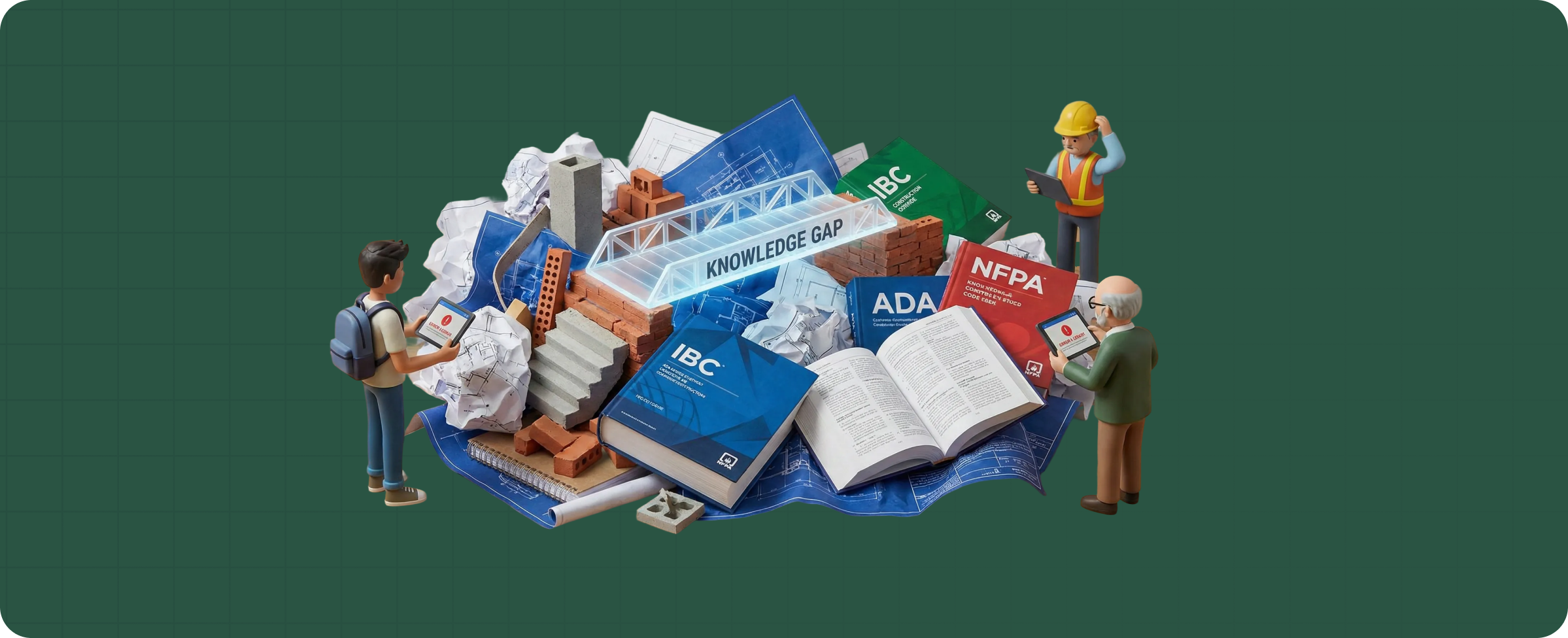
Building codes are hard to learn because they are dense, legislative documents written with complex language, layered exceptions, and heavy cross-referencing across dozens of other standards. They form a multi-code ecosystem - IBC, IFC, IEBC, IMC, IPC, NEC, NFPA standards, ADA/ANSI accessibility rules, ASHRAE/IECC energy codes, and local amendments - that all interact and update on different cycles. This creates a constantly shifting landscape where the “right answer” varies by jurisdiction, edition, and AHJ interpretation.
Juniors struggle because they lack foundational mental models: understanding code hierarchy, knowing where to look, and recognizing patterns such as how occupancy drives fire ratings, or how ratings impact assemblies, MEP penetrations, and inspections. Their fear of missing something critical makes them heavily dependent on mid-levels and seniors.
Mid-level professionals become bottlenecks. They know enough to identify issues but not enough to be fully confident. They must validate all junior research, cross-check codes manually, and make judgment calls under time pressure - often with incomplete depth in accessibility, fire protection, multi-code reasoning, and local amendments. Their knowledge is broad but shallow.
Senior professionals hold most of the tribal knowledge - gained from decades of encountering plan review cycles, inspector inconsistencies, code evolution, local politics, and project failures. They know what exceptions AHJs accept, which interpretations have backfired in the past, and how to navigate conflicting codes. But this knowledge is rarely centralized, documented, or scalable.
Knowledge gaps persist because firms lack standardized workflows for code research, have fragmented documentation, and rely on ad hoc mentorship. Most interpretations live in redlines, emails, Slack messages, or a senior’s memory. Teams repeatedly redo the same research for every project, and multi-code reasoning remains difficult - even for experts.
In short, building codes are hard to learn because they are complex, interconnected, ambiguous, inconsistent across jurisdictions, dependent on experience, and rarely documented in a structured way. These conditions create persistent gaps among juniors, mid-levels, and seniors - slowing workflows, increasing risk, and concentrating expertise in a small number of overextended experts.
1. Why Building Codes Are Hard to Learn at All
1.1 Codes aren’t written like textbooks - they’re written like legislation
Dense, legalistic language
- Exceptions within exceptions
- Footnotes and conditional clauses
- Cross-references that require jumping 10+ pages
= Cognitive overload
Architects and engineers must navigate:
- prescriptive rules
- performance alternatives
- exceptions
- local modifications
- referenced standards
1.2 Code mastery requires experience, not just reading
Understanding why a rule exists is key to applying it.
But most juniors only see fragments of real-world application.
1.3 Multi-code reasoning is inherently complex
The IBC references:
- NFPA (13, 72, 101, 70)
- ANSI A117.1
- ASHRAE 62.1/90.1
- ASTM, UL, ACI, AISC standards
And every referenced standard can reference others.
1.4 Code cycles and local amendments constantly change
Professionals must track:
- new editions
- state adoptions
- city/county amendments
- fire marshal bulletins
- accessibility laws
- energy code updates
The “correct” answer literally changes by zip code and by year.
2. The Junior-Level Challenge: Understanding the Landscape
Junior designers, engineers, and interns face the steepest learning curve because they’re missing the mental maps needed to interpret the code.
2.1 They don’t know where to look
Most early-stage professionals don’t understand:
- code hierarchy
- how to navigate jurisdictions
- which code applies when
- how to identify amendments
- how to read referenced standards
2.2 They lack code “pattern recognition”
They often can’t see how:
- occupancy classification → affects fire ratings
- fire ratings → affect wall types
- wall types → affect MEP penetrations
- MEP penetrations → affect field inspections
2.3 They rely heavily on seniors
Juniors frequently ask seniors:
- “Am I using the right section?”
- “Which exception applies?”
- “Is this an interpreting question or a strict requirement?”
2.4 They fear missing something
The biggest junior fear:
Accidentally missing a requirement that will blow up permitting.
Because they don’t know what they don’t know.
3. The Mid-Level Challenge: Becoming the Bottleneck
What can you ask? (Sample questions)
- What building code edition does my state currently enforce?
- How do state-specific amendments modify the base IBC?
- What structural design loads apply in my jurisdiction?
- What energy code requirements apply to my building type?
Mid-level professionals know enough to be dangerous - and to feel overwhelmed.
3.1 They must validate every junior’s research
Every design question funnels back to mid-level staff. This creates huge load and slows project timelines.
3.2 Their code knowledge is “broad but shallow”
Mid-levels understand many areas, but lack:
- deep accessibility mastery
- multi-code fire reasoning
- NFPA-level specificity
- AHJ interpretation patterns
- local amendment depth
3.3 They are under pressure to deliver fast answers
Mid-level professionals often make judgment calls based on partial information, which introduces risk.
3.4 Mid-levels are stuck cross-checking everything manually
Typical workflow:
- Jump between IBC chapters
- Search PDFs
- Check local amendments
- Compare with designer sketches
- Email seniors for confirmation
This creates the “mid-level bottleneck problem” that plagues architecture and engineering firms.
4. The Senior-Level Challenge: High Liability and Tribal Knowledge
Senior architects and engineers don’t just know the code - they know the interpretation history behind decisions.
4.1 Seniors rely on decades of mental models
They’ve seen:
- plan review cycles
- inspector disagreements
- code changes across 3–5 editions
- mistakes junior/mid-levels make
- which exceptions AHJs accept or reject
4.2 They hold the firm’s most critical tribal knowledge
Seniors know:
- local AHJ personalities
- historical case law
- how a code worked two cycles ago
- how the fire marshal interprets issues
- what caused past failures
This knowledge is rarely documented - and often lost when they retire or switch firms.
4.3 They are exhausted by constant interpretation requests
Seniors often become de facto:
- plan reviewers
- internal code consultants
- egress experts
- accessibility interpreters
- fire separation specialists
Their time is stretched thin.
4.4 Seniors carry the most liability
If something goes wrong, it’s the senior engineer/architect who takes the hit - not the junior who interpreted the code incorrectly.
5. Why Knowledge Gaps Persist - Even in Mature Firms
5.1 Code research has no standardized workflow
Most firms have chaotic processes:
- PDFs
- Screenshots
- Sticky notes
- Email threads
- Excel checklists
- Whiteboard sketches
- Mentorship “as time permits”
5.2 Interpretations aren’t documented
Most code decisions are lost in:
- Slack channels
- Redlines
- Senior memory
- Meeting notes
- Phone calls with AHJs
5.3 Repetition is rampant
Every project repeats the same research because:
- There’s no project memory
- Teams don’t share tables
- Checklists aren’t centralized
5.4 Multi-code interactions are hard even for experts
Juniors can’t see the connections.
Mid-levels understand the surface of interactions.
Seniors understand the full reasoning - but can’t scale that expertise to the entire team.
6. Role-by-Role Pain Points in Knowledge Development
6.1 Architects
- Egress logic
- Fire ratings
- Accessibility
- Assembly/wall types
- Mixed occupancies
6.2 Engineers
- HVAC sizing based on code
- Sprinkler thresholds
- Fire alarm integration
- Electrical clearance rules
- Structural load paths
6.3 Contractors/Subs
- Material substitutions
- Firestopping
- Accessibility installation
- Rated assemblies
- Utility clearances
6.4 Inspectors
- Inconsistent drawings
- Missing documentation
- Poor justifications
- Field deviations
6.5 Owners
- Confusion about delays
- Differing interpretations across jurisdictions
- Cost impacts of compliance decisions
7. Real-World Examples of How Knowledge Gaps Cause Problems
7.1 Egress miscalculations
Juniors miscalculate occupant loads → Mid-levels catch the error → Seniors redesign circulation late in DD.
7.2 Accessibility failures
Junior designs don’t meet ADA clearances → Mid-level adjusts → Senior must justify modifications.
7.3 Fire protection coordination gaps
Architects assume sprinkler exceptions apply → Fire consultant disagrees → Fire marshal rejects design.
7.4 Mechanical room errors
Architectural room sizes fail NEC or IMC rules → Late redesign → Mechanical replanning → Electrical rerouting → Major cost impact.
8. How Firms Try to Solve Knowledge Gaps Today
8.1 Mentorship
Effective but slow and inconsistent.
8.2 Internal checklists
Useful but outdated quickly and rarely shared across teams.
8.3 Code consultants
Help, but expensive and project-limited.
8.4 Lunch-and-learns
Low retention, limited coverage.
8.5 Asking AHJs
Helpful but not scalable - and interpretations vary between reviewers.
FAQs
1. Why are building codes harder to learn than other technical subjects?
Because they’re written as legislation - not instructional material - filled with exceptions, cross-references, and dense legal language that requires interpretation rather than memorization.
2. Why do junior professionals struggle the most with code learning?
They lack foundational mental models for code hierarchy, multi-code interactions, and jurisdictional rules. Without understanding “why” a rule exists, applying it correctly becomes extremely difficult.
3. Why do mid-level staff become bottlenecks in code compliance?
They must review, verify, and validate all junior research while still lacking the deep interpretive judgment that seniors have. This creates workload strain and slows project timelines.
4. Why do seniors hold most of the firm’s code knowledge?
Because code mastery requires decades of exposure to real projects, plan reviews, field inspections, iterative failures, and AHJ patterns - experience that cannot be learned from reading the book alone.
5. Why do knowledge gaps persist even in experienced firms?
Interpretations are rarely documented, research is repeated for every project, and decisions live in scattered emails, redlines, or senior memory - making it impossible to create a centralized institutional knowledge base.
6. Why is multi-code reasoning one of the biggest obstacles?
Every question spans several codes - IBC, NFPA, ADA, ANSI, ASHRAE, NEC, and local amendments. Each interacts differently, updates on a different cycle, and may contradict the others.
7. Can building code knowledge ever be fully standardized or systematized?
Only partially. Some workflows, checklists, and rules can be standardized, but deep judgment - especially in interpreting exceptions, amendments, and AHJ behavior - comes only from sustained real-world experience.
References
ICC Codes, NFPA Standards, ADA/ANSI, ASHRAE 62.1/90.1, IECC, state/local amendments, inspection and permitting workflows across U.S. jurisdictions, and deep industry practice knowledge across architecture, engineering, and construction.
Related Building Code Resources
- Building CodesWhat Are the Key Aspects to Consider When Analyzing Building Codes?
- Building CodesDigital Code Libraries & Search Tools: What They Fix and What They Don’t
- Building CodesWhere Traditional Building Code Research Breaks Down
- Building CodesThe Hidden Costs of Manual Building Code Research
- Building CodesTraditional Building Code Research Methods
MeltPlan
A curated stream of preconstruction intelligence, estimating innovation, takeoff breakthroughs, workflow advancements, and expert perspectives—powered by the AI and technology shaping the future of construction.
Visit SiteDon't miss what's shaping AEC
The latest on preconstruction, codes, AEC news & trends — so you're always in the know.