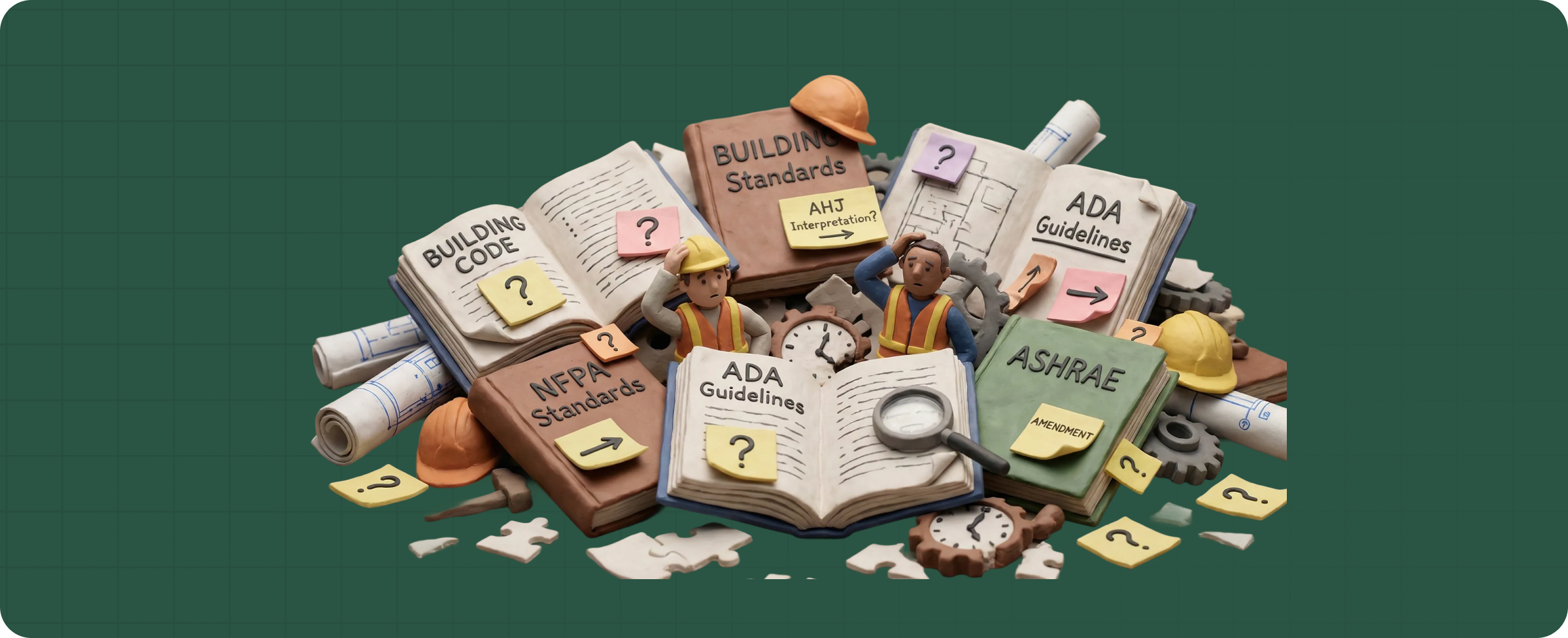
Why Do AHJs (Authorities Having Jurisdiction) Vary So Much - and Why Do They Matter So Much in Building Code Compliance?
Authorities Having Jurisdiction (AHJs) matter immensely because they hold the final legal authority over how building codes are adopted, interpreted, and enforc..

Authorities Having Jurisdiction (AHJs) matter immensely because they hold the final legal authority over how building codes are adopted, interpreted, and enforced. While the model codes (IBC, IFC, IMC, etc.) provide a baseline, every city, county, state, and special district in the U.S. independently chooses which edition to adopt, how to amend it, how strictly to enforce it, and how to interpret ambiguous or conflicting language. This decentralization results in thousands of unique regulatory environments, each shaped by local hazards, political priorities, resources, staffing expertise, and historical precedents.
AHJs vary because their adoption cycles are unsynchronized, their local amendments differ widely, and their priorities reflect regional concerns - such as seismic safety in California, wind resistance in Florida, fire protection in New York, or minimal regulation in parts of Texas. Staffing differences add even more variation: some AHJs have highly specialized plan reviewers and inspectors, while others rely on generalists with limited training. Local precedents - what was allowed or rejected in previous projects - become unwritten rules that heavily influence enforcement but are rarely published.
AHJs matter because they decide what complies with the code. They determine which exceptions are acceptable, what constitutes equivalency, how conflicting sections are resolved, what documentation is required, and ultimately what passes inspection. Field inspectors often enforce differently from plan reviewers, and fire marshals may apply stricter standards than the building department. Many AHJ policies are not documented publicly and may even change over time due to staff turnover, new leadership, notable incidents, or internal policy shifts.
This variability leads to widely different outcomes for identical buildings in different jurisdictions. Designers and builders struggle because AHJ requirements can be inconsistent, unpublished, or subject to individual judgment. Navigating AHJ preferences - through pre-application meetings, ongoing communication, and clear documentation - is often as important as understanding the code itself. In short, AHJs vary because the U.S. regulatory system is decentralized, and they matter because their interpretation - not the model code - is what ultimately governs compliance.
Introduction: AHJs Are the Invisible Giants of Building Code Compliance
Professionals often view “the code” as the final authority - but in reality, the AHJ is the final authority. The building official (and the fire marshal) decides:
- what version of the code applies
- how the code is interpreted
- which exceptions are allowed
- what constitutes acceptable equivalency
- what will pass inspection
Two identical buildings in two cities can follow the same model code and still have different code paths because AHJs enforce differently.
This article explains why AHJs vary, how they influence compliance, and why navigating AHJ interpretation is as critical as understanding the code itself.
1. What Is an AHJ - and Who Counts as One?
Many professionals assume AHJ = building department. In reality, it includes multiple entities:
1.1 Building Department AHJ
- Building official
- Plan reviewers
- Permit technicians
1.2 Fire Department AHJ
- Fire marshal
- Fire prevention officers
- Fire inspectors
1.3 Specialty AHJs
Some projects involve separate authorities:
- Health department
- Environmental agency
- Utilities (gas, electric)
- Elevator/escalator divisions
- Accessibility review boards
- Zoning boards
1.4 Federal or special agency AHJs
For certain buildings:
- DoD
- VA
- GSA
- FAA
- DHS
- Tribal authorities
- State historical preservation offices
Each can override design decisions.
2. Why AHJs Vary So Much Across the United States
2.1 Decentralized Code Adoption
Every AHJ adopts:
- a different model code edition
- its own amendments
- its own supplemental policies
- unique inspection practices
No two AHJs enforce the same package.
2.2 Local Priorities Shape Enforcement
Examples:
- California: seismic, accessibility, energy efficiency
- Florida: wind loads, impact resistance
- New York City: fire protection and life safety
- Texas: varies by city; some focus on minimal regulation
Local hazards, politics, and culture influence what the AHJ emphasizes.
2.3 Staffing, training, and expertise differ dramatically
Some AHJs have:
- highly trained plan reviewers
- specialized inspectors
- dedicated fire protection engineers
Others have:
- limited staff
- generalists with broad responsibilities
- inconsistent training
This leads to different interpretations of the same code text.
2.4 Local amendments change enforcement
Cities often modify:
- fire ratings
- egress rules
- accessibility
- mechanical ventilation
- energy requirements
- fire department access
These amendments dramatically shift compliance pathways.
2.5 Historical precedents shape decisions
Plan reviewers rely on what:
- was allowed in past projects
- has caused issues before
- their predecessor accepted or rejected
- their department traditionally enforces
This informal history becomes de facto policy.
3. Why AHJ Interpretations Matter More Than the Code Text
What can you ask? (Sample questions)
- What building code edition does my state currently enforce?
- How do state-specific amendments modify the base IBC?
- What structural design loads apply in my jurisdiction?
- What energy code requirements apply to my building type?
3.1 AHJs have legal authority to interpret the code
The IBC explicitly states that the building official decides:
- validity of exceptions
- methods of compliance
- equivalency
- alternative materials
This means the code is not self-executing - the AHJ decides.
3.2 AHJs can override designer interpretations
Even perfect code logic can be rejected if the AHJ believes:
- risk is too high
- fire department operations will be hindered
- accessibility is compromised
- the design doesn’t meet local intent
3.3 AHJs determine the acceptable level of proof
Some AHJs want:
- thorough code studies
- calculations
- drawings
- technical justification
Others accept:
- a paragraph of explanation
- industry best practices
- precedent
3.4 AHJs resolve ambiguous or conflicting code sections
In cases where:
- codes contradict
- a condition is not covered
- performance-based methods are used
The AHJ must make the call.
3.5 AHJs decide what passes inspection
Field inspectors can override drawings if:
- installation differs
- devices are mounted incorrectly
- firestopping is incomplete
- clearances are violated
- accessibility measurements fail
4. How AHJ Variability Shows Up During Design and Permitting
4.1 Plan reviewers interpret the code differently
Two plan reviewers may require different:
- separation distances
- sprinkler exceptions
- egress widths
- smoke control logic
- alarm zoning
- corridor ratings
4.2 Permit review timelines vary wildly
Some jurisdictions:
- take 2–3 weeks
Others:
- 12–20 weeks
Backlogs and staffing shortages drive huge differences.
4.3 Pre-application meetings reveal AHJ “preferences”
Many AHJs informally disclose preferences, such as:
- preferred egress strategies
- acceptable fire protection configurations
- accessibility hot spots
- envelope detailing expectations
But these may not be documented anywhere.
5. AHJ Variability During Construction and Inspection
5.1 Field inspectors enforce differently than plan reviewers
Common phenomenon:
“The plans passed, but the inspector won’t approve the installation.”
Reasons:
- field conditions differ
- inspector sees a risk not evident on drawings
- local policy changed mid-project
- inspector interprets code more strictly
5.2 Fire marshals often enforce higher standards
Fire departments focus on:
- operations
- firefighter safety
- response paths
- equipment access
- fire behavior
This leads to stricter enforcement of:
- fire lanes
- sprinkler coverage
- alarm systems
- smoke control
- FDC location
- hazardous materials rules
5.3 Accessibility inspectors are some of the strictest
They verify:
- turning radii
- reach ranges
- ramp slopes
- door clearances
- vertical access
- restroom layouts
A few inches can cause inspection failure.
6. Real Examples of AHJ-Driven Interpretation Differences
6.1 Fire Sprinkler Requirements
Identical projects:
- AHJ A accepts sprinkler exception
- AHJ B requires full coverage based on local history
- AHJ C requires quick-response sprinklers due to local fires
6.2 Corridor Ratings
For the same occupant load:
- City A requires 0.5-hour
- City B requires 1-hour
- City C requires no rating due to local amendments
6.3 ERRC/ERRS Radio Coverage
Some cities require ERCES systems in every building.
Others don’t enforce it at all.
6.4 Fire Department Access
Fire lane width, distance, and turning radii differ dramatically across cities.
6.5 Accessibility Enforcement
In some states, ADA + ANSI is enough.
In others (like California), local accessibility is stricter than federal rules.
7. Why Designers and Builders Struggle With AHJs
7.1 AHJ policies are rarely documented
Changes often spread through:
- word of mouth
- emails
- rejection comments
- conversations with inspectors
7.2 AHJs change interpretations over time
Based on:
- staff turnover
- major incidents
- lawsuit exposure
- new fire chiefs
- new building officials
7.3 AHJs may be inconsistent internally
Different plan reviewers → different interpretations
Different inspectors → different enforcement
7.4 Applicants must adapt to AHJ preferences
Even if not documented.
7.5 Designers often misunderstand AHJ authority
They assume the code text is final - when the AHJ is final.
FAQs
1. Why do AHJs interpret the same code differently?
Because each AHJ has its own amendments, risk priorities, staffing levels, training background, and enforcement culture - resulting in different interpretations of the same model code text.
2. Who has the final authority in code interpretation - the code book or the AHJ?
The AHJ. The building official (and the fire marshal for fire-related issues) has legal authority to interpret the code, accept exceptions, approve alternatives, and determine compliance.
3. Why do plan reviewers and field inspectors disagree?
Field conditions differ from drawings, inspectors may follow stricter internal policies, and interpretation varies between individuals. Inspectors also evaluate installation safety in real time.
4. Do fire marshals operate independently from the building department?
Yes. Fire marshals enforce the fire code and operational safety requirements, often with their own policies, interpretations, and authority that can override design assumptions.
5. Why do AHJ rules and interpretations change over time?
Changes in leadership, staffing turnover, major incidents, lawsuits, or local policy updates can shift how an AHJ interprets and enforces the code - even without formal documentation.
6. Why are some jurisdictions stricter than others?
Local hazards, past incidents, political priorities, and community expectations shape enforcement emphasis - for example, seismic safety in California or fire protection in New York City.
7. How can designers avoid conflicts with AHJs?
By holding early coordination meetings, documenting interpretations, presenting clear code rationale, and proactively aligning with each AHJ’s preferences, policies, and past decisions.
References
ICC Codes (IBC/IFC), NFPA Standards, ADA Standards, ANSI A117.1, state/local amendments, municipal policies, fire marshal bulletins, accessibility enforcement practices, and industry experience across hundreds of U.S. jurisdictions.
Related Building Code Resources
- Building CodesWhat Are the Key Aspects to Consider When Analyzing Building Codes?
- Building CodesDigital Code Libraries & Search Tools: What They Fix and What They Don’t
- Building CodesWhere Traditional Building Code Research Breaks Down
- Building CodesThe Hidden Costs of Manual Building Code Research
- Building CodesTraditional Building Code Research Methods
MeltPlan
A curated stream of preconstruction intelligence, estimating innovation, takeoff breakthroughs, workflow advancements, and expert perspectives—powered by the AI and technology shaping the future of construction.
Visit SiteDon't miss what's shaping AEC
The latest on preconstruction, codes, AEC news & trends — so you're always in the know.