Why Do Code Documentation and Traceability Matter So Much (and Why Do Firms Fail at It)?
Code documentation and traceability matter because every code interpretation made during design carries legal, safety, and regulatory consequences. Decisions re..
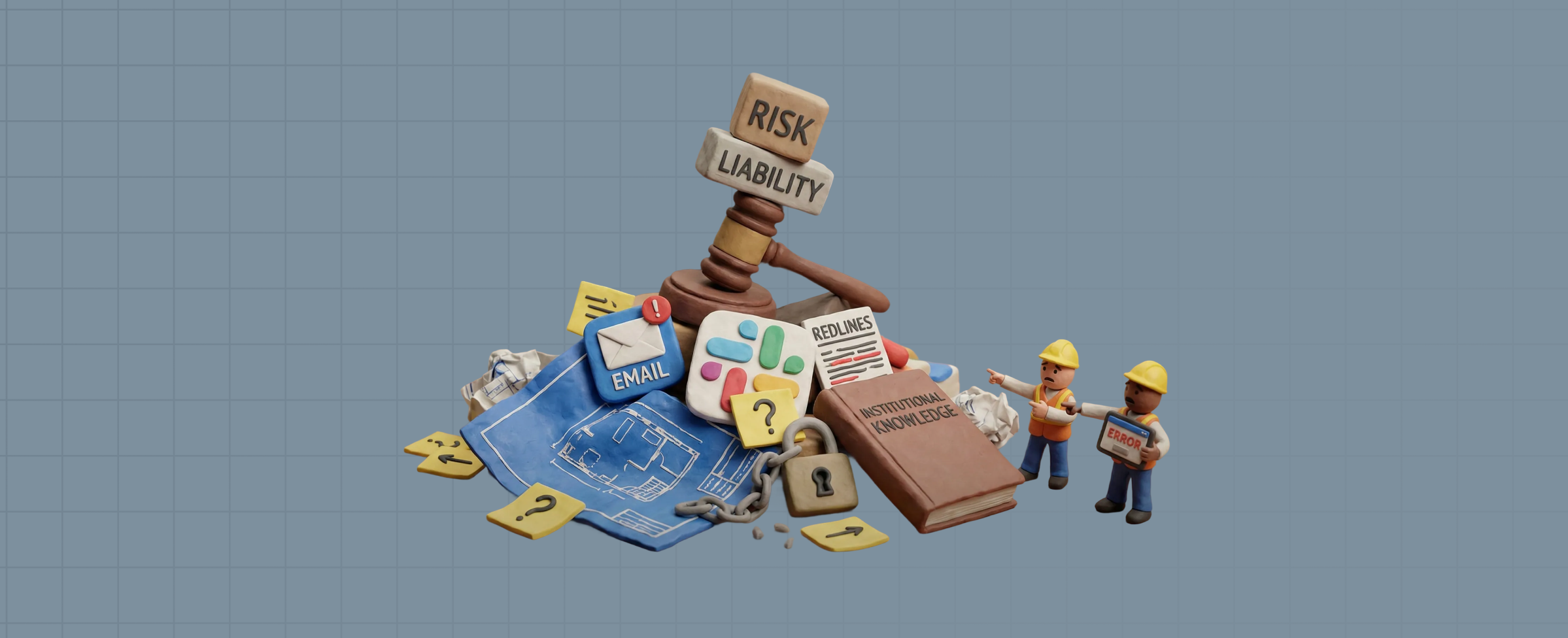
Code documentation and traceability matter because every code interpretation made during design carries legal, safety, and regulatory consequences. Decisions related to egress, fire protection, accessibility, ventilation, hazardous materials, and exceptions must be defensible, traceable, and reproducible - not only for permit approval and inspections, but also for liability protection if something goes wrong. Without a documented record of how requirements were interpreted, which editions were applied, what exceptions were used, and why certain choices were made, firms cannot prove due diligence, cannot resolve disputes efficiently, and cannot preserve institutional knowledge for future projects.
Yet most firms fail at code documentation because their workflows are fragmented and informal. Critical decisions live in Slack threads, emails, PDF markups, personal notebooks, hallway conversations, or the memories of senior staff. There is no centralized code repository, no standardized decision log, and no firm-wide workflow. Code research is rarely billable, interpretations evolve across design phases, multiple disciplines contribute without shared ownership, and everyone assumes someone else documented the final decision. As a result, teams repeat research on every project, apply inconsistent interpretations, struggle during AHJ reviews and field inspections, and face heightened liability exposure.
Good documentation requires structure - code matrices, decision logs, annotated drawings, version-controlled amendments, and centralized repositories - but most firms lack the process, culture, and tools to implement it.
Introduction: Code Decisions Aren’t Just Answers - They’re Liability
Unlike design sketches or engineering calculations, code decisions carry legal implications. Every choice made - fire ratings, egress sizing, accessibility clearances, mechanical ventilation, sprinkler thresholds - must be:
- defensible
- documented
- traceable
- reproducible
But most firms treat code research as something informal: a quick search, a Slack message, a conversation with a senior, or a handwritten note. This approach works - until it doesn’t.
Below we explore why documentation matters, why firms consistently fail at it, and how this contributes to delays, rework, and risk across the industry.
1. Why Code Documentation and Traceability Are Critical
1.1 Code interpretations are legally binding decisions
If something goes wrong - fire, injury, accessibility complaint - the question becomes: “Why did you interpret the code this way?”
Without documentation, firms cannot prove they acted responsibly.
1.2 AHJs expect clear justifications
During plan review, AHJs often request:
- code studies
- narrative justifications
- section-by-section breakdowns
- references to adopted code editions
- documentation of exceptions
Weak documentation → slower permits + more corrections.
1.3 Firms need traceability to defend decisions
In disputes or lawsuits, the burden is on the design team to show:
- how they read the code
- which exceptions applied
- what amendments were used
- how alternatives were justified
Without a documented trail, firms are exposed.
1.4 Future project teams rely on past logic
Code decisions form “precedent” that informs:
- future designs
- future scopes
- future interpretations
Without documentation, each project becomes a blank slate.
2. The Typical Reality: Code Decisions Aren’t Documented Anywhere Useful
Most firms rely on ad hoc, decentralized methods.
2.1 Emails and Slack messages
Critical decisions are often hidden in:
- internal chats
- 20-message email threads
- conversations with seniors
Impossible to retrieve later.
2.2 PDF markups and redlines
Code decisions embedded in:
- commented PDFs
- screenshot annotations
- markup layers
These often get overwritten or lost.
2.3 Personal notes
Many decisions live in:
- notebooks
- sticky notes
- personal OneNote files
- people's heads
These leave the firm when people leave.
2.4 Verbal instructions
One of the most dangerous failure points: “Just trust me, I’ve done this before.” Zero documentation.
2.5 Old checklists that are never updated
Teams use outdated:
- Excel checklists
- Word templates
- legacy project files
Often based on older code cycles.
3. Why Firms Consistently Fail at Code Documentation
What can you ask? (Sample questions)
- What building code edition does my state currently enforce?
- How do state-specific amendments modify the base IBC?
- What structural design loads apply in my jurisdiction?
- What energy code requirements apply to my building type?
3.1 No standardized workflow
Every designer has their own method.
Most firms have no:
- code log
- central repository
- official documentation process
3.2 Code research isn’t billable
Teams feel pressure to:
- finish fast
- skip note-taking
- avoid writing detailed justifications
This creates a culture of “speed over accuracy.”
3.3 Code interpretations evolve during the project
Designs evolve - and so do interpretations.
But teams rarely update:
- earlier decisions
- earlier clarifications
- earlier assumptions
Leading to inconsistencies.
3.4 Code decisions involve multiple disciplines
Architecture + MEP + fire protection + structural must align.
No single person “owns” the documentation, so no one documents it.
3.5 Everyone assumes someone else kept the record
“Didn’t the fire consultant write this?”
“Did the architect document this exception?”
“Did the MEP team note their airflow calculations?”
Often → nobody did.
3.6 People underestimate the importance until something fails
Permit rejection?
Inspector redline?
Client complaint?
Lawsuit?
Only then does documentation become a priority.
4. The Consequences of Poor Documentation
4.1 Repeated research across every project
Costly, slow, and inefficient.
Every team re-learns the same code.
4.2 Inconsistent interpretations
Different teams = different answers = permitting problems.
4.3 Failed plan reviews
Lack of justification = AHJ pushback.
4.4 Failed inspections
Field conditions differ from undocumented design assumptions.
4.5 Liability exposure
No proof = no defense.
4.6 Loss of institutional knowledge
When seniors retire or switch firms, decades of knowledge vanish.
4.7 Inefficient conflict resolution
Without documentation, teams don’t know:
- what was decided
- why it was decided
- when it was decided
- who decided it
This leads to circular conversations.
5. The Hardest Areas to Document Properly
5.1 Fire protection logic
Documenting exceptions for sprinklers, fire barriers, smoke partitions, and alarm strategies is extremely complex.
5.2 Egress justification
Occupant load → exit width → ratings → discharge paths requires multi-code reasoning and formal documentation.
5.3 Accessibility
ADA + ANSI + local amendments -> high documentation burden.
5.4 Mechanical ventilation
ASHRAE vs. IMC vs. IECC → conflicting requirements.
5.5 Alternative Means & Methods (AMMRs)
Require strong narratives and long-term traceability.
5.6 Hazardous materials compliance
Highly regulated across multiple codes & standards.
6. What Good Code Documentation Looks Like
While most firms lack this, best practices include:
6.1 Code matrices
Structured tables of applicable requirements.
6.2 Decision logs
Chronological record of:
- interpretations
- assumptions
- clarifications
6.3 Narrative code reports
Used for plan review submissions.
6.4 Annotated drawings
Showing where each rule impacts design.
6.5 Centralized code repository
Accessible across teams.
6.6 Version-controlled amendment lists
Tracking changes across code cycles.
6.7 Documentation of AHJ conversations
Especially when decisions are made informally.
FAQs
1. Why do firms struggle with code documentation?
Because workflows are unstructured, decentralized, and rely on emails, chats, and personal memory instead of standardized systems.
2. Why is traceability important for code decisions?
It provides defensibility, supports permitting, strengthens liability protection, and preserves institutional knowledge for future projects.
3. What happens when code interpretations aren’t documented?
Teams repeat research, make inconsistent decisions, face plan-review delays, fail inspections, and increase legal risk.
4. Who is responsible for documenting code decisions?
All disciplines share responsibility, but firms often fail because no single person or team “owns” documentation.
5. Which code areas require the most rigorous documentation?
Egress logic, fire protection strategies, accessibility interpretations, mechanical ventilation paths, hazardous materials compliance, and any Alternate Means & Methods requests.
6. Why do code decisions get lost so easily?
Because they’re buried in email threads, Slack messages, PDF markups, personal notes, and conversations that never make it into project records.
7. How should code research ideally be documented?
Through structured code matrices, decision logs, annotated drawings, narrative code reports, version-controlled amendment lists, and a centralized, searchable repository.
8. Why does poor documentation increase liability?
If an incident occurs, the firm cannot prove how or why the decision was made - making it appear uninformed or negligent.
9. How does poor documentation affect permitting?
AHJs expect clear justification. Missing documentation leads to questions, corrections, delays, and resubmissions.
10. What is the biggest long-term cost of poor documentation?
Loss of institutional knowledge - when senior staff leave, their interpretations and reasoning leave with them.
References
ICC Codes (IBC/IFC/IEBC), NFPA Codes (13, 72, 101), ADA Standards, ANSI A117.1, ASHRAE Standards, state and local amendments, industry best practices for permitting and documentation, and extensive real-world experience across architecture, engineering, and construction.
Related Building Code Resources
- Building CodesWhat Are the Key Aspects to Consider When Analyzing Building Codes?
- Building CodesDigital Code Libraries & Search Tools: What They Fix and What They Don’t
- Building CodesWhere Traditional Building Code Research Breaks Down
- Building CodesThe Hidden Costs of Manual Building Code Research
- Building CodesTraditional Building Code Research Methods
MeltPlan
A curated stream of preconstruction intelligence, estimating innovation, takeoff breakthroughs, workflow advancements, and expert perspectives—powered by the AI and technology shaping the future of construction.
Visit SiteDon't miss what's shaping AEC
The latest on preconstruction, codes, AEC news & trends — so you're always in the know.