Why Does Building Code Research Take So Long (and Why Is the Workflow So Slow, Manual, and Fragmented)?
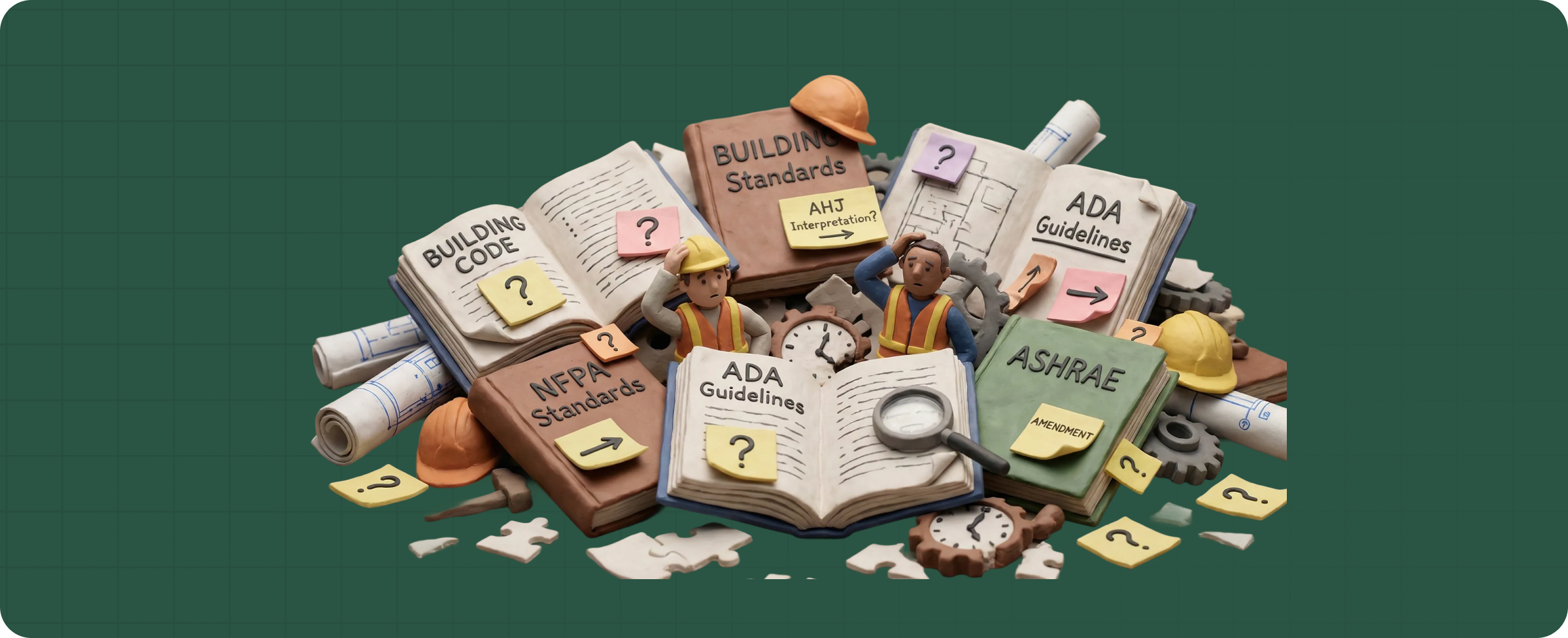
Building code research is slow because the process is fundamentally multi-source, multi-step, and inherently fragmented across dozens of documents, jurisdiction..
Contents
Building code research is slow because the process is fundamentally multi-source, multi-step, and inherently fragmented across dozens of documents, jurisdictions, standards, and interpretations. Before researching a single requirement, professionals must determine the correct jurisdiction, adopted code editions, amendments, referenced standards, fire marshal bulletins, and accessibility rules - all of which vary by city, update irregularly, and rarely exist in a centralized, searchable location.
Research tools are primitive: PDFs, scanned documents, unsearchable municipal files, paywalled standards, bookmarked websites, internal notes, email chains, and tribal knowledge scattered across teams. Keyword search is ineffective because code logic depends on context, exceptions, definitions, and cross-references spanning multiple chapters and external standards.
Building codes themselves are written in dense legal language with exceptions buried in footnotes, tables, and conditional clauses. Nearly every question requires multi-code reasoning - combining IBC with NFPA, ADA/ANSI, ASHRAE, IECC, IMC, IFC, and local amendments. These codes often contradict each other, forcing professionals to reconcile conflicts manually.
Firms compound the problem: interpretations are rarely documented; checklists become outdated; knowledge lives with senior staff; and each project repeats the same research because there is no project memory or standardized workflow. AHJ variability adds further friction - plan reviewers, inspectors, and fire marshals interpret rules differently, and many policies are unpublished.
As a result, even simple questions - like calculating an occupant load, designing a corridor, or laying out an accessible restroom - require navigating an entire ecosystem of documents and interpretations. Code research ends up consuming massive time across the industry, often unbillable and high-risk, because the system forces professionals to become detectives rather than simply “look up a rule.”
Introduction: Code Research Isn’t “Looking Up a Rule” - It’s an Investigation
Most people outside the industry assume code research is like searching in a textbook. But in reality, researching a building code question is more like detective work:
- Which code edition applies?
- What local amendments apply?
- Does the fire marshal override this?
- Which referenced standard governs?
- Are there exceptions or conflicting rules?
- Are there AHJ memos or bulletins?
- Did seniors solve this in a previous project?
This is why even the simplest question - like corridor width or accessible turning radius - can spiral into hours of searching.
1. Code Research Is Inherently Multi-Step and Multi-Source
Here’s what a typical professional has to do before they even start researching the rule itself:
1.1 Identify the correct jurisdiction
City → County → State → Special district
Each has different rules.
1.2 Determine the correct code list
- IBC edition
- IFC edition
- IEBC
- NEC, IMC, IPC
- IECC or ASHRAE
- ADA / ANSI
- Local amendments
- Fire marshal policies
- Referenced standards
1.3 Reconcile conflicting editions
E.g.:
- State uses IBC 2018
- City amendments reference IBC 2015
- NFPA 13 adopted from 2016
- ASHRAE 90.1 from 2019
This is extremely common.
1.4 Only then can you begin actual research
This “setup work” often takes longer than the research itself.
2. Research Tools Are Primitive and Fragmented
Professionals depend on:
- PDF downloads
- Keyword searches
- Scanned documents
- Unsearchable municipal PDFs
- Internal server folders
- Bookmarked pages
- Physical code books
- Email chains with seniors
- Notes from past projects
Nothing is centralized. Nothing is linked. Nothing is structured.
2.1 Keyword search is nearly useless
Searching “exit sign” might return:
- 20 irrelevant hits
- 4 different code sections
- exceptions hidden in footnotes
- definitions hidden in Chapter 2
- referenced standards hidden elsewhere
Keyword search doesn’t understand multi-code logic or context.
2.2 Referenced standards are behind paywalls
NFPA, ASHRAE, UL, ASTM, ACI, AISC = all separate downloads, paywalls, and editions.
2.3 Local amendments are often hidden, outdated, or incomplete
Many cities provide:
- multiple amendment packets
- partial redlines
- outdated PDFs
- missing pages
- deep website layers
Professionals waste time verifying if the document is even current.
3. Code Language Itself Makes Research Hard
What can you ask? (Sample questions)
- What building code edition does my state currently enforce?
- How do state-specific amendments modify the base IBC?
- What structural design loads apply in my jurisdiction?
- What energy code requirements apply to my building type?
Building codes are written in dense, cross-referenced legal language.
3.1 The structure is not intuitive
Understanding Chapter 10 egress may require:
- Chapter 2 definitions
- Chapter 3 occupancy
- Chapter 4 special uses
- Chapter 5 mixed-use rules
- Chapter 7 fire-resistance
- Chapter 9 fire protection systems
- NFPA 101
- NFPA 13
- Local fire marshal policies
All to determine one single requirement.
3.2 Exceptions are buried everywhere
- Exceptions within exceptions
- Footnotes
- Cross-references
- Conditional rules (“where provided…”)
- Tables that modify text
- Notes that modify tables
If you miss one exception, you might be non-compliant.
3.3 Rules conflict across codes
Examples:
- IBC egress width vs. NFPA 101 width
- ADA vs. ANSI A117.1
- ASHRAE vs. IECC
- IMC vs. local mechanical amendments
Professionals must reconcile conflicts manually.
4. Multi-Code Reasoning Makes Research Slow and Error-Prone
To answer almost any code question, you must navigate multiple codes.
4.1 Egress Example
To calculate exit width, you need:
- IBC occupant load factors
- IBC egress width equations
- Local amendments
- NFPA 101 width adjustments
- ADA accessible egress rules
- Fire marshal interpretations
- Electric door hardware rules (NFPA 70, UL standards)
4.2 Mechanical Example
To calculate outdoor air requirements:
- IMC
- ASHRAE 62.1
- city amendments
- IECC interaction with controls
- fire/smoke damper rules (IBC/IFC)
4.3 Fire Protection Example
To determine sprinkler coverage:
- IBC triggers
- local sprinkler ordinances (e.g., SF)
- NFPA 13 spacing
- NFPA 72 alarm integration
- fire pump requirements (NFPA 20)
Each question turns into a multi-document journey.
5. Organizational Issues Slow Down Research Even More
5.1 Firms don’t document interpretations
Most code decisions live in:
- email threads
- Slack/Teams chats
- sticky notes
- markup PDFs
- senior memory
So the same question gets asked again on the next project.
5.2 Knowledge is concentrated in seniors
Junior → Asks mid-level
Mid-level → Unsure
Senior → Gives answer from experience
Senior leaves → Knowledge lost
This cycle repeats endlessly.
5.3 Code checklists are outdated
Every firm has:
- old Excel checklists
- half-updated PDF checklists
- personal notes
- outdated templates
Teams don’t know which version is correct.
5.4 No project memory
Every project restarts code research from scratch - even when past projects solved the same issues.
6. AHJ Variability Forces Re-Researching the Same Questions
Even if the code text is clear, AHJs interpret it differently.
6.1 Plan reviewer interpretations differ by person
Example: one plan reviewer may accept an exception another rejects.
6.2 Field inspectors override plan reviewers
Field inspectors often:
- enforce unwritten policies
- follow stricter fire marshal guidance
- reinterpret accessibility rules
- require field adjustments
Designers must research how this inspector reads the code.
6.3 Local fire marshals often have unpublished policies
Examples:
- sprinkler spacing restrictions
- ERCES/ERRC communication system rules
- fire lane requirements
- hazardous materials rules
You can’t look these up - you must know them.
7. Real Examples of Why Code Research Takes Hours
7.1 Determining occupant load
- Identify right occupancy group
- Verify mixed-use rules
- Check local modifications
- Apply exceptions for concentrated use
- Check NFPA adjustments for assembly areas
What seems simple isn’t.
7.2 Designing an accessible restroom
- ADA
- ANSI A117.1
- IBC Chapter 11
- State accessibility amendments
- Local accessibility overlays
All needed for one layout.
7.3 Fire-rated corridor determination
- Corridor width triggers
- Separation rules
- Sprinkler exception
- Smoke partition exceptions
- NFPA 101 cross-reference
- Local fire marshal preferences
And that’s for a hallway.
8. The Result: Code Research Consumes Massive Time Across the Industry
Architects regularly spend: 8–20 hours/week on code research.
Engineers spend: 5–15 hours/week resolving cross-references.
Contractors and inspectors spend: hours per issue clarifying unclear requirements.
This time is unbillable, high-risk, and slow - and the system makes it unavoidable.
FAQs
1. Why does building code research take so long?
Because every question requires navigating multiple codes, editions, amendments, standards, exceptions, and AHJ interpretations - none of which exist in one place.
2. Why isn’t building code research centralized or standardized?
The U.S. allows each state and city to adopt and modify codes independently, leading to thousands of decentralized sources with no unified database.
3. Why doesn’t keyword search work for code research?
Code logic depends on context, exceptions, definitions, and cross-references across multiple chapters and standards - none of which keyword search can interpret.
4. Why do firms end up repeating the same code research over and over?
Because interpretations aren’t documented, project memory doesn’t exist, and knowledge remains siloed in emails, senior brains, and outdated checklists.
5. Why do referenced standards slow down the workflow?
Because NFPA, ASHRAE, UL, ASTM, ACI, and AISC standards are paywalled, updated independently, sometimes jurisdiction-modified, and rarely aligned with the adopted code edition.
6. Why is multi-code reasoning such a bottleneck?
Most requirements involve multiple codes (e.g., IBC + NFPA + ADA + ASHRAE), and professionals must manually reconcile conflicts, exceptions, and overlaps.
7. How do AHJ reviewers and inspectors contribute to delays?
They often enforce unpublished interpretations, stricter internal policies, or case-by-case judgment calls that require re-researching the same questions for each jurisdiction.
8. Do errors in code research create real project consequences?
Yes - errors lead to plan review rejections, redesigns, rework, field changes, schedule delays, and liability exposure for both designers and owners.
References
ICC Codes (IBC/IFC/IEBC/IMC/IPC), NFPA 13/72/101/70, ASHRAE 62.1/90.1, ADA Standards, ANSI A117.1, state/local amendments, plan review guidance, inspection field practices, and expert industry knowledge.
Related Building Code Resources
- Building CodesWhat Are the Key Aspects to Consider When Analyzing Building Codes?
- Building CodesDigital Code Libraries & Search Tools: What They Fix and What They Don’t
- Building CodesWhere Traditional Building Code Research Breaks Down
- Building CodesThe Hidden Costs of Manual Building Code Research
- Building CodesTraditional Building Code Research Methods
Don't miss what's shaping AEC
The latest on preconstruction, codes, AEC news & trends — so you're always in the know.
MeltPlan
A curated stream of preconstruction intelligence, estimating innovation, takeoff breakthroughs, workflow advancements, and expert perspectives—powered by the AI and technology shaping the future of construction.
Visit Site