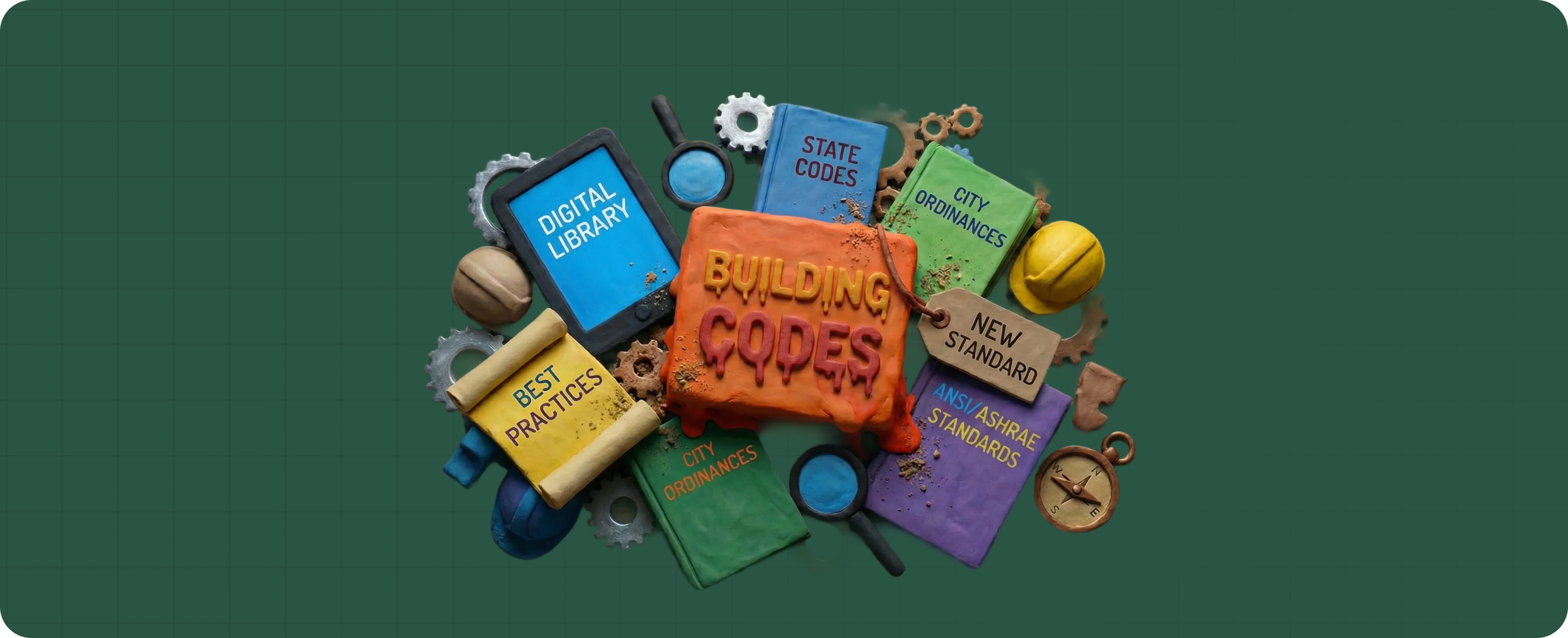
Why Is It So Hard to Access the Right Building Codes (Local Amendments, Referenced Standards, Updates)?
Accessing the correct building codes is difficult because the United States has no centralized code source and every state, county, and city independently adopt..
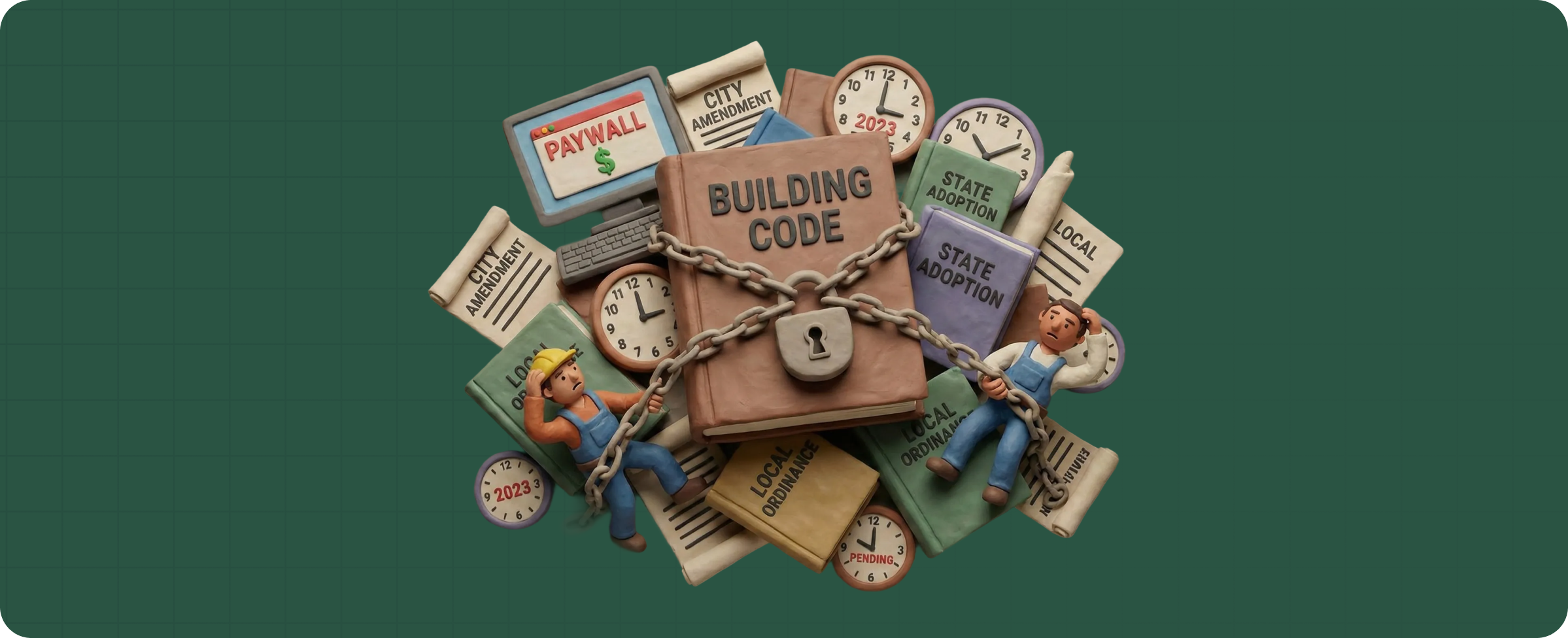
Accessing the correct building codes is difficult because the United States has no centralized code source and every state, county, and city independently adopts, modifies, and publishes its own version of the codes - often in fragmented, inconsistent, or outdated formats. Architects, engineers, contractors, and inspectors must piece together information from model codes (IBC, IFC, IMC, IPC), state adoption lists, local amendment packets, fire marshal bulletins, accessibility rules, and referenced standards like NFPA, ASHRAE, UL, ASTM, ACI, and AISC - most of which are paywalled and updated on different timelines.
Local amendments are the biggest access challenge: they are often scattered across municipal websites, buried in legislative documents, split across multiple departments, or silently updated without version control. Jurisdictions publish documents in inconsistent formats - PDFs, scanned images, HTML fragments, redlines, agendas, or poorly indexed attachments - making it difficult to determine what is current or complete.
Referenced standards create a second layer of complexity: they are typically paywalled, updated annually, and their editions often do not match the editions adopted by the governing jurisdiction. Jurisdictions may also modify referenced standards themselves. Because standards reference other standards, each requirement can cascade into another chain of documents.
Updates are almost impossible to track because adoption cycles vary dramatically between jurisdictions. Some states update every three years; some every nine; some leave it to each city. Many cities lag multiple cycles behind, and most jurisdictions provide no alerts, notifications, or centralized databases when updates occur. Fire marshals often apply unpublished interpretations or informal policies that never appear in the official code.
The result is a fragmented, decentralized, unindexed ecosystem where professionals must manually reconstruct the governing rule set for each project. This leads to outdated information, mismatched code editions, missed amendments, inconsistent submittals, permitting delays, redesigns, rework, and liability exposure. In short, accessing the right building codes is hard because the system is decentralized, unsynchronized, inconsistently published, paywalled, ever-changing, and dependent on dozens of interlinked documents across multiple authorities.
1. The U.S. Has No Single Building Code - Only a Decentralized Patchwork
1.1 Every jurisdiction chooses its own adoption path
Even neighboring cities may enforce:
- different versions of IBC
- different fire code amendments
- different energy codes
- different accessibility rules
This decentralization means professionals must:
- identify the jurisdiction
- check state-level adoptions
- confirm local amendments
- search for departmental bulletins
- figure out which referenced standards apply
This already creates 4–6 layers of required documents.
1.2 Adoption cycles are misaligned
Model codes update every 3 years.
States update every 3–9 years.
Cities update whenever they choose.
Referenced standards update annually.
Fire marshals issue memos continuously.
There is no synchronization.
1.3 No standard format for publishing codes
Some jurisdictions use:
- HTML pages
- Word docs
- 300-page amendment PDFs
- Scanned, unsearchable documents
- Dropbox links
- Hard copies only
Others publish:
- partial amendments
- only redline changes
- only differences from the state code
Professionals must reconstruct the full governing code manually.
2. Local Amendments Are Scattered, Hidden, and Hard to Track
Local amendments are the single biggest source of code access problems.
2.1 Many cities hide amendments deep in municipal websites
Finding the right documents often requires navigating:
- building department pages
- fire department pages
- planning pages
- legislative ordinances
- PDF packets hidden in agendas
- city council resolutions
Some amendments are never indexed.
2.2 Amendments often come in multiple layers
A city may publish:
- administrative amendments
- building code amendments
- fire code amendments
- housing, zoning, or energy amendments
- supplemental policies
- fire marshal bulletins
- interpretation memos
- accessibility clarifications
None are in one place.
2.3 Many amendments change silently
Jurisdictions frequently:
- update PDFs without versioning
- replace documents without changelogs
- publish addendums with no announcements
- distribute updates only via email or in-person meetings
Designers often work from outdated information without realizing it.
3. Referenced Standards Are a Second, Even Harder Access Problem
What can you ask? (Sample questions)
- How do local code amendments modify the base IBC requirements?
- What triggers the need for a building permit?
- What plan review documents are typically required?
- How do jurisdictional amendments affect fire and structural codes?
Referenced standards include:
- NFPA (fire alarms, sprinklers, life safety, electrical)
- ASHRAE (ventilation, energy)
- UL/ASTM (product/material standards)
- AISC/ACI (structural steel & concrete)
- SMACNA/AHRI (MEP design)
3.1 They are often paywalled
Professionals must purchase:
- NFPA 13
- NFPA 72
- NFPA 70 (NEC)
- ASHRAE 62.1
- ASHRAE 90.1
Many smaller firms cannot afford full subscriptions.
3.2 Their editions often don’t match the adopted code
Example:
- IBC 2021 references ASHRAE 90.1-2019
- A jurisdiction may adopt a modified ASHRAE 90.1-2016
- NFPA codes update annually
Professionals must reconcile mismatched edition years.
3.3 Jurisdictions modify referenced standards
Some states override:
- fire sprinkler densities
- ventilation rates
- energy performance criteria
…without clearly summarizing the changes.
3.4 Standards reference other standards
NFPA 13 references ASTM standards
ASHRAE references AMCA
UL listings reference NFPA
AISC references ACI
So even referenced standards reference additional standards.
4. Updates, Amendments, and Code Cycles Are Nearly Impossible to Track
4.1 Code cycles vary dramatically by state
| State | IBC Cycle | Notes |
|---|---|---|
| CA | 3 years | Title 24 is updated consistently |
| FL | 3 years | FBC has heavy amendments |
| TX | varies by city | No statewide enforcement |
| NY | unique NYC code | State and NYC differ completely |
Professionals can’t rely on memory alone.
4.2 Many cities lag several cycles behind
Some jurisdictions still enforce:
- IBC 2012
- NEC 2011
- IECC 2009
while others enforce the latest versions.
4.3 There is no notification system
When a city updates:
- no email blast
- no centralized database
- no automatic update
- sometimes no press release
Professionals are expected to magically know.
4.4 Plan reviewers and inspectors may apply unofficial interpretations
Fire marshals may enforce:
- stricter sprinkler spacing
- tighter egress rules
- unique fire alarm zoning
- city-specific ventilation requirements
These are often not published anywhere.
5. The Real-World Impact on Design and Construction Teams
5.1 Architects spend hours just figuring out the governing code list
Before even researching, they must answer:
- What edition?
- What amendments?
- Which referenced standards?
- Which local policies?
- Which interpretations?
5.2 Engineers must reconcile mismatched editions and conflicting requirements
Mechanical engineers must align:
- IMC
- IECC/ASHRAE
- local energy codes
- fire marshal ventilation rules
Electrical engineers must align:
- NEC (NFPA 70)
- IBC electrical rooms
- city amendments
- utility company requirements
5.3 Contractors must interpret conflicting field requirements
On site, they deal with:
- inspector preferences
- unclear amendments
- legacy drawings
- undocumented AHJ policies
5.4 Inspectors struggle with inconsistent submittals
When designers use outdated codes, inspectors face:
- non-compliant drawings
- late change orders
- rejected installations
- delays in occupancy
6. Real Examples of Access-Related Problems
6.1 Wrong amendment packet used
A designer uses a 2018 amendment PDF for a city enforcing 2021 updates → Failure at permitting.
6.2 Wrong edition of NFPA 13 used
Sprinkler designer uses 2019 instead of 2016 → AHJ rejects system.
6.3 ADA vs. local accessibility confusion
Architect uses ANSI numbers instead of ADA or local amendments → Accessibility inspectors reject restroom layouts.
6.4 Outdated energy code
MEP team designs to ASHRAE 90.1-2016 but state adopted 2019 → Energy reviewer stops the project.
7. Why Access Challenges Exist (The Root Causes)
7.1 Decentralization
Thousands of jurisdictions, each with autonomy.
7.2 No centralized update infrastructure
No national repository, no API, no common system.
7.3 Legacy publishing workflows
Many jurisdictions lack resources for:
- proper indexing
- version control
- digital records
- searchable formats
7.4 Referenced standards complexity
Separate organizations, separate cycles, separate licensing.
7.5 Code language itself is fragmented
Heavy cross-referencing makes it impossible to evaluate one document in isolation.
FAQs
1. Why is it so hard to find the correct building codes for my project?
Because every state and city adopts different versions, publishes amendments inconsistently, and provides no centralized repository - requiring you to hunt across multiple websites and documents.
2. Do all cities modify the IBC or other model codes?
Yes. Almost every major city has at least some local amendments - many have extensive, multi-layered modifications across building, fire, energy, and accessibility codes.
3. Why are referenced standards (NFPA, ASHRAE, UL, ASTM) so difficult to access?
They are published by private organizations, typically paywalled, and not included with the adopted code. Their editions often differ from those adopted by your jurisdiction.
4. How do I know which code edition and amendments apply to a project?
You must check the state adoption list, the city or county amendments, any fire marshal policies, and any referenced standards required by the adopted code edition.
5. What is the biggest risk of using the wrong code version or missing amendments?
Failed permitting, redesigns, construction delays, costly rework, rejected inspections, and increased liability for the design team and owner.
6. Why are code updates so hard to track?
Jurisdictions rarely announce updates. Many silently replace PDFs or add amendment packets without versioning, notifications, or changelogs.
7. Do inspectors and fire marshals enforce codes differently than what’s published?
Yes. AHJs often enforce unpublished interpretations, stricter local policies, or operational requirements not found in the code - and these are not centralized anywhere.
References
ICC Codes, NFPA Standards, ASHRAE, ANSI A117.1, ADA Standards, IECC, state administrative bulletins, city/county amendment packets, fire marshal policies, AHJ documentation - and extensive industry practice.
Related Building Code Resources
- Building CodesWhat Are the Key Aspects to Consider When Analyzing Building Codes?
- Building CodesDigital Code Libraries & Search Tools: What They Fix and What They Don’t
- Building CodesWhere Traditional Building Code Research Breaks Down
- Building CodesThe Hidden Costs of Manual Building Code Research
- Building CodesTraditional Building Code Research Methods
MeltPlan
A curated stream of preconstruction intelligence, estimating innovation, takeoff breakthroughs, workflow advancements, and expert perspectives—powered by the AI and technology shaping the future of construction.
Visit SiteDon't miss what's shaping AEC
The latest on preconstruction, codes, AEC news & trends — so you're always in the know.