NYS Residential Code (RCNYS): Key Requirements for Construction & Renovation
The New York State Uniform Fire Prevention and Building Code, often called the "Uniform Code," governs construction across the state. For one- and two-family ho..
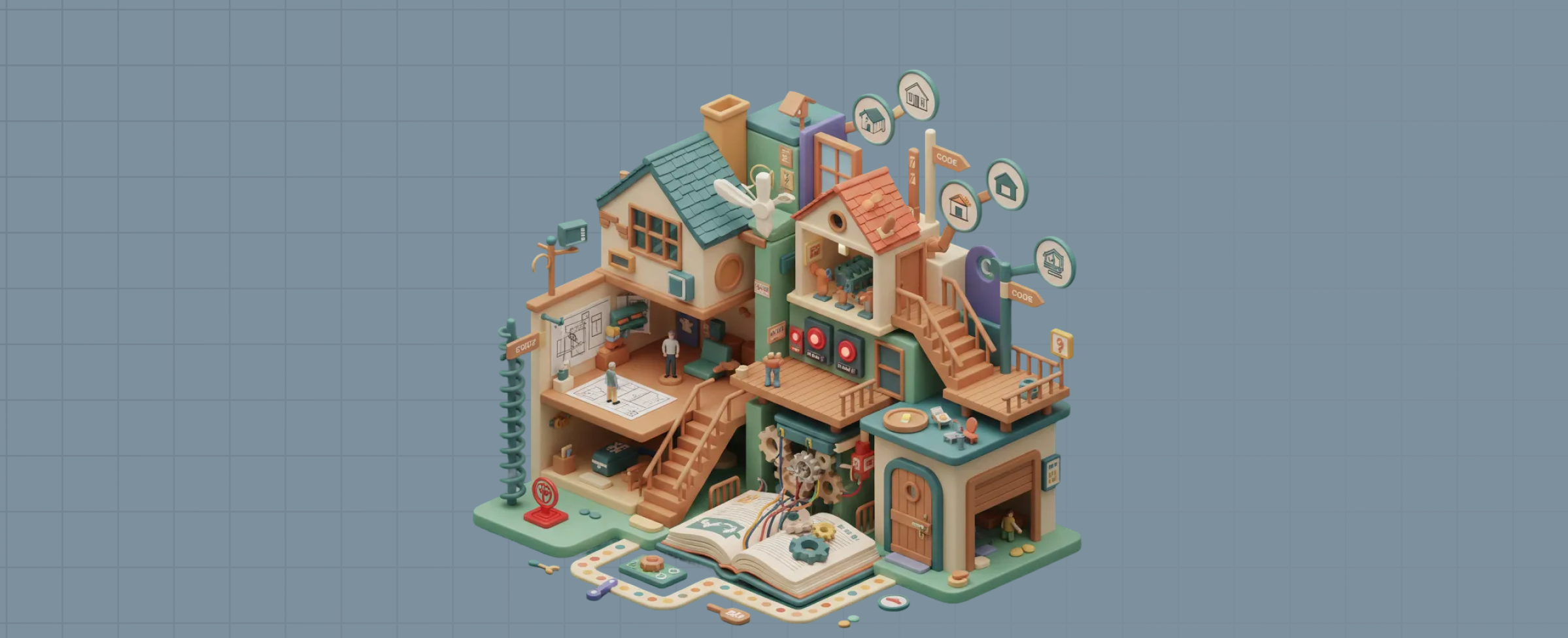
A Guide to the 2020 New York State Residential Code (RCNYS)
The New York State Uniform Fire Prevention and Building Code, often called the "Uniform Code," governs construction across the state. For one- and two-family homes and townhouses, the primary document is the Residential Code of New York State (RCNYS). Understanding its key provisions is essential for architects, builders, and homeowners to ensure projects are safe, compliant, and permitted without delay.
This guide explains critical RCNYS requirements for common residential projects, from basement finishing and deck construction to fire safety systems.
Core RCNYS Requirements at a Glance
For residential projects in New York State (outside of NYC), the 2020 RCNYS establishes clear minimum standards for safety and construction. Here are the key takeaways for the most common questions:
- Stair Guardrails: A guardrail is only required on the open side of stairs when the total vertical drop is more than 30 inches. A short flight of stairs with only two risers will not require a guardrail as it falls below this height threshold.
- Building Permits: Finishing a basement is a significant alteration that involves structural, electrical, and life-safety elements (like egress). A building permit is required for this work in virtually every jurisdiction in New York State.
- Residential Sprinklers: No. While the model International Residential Code (IRC) requires fire sprinklers in new one- and two-family homes, New York State has a specific amendment that deletes this requirement. Sprinklers are not mandated statewide in new single-family homes.
- Deck Handrails & Guards:
- Handrails are required on at least one side of any stair with four or more risers.
- Guardrails are required on the open sides of decks, stairs, and landings that are more than 30 inches above the ground.
- Smoke & CO Alarms: Interconnected smoke alarms are required in every sleeping room, outside each sleeping area, and on every level (including basements). Carbon monoxide alarms are required outside sleeping areas if the home has fuel-burning appliances or an attached garage.
- Garage/House Door: The door separating an attached garage from the house must provide fire protection. This is typically achieved with a 20-minute fire-rated door, though certain solid wood or steel doors also qualify. Crucially, the door must be self-closing and self-latching.
Why Understanding the NYS Residential Code is Crucial
Navigating the New York State Uniform Code is a fundamental part of any residential design and construction project. It's not a single book but a suite of regulations, including the Residential Code (RCNYS), Building Code (BCNYS), Energy Conservation Construction Code (ECCCNYS), and others. These codes are based on the International Code Council's (ICC) model codes but contain specific New York State amendments.
Failing to understand these requirements can lead to:
- Permit Denials: Plan reviews will fail if designs don't meet minimum code, causing costly delays.
- Failed Inspections: Work that doesn't match the approved plans or meet code will be rejected by the local code enforcement officer, requiring rework.
- Safety Hazards: Code requirements for egress, fire separation, and fall protection are based on decades of safety data. Bypassing them puts occupants at risk.
- Resale Issues: Non-permitted work can create significant legal and financial problems when selling a property.
It's also critical to distinguish between the New York State code and the New York City Building Code. NYC has the authority to write and enforce its own distinct set of construction codes, which are generally more stringent. The RCNYS applies to all municipalities in the state except for New York City.
Under the 2020 Residential Code of NYS (RCNYS), is a guardrail required on the open side of a set of stairs with only two risers, and if so, what is the minimum required height?
What can you ask? (Sample questions)
- What building code edition does my state currently enforce?
- How do state-specific amendments modify the base IBC?
- What structural design loads apply in my jurisdiction?
- What energy code requirements apply to my building type?
No, a guardrail is not required on the open side of a set of stairs with only two risers. The requirement for a guardrail is triggered by the height of the fall, not the number of steps.
According to 2020 RCNYS Section R312.1, guards are required on the open sides of walking surfaces, including stairs, ramps, and landings, that are located more than 30 inches measured vertically to the floor or grade below.
- Analysis: A standard residential riser height is around 7.75 inches. A flight of stairs with two risers would have a total height of approximately 15.5 inches (2 x 7.75").
- Conclusion: Since 15.5 inches is significantly less than the 30-inch threshold, no guardrail is mandated by the RCNYS.
If a guardrail were required (i.e., the drop was over 30 inches), RCNYS R312.1.2 specifies that the minimum height for a residential guardrail is 36 inches, measured vertically from the leading edge of the stair nosing or the walking surface.
Do I need a building permit to finish my basement in a suburb of Rochester, NY?
Yes, you absolutely need a building permit to finish a basement anywhere in New York State, including the suburbs of Rochester (like Pittsford, Brighton, Greece, etc.). Finishing a basement is considered an alteration, not a simple cosmetic repair, and it involves multiple life-safety and building system components.
The 2020 RCNYS Section R105.1 (Required) states that any owner or authorized agent who intends to "construct, enlarge, alter, repair, move, demolish or change the occupancy of a building or structure…shall first make application to the building official and obtain the required permit."
Work typically involved in finishing a basement that requires a permit includes:
- Framing: Constructing new walls.
- Insulation: Must meet the requirements of the NYS Energy Code.
- Electrical: New outlets, switches, and lighting circuits must be installed to code (referencing the NFPA 70 - National Electrical Code).
- Plumbing/Mechanical: Adding a bathroom or modifying HVAC ductwork.
- Egress: If you add a sleeping room (bedroom), you must provide an emergency escape and rescue opening (egress window or door) per RCNYS R310.
While the state sets the minimum code, enforcement is handled by the local municipality's code enforcement office or building department. You will need to submit plans to your specific town or village for review and approval before beginning work.
Are sprinklers required in all new single-family homes built in New York State?
No, fire sprinklers are not required in new one- and two-family homes in New York State. This is a critical New York-specific amendment to the model code that often causes confusion.
The model code, the 2018 International Residential Code (IRC), on which the 2020 RCNYS is based, does have a provision (IRC R313.2) mandating automatic fire sprinkler systems in new townhouses and one- and two-family dwellings.
However, New York State has specifically amended this section. The 2020 RCNYS Section R313 is modified with a state amendment that deletes the requirement for sprinklers in one- and two-family dwellings. The requirement for sprinklers in new townhouses remains.
Therefore, while builders can voluntarily install them, there is no statewide mandate for sprinkler systems in newly constructed single-family houses under the current NYS Uniform Code.
According to the NYS Residential Code, what are the requirements for handrails and guardrails on my deck stairs?
The requirements for handrails and guardrails on deck stairs are distinct and based on different triggers: the number of steps for handrails and the fall height for guardrails.
Handrail Requirements (RCNYS R311.7.8):
- Trigger: A handrail is required on at least one side of any stairway with four or more risers.
- Height: The top of the handrail must be placed between 34 and 38 inches vertically above the nosing of the stair treads.
- Grip Size & Shape: The handrail must have a continuous grip and meet specific dimensional requirements for graspability. A common compliant shape is a "Type I" handrail (circular cross-section between 1¼ and 2 inches in diameter) or a "Type II" handrail with a perimeter between 4 and 6¼ inches.
- Continuity: Handrails must be continuous for the full length of the flight, from a point directly above the top riser to a point directly above the bottom riser.
Guardrail Requirements (RCNYS R312.1):
- Trigger: A guardrail is required along the open sides of stairs and landings that are more than 30 inches above the floor or grade below.
- Height: The guard must be a minimum of 36 inches high.
- Opening Limitations: The balusters or intermediate rails must be spaced such that a 4-inch diameter sphere cannot pass through. On stairs, the opening between the bottom rail and the treads is limited so a 6-inch sphere cannot pass through the triangle formed by the riser, tread, and bottom rail.
In practice, for a tall set of deck stairs, you will have both a guardrail and a handrail. The guardrail provides the 36-inch tall barrier, and a separate handrail can be mounted to it, or the top rail of the guard itself can be designed to also serve as the handrail if it meets the graspability requirements.
How many smoke and carbon monoxide detectors do I need in my house in NYS?
The number and location of smoke and carbon monoxide detectors are specified in the RCNYS to provide early warning for occupants.
Smoke Alarms (RCNYS R314): For new construction, smoke alarms must be installed in the following locations:
- In each sleeping room.
- Outside each separate sleeping area in the immediate vicinity of the bedrooms.
- On each additional story of the dwelling, including basements and habitable attics, but not including crawl spaces and uninhabitable attics.
- Power Source: In new construction, alarms must be hard-wired with a battery backup.
- Interconnection: All required smoke alarms must be interconnected so that when one alarm sounds, they all sound.
Carbon Monoxide (CO) Alarms (RCNYS R315): CO alarms are required in dwellings that contain a fuel-burning appliance (e.g., gas furnace, water heater, fireplace) or have an attached garage.
- They must be installed outside of each separate sleeping area in the immediate vicinity of the bedrooms.
- Where a fuel-burning appliance is located within a bedroom or its attached bathroom, a CO alarm must be installed within the bedroom.
- Power Source: In new construction, CO alarms must be hard-wired with battery backup. In existing dwellings, they can be battery-powered or plug-in.
What is the required fire rating for a door between my garage and my house under the NYS Residential Code?
The door separating an attached garage from the living space of a house must provide a level of fire resistance to slow the spread of a potential fire from the garage.
According to 2020 RCNYS Section R302.5.1 (Openings and penetrations), the door must be one of the following:
- A solid wood door not less than 1-3/8 inches thick.
- A solid or honeycomb-core steel door not less than 1-3/8 inches thick.
- A 20-minute fire-rated door.
While all three options are technically compliant, installing a labeled 20-minute fire-rated door and frame assembly is the most common and verifiable method used by builders to meet this requirement.
In addition to the door construction, two other critical requirements apply:
- Self-Closing: The door must be equipped with a self-closing device.
- Self-Latching: The door must have a self-latching device.
This ensures the door remains closed and latched to maintain the fire separation, unless someone is actively passing through it.
Additional Supporting Sections
Navigating NYS vs. NYC Building Codes
A common point of confusion is the difference between the statewide building code and the code used in New York City. They are separate legal and technical documents. Understanding which one applies to your project is the first step in compliance.
| Feature | New York State (Uniform Code) | New York City (NYC Construction Codes) |
|---|---|---|
| Governing Law | NYS Executive Law, Article 18 | NYC Administrative Code, Title 28 |
| Primary Codebooks | Based on the I-Codes (RCNYS, BCNYS) | A unique code based on the IBC but with extensive local amendments |
| Enforcing Body | Local city, town, or village Code Enforcement Office | NYC Department of Buildings (DOB) |
| Applicability | All of NYS except the five boroughs of NYC | The five boroughs: Manhattan, Brooklyn, Queens, The Bronx, Staten Island |
| Typical User | Suburban/rural homeowners, builders, architects | Urban developers, architects, engineers focused on high-density construction |
The Role of the Local Code Enforcement Officer
While the New York Department of State adopts and maintains the Uniform Code, it does not perform local plan reviews or inspections. This responsibility is delegated to the local Authority Having Jurisdiction (AHJ)—your town, village, or city's building department or code enforcement office.
The local Code Enforcement Officer (CEO) or Building Inspector is your primary point of contact for:
- Permit Applications: Submitting plans and paperwork for approval.
- Code Interpretations: Getting clarification on how a specific rule applies to your project. Local interpretations can vary.
- Required Inspections: Scheduling and passing inspections for footings, framing, plumbing, electrical, insulation, and final Certificate of Occupancy.
Always consult with your local building department at the beginning of any project. They can provide specific checklists, application forms, and guidance on local requirements that may go beyond the base RCNYS.
Key Differences in the 2020 RCNYS (Compared to the Model IRC)
New York State's adoption of the 2018 IRC includes several significant amendments. Professionals working in NYS should be aware of these key changes:
- Fire Sprinklers: As noted, the mandate for sprinklers in new one- and two-family homes is deleted.
- Energy Code: RCNYS Chapter 11 is replaced entirely by a reference to the Energy Conservation Construction Code of New York State (ECCCNYS). This is a separate, more stringent energy code.
- Snow Loads: Appendix N of the RCNYS provides specific ground snow loads for every county and many municipalities, which must be used for structural design.
- Stair Geometry: NYS has historically maintained slightly different stair riser and tread dimensions than the model IRC. The 2020 RCNYS allows for a maximum riser height of 8-1/4 inches and a minimum tread depth of 9 inches (as opposed to the IRC's 7-3/4" and 10").
Frequently Asked Questions (FAQ)
1. Where can I find the official NYS building codes online for free? The complete suite of the New York State Uniform Code, including the RCNYS, can be viewed for free on the International Code Council's public access website and through the NYS Department of State, Division of Building Standards and Codes website.
2. Does the RCNYS apply to a three-family apartment building? No. The RCNYS applies to one- and two-family dwellings and townhouses not more than three stories high. A three-family building would fall under the jurisdiction of the Building Code of New York State (BCNYS), which covers commercial and multi-family residential buildings.
3. What is the current version of the NYS Uniform Code? As of early 2024, the effective code is the 2020 Uniform Code, which is based on the 2018 I-Codes. New York State is on a three-year adoption cycle, so an update is anticipated. Always verify the currently enforced edition with your local building department.
4. Do I need an architect or engineer to get a residential permit in NYS? It depends on the scope of the project. For minor alterations, a homeowner can often draw their own plans. However, for new construction, significant additions, or any work involving major structural changes, state law requires the plans to be prepared and stamped by a New York State licensed Registered Architect or Professional Engineer.
5. What happens if I finish my basement without a permit? Working without a permit can lead to a stop-work order, fines from the local municipality, and having to remove or expose the completed work for inspection. It can also create significant problems when you try to sell the home, as unpermitted work may need to be legalized or disclosed, potentially lowering the property value.
6. Is an egress window required when I finish my basement? Yes, if you add a "sleeping room" (bedroom) in a basement, RCNYS R310 requires that the room have at least one emergency escape and rescue opening (egress window or door) that leads directly outside.
7. Are there special code requirements for coastal areas like Long Island? Yes. Homes in coastal regions, particularly on Long Island, must be designed to withstand higher wind loads as specified in RCNYS Chapter 3. Areas within flood zones also have extensive additional requirements for foundation design and elevation to mitigate flood damage.
8. How does the NYS Energy Code relate to the Residential Code? The Energy Conservation Construction Code of New York State (ECCCNYS) is a companion document to the RCNYS. Chapter 11 of the RCNYS directs the user to the ECCCNYS for all requirements related to energy efficiency, including insulation levels, window performance (U-factor), air leakage, and HVAC system efficiency.
Related Building Code Resources
- Permits & AmendmentsNavigating North Dakota Building Permits & Local Code Amendments
- Energy Code (IECC)North Dakota Energy & MEP Codes: A Compliance Guide for IECC, NEC, IMC & IPC
- Building CodesND Code for Existing Buildings: Ag Exemptions, Renovations, Pole Barns & Tiny Homes
- Fire & Life SafetyNorth Dakota Residential Code: Key IRC Requirements for Decks, Egress, Garages & Railings
- Structural DesignNorth Dakota Structural Design: Code Requirements for Snow Loads, Frost Depth & Wind
MeltPlan
A curated stream of preconstruction intelligence, estimating innovation, takeoff breakthroughs, workflow advancements, and expert perspectives—powered by the AI and technology shaping the future of construction.
Visit SiteDon't miss what's shaping AEC
The latest on preconstruction, codes, AEC news & trends — so you're always in the know.