Utah Code Guide to Building Height, Area, and Occupancy Separation
Utah enforces the 2021 International Building Code (IBC) with state-specific amendments found in Utah Code Title 15A. For designers and builders, understanding ..
Utah Building Code Guide: Height, Area & Occupancy Separation Requirements
Core Requirements for Height, Area, and Occupancy in Utah
Utah enforces the 2021 International Building Code (IBC) with state-specific amendments found in Utah Code Title 15A. For designers and builders, understanding the state's application of rules for building size, construction type, and occupancy separation is fundamental to a successful project.
Here are the key takeaways for projects in Utah, particularly in jurisdictions like Salt Lake City:
- Governing Code: The 2021 IBC serves as the base code, with amendments adopted by the Utah Uniform Building Code Commission. Always verify local amendments, as cities like Salt Lake City can have more restrictive requirements.
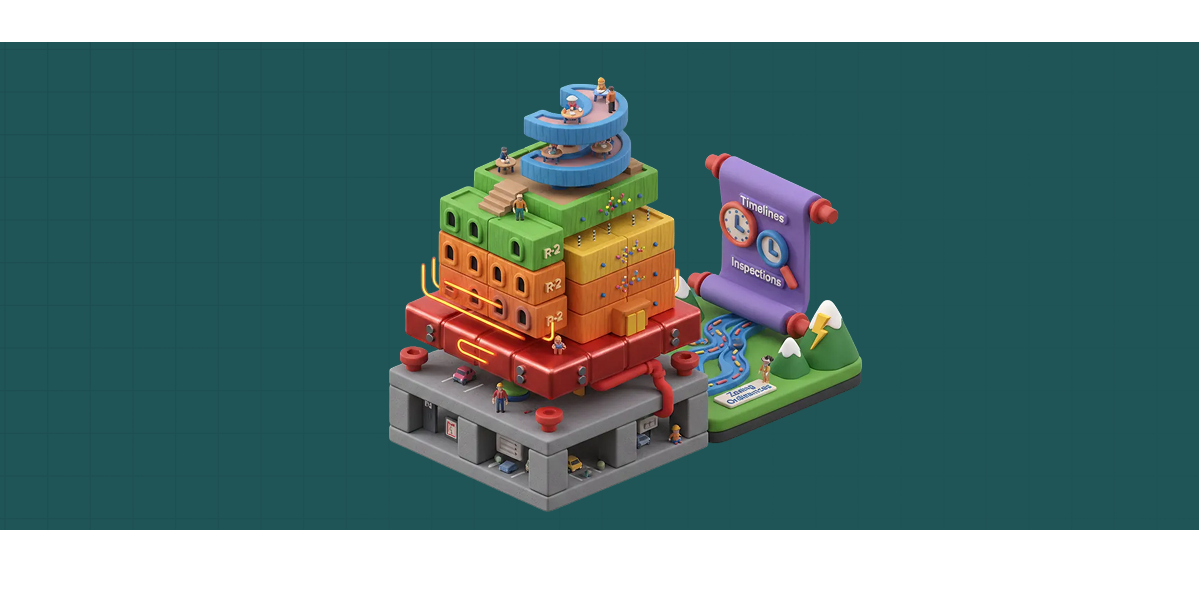
- Podium Buildings (R-2 over S-2): Podium designs are governed by IBC §510.2. This allows a Type IA concrete podium supporting a separate building of a less restrictive construction type (e.g., Type IIIA or VA wood-frame). The building above the podium is treated separately for height and area calculations, subject to the limits for its construction type.
- Mixed-Occupancy Separation: The fire-resistance rating for separations between occupancies is dictated by IBC Table 508.4. For a residential (R-2) use above an enclosed parking garage (S-2), the specific requirements of IBC §406.2.2 mandate a fire barrier and horizontal assembly with a minimum 2-hour fire-resistance rating. Utah has not amended this fundamental requirement.
- Occupant Load Factors: Occupant loads are calculated per IBC Table 1004.5. For outdoor dining patios at restaurants (Assembly A-2), the standard factor for "Unconcentrated (tables and chairs)" at 15 net square feet per occupant is typically used. Utah has no statewide amendment altering this, but the final determination is made by the local building or fire official.
| Requirement | Governing Code Section (2021 IBC) | Key Utah Provision |
|---|---|---|
| Podium Design | §510.2 (Horizontal building separation) | Follows IBC; allows separate height/area calculation for building above podium. |
| Height & Area Limits | Tables 504.3, 504.4, 506.2 | Follows IBC; increases allowed for sprinklers (§506.3) and frontage (§506.2). |
| R-2 over S-2 Garage | §406.2.2 & §508.4 | Requires a minimum 2-hour fire-rated separation. |
| Restaurant Patio Load | Table 1004.5 | Defaults to 15 net sq. ft./person; subject to local AHJ approval. |
Why Height, Area, and Occupancy Rules Matter in Utah
The rules governing building height, floor area, construction type, and occupancy separation are the foundation of building code compliance. These interconnected requirements, primarily found in Chapter 5 of the IBC, are among the first decisions made during schematic design and have cascading impacts on a project's scope, budget, and feasibility.
- Project Feasibility: Early analysis of these rules determines the maximum building size and density achievable on a given site, directly influencing the financial viability of a project. A miscalculation can force costly redesigns or even render a project unbuildable as planned.
- System Integration: The chosen construction type dictates the required fire-resistance ratings for structural frames, floors, and walls. This directly impacts material selection (e.g., steel vs. wood vs. concrete) and coordination with MEP systems, as all penetrations through rated assemblies must be properly firestopped.
- Life Safety & Egress: Occupancy classification and separation are critical for life safety. They determine the level of fire protection required (e.g., sprinklers, alarms), the number and size of exits needed, and the required separation between different hazards, such as a parking garage and the residences above it.
Common pitfalls include miscalculating allowable area increases for frontage and sprinklers, improperly detailing the separation for podium-style buildings, or failing to account for more restrictive local zoning ordinances or fire codes that may exist in jurisdictions like Salt Lake City or Park City.
For a new multi-family R-2 occupancy project in Salt Lake City, what are the specific height, area, and construction type limitations as amended by the Utah Building Code, and how do they impact the requirement for a podium design (Type IA over Type IIIA)?
For an R-2 multi-family project in Salt Lake City, the height, area, and construction type limitations are dictated by the 2021 IBC as adopted by Utah, with podium design provisions following IBC §510.2. A podium approach allows designers to maximize density by placing a lighter-framed building (like Type IIIA) on top of a robust, noncombustible base (Type IA).
Detailed Explanation:
Utah's building code does not substantively amend the core provisions of IBC Chapter 5 that govern this scenario. Therefore, the analysis defaults to the IBC model code.
1. Podium Design (Horizontal Building Separation): The key to this design is IBC 2021 §510.2, which allows a building to be divided by a 3-hour fire-rated horizontal assembly (the "podium slab"). When this is done:
- The portion below the podium (e.g., Type IA) and the portion above it (e.g., Type IIIA) are considered separate and distinct buildings for the purpose of calculating allowable area, height, and number of stories.
- The building above the podium must be of a construction type permitted by the height and area tables.
2. Analyzing the Building Above the Podium (Type IIIA, R-2 Occupancy): The limits for the residential portion are determined from the IBC tables, assuming it is equipped with an NFPA 13 sprinkler system:
- Base Height & Stories (Table 504.3 & 504.4): For an R-2 occupancy of Type IIIA construction, the base limit is 4 stories and 65 feet in height.
- Sprinkler Increase (§504.2): With an NFPA 13 sprinkler system, the height can be increased by 20 feet and the number of stories by one.
- Adjusted Limit: 5 stories and 85 feet.
- Base Allowable Area (Table 506.2): For an R-2, Type IIIA building, the base allowable area per floor is 24,000 sq. ft.
- Area Increases (§506.2 & 506.3):
- Frontage Increase (If): The area can be increased based on the percentage of the building perimeter fronting a public way or open space. The formula is
If = [F/P - 0.25]W/30, where F is accessible perimeter, P is total perimeter, and W is the width of the open space. - Sprinkler Increase (Is): For a multi-story building with an NFPA 13 system, the allowable area per floor can be tripled (Is = 3).
- Total Allowable Area (Aa):
Aa = A_tabular * (1 + If/100 + Is/100)which simplifies toAa = A_tabular * (If_multiplier + 3). This can result in a significantly larger building footprint.
- Frontage Increase (If): The area can be increased based on the percentage of the building perimeter fronting a public way or open space. The formula is
3. Analyzing the Building Below the Podium (Type IA, S-2 Occupancy): The podium itself is typically Type IA construction, which has unlimited height and area under IBC §503.1. When used for S-2 parking, it is typically one story at or above grade. The 3-hour rated slab separating it from the R-2 above is the critical element.
Salt Lake City Considerations: While the building code follows the IBC, Salt Lake City's zoning ordinances will impose their own, often more restrictive, height limits, setbacks, and floor area ratios (FAR). The project must comply with both the building code's life-safety limits and the local zoning's urban planning limits. For example, a zoning district may cap building height at 60 feet, which would override the 85-foot potential under the building code.
For a mixed-occupancy building, how do Utah amendments address the fire and smoke separation requirements between a parking garage (S-2) and a residential occupancy (R-2) above it?
Utah amendments do not modify the IBC's stringent requirements for separating an enclosed S-2 parking garage from an R-2 residential occupancy. The separation must be a minimum 2-hour fire-rated horizontal assembly and a 2-hour fire barrier, and all openings must be adequately protected.
Detailed Explanation:
The requirements for this common mixed-occupancy scenario are found in multiple sections of the 2021 IBC, which Utah has adopted without amendment in this area.
- Primary Requirement (IBC §406.2.2): This section specifically addresses the separation between enclosed parking garages and other occupancy groups. It states that a separation is required in accordance with IBC §508.4.
- Separated Occupancy Table (IBC §508.4.4 & Table 508.4): This table provides the required hourly fire-resistance ratings for fire barriers between different occupancies. Looking at the table for a separation between S-2 and R-2, it requires a 2-hour rated separation.
- Vertical vs. Horizontal Separation:
- If the occupancies are side-by-side, the separation is a fire barrier (a wall).
- If the R-2 is above the S-2, the separation is a horizontal assembly (a floor/ceiling system). Both must achieve a 2-hour fire-resistance rating.
- Continuity and Openings: The 2-hour separation must be continuous. All penetrations (for ducts, pipes, conduits) must be protected with a listed firestop system rated for 2 hours (IBC §714). Any communicating doors would require a 1.5-hour fire door assembly (IBC Table 716.1(2)), though direct access between a garage and an individual dwelling unit is further regulated.
- Smoke and Fume Control: Beyond the fire rating, the separation must also be designed to prevent the passage of smoke and vehicle exhaust fumes into the residential areas. IBC §406.2.2 explicitly requires the separation to be constructed to "prevent the passage of fumes." This is typically achieved through proper sealing of all joints and penetrations in the horizontal assembly.
- Support Elements: Any structural members, such as columns or walls within the S-2 garage that support the 2-hour horizontal separation above, must also have a minimum 2-hour fire-resistance rating (IBC §508.4.2).
In practice, this is almost always achieved with a cast-in-place concrete slab (the "podium"), which inherently provides the required 2-hour fire rating and durability.
When calculating occupant load for a restaurant in Utah, are there any state or local (e.g., Salt Lake City) amendments that specify a different occupant load factor for outdoor dining patios compared to the IBC?
No, there are no specific statewide Utah amendments that provide a different occupant load factor for outdoor dining patios. The calculation defaults to the factors listed in IBC 2021 Table 1004.5, with the final interpretation and application left to the local Authority Having Jurisdiction (AHJ), such as the Salt Lake City Building Official or Fire Marshal.
Detailed Explanation:
The occupant load calculation is a critical step in determining the required capacity and dimensions of a building's means of egress system (doors, corridors, stairs).
- Governing Code Section (IBC Table 1004.5): This table, titled "Maximum Floor Area Allowances Per Occupant," is the standard used across the country. For an Assembly (A-2) occupancy like a restaurant, it provides several factors.
- Applicable Factor: An outdoor dining patio falls under the "Assembly without fixed seats" function. The most commonly applied factor by plan reviewers and fire marshals for a typical restaurant patio with tables and chairs is:
- Unconcentrated (tables and chairs): 15 net square feet per occupant.
- "Net" vs. "Gross" Area: The "net" designation means that fixed objects that obstruct the space—such as large planters, service stations, or permanent columns—are excluded from the square footage used in the calculation. You calculate the occupant load based on the actual usable floor area.
- Local Interpretation (Salt Lake City): While there is no formal amendment in Salt Lake City's code that changes this factor, the local AHJ has the final say. A fire marshal or plan reviewer could potentially require a different factor based on the specific layout. For example:
- If a patio area is designed primarily for standing and drinking with very few tables (like a beer garden), the AHJ might require the "Standing space" factor of 5 net sq. ft. per occupant.
- If the patio is densely packed with chairs for an event, the "Concentrated (chairs only—not fixed)" factor of 7 net sq. ft. per occupant could be applied.
It is a best practice for architects and engineers designing restaurants in Salt Lake City or anywhere else in Utah to confirm the intended occupant load factor with the local building department or fire marshal during the design development phase to avoid surprises during plan review.
Jurisdictional Variations and Local Amendments in Utah
What can you ask? (Sample questions)
- How does IBC classify mixed-use buildings?
- When does a renovation trigger a change of occupancy?
- What are the IEBC triggers for code compliance upgrades?
- How do separated vs. nonseparated mixed occupancies differ?
While the State of Utah adopts the 2021 IBC as a uniform minimum standard, it's crucial to remember that local jurisdictions (counties and cities) can and do adopt amendments that are more restrictive. Designers must verify requirements with the local building department for every project.
Common Areas for Local Amendments:
- Snow Loads: Mountain communities like Park City have significantly higher ground snow load requirements than the Salt Lake Valley, impacting structural design. Always consult the local jurisdiction's specified ground snow load.
- Seismic Design: The Wasatch Front, including Salt Lake City, is in a high seismic region (Seismic Design Category D). While the IBC provides the framework, local jurisdictions may have specific guidance or enforcement priorities related to seismic detailing.
- Wildland-Urban Interface (WUI): Many communities along the mountain benches are subject to WUI codes, which impose strict requirements for ignition-resistant construction materials and defensible space, regardless of the base construction type.
- Zoning Ordinances: As mentioned, local zoning codes are separate from the building code and often place the most significant restrictions on a project's height, footprint (via setbacks), and overall density (via Floor Area Ratio or dwelling units per acre).
Coordination for Height, Area, and Separation Compliance
Achieving compliance with height, area, and separation requirements is a team effort requiring close coordination between disciplines.
- Architect → Structural Engineer: The architect's initial decisions on construction type, building height, and the use of podiums directly inform the structural engineer's design. The structural system must be designed to achieve the fire-resistance ratings mandated by IBC Chapter 6 for the chosen construction type.
- Architect → MEP & Fire Protection Engineers: The fire-rated separations established by the architect create barriers that all mechanical, electrical, plumbing, and fire sprinkler systems must cross.
- MEP: Engineers must specify UL-listed firestop assemblies for every penetration through a rated wall or floor (e.g., podium slab).
- Fire Protection: The sprinkler system design is based on the occupancy classification and construction type. The presence of a full NFPA 13 system is often what allows for the height and area increases that make a project feasible.
- All Disciplines → Plan Review & Inspection: The construction documents must clearly demonstrate compliance. Details for fire-rated assemblies, penetration firestopping, and continuity of separations are heavily scrutinized during plan review. Field inspectors will later verify that these details were constructed exactly as specified.
FAQ: Utah Building Code
What is the current building code in Utah? As of 2024, Utah has adopted the 2021 International Building Code (IBC), 2021 International Residential Code (IRC), and other 2021 I-Codes, with state-specific amendments outlined in Utah Code Title 15A.
Where can I find the official Utah building code amendments? The amendments are codified in Utah Code Title 15A, State Construction and Fire Codes Act. They are available online through the Utah State Legislature's website.
Does a building in Salt Lake City need to be sprinklered? Generally, yes for most new commercial and multi-family residential buildings. Per IBC §903.2, automatic sprinkler systems are required based on occupancy group, fire area size, and occupant load. For example, all R-2 occupancies (apartments/condos) require an NFPA 13R or 13 system.
How does seismic design affect building height in Utah? While seismic design categories along the Wasatch Front are high, the seismic provisions in ASCE 7 (referenced by the IBC) primarily affect the structural system's design and detailing (e.g., type of lateral force-resisting system, connection details). They do not directly alter the prescriptive height and area limits found in IBC Chapter 5, though they may make it impractical or cost-prohibitive to use certain structural systems for taller buildings.
What is a fire barrier? A fire barrier is a fire-resistance-rated wall assembly designed to restrict the spread of fire. It must be continuous from the floor to the deck above and is used to separate different occupancies, exit enclosures, or create horizontal exits as defined in IBC Chapter 7.
Can I use wood-frame construction for a 5-story apartment building in Utah? Yes. A Type IIIA or Type VA wood-framed building can achieve 5 stories in height when fully sprinklered and placed on top of a Type IA podium, as permitted by IBC §510.2. A standalone Type IIIA building can also reach 5 stories with a sprinkler height increase.
Are there special fire code requirements in Salt Lake City? Yes, the Salt Lake City Fire Department enforces the International Fire Code (IFC) with local amendments. These often include more stringent rules for fire apparatus access roads, fire hydrant locations, and fire alarm system requirements.
Does Utah have its own accessibility code? Utah adopts and amends Chapter 11 of the IBC and the ICC A117.1 standard for accessibility. Designers must consult the Utah state amendments to ensure compliance with state-specific requirements for accessible routes, restrooms, and parking.
More Utah Building Code Guides
- MEP CodesUtah's Key Amendments to Mechanical, Electrical, and Plumbing (MEP) Codes
- Residential Code (IRC)Utah Residential Code (IRC) Guide for Home Construction & Remodeling
- Wildfire / WUI CodesAdvanced Utah Code: Existing Buildings (IEBC) and Wildland-Urban Interface (WUI)
- Structural DesignStructural Design in Utah: Seismic, Snow Load, and Foundation Code Requirements
- Overview GuideUtah Building Code Explained: Adopted Codes, Amendments & Local Jurisdiction
MeltPlan
A curated stream of preconstruction intelligence, estimating innovation, takeoff breakthroughs, workflow advancements, and expert perspectives—powered by the AI and technology shaping the future of construction.
Visit SiteDon't miss what's shaping AEC
The latest on preconstruction, codes, AEC news & trends — so you're always in the know.