Arizona Commercial Egress & Life Safety Code Requirements
In Arizona, building and fire codes are adopted and amended at the local level, meaning there is no single statewide building code. For commercial projects, arc..
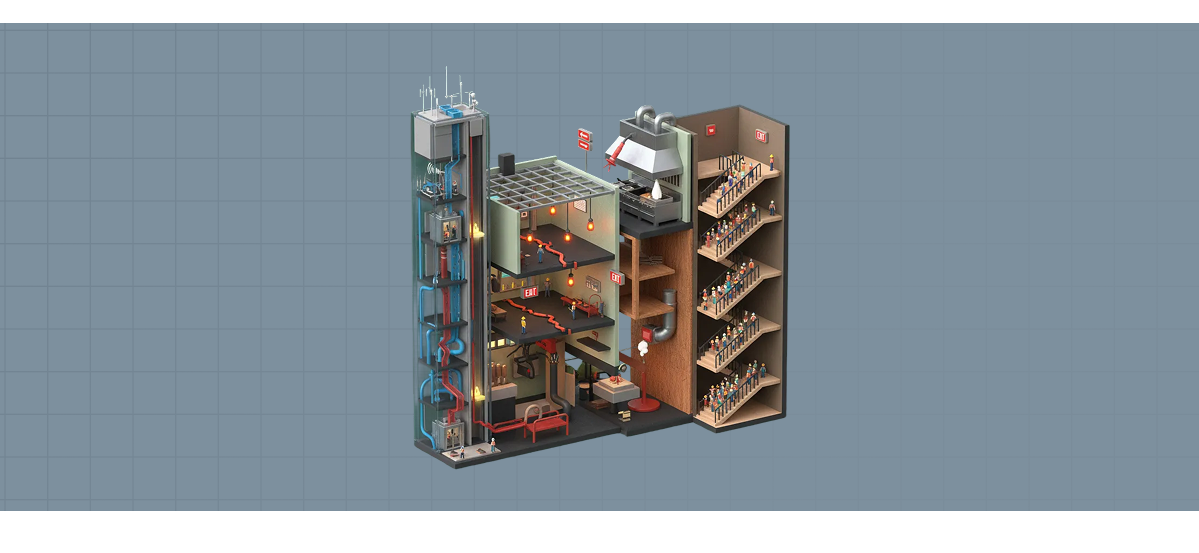
Navigating Arizona's Commercial Egress and Life Safety Codes: A Guide for Phoenix, Scottsdale, and Tucson
Arizona Egress & Life Safety Codes: A Summary
In Arizona, building and fire codes are adopted and amended at the local level, meaning there is no single statewide building code. For commercial projects, architects and engineers must consult the specific amendments for the city or county of jurisdiction. Most major metropolitan areas, including Phoenix, Scottsdale, and Tucson, have adopted the 2018 International Building Code (IBC) and International Fire Code (IFC) as their foundation, but each has critical local modifications impacting egress and life safety design.
Key requirements across these jurisdictions include:
- High-Rise Buildings (Scottsdale): Scottsdale's amendments to the 2018 IFC impose stringent requirements for high-rise buildings. This includes mandatory smoke control systems per IBC §909, the installation of Fire Service Access Elevators (FSAE) per IBC §3007, and robust Emergency Responder Radio Coverage Systems (ERRCS) with specific signal strength and testing protocols that often exceed the base IFC §510 requirements.
- Emergency Lighting & Signage (Phoenix): In Phoenix, alterations to tenant spaces are governed by the 2018 International Existing Building Code (IEBC) and Phoenix Fire Code amendments. Any alteration affecting an element of the means of egress, including relocating a wall or door along an exit path, typically triggers the requirement to upgrade existing emergency lighting and exit signs in the area of work to meet current code, which mandates 1 foot-candle of illumination at the floor and internally or externally illuminated signs with specific lettering.
- Commercial Kitchens (Scottsdale): For commercial kitchen hoods, Scottsdale enforces the 2018 International Mechanical Code (IMC) and IFC. This includes maintaining a minimum 18-inch clearance to combustible materials (reducible with listed protection) and mandates that all fire suppression systems for grease-producing appliances comply with UL 300, a requirement now standard in the model codes to handle modern high-temperature cooking oils.
- Egress Stair Width (Tucson): Tucson follows the 2018 IBC for calculating egress stair width. The width is based on the building's occupant load, with a minimum of 44 inches for stairs serving 50 or more occupants and 36 inches for those serving fewer than 50. The calculation is typically 0.3 inches per occupant for sprinklered buildings.
Context + Why This Topic Matters
Understanding local code amendments in Arizona isn't just a best practice—it's essential for project approval and public safety. Because Arizona operates under a "home rule" system, each city and county acts as its own authority having jurisdiction (AHJ). An architect cannot assume that a design compliant with the base IBC or IFC will be accepted in Phoenix, Scottsdale, or Tucson.
This decentralized system creates several challenges and pitfalls:
- Design Inconsistencies: A high-rise design acceptable in Phoenix may require significant changes to its smoke control or radio coverage systems to be approved in Scottsdale.
- Permitting Delays: Submitting plans based solely on the model I-Codes without researching local amendments is a primary cause of plan review rejection, leading to costly delays and redesigns.
- Coordination Complexity: Life safety systems involve tight coordination between architects, MEP engineers, and fire protection specialists. For example, the architect designs the egress path, the mechanical engineer designs the smoke control system, and the electrical engineer powers the emergency lighting, fire alarm, and ERRCS amplifiers—all of which must comply with different sections of the code and local amendments.
- Inspection Failures: Field inspectors are enforcing the locally adopted code. An installation that meets the base IBC but overlooks a local Phoenix Fire Code amendment for exit sign placement will fail inspection, impacting project timelines and occupancy.
Successfully navigating this landscape requires a proactive approach to identify and integrate jurisdictional requirements from the very beginning of the design process.
Detailed Answers to Each Question
What can you ask? (Sample questions)
- What occupant load factor determines the number of exits?
- When are two exits required from a story or space?
- What is the minimum corridor width for egress per IBC?
- How do dead-end corridor limits vary by occupancy type?
Detail the City of Scottsdale's fire code amendments and plan review requirements for a new high-rise building, specifically addressing required smoke control systems, fire service access elevators, and emergency responder radio coverage system (ERRCS) specifications and testing protocols.
The City of Scottsdale has adopted the 2018 International Fire Code (IFC) and International Building Code (IBC) with significant local amendments that enhance life safety requirements for high-rise buildings (buildings with an occupied floor more than 75 feet above the lowest level of fire department vehicle access). Design professionals must adhere to these Scottsdale-specific requirements during design and plan review.
Smoke Control Systems
Scottsdale strictly enforces the smoke control requirements of IBC 2018 §909 for all high-rise buildings.
- System Requirement: A smoke control system is mandatory. For high-rise buildings, this typically takes the form of a stairwell pressurization system to keep egress stairs tenable during a fire event.
- Design and Rationale: A full smoke control report, prepared and sealed by a registered design professional (typically a fire protection or mechanical engineer), must be submitted with the permit documents. This report must detail the system's design, the rationale behind it, and a complete sequence of operations as required by IBC §909.4.
- Special Inspections & Testing: Scottsdale requires special inspections for smoke control systems per IBC §1705.18. Before a Certificate of Occupancy is issued, a final acceptance test witnessed by the Scottsdale Fire Department is required. This test must demonstrate that the system performs as designed, meeting the pressure differentials and other criteria outlined in IBC §909.
Fire Service Access Elevators (FSAE)
Scottsdale enforces the requirements of IBC 2018 §3007 for Fire Service Access Elevators.
- Requirement: At least two FSAEs are required in high-rise buildings. These elevators provide a protected environment for firefighters to transport personnel and equipment to upper floors.
- Key Design Features:
- Direct Access: The FSAE must open into a fire-service access elevator lobby that is separated from the rest of the floor by a smoke barrier, per IBC §3007.6.
- Standpipe Connection: A Class I standpipe hose connection is required within the FSAE lobby.
- Size and Capacity: The elevator car must be sized to accommodate an ambulance stretcher, as specified in IBC §3007.4.
- Protection: The FSAE hoistway, lobby, and machine room require enhanced fire-resistance ratings and protection against water infiltration from fire sprinkler operation.
- Plan Review: Plans must clearly label the FSAEs and detail all required components, including the lobby, smoke barriers, standpipe locations, and compliance with power and communication requirements from IBC §3007.8 and §3007.9.
Emergency Responder Radio Coverage System (ERRCS)
This is a point of major emphasis for the Scottsdale Fire Department. They strictly enforce IFC 2018 §510 and their own published standards and guidelines.
- Coverage Requirement: Approved radio coverage for emergency responders is required throughout the building. Scottsdale requires a minimum inbound and outbound signal strength of -95 dBm.
- Coverage Area:
- Critical Areas: 99% floor area coverage is required in all basements, elevator lobbies, exit stairs, and fire command centers.
- General Areas: 90% floor area coverage is required in all other areas of the building.
- Testing and Documentation:
- Initial Survey: A radio frequency survey may be required before construction to determine if an ERRCS is needed.
- System Design: If required, plans for the system, including the location of the bi-directional amplifier (BDA), antennas, and power supplies, must be submitted for review. The system must be designed by a qualified professional and often requires FCC licensing.
- Acceptance Testing: Upon completion, a comprehensive acceptance test report must be submitted to the Scottsdale Fire Department. This report must include grid-test results demonstrating compliance with the -95 dBm signal strength requirement and be certified by a qualified technician. The Fire Department must witness and approve this final test.
What are the specific emergency lighting and exit signage illumination requirements under the Phoenix Fire Code for a tenant space undergoing an alteration? When does the alteration trigger the requirement to upgrade the existing exit signs to current standards?
For an alteration within an existing tenant space in Phoenix, the emergency lighting and exit signage requirements are governed by the 2018 International Building Code (IBC), 2018 International Existing Building Code (IEBC), and the City of Phoenix Fire Code, which is based on the 2018 IFC with amendments. The trigger for upgrading these systems is based on the scope of the alteration.
Triggering an Upgrade
An alteration triggers the requirement to upgrade emergency lighting and exit signs in the area of work to current standards when the work affects a component of the means of egress. According to IEBC 2018 §705, this is considered an Alteration-Level 1.
- Key Trigger: Any work that alters a "means of egress element" requires that element to comply with the code for new construction (IBC Chapter 10).
- Practical Examples:
- Relocating a wall along an exit corridor.
- Moving a door that is part of an accessible route or exit path.
- Reconfiguring a space that changes the travel distance to an exit.
- Any work that requires new or relocated exit signs or emergency lights.
If the alteration is purely cosmetic (e.g., new paint, carpet) and does not modify the egress path, an upgrade is generally not required. However, plan reviewers and inspectors in Phoenix interpret "alteration" broadly. If a permit is pulled for significant interior remodeling, they will almost always require the egress lighting and signage within the scope of work to be brought up to current code.
Current Requirements for Upgraded Systems
When an upgrade is triggered, the new or replacement systems must comply with IBC 2018 Chapter 10.
Emergency Lighting (IBC §1008.2):
- Illumination Level: The means of egress must be illuminated to an average of 1 foot-candle (11 lux) at the walking surface.
- Uniformity: The minimum illumination at any point cannot be less than 0.1 foot-candle (1 lux).
- Power Source: The system must be connected to an emergency power source (e.g., battery backup, generator) and provide illumination for at least 90 minutes upon failure of normal power.
Exit Signage (IBC §1013):
- Location: Exit signs are required at all exits and where the direction of egress travel is not immediately apparent.
- Illumination: Signs must be internally or externally illuminated at all times. The illumination source must also be on emergency power.
- Power: Per Phoenix Fire Code amendments, exit signs must be connected to a dedicated circuit.
- Graphics: Signs must comply with the graphical requirements of IBC §1013.2, typically showing the word "EXIT" in 6-inch-high letters or using internationally recognized pictograms.
For a commercial kitchen hood installation in Scottsdale, what are the specific clearance-to-combustibles requirements, and do the Scottsdale Fire Department amendments mandate a specific type of fire suppression system (e.g., UL 300) beyond the base IMC/IFC requirements?
The City of Scottsdale enforces the 2018 International Mechanical Code (IMC) and 2018 International Fire Code (IFC) for commercial kitchen hood installations. The requirements for clearance to combustibles and the type of fire suppression system are well-defined by these model codes, and Scottsdale's enforcement is strict.
Clearance-to-Combustibles Requirements
The primary code section governing clearances is IMC 2018 §506.4. The requirements are designed to prevent the high heat from cooking operations and grease buildup in the hood and ductwork from igniting adjacent combustible materials (like wood framing or gypsum board with paper facing).
- Standard Clearance: A minimum clearance of 18 inches (457 mm) must be maintained between the hood or exhaust duct and any combustible material.
- Reduced Clearances: This 18-inch clearance can be reduced if the combustible material is protected according to the methods listed in IMC Table 506.4. These methods include using materials like 24-gauge sheet metal with an air gap, mineral wool batts, or other listed assemblies. The specific reduction allowed depends on the protection method used.
- Listed Hoods and Ducts: If a factory-built commercial kitchen hood or grease duct is "listed and labeled" (e.g., by UL), it must be installed with the clearances specified in its manufacturer's installation instructions. Per IMC §506.4, Exception 1, the listed clearance supersedes the generic 18-inch rule.
- Enforcement: Scottsdale plan reviewers and inspectors will verify these clearances on drawings and in the field. All combustible construction, including wall studs and ceiling joists, must be held back the required distance.
Fire Suppression System Mandate
The Scottsdale Fire Department, by enforcing the 2018 IFC, mandates a specific type of fire suppression system performance standard.
- UL 300 Compliance:IFC 2018 §904.12.1 explicitly requires that fire-extinguishing systems for commercial cooking systems that produce grease-laden vapors comply with UL 300, Standard for Fire Testing of Fire Extinguishing Systems for Protection of Commercial Cooking Equipment.
- Why UL 300? This is not a Scottsdale-specific amendment but rather a critical requirement within the model code itself. UL 300 was developed in the 1990s in response to changes in the food service industry:
- Higher-Temperature Oils: Vegetable-based cooking oils burn at significantly higher temperatures than the animal fats they replaced.
- High-Efficiency Appliances: Modern appliances are better insulated and cool down much more slowly, increasing the risk of re-flash after a fire is initially extinguished.
- System Type: UL 300 effectively mandates the use of wet chemical fire suppression systems, as older dry chemical systems are not effective at cooling the hot oils and preventing re-flash. The wet chemical agents saponify the grease (turn it into a soapy foam), which both extinguishes the flame and cools the surface.
- Interlocks: Per IFC §904.12.2, the suppression system must be interlocked to automatically shut off all sources of fuel and electric power to the cooking appliances upon activation. This is a key safety feature that Scottsdale inspectors will verify.
In summary, Scottsdale does not add requirements beyond the IMC/IFC for UL 300 but strictly enforces it as the mandatory standard for all new and modified commercial kitchen hood suppression systems.
How wide does an egress stair have to be in a commercial building in Tucson?
The required width for an egress stair in a commercial building in Tucson is determined by the 2018 International Building Code (IBC), which the City of Tucson has adopted. The width depends on the occupant load the stair serves, but must also meet a minimum dimension.
The final required width is the greatest value derived from the following two calculations as outlined in IBC Chapter 10:
1. Calculation Based on Occupant Load (IBC §1005.3)
The code provides factors to calculate the required width based on the number of people who will use the stair in an emergency.
- For buildings equipped with an automatic sprinkler system: The total required width is the occupant load served by the stair multiplied by 0.3 inches per occupant.
- For buildings equipped with sprinklers AND an emergency voice/alarm communication system: The factor is reduced to 0.2 inches per occupant.
- For buildings without a sprinkler system: The factor is 0.3 inches per occupant (but most commercial buildings in Tucson will require sprinklers based on other code sections).
Example: If a stair serves a floor with an occupant load of 200 people in a sprinklered building, the calculated width would be: 200 occupants * 0.3 inches/occupant = 60 inches.
2. Minimum Width Requirement (IBC §1011.2)
Regardless of the calculation above, the stair must meet a minimum width dimension.
- For stairs serving an occupant load of 50 or more: The minimum clear width must be at least 44 inches (1118 mm).
- For stairs serving an occupant load of less than 50: The minimum clear width must be at least 36 inches (914 mm).
The "clear width" is measured between the handrails. If handrails are not present, it is measured between the finished wall surfaces.
Determining the Final Required Width in Tucson
To find the required stair width for a project in Tucson, you must:
- Calculate the occupant load of the area served by the stair using IBC Table 1004.5.
- Multiply that occupant load by the appropriate factor (usually 0.3).
- Determine the minimum width based on whether the occupant load is 49 or less, or 50 or more.
- The required width is the larger of the values from Step 2 and Step 3.
Using the previous example:
- Calculated width: 60 inches
- Minimum width (for occupant load > 50): 44 inches
- Final Required Stair Width: 60 inches
Tucson's building department does not have a standard amendment that modifies these specific IBC calculations, so adherence to the model code is the standard practice.
Additional Supporting Sections
Jurisdictional Variations: The "Home Rule" Challenge in Arizona
A common mistake for design professionals working in Arizona is assuming code consistency across municipal boundaries. Arizona's "home rule" status grants cities and counties the authority to adopt and amend their own codes. While most major jurisdictions like Phoenix, Scottsdale, Tucson, Mesa, and Chandler use the 2018 I-Codes as a base, their amendments can differ significantly.
- Fire Sprinkler Thresholds: One city may require sprinklers in all new commercial buildings over 3,000 sq. ft., while another might stick to the IBC's 5,000 sq. ft. threshold for certain occupancies.
- Wildland-Urban Interface (WUI): Jurisdictions like Flagstaff and parts of Scottsdale have extensive WUI code amendments that impose strict requirements for exterior materials, roofing, and defensible space that are not found in Phoenix or Tucson.
- Administrative Amendments: Cities often amend Chapter 1 of the IBC and IFC to modify fees, permit processes, and the powers of the building official.
- Local Initiatives: A city might have a green building or water conservation ordinance that adds requirements on top of the base IECC or IPC.
Best Practice: Always begin a project by obtaining the current code adoption information and the published local amendments directly from the city or county's building department website. Never assume the IBC is the complete and final authority.
Coordination is Key: Integrating Life Safety Across Disciplines
Egress and life safety systems are not the responsibility of a single discipline; they require seamless coordination between the entire design team.
- Architect & Fire Protection Engineer: The architect lays out the means of egress (corridors, stairs, exits), and the fire protection engineer designs the active systems (sprinklers, fire alarms) that protect that path. They must coordinate fire-rated wall locations, sprinkler head placement, and alarm device locations to ensure full compliance.
- MEP & Architect:
- Mechanical: Smoke control systems are designed by the mechanical engineer but are integrated into the architect's stairwells and shafts. Duct penetrations through fire-rated walls must be properly detailed and specified with fire/smoke dampers.
- Electrical: Emergency lighting, exit signs, fire alarms, and ERRCS all require power. The electrical engineer must ensure these systems are on emergency power circuits (and often dedicated circuits, per local rules) and that wiring meets survivability requirements where necessary.
- Plumbing: The plumbing engineer designs the standpipe systems required in high-rise buildings and large floor plates, which must be coordinated with the architect's stairwell and building core design.
A failure in coordination, such as an HVAC duct running through a required fire-rated corridor without a proper damper, can lead to failed inspections and costly rework.
Permitting and Plan Review in Arizona Jurisdictions
When submitting plans for a commercial project in cities like Phoenix or Scottsdale, life safety sheets and narratives are heavily scrutinized. To ensure a smooth review process:
- Provide a Code Analysis: A dedicated sheet or section of the plans should clearly outline the project's compliance with key code parameters: occupancy group, construction type, building height and area, sprinkler and alarm provisions, and occupant load calculations.
- Clearly Document Egress: Egress plans should be clean and easy to read, showing exit access paths, travel distances, exit widths, common path of travel, and occupant load per space.
- Submit System-Specific Documents: For complex systems, expect to submit separate documentation:
- Smoke Control: A rational analysis report.
- ERRCS: Signal strength surveys and system design drawings.
- Fire Sprinklers/Alarms: Separate deferred submittals from a licensed fire protection contractor are typically required.
- Reference Local Amendments: If a design element is driven by a specific local amendment, it is a best practice to note that amendment on the plans. This shows the plan reviewer that you have done your due diligence and understand the local requirements.
Cluster-Level FAQ Section
1. Does Arizona have a statewide building code? No, Arizona does not have a single, statewide building code. Each city, town, and county is responsible for adopting and amending its own codes, a system known as "home rule." This means requirements can vary significantly between jurisdictions like Phoenix and Flagstaff.
2. What version of the IBC do most Arizona cities use? As of the early 2020s, most major metropolitan areas in Arizona, including Phoenix, Scottsdale, Tucson, Mesa, and Chandler, have adopted the 2018 International Building Code (IBC) and its family of I-Codes (IFC, IMC, etc.) as their base code, along with local amendments.
3. Are fire sprinklers required in all new commercial buildings in Arizona? Not automatically, but they are required in most. The requirement is based on the building's occupancy group, fire area size, and occupant load as defined in IBC Chapter 9. Many Arizona cities have also adopted amendments that lower the square footage thresholds, making sprinklers mandatory in a wider range of buildings than the base IBC might require.
4. What are the basic ADA requirements for an egress door in Phoenix? An accessible egress door in Phoenix must meet the requirements of IBC Chapter 11 and ANSI A117.1. This includes a minimum clear opening width of 32 inches, maneuvering clearances on both sides of the door, hardware that does not require tight grasping or twisting (like a lever), and a maximum opening force.
5. Do I need a separate fire alarm permit in Scottsdale? Yes. While the architectural plans will show the general fire alarm device locations for review, the installation of the fire alarm system requires a separate permit. This permit is typically pulled by the licensed fire alarm contractor, who submits detailed shop drawings, battery calculations, and voltage drop calculations for review by the Scottsdale Fire Department.
6. How is occupant load calculated under the Tucson building code? Tucson follows IBC 2018 §1004 to calculate occupant load. The floor area of a space is divided by the "occupant load factor" found in Table 1004.5. For example, a business area has a factor of 150 gross square feet per person, while an assembly space with unconcentrated tables and chairs has a factor of 15 net square feet per person.
7. What are the general requirements for fire-rated corridors in Arizona? Fire-rated corridors are required in many occupancy groups to protect the exit access path. Per IBC Chapter 10, when required, these corridors must typically have a 1-hour fire-resistance rating. All doors opening into the corridor must be fire-rated (usually 20 minutes) and self-closing. All penetrations for ducts, pipes, and conduits must be protected with listed firestop systems.
8. Is emergency power required for all egress lighting? Yes. Per IBC §1008, all required means of egress illumination and exit signs must be connected to an emergency power system that can operate for at least 90 minutes after a power failure. This is typically accomplished with battery backup units integral to the light fixtures or a central inverter or generator.
More Arizona Building Code Guides
- Permits & AmendmentsArizona Building Codes: Current Adoption, Amendments & Permit Guide
- Residential Code (IRC)Arizona Residential Code (IRC) Guide: Decks, Pools, Garages & ADUs
- Accessibility (ADA)Applying Accessibility Codes (ADA & ANSI A117.1) in Arizona
- Wildfire / WUI CodesArizona Environmental Hazard Codes: WUI, Floodplain & HazMat Requirements
- Energy Code (IECC)Navigating the Arizona Energy Code (IECC): Commercial & Residential Compliance
MeltPlan
A curated stream of preconstruction intelligence, estimating innovation, takeoff breakthroughs, workflow advancements, and expert perspectives—powered by the AI and technology shaping the future of construction.
Visit SiteDon't miss what's shaping AEC
The latest on preconstruction, codes, AEC news & trends — so you're always in the know.