Arizona Environmental Hazard Codes: WUI, Floodplain & HazMat Requirements
Arizona's diverse geography presents unique design challenges, from high-altitude forests to low-lying desert riverbeds. Unlike states with a single, mandatory ..
Navigating Arizona's Specialized Building Codes: A Guide to WUI, Floodplain, and Hazmat Requirements
Arizona's diverse geography presents unique design challenges, from high-altitude forests to low-lying desert riverbeds. Unlike states with a single, mandatory building code, Arizona grants authority to local jurisdictions, creating a complex web of amendments. For design professionals, mastering the base IBC, IRC, and IFC is only the beginning. True compliance requires a deep understanding of specialized local codes governing Wildland-Urban Interface (WUI), floodplain construction, and hazardous materials storage.
Core Requirements for Specialized Environmental Codes in Arizona
Navigating Arizona’s specialized codes requires a location-specific approach. There is no statewide code, so compliance hinges on the amendments adopted by the city, county, or local fire district where the project is located.
Wildland-Urban Interface (WUI) in High-Risk Areas (e.g., Flagstaff): Projects in designated WUI zones must adhere to the International Wildland-Urban Interface Code (IWUIC), heavily amended locally. Key requirements focus on "hardening" the structure against ignition from embers and flames.
- Construction Materials: Mandates for Class A roofing, ignition-resistant or noncombustible siding and decking, and dual-pane tempered glass.
- Defensible Space: Strict vegetation management rules are enforced in zones extending up to 100 feet or more from the structure.
- Access: Fire apparatus access roads must meet stringent width, grade, and turnaround standards.
Flood-Resistant Construction (e.g., Yuma County): Projects in FEMA-designated Special Flood Hazard Areas (SFHAs) must be designed to resist flood damage, primarily by elevating structures and utilities.
- Elevation: The lowest floor must be elevated to the Base Flood Elevation (BFE) plus a locally mandated "freeboard" (typically 1-2 feet).
- Materials: All materials used below this design flood elevation must be flood-damage resistant (e.g., concrete, solid wood, steel). Drywall and standard insulation are prohibited.
- Foundations & Utilities: Foundations require flood vents, and all MEP equipment (HVAC, electrical panels, water heaters) must be elevated above the design flood elevation.
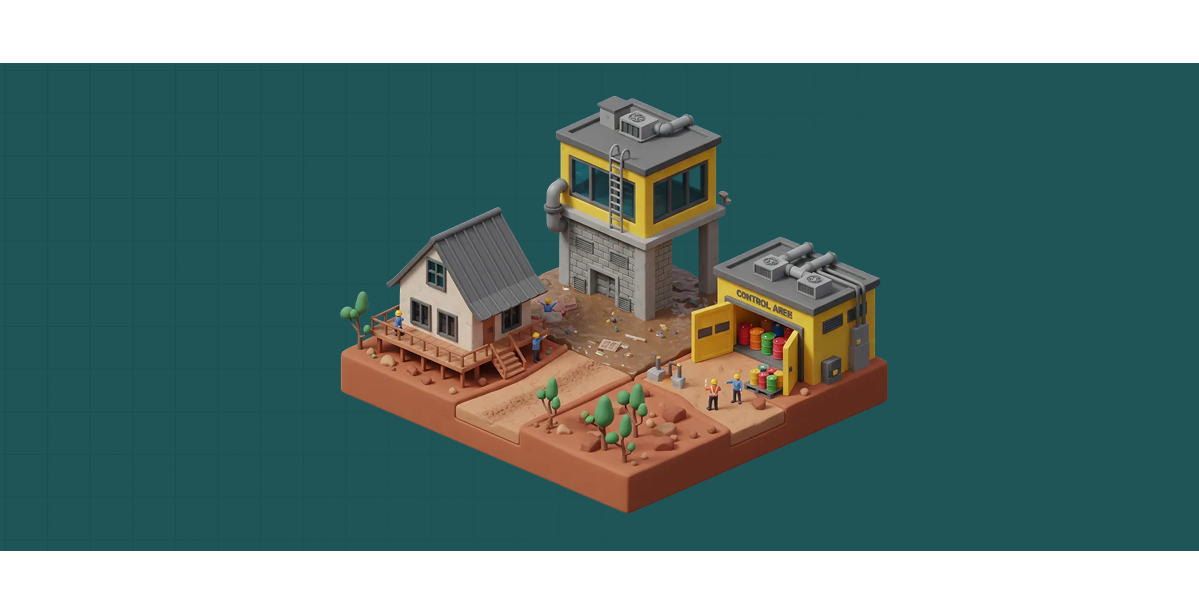
Hazardous Materials Storage (e.g., Maricopa County): Facilities storing chemicals beyond exempt amounts are governed by the International Fire Code (IFC) and local fire marshal requirements.
- Control Areas: The IFC uses a "control area" concept to isolate hazardous materials within specific, fire-rated zones, avoiding the need to classify the entire building as a high-hazard Group H occupancy.
- Containment & Ventilation: Secondary containment is required for all liquids to capture spills, and specialized ventilation systems are mandated based on the specific chemical hazards.
Why This Topic Matters in Arizona
Understanding these specialized environmental codes is critical for project success in Arizona. Ignoring them can lead to costly redesigns, permit denials, failed inspections, and significant life-safety risks. Because Arizona lacks a uniform statewide code, a design that is compliant in Phoenix may be grossly inadequate in Flagstaff or Yuma.
- Project Workflow: These requirements impact a project from the very beginning. Site selection, building footprint, material specification, and foundation design are all dictated by these overlays. Architects must identify applicable WUI, floodplain, and hazmat requirements during the conceptual design phase.
- Interdisciplinary Coordination: Compliance is a team effort. Architects define the building envelope with WUI-rated materials, civil engineers design site grading around floodplains and fire access roads, structural engineers design flood-resistant foundations, and MEP engineers elevate utilities and design hazmat ventilation systems.
- Common Pitfalls: A common mistake is assuming the base IBC or IRC is sufficient. Designers unfamiliar with Arizona's local amendments may specify non-compliant siding in a WUI zone, place an HVAC unit at grade in a floodplain, or fail to provide required secondary containment for a small chemical storage room, all of which will halt a project during plan review.
What are the specific Wildland-Urban Interface (WUI) code requirements adopted by the City of Flagstaff for a new custom home project?
What can you ask? (Sample questions)
- What building code edition does my state currently enforce?
- How do state-specific amendments modify the base IBC?
- What structural design loads apply in my jurisdiction?
- What energy code requirements apply to my building type?
For a new custom home in Flagstaff, you must comply with the City of Flagstaff's adopted 2018 International Wildland-Urban Interface Code (IWUIC) with significant local amendments found in Flagstaff City Code, Title 14. These requirements are among the most stringent in the state and focus on creating an "ignition-resistant" structure and maintaining a defensible space to protect against wildfire.
The specific requirements are based on the property's location within a designated WUI Fire Area, which covers most of the city.
Detailed WUI Requirements in Flagstaff
1. Ignition-Resistant Construction Materials (IWUIC Chapter 5, as amended): The goal is to "harden" the home against ignition from flying embers, which are the primary cause of home loss in wildfires.
- Roofing (IWUIC §504.2): All new roofs must have a Class A roof assembly. This includes the roof covering (e.g., asphalt shingles, metal, tile) and the underlying components. Wood shake or shingle roofs are prohibited, regardless of treatment.
- Siding and Exterior Walls (IWUIC §504.6): Exterior walls must be constructed with noncombustible or ignition-resistant materials. Approved materials include:
- Fiber-cement siding
- Stucco
- Brick or stone veneer
- Metal siding
- Fire-retardant-treated wood (must meet specific testing standards)
- Heavy timber or log wall construction is also permitted.
- Decks, Porches, and Balconies (IWUIC §504.7): All walking surfaces and structural support elements must be built of noncombustible or ignition-resistant materials. This is a critical amendment, as traditional wood decks are a major vulnerability. Composite decking must carry an ignition-resistant rating.
- Vents (IWUIC §504.5): All attic, foundation, and other ventilation openings must be covered with a noncombustible wire mesh with openings no larger than 1/8 inch to prevent ember intrusion.
- Windows and Glazing (IWUIC §504.8): Windows must be a minimum of dual-pane insulating glass units. The exterior pane must be tempered glass, providing greater resistance to breaking from radiant heat.
- Eaves and Soffits (IWUIC §504.4): Eaves and soffits must be protected on the exposed underside with ignition-resistant materials.
2. Defensible Space (IWUIC Chapter 6 & Flagstaff Fire Dept. Standards): This involves managing vegetation around the home to reduce fuel for a fire. Flagstaff enforces a multi-zone system.
- Zone 1 (0 to 5 feet from the home): The "Immediate Zone." This area must be completely free of flammable materials.
- Use noncombustible materials like gravel, pavers, or concrete.
- No flammable vegetation, firewood piles, or combustible mulch.
- Remove any portion of trees overhanging the roof.
- Zone 2 (5 to 30 feet from the home): The "Intermediate Zone."
- Trees should be thinned so canopies are at least 10 feet apart.
- Remove lower tree limbs up to 6-10 feet from the ground ("limbing up").
- Grasses should be mowed to a height of 4 inches or less.
- Remove "ladder fuels" (vegetation that can carry fire from the ground into trees).
- Zone 3 (30 to 100 feet from the home): The "Extended Zone." The goal is to further reduce fuel density and slow a fire's spread. This involves more significant tree thinning and vegetation management, often guided by a professional forester or the Fire Department.
3. Fire Apparatus Access Roads (IFC Chapter 5 & Appendix D, as amended): Emergency responders must be able to reach the property.
- Road Width: Access roads must have an unobstructed width of not less than 20 feet.
- Grade: The grade of the road shall not exceed 12%.
- Turning Radius: Must meet Flagstaff Fire Department standards to accommodate large fire trucks.
- Dead-End Roads: Dead-end roads longer than 150 feet must have an approved turnaround (e.g., a cul-de-sac or hammerhead turn).
- Surface: Roads must have an all-weather driving surface capable of supporting the weight of fire apparatus (40,000 lbs).
For a project in a designated floodplain in Yuma County, what are the specific flood-resistant construction requirements?
For a project in a Special Flood Hazard Area (SFHA) in Yuma County, you must comply with the Yuma County Floodplain Ordinance, which adopts the standards of the National Flood Insurance Program (NFIP), the International Building Code (IBC) Chapter 16, and the referenced standard ASCE 24, Flood Resistant Design and Construction. The primary goal is to elevate the habitable portions of the structure and its utilities above the predicted flood level and ensure any components below that level can withstand flood forces and moisture.
The core requirements hinge on the Base Flood Elevation (BFE) shown on the official Flood Insurance Rate Maps (FIRMs).
Detailed Flood-Resistant Construction Requirements in Yuma County
1. Base Flood Elevation (BFE) Plus Freeboard:
- BFE: This is the computed elevation to which floodwater is anticipated to rise during the base (1%-annual-chance) flood. It is determined from the FEMA FIRM for the property.
- Freeboard: Yuma County requires a "freeboard" factor for safety. The lowest floor (including basement) of a residential structure must be elevated to at least 1 foot above the BFE. For non-residential structures, the building can be elevated or dry-floodproofed to this level. This combined elevation (BFE + freeboard) is known as the Design Flood Elevation (DFE).
2. Foundation Design Standards (ASCE 24 Chapter 6): The foundation must be designed to anchor the structure and resist flood forces like hydrostatic pressure and buoyancy.
- Enclosed Areas Below DFE: Any enclosed areas below the DFE, such as a crawlspace or garage, must be equipped with flood openings (vents).
- The total net area of the openings must be at least 1 square inch for every 1 square foot of enclosed area.
- The bottom of each opening must be no higher than 1 foot above the adjacent grade.
- These vents allow floodwater to enter and exit, equalizing hydrostatic pressure and preventing foundation wall collapse.
- Prohibited Foundations: Basements are generally not permitted.
- Foundation Types: Common compliant foundations include:
- Elevated on Piers, Piles, or Columns: This is a preferred method, as it elevates the structure well above the flood level with minimal obstruction to floodwaters.
- Solid Foundation Walls with Flood Vents: As described above, this is acceptable for crawlspaces and other non-habitable enclosed areas.
3. Flood Damage-Resistant Materials (ASCE 24 Chapter 5 & FEMA Technical Bulletin 2): All building materials used below the Design Flood Elevation (DFE) must be resistant to flood damage. This means they must be able to withstand direct contact with floodwater for an extended period without significant deterioration.
- Acceptable Materials:
- Concrete, concrete block (CMU)
- Pressure-treated lumber (structural elements)
- Steel framing
- Brick and stone
- Closed-cell foam insulation
- Cement board (in place of drywall)
- Unacceptable Materials:
- Standard (paper-faced) drywall
- Untreated wood
- Fiberglass batt or open-cell foam insulation
- Carpet and pad
- Most wood flooring products
4. Utility Elevation and Protection (IBC §1612.4 & ASCE 24 Chapter 7): All mechanical, electrical, plumbing, and other service equipment must be designed and located to prevent water from entering or accumulating within the components during a flood.
- Elevation: All equipment—including HVAC compressors, water heaters, electrical panels, and ductwork—must be elevated to or above the Design Flood Elevation (DFE).
- Anchoring: Fuel tanks and other equipment must be securely anchored to resist flotation and lateral movement.
- Plumbing: All plumbing systems must be designed to prevent the infiltration of floodwater into the systems and the discharge from the systems into floodwaters.
Which chapters of the IFC govern an industrial facility in Maricopa County storing hazardous materials?
For an industrial facility in an unincorporated area of Maricopa County, the storage, use, and handling of hazardous materials are primarily governed by the 2018 International Fire Code (IFC), as adopted and amended by the County. The local fire district serving that specific area (e.g., Rural Metro, a municipal department via intergovernmental agreement) is the primary Authority Having Jurisdiction (AHJ) and may have its own standards and interpretations.
The key IFC chapters governing your facility are IFC Chapter 50 (Hazardous Materials—General Provisions), along with the specific chapters for each hazard class of chemicals in your inventory (e.g., Chapter 57 for Flammable and Combustible Liquids, Chapter 60 for Highly Toxic Materials).
Key IFC Provisions for Hazardous Materials in Maricopa County
1. Control Areas (IFC §5003.8.3): The "control area" concept is fundamental to the IFC's approach. It allows a facility to store quantities of hazardous materials exceeding the "Maximum Allowable Quantity" (MAQ) per control area (found in Tables 5003.1.1(1) and 5003.1.1(2)) without classifying the entire building as a high-hazard Group H occupancy.
- Definition: A control area is a space within a building where hazardous materials are stored, enclosed and bounded by fire barriers or fire walls.
- Number of Control Areas: The number of control areas permitted in a building is based on the floor level. For buildings with sprinklers (NFPA 13), you can have:
- Four (4) control areas on floors 1 and 2.
- Three (3) control areas on floor 3.
- Two (2) control areas on floors 4 through 9.
- MAQ Increases: The MAQ per control area can often be doubled if the building is fully sprinklered and again if storage is in approved cabinets or enclosures.
2. Fire-Rated Separations (IFC Table 5003.8.3.2): Control areas must be separated from each other and from other parts of the building by fire-rated construction.
- Requirement: The required fire-resistance rating is typically 1-hour for separations between adjacent control areas and for separating them from other building areas.
- Exterior Walls: When a control area is on an exterior wall, fire separation distance requirements to property lines must also be evaluated per IBC Chapter 6.
3. Secondary Containment (IFC §5004.2): Secondary containment is required to prevent the release of hazardous materials in case of a leak or spill from the primary container.
- Applicability: Required for liquids and solids where a spill could be hazardous.
- Sizing: The containment system must have the capacity to hold:
- The volume of the largest container, OR
- 10% of the aggregate volume of all containers, whichever is greater.
- If the area is protected by fire sprinklers, the containment must also be able to hold the sprinkler discharge for a 20-minute duration.
- Methods: Common methods include poured concrete curbing, double-walled tanks, or approved containment pallets.
4. Ventilation (IFC §5004.3 & Specific Chapters): Proper ventilation is critical for dispersing flammable, toxic, or corrosive vapors.
- Requirement: Mechanical exhaust ventilation is typically required for indoor storage areas. The rate is often specified as not less than 1 cubic foot per minute per square foot (cfm/sf) of floor area.
- Activation: The system may need to operate continuously or be activated by a gas detection system.
- Emergency Power: For highly hazardous materials, the ventilation system may require a backup power source (IFC §5004.7).
- Chemical-Specific Needs: Always consult the Safety Data Sheet (SDS) for each chemical and the specific IFC chapter (e.g., Chapter 58 for Flammable Gases) for unique ventilation or monitoring requirements.
Additional Supporting Sections
Jurisdictional Variations Across Arizona
The lack of a single statewide building code in Arizona cannot be overstated. The requirements discussed for Flagstaff, Yuma, and Maricopa are specific to those jurisdictions and their adopted code versions.
- WUI Codes: While Flagstaff has some of the most comprehensive WUI regulations, other communities like Prescott, Sedona, and Pinetop-Lakeside also have their own adopted versions of the IWUIC with local amendments. A project in Tucson's foothills will have different—though conceptually similar—defensible space and material requirements than one in Flagstaff.
- Floodplain Ordinances: Every county and many municipalities with designated floodplains (e.g., Phoenix, Scottsdale, Pima County) manage their own floodplain programs. While all are based on NFIP minimums, the critical "freeboard" requirement can vary. One jurisdiction might require 1 foot, another 1.5 feet, and another 2 feet, significantly impacting foundation design and cost.
- Fire Codes: While most jurisdictions adopt the IFC, amendments and interpretations by the local fire marshal are paramount. The Phoenix Fire Department, for example, has its own published design standards and plan review checklists that supplement the IFC and must be followed for projects within its jurisdiction. Always verify requirements with the local fire department early in the design process.
Coordination Considerations for Design Professionals
Effective coordination is essential to integrate these specialized requirements without causing conflicts or delays.
- Architect ↔ Civil Engineer: The architect's site plan must align with the civil engineer's grading plan to ensure fire apparatus access roads meet slope and width requirements and that the building's finished floor elevation meets or exceeds the DFE in a floodplain.
- Architect ↔ Structural Engineer: The architect's choice of WUI-compliant siding and roofing must be coordinated for structural loading. In floodplains, the architect and structural engineer must work together to design a foundation system (e.g., piers, vented crawlspace) that is both functional for the building program and compliant with ASCE 24.
- Architect ↔ MEP Engineer: For facilities with hazardous materials, the architect must provide the correctly sized and fire-rated rooms for control areas, while the MEP engineer designs the corresponding specialized ventilation, gas detection, and emergency power systems required by the IFC. For floodplains, the architect must provide elevated platforms or interior spaces for the MEP engineer to locate equipment above the DFE.
Navigating Plan Review with Local AHJs
For these specialized codes, the Authority Having Jurisdiction (AHJ) is not just the building department. It includes specialized reviewers who have final say.
- The Fire Marshal: For WUI and hazardous materials, the local fire marshal or fire plan reviewer is the primary AHJ. They will review fire apparatus access, defensible space plans, ignition-resistant material specifications, and all aspects of hazmat storage. Early consultation is highly recommended.
- The Floodplain Administrator: For projects in a floodplain, the county or city floodplain administrator reviews all plans for compliance with the local ordinance and ASCE 24. They are the definitive source for determining BFE, freeboard requirements, and acceptable foundation designs. They must approve the design before a building permit can be issued.
Frequently Asked Questions (FAQ)
1. Does Arizona have a statewide building code? No. Arizona does not have a mandatory, statewide building code. Each city, town, and county adopts and amends its own codes, typically based on the model codes from the International Code Council (ICC).
2. How do I find the Wildland-Urban Interface (WUI) requirements for my property? You must contact the local building department and/or fire department for the jurisdiction where your property is located. They maintain maps of designated WUI zones and can provide their specific code amendments and construction standards.
3. What is "freeboard" in floodplain design? Freeboard is a safety factor expressed in feet above a flood level. In floodplain construction, it is the additional height required above the Base Flood Elevation (BFE) for the lowest floor of a building, providing an extra margin of protection against floods higher than anticipated.
4. Where can I find my property's Base Flood Elevation (BFE)? You can find the BFE for your property on the official Flood Insurance Rate Maps (FIRMs) published by the Federal Emergency Management Agency (FEMA). These maps are available online through the FEMA Map Service Center.
5. What is a "control area" for hazardous materials? A control area is a building compartment designed to contain hazardous materials within fire-rated walls and floors. The International Fire Code (IFC) uses this concept to allow limited quantities of chemicals to be stored in a building without requiring the entire structure to meet the stringent requirements of a high-hazard (Group H) occupancy.
6. Can I use standard wood decking in Flagstaff's WUI zone? No. The City of Flagstaff's WUI code amendments require that all deck walking surfaces and structural supports be made of noncombustible or approved ignition-resistant materials. Standard, untreated wood decking is not permitted.
7. Do I need a special permit for storing chemicals in Maricopa County? Yes. In addition to building permits for the construction of storage areas, you will likely need an operational permit from the local fire department to store, handle, or use hazardous materials above certain quantities.
8. Can I use regular paper-faced drywall in a flood zone in Yuma County? No. Any materials used below the Design Flood Elevation (BFE plus freeboard) must be flood-damage resistant. Standard drywall degrades quickly when wet and is not permitted. You must use materials like cement board or other approved water-resistant products.
9. What is a Class A roof? A Class A roof assembly is one that has been tested to be effective against severe fire exposure. It offers the highest level of fire resistance for roofing and is a standard requirement in high-risk WUI areas like Flagstaff.
10. Who enforces these specialized codes in Arizona? Enforcement is handled at the local level. WUI and hazmat codes are enforced by the local building and fire departments. Floodplain construction codes are enforced by the designated city or county floodplain administrator, in conjunction with the building department.
More Arizona Building Code Guides
- Permits & AmendmentsArizona Building Codes: Current Adoption, Amendments & Permit Guide
- Residential Code (IRC)Arizona Residential Code (IRC) Guide: Decks, Pools, Garages & ADUs
- Accessibility (ADA)Applying Accessibility Codes (ADA & ANSI A117.1) in Arizona
- Fire & Life SafetyArizona Commercial Egress & Life Safety Code Requirements
- Energy Code (IECC)Navigating the Arizona Energy Code (IECC): Commercial & Residential Compliance
MeltPlan
A curated stream of preconstruction intelligence, estimating innovation, takeoff breakthroughs, workflow advancements, and expert perspectives—powered by the AI and technology shaping the future of construction.
Visit SiteDon't miss what's shaping AEC
The latest on preconstruction, codes, AEC news & trends — so you're always in the know.