Structural Design in Nevada: Seismic, Wind, Snow Loads, and Special Inspection Mandates
Nevada's diverse and often extreme geography—from the mountainous terrain of the Sierra Nevada to the expansive Mojave Desert—presents unique structural des..
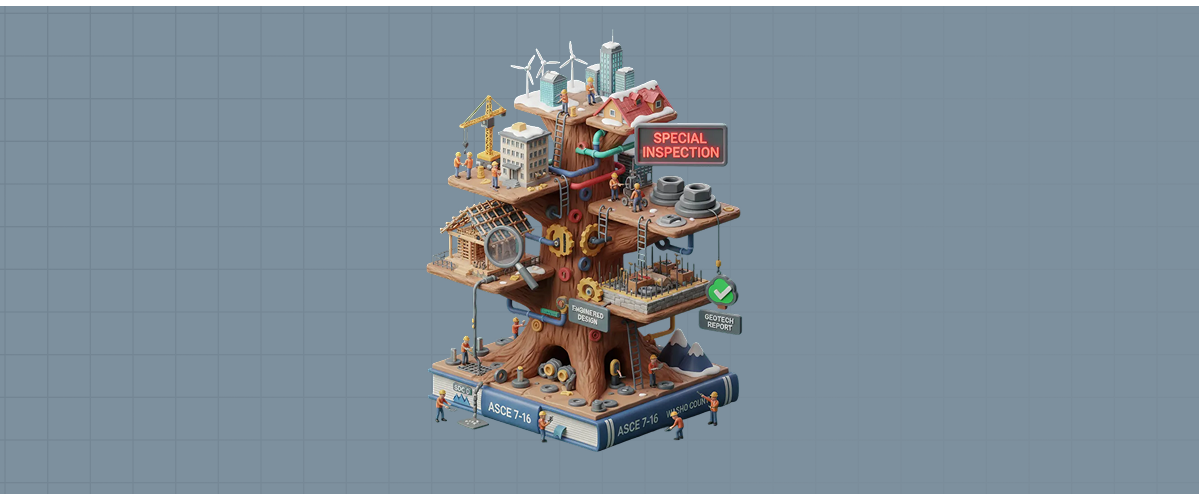
Navigating Nevada's Structural Codes: A Guide to Seismic Design, Special Inspections, and Foundation Requirements
Nevada's diverse and often extreme geography—from the mountainous terrain of the Sierra Nevada to the expansive Mojave Desert—presents unique structural design challenges. The state's building codes reflect these challenges, with stringent requirements for seismic activity, high winds, and heavy snow loads. For architects, engineers, and contractors, a deep understanding of these codes, particularly the significant local amendments in jurisdictions like Washoe and Clark Counties, is critical for project success.
This guide provides a comprehensive overview of Nevada's structural design parameters and special inspection mandates, based on the currently adopted 2018 International Building Code (IBC) and International Residential Code (IRC) with state and local amendments.
Key Takeaways on Nevada Structural Codes
- Governing Codes: Nevada has adopted the 2018 International Code Council (I-Code) series. However, major jurisdictions like Clark County (Las Vegas) and Washoe County (Reno) have extensive and legally binding amendments that often supersede the base code.
- High Seismic Risk: A significant portion of Nevada, including its major population centers, is located in Seismic Design Category (SDC) C or D. This mandates robust seismic force-resisting systems, detailed foundation requirements, and rigorous special inspections.
- Jurisdiction-Specific Environmental Loads: Do not rely on generic national maps for environmental loads.
- Snow Loads: In Washoe County and other northern/mountainous areas, ground snow loads are site-specific and must be obtained directly from the local building department. They can vary dramatically with elevation.
- Wind Loads: Clark County and other southern areas have specific wind speed requirements that must be confirmed with local amendments.
- Special Inspections are Mandatory: Special inspections, as outlined in IBC Chapter 17, are not optional. They are required for a wide range of structural work, including concrete, welding, high-strength bolting, and critically, seismic force-resisting systems and post-installed anchors. A "Statement of Special Inspections" prepared by the design professional is required at the time of permit submittal.
Context + Why This Topic Matters
Structural design in Nevada is a practice in specifics. The state's position on active fault lines, such as the Walker Lane system, makes seismic design a primary life-safety concern. This reality is reflected in every aspect of the building code, from foundation design in the IRC to the special inspection requirements for essential facilities in the IBC.
Design professionals must navigate a multi-layered code environment:
- Model Codes: The 2018 IBC and IRC provide the base framework.
- State Amendments: The Nevada State Public Works Division adopts the codes and may include statewide amendments.
- Local Ordinances: Counties and cities (e.g., Washoe, Clark, Reno, Las Vegas) enact the most critical amendments, especially concerning structural design parameters.
A common pitfall is designing a project based solely on the IBC or ASCE 7 without consulting the local jurisdiction's specific requirements for snow, wind, and seismic design values. This can lead to significant redesigns during plan review, causing costly project delays. Similarly, underestimating the scope and cost of the required special inspection program can lead to failed inspections and disputes during construction.
What are the controlling structural design parameters (Seismic Design Category, wind speed, ground snow load) for a new essential facility (Risk Category IV) in Washoe County, and what are the specific special inspection requirements mandated by the Nevada State Building Code and local amendments for the seismic force-resisting system?
The controlling design parameters for a Risk Category IV facility in Washoe County must be determined using a combination of ASCE 7-16 (as referenced by the 2018 IBC) and, most importantly, specific data provided by the Washoe County Community Services Department. Special inspections for the seismic force-resisting system will be extensive, requiring continuous inspection for most critical elements as mandated by IBC Chapter 17.
Deeper Explanation:
1. Risk Category: Per IBC 2018 Table 1604.5, a new essential facility (e.g., hospital, fire station, emergency operations center) is classified as Risk Category IV. This classification increases the design loads through importance factors to ensure the building remains operational after a major event.
2. Seismic Design Parameters:
- Seismic Design Category (SDC): Washoe County is located in a high seismic area. The SDC will almost certainly be SDC D or potentially SDC E, depending on the site-specific soil conditions.
- Determination: The SDC is determined per ASCE 7-16 Chapter 11. While online tools like the ASCE 7 Hazard Tool can provide preliminary values for mapped spectral response accelerations (Ss and S1), a site-specific geotechnical investigation is required for a Risk Category IV facility.
- Geotechnical Report: The geotechnical report will provide the official Site Class (A-F) and the design-level spectral response acceleration parameters, SDS and SD1.
- Seismic Importance Factor (Ie): For a Risk Category IV structure, Ie = 1.5 per ASCE 7-16 Table 1.5-2.
3. Wind Speed:
- Determination: The basic wind speed is determined from the maps in ASCE 7-16 Chapter 26, Figures 26.5-1A through 26.5-1D.
- Risk Category IV Map: You must use the map specific to Risk Category IV, which results in a higher design wind speed than for a standard building. For the Reno area, this is typically 110 mph (Vult).
- Wind Importance Factor (Iw): For Risk Category IV, Iw = 1.15 per ASCE 7-16 Table 1.5-2, though this is now incorporated directly into the wind pressure equations rather than being a standalone factor.
4. Ground Snow Load (Pg):
- CRITICAL SOURCE: You must not use the ground snow load map from ASCE 7-16 Figure 7.2-1. Washoe County has extreme variations in snow load due to elevation.
- Official Requirement: The Washoe County Community Services Department, Building & Safety Division, is the sole authority having jurisdiction for design snow loads. The designer must provide the Assessor's Parcel Number (APN) or site address to the county to obtain the official site-specific ground snow load (Pg). This can range from 20 psf in the valley to over 400 psf in the mountains.
5. Special Inspection for Seismic Force-Resisting System (SFRS): For a Risk Category IV building in SDC D, special inspection requirements are among the most stringent in the code. These are mandated by IBC 2018 Chapter 17, specifically Section 1705.12 (Special inspection for seismic resistance).
- Statement of Special Inspections: The registered design professional must prepare and submit this document with the permit plans, outlining all required inspections.
- Continuous Special Inspection: As required by IBC §1705.12.1, continuous special inspection is required for the installation of the following SFRS components:
- Structural steel welding and high-strength bolting.
- Reinforcing steel placement in intermediate and special moment frames and shear walls.
- Placement of concrete in intermediate and special moment frames and shear walls.
- Other Required Inspections: In addition to the SFRS, other elements will require inspection per IBC Chapter 17, including:
- Concrete: Reinforcing steel, formwork, and concrete placement and testing (IBC Table 1705.3).
- Soils: Verification of bearing capacity, fill placement, and compaction (IBC §1705.6).
- Structural Masonry: Reinforcement, grout placement, and prism testing (IBC §1705.4).
When is a special inspection required for post-installed concrete anchors in Nevada? Does it depend on the Seismic Design Category or the type of load (gravity vs. lateral)?
What can you ask? (Sample questions)
- What building code edition does my state currently enforce?
- How do state-specific amendments modify the base IBC?
- What structural design loads apply in my jurisdiction?
- What energy code requirements apply to my building type?
Yes, special inspection is required for most post-installed concrete anchors in Nevada, and the requirements are based on both the Seismic Design Category (SDC) and the nature of the applied loads. The level of inspection becomes significantly more rigorous in higher seismic zones (SDC C through F), especially for anchors resisting seismic tension forces.
Deeper Explanation:
The primary code reference for post-installed anchor inspection is IBC 2018 Chapter 17 and the referenced standard, ACI 318-14.
General Requirement:IBC 2018 Table 1705.3 requires periodic special inspection for "Anchors post-installed in hardened concrete members." This is the baseline requirement for all SDCs and load types.
Seismic Requirement (The Critical Driver): The requirements are elevated for seismic applications. IBC §1705.3.9 specifically addresses this, stating:
"Continuous special inspection shall be performed during installation of adhesive anchors and periodic special inspection shall be performed during installation of mechanical anchors in concrete where the anchors are used to resist seismic loads in structures assigned to Seismic Design Category C, D, E or F."
Load Type (Gravity vs. Lateral): The code distinguishes between anchors resisting different load types, especially tension.
- Seismic Tension: Anchors designed to resist tension forces as part of the seismic force-resisting system (e.g., collector connections, brace frame anchors, shear wall hold-downs) in SDC C, D, E, or F require continuous special inspection.
- Gravity/Other Loads: Anchors resisting gravity loads or non-seismic lateral loads generally fall under the periodic special inspection requirement of Table 1705.3. However, the engineer of record can specify continuous inspection if the connection is critical.
Inspection Details: The special inspector is responsible for verifying several critical items, as detailed in ACI 318-14:
- Anchor type and diameter match the approved plans.
- Installer qualifications (e.g., ACI/CRSI Certified Adhesive Anchor Installer).
- Proper hole drilling method, diameter, and depth.
- Thorough hole cleaning procedures.
- Correct adhesive mixing and injection (for adhesive anchors).
- Proper setting of the anchor element.
- Correct installation torque (for mechanical anchors).
- Required edge distances and spacing are maintained.
What are the specific Nevada code requirements for foundation reinforcement and anchor bolt spacing for a single-family home located in Seismic Design Category D?
For a single-family home in SDC D, Nevada's adopted 2018 International Residential Code (IRC) provides prescriptive requirements for foundation reinforcement and anchor bolt detailing to resist seismic forces. These include minimum steel reinforcement in stem walls, minimum anchor bolt size, reduced maximum spacing, and the use of oversized plate washers.
Deeper Explanation:
The following requirements are based on the IRC for conventional light-frame construction in SDC D0, D1, and D2.
Foundation Reinforcement:
- IRC §R403.1.3 (Seismic reinforcing): This section mandates specific minimum reinforcement for concrete and masonry footings and foundation walls in SDC D0, D1, and D2.
- Stem Walls: Concrete stem walls must have, at a minimum, one #4 bar at the top of the wall and one #4 bar at the bottom of the footing. Additional vertical and horizontal reinforcement may be required based on wall height and soil conditions.
Sill Plate Anchorage:
- Anchor Bolt Size and Embedment: Per IRC §R403.1.6, anchor bolts must be at least 1/2-inch in diameter and extend a minimum of 7 inches into the concrete or masonry.
- Spacing: The critical seismic requirement is in IRC §R602.11.1. In SDC D0, D1, and D2, anchor bolts must be spaced a maximum of 4 feet on center.
- Location: Bolts must be placed within 12 inches of the ends of each piece of sill plate. There must be a minimum of two bolts per plate section.
- Plate Washers (Crucial Detail):IRC §R602.11.1 requires a 3-inch by 3-inch by 0.229-inch-thick steel plate washer to be installed between the sill plate and the nut on each anchor bolt. Standard round washers are not permitted for this application in SDC D. This is a critical detail to prevent the sill plate from pulling over the nut during an earthquake.
Local Amendments: Always verify with the local building department (e.g., Washoe County, Clark County). They may have standard foundation detail sheets or local amendments that provide additional or more stringent requirements.
How do I find out the snow load requirements for my property in Washoe County?
You must obtain the official design ground snow load directly from the Washoe County Community Services Department, Building & Safety Division. It is a violation of the local code to use generic values from ASCE 7 or other national sources for projects within Washoe County.
Deeper Explanation:
Washoe County's mountainous terrain creates microclimates where snow loads can vary from 20 pounds per square foot (psf) in the Reno valley to over 400 psf near Lake Tahoe and on Mount Rose. Using an incorrect value is a significant life-safety issue and a common reason for plan rejection.
Steps to Obtain the Official Snow Load:
- Identify Your Property: You will need the site address or, preferably, the Assessor's Parcel Number (APN).
- Contact Washoe County:
- Online GIS Map: The most efficient method is to use the county's online GIS (Geographic Information System) mapping tool. It allows you to search for a parcel and view its specific building code requirements, including the ground snow load.
- Direct Inquiry: You can also contact the Building & Safety Division directly by phone or by visiting their offices.
- Use the Official Value: The value provided by the county is the ground snow load (Pg). The structural engineer must then use this value in conjunction with the formulas in ASCE 7-16, Chapter 7 to calculate the actual design roof snow load (Pf), accounting for factors like roof slope, thermal conditions, exposure, and drifting.
What are the seismic design requirements for a house in Nevada?
The seismic design requirements for a house in Nevada are governed by the 2018 International Residential Code (IRC). The core requirements involve determining the home's Seismic Design Category (SDC), providing proper foundation anchorage, and designing a complete lateral force-resisting system using braced wall lines.
Deeper Explanation:
Designing a home to resist seismic forces involves a systematic approach:
Determine the Seismic Design Category (SDC):
- The SDC is the first and most important step. It can be determined using the maps in IRC Figure R301.2(2) or, more accurately, by using the latitude and longitude of the site in an online tool like the ASCE 7 Hazard Tool. Most populated areas of Nevada fall into SDC C or D.
Foundation and Anchorage:
- The foundation must be properly anchored to resist sliding and overturning.
- As detailed previously, this involves specific requirements for anchor bolt size, spacing, location, and the use of 3"x3" plate washers in SDC D and higher (IRC §R602.11.1).
- Foundation stem walls must also contain minimum horizontal reinforcement (IRC §R403.1.3).
Wall Bracing (The Primary Lateral System):
- The IRC requires that exterior and certain interior walls be braced to resist lateral forces from wind and earthquakes. This is achieved by creating "braced wall lines."
- IRC Section R602.10 provides detailed prescriptive requirements for the amount, location, and type of wall bracing required.
- The required length of bracing increases significantly in higher SDCs.
- Bracing Methods: The code allows several methods, including wood structural panels (plywood/OSB), gypsum board, let-in bracing, and others. Wood structural panels are the most common and effective method in high-seismic areas.
Other Important Details:
- Cripple Walls: If the house has a crawl space with short "cripple walls," they must be braced per IRC §R602.11.
- Masonry and Veneer: Stone or brick veneer must be properly tied to the structure per IRC Chapter 7.
- Water Heaters: Water heaters must be strapped and secured to the wall to prevent them from tipping over during an earthquake, which can cause fire or water damage (California Plumbing Code §507.2, often adopted by reference or as a best practice).
What are the building code requirements for a retaining wall over 4 feet high in Nevada?
In Nevada, any retaining wall over 4 feet in height, measured from the bottom of the footing to the top of the wall, requires a building permit and must be designed by a registered professional engineer. The design must comply with the 2018 IBC and account for lateral earth pressures, surcharge loads, drainage, and seismic forces.
Deeper Explanation:
Permit Trigger:IBC §105.2 exempts retaining walls that are not over 4 feet high from needing a permit, provided they are not supporting a surcharge. Any wall exceeding this height, or a shorter wall supporting a surcharge (like a slope or driveway), requires a permit and an engineered design.
Design Loads (IBC Chapter 16 and 18):
- Lateral Earth Pressure: The primary load on the wall. The design must be based on soil parameters provided in a geotechnical report, which will give values for active, passive, and at-rest pressures (IBC §1610.1).
- Surcharge Loads: The design must include any additional loads applied behind the wall, such as from adjacent footings, slopes, or vehicle traffic (IBC §1807.2.1).
- Hydrostatic Pressure: Retaining walls must have a drainage system (e.g., perforated pipe, gravel backfill) to relieve water pressure. If no drainage is provided, the wall must be designed to resist the full hydrostatic load, which is very significant (IBC §1807.1.4).
- Seismic Earth Pressure: In SDC C and higher, the design must include the additional lateral pressure generated during an earthquake, as required by ASCE 7-16 §11.8.3. The geotechnical report should provide the seismic load increment.
Special Inspections:
- Engineered concrete or masonry retaining walls fall under the requirements of IBC Chapter 17. Special inspections will be required for reinforcing steel placement, concrete strength testing, and masonry grout placement.
Additional Supporting Sections
Jurisdictional Variations: Clark County vs. Washoe County
While both major Nevada jurisdictions have high seismic risk, their other environmental design loads create distinct priorities:
Clark County (Las Vegas Metropolitan Area):
- Dominant Loads: Seismic (SDC D) and Wind.
- Wind Speed: Design wind speeds are high. Always verify with the most current Clark County amendments, as they may specify speeds higher than the base ASCE 7 maps.
- Soils: Expansive soils (caliche) are a major geotechnical concern, often requiring post-tensioned slabs or other specialized foundation systems.
- Snow: Negligible for most of the valley.
Washoe County (Reno-Sparks Metropolitan Area):
- Dominant Loads: Seismic (SDC D) and Snow.
- Snow Load: The defining environmental load, especially at higher elevations. It is site-specific and must be obtained from the county. This is the most common design error for those unfamiliar with the region.
- Wind: Also a significant design consideration, but often secondary to the heavy snow and seismic requirements.
The Critical Role of the Geotechnical Report
For any commercial building, engineered retaining wall, or custom home on a challenging site in Nevada, a site-specific geotechnical report is not just recommended—it is essential. The structural design is fundamentally dependent on the information it contains:
- Site Class for seismic calculations.
- SDS and SD1 values (seismic acceleration parameters).
- Soil bearing capacity for foundation design.
- Recommendations for expansive or collapsible soils.
- Lateral earth pressure values (active, passive, at-rest, and seismic) for retaining wall design.
- Pavement section recommendations.
Submitting plans for a significant structure without a geotechnical report is a guaranteed path to plan rejection by the building department.
Best Practices for Coordinating Special Inspections
A smooth special inspection process is key to keeping a project on schedule.
- Early Planning: The Engineer of Record must create a complete and accurate Statement of Special Inspections and include it in the permit set.
- Hire a Reputable Agency: The owner or contractor should hire a qualified, independent special inspection agency well before construction begins.
- Pre-Construction Meeting: The special inspection agency should hold a meeting with the contractor, relevant subcontractors, and the design team to review the inspection requirements, reporting procedures, and scheduling protocol.
- Clear Communication: The contractor must provide adequate notice to the inspection agency before work requiring inspection is performed. Failure to do so can result in costly tear-outs or delays.
- Final Report: The special inspection agency must submit a final summary report to the building department, confirming that all required inspections were performed and work was found to be in substantial conformance with the approved documents. This report is required before a Certificate of Occupancy can be issued.
Frequently Asked Questions (FAQ)
Does Nevada have a statewide building code? Yes, Nevada adopts a set of codes based on the International Codes (I-Codes). However, local jurisdictions like Clark and Washoe counties have the authority to create and enforce their own amendments, which can be more restrictive than the state-adopted codes.
What is the current building code in Las Vegas? The City of Las Vegas and Clark County have adopted the 2018 International Building Code (IBC) and International Residential Code (IRC) along with significant local amendments. Always refer to the Southern Nevada Building Officials for the latest adopted codes and amendments.
Do I need an engineer for my house plans in Nevada? Not always. If your home's design strictly follows the prescriptive requirements of the IRC for things like size, shape, and wall bracing, an engineer may not be required by the building department. However, for homes in high seismic zones (SDC D), with complex geometry, large window openings, or on sites with poor soil, an engineered design is almost always necessary and highly recommended.
Are special inspections required for residential projects? Typically, the full IBC Chapter 17 special inspection program is not applied to single-family homes built under the prescriptive IRC. However, the local building inspector will still perform key inspections (footings, framing, etc.). If any part of the home requires an engineered design (e.g., a steel moment frame or a large retaining wall), those specific elements will trigger special inspection requirements.
How do I find the Seismic Design Category for my property? You can get a reliable determination of your SDC by entering your site's address or latitude and longitude into the free online ASCE 7 Hazard Tool or the ATC Hazards by Location tool.
What is a "Statement of Special Inspections"? It is a formal document, prepared and signed by the Engineer of Record, that lists all the structural elements and construction operations on a project that require special inspection per IBC Chapter 17. This statement must be submitted with the permit application and is used by the building department, contractor, and special inspection agency.
What's the difference between ground snow load and roof snow load? Ground snow load (Pg) is the baseline value determined by the local jurisdiction based on historical climate data for a specific location. The structural engineer uses this Pg value in ASCE 7 formulas to calculate the design roof snow load (Pf), which accounts for factors like roof slope, wind exposure, and thermal conditions that cause snow to accumulate or slide.
Do I need a permit for a deck in Nevada? Yes, in nearly all Nevada jurisdictions, decks that are more than 30 inches above the ground, are attached to the house, or serve a required exit door require a building permit.
Where can I find the Nevada state and local code amendments? The Nevada State Public Works Division Board website is the source for statewide adoptions. For local amendments, which are often more critical for design, you must go directly to the website of the local building department, such as the Clark County Department of Building & Fire Prevention or the Washoe County Community Services Department.
More Nevada Building Code Guides
- Commercial Code (IBC)Commercial Design in Nevada: Applying IBC & Local Amendments for High-Rise, Warehouse, and Casino Projects
- Fire & Life SafetyNevada Residential Code (IRC) Requirements: A Guide for Decks, ADUs, Fire Separation, and More
- Energy Code (IECC)Complying with the Nevada Energy Code (IECC): Commercial & Residential Requirements
- Wildfire / WUI CodesNevada Wildland Urban Interface (WUI) Code: Applicability and Construction Requirements
- Overview GuideNevada Building Code Explained: State Adoption, Local Amendments, and Enforcement
MeltPlan
A curated stream of preconstruction intelligence, estimating innovation, takeoff breakthroughs, workflow advancements, and expert perspectives—powered by the AI and technology shaping the future of construction.
Visit SiteDon't miss what's shaping AEC
The latest on preconstruction, codes, AEC news & trends — so you're always in the know.