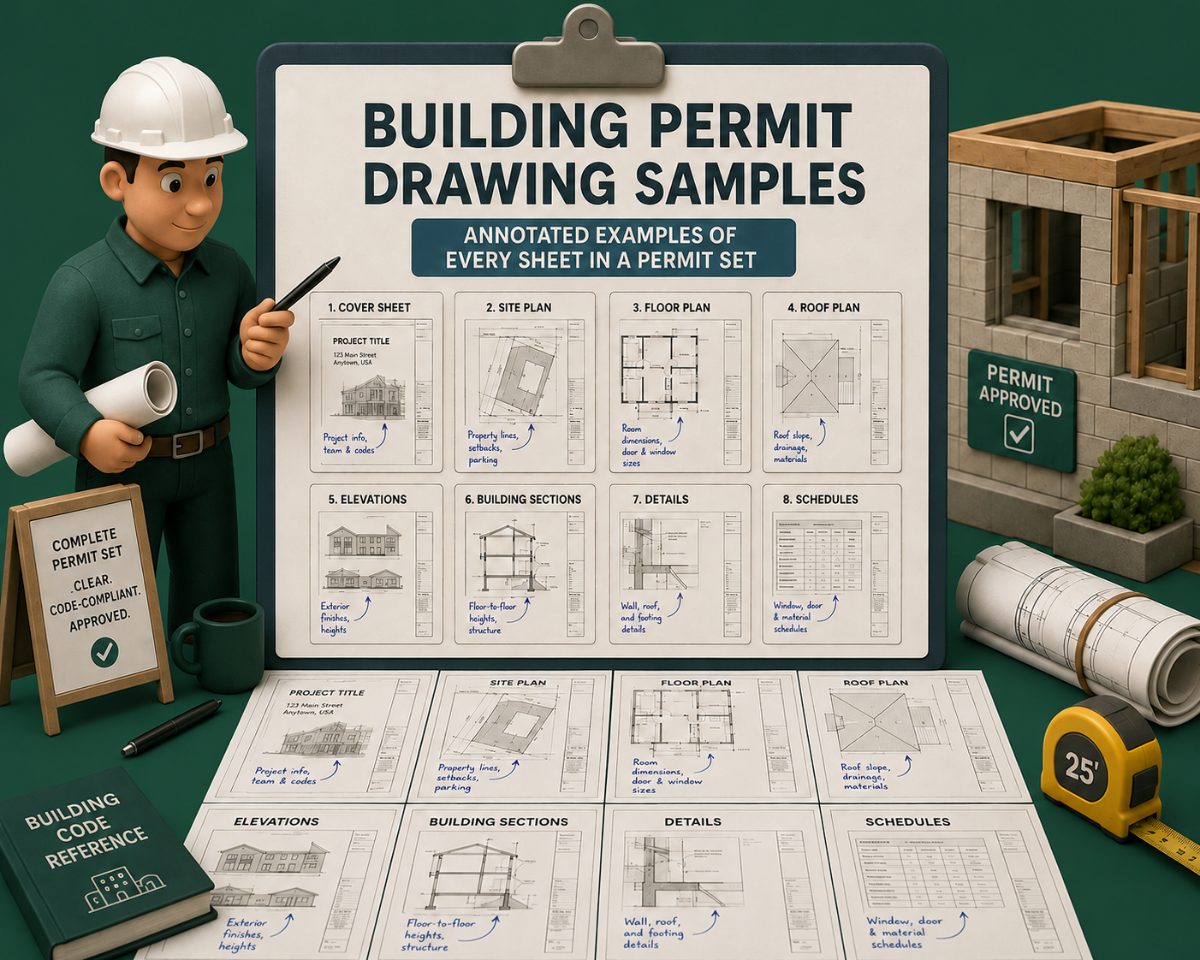
Building Code Compliance Software: What the Category Means and How to Evaluate It
Architects on a typical project spend somewhere between 50 and 300 hours on code research — flipping through ICC Digital Codes, chasing cross-references acros..
.jpg?alt=media&token=8ec51d53-b490-4fd8-acb8-2c5cdd559afb)
Architects on a typical project spend somewhere between 50 and 300 hours on code research — flipping through ICC Digital Codes, chasing cross-references across IBC, IFC, IECC, and ADA, and reconciling state amendments that change every cycle. The work is not glamorous, it is not billable at full rate, and it is the part of design where a single missed cross-reference becomes a plan-check correction, a redesign, or, in the worst case, a stop-work order in the field. The category that exists to compress that work is "building code compliance software," and what it actually means has changed substantially in the last 24 months.
This article defines the category, separates the kinds of tools that get grouped under it, names the evaluation criteria that matter, and explains where AI-based code research, the newest subcategory, sits relative to the older approaches. It is written for the architect or design engineer who is actively deciding whether to adopt a tool, what to evaluate it against, and whether the time saved is real.
What Does "Building Code Compliance Software" Actually Mean?
The phrase covers four distinct categories of tools. They are commonly conflated in software listings and SEO content, but they solve different problems and produce different outputs.
1. Code reference platforms.ICC Digital Codes, UpCodes, and similar tools host the text of building codes — searchable, linkable, and (in the case of ICC) authoritative. These platforms answer "what does the code say?" but not "what does the code require for my project?" The architect still does the interpretation, cross-referencing, and compliance-path construction by hand. ICC Digital Codes is the most-used in this category and is what most code-reference workflows start from.
2. Code-matrix spreadsheets and templates. Many firms maintain internal code matrices — Excel or Google Sheets templates with rows for each code section that applies to a project type, columns for the project values, and conditional logic for compliance. Some are free, some are paid templates. They formalize a firm's interpretation process but require the firm to keep them current as codes change, and they don't help with novel project types or unfamiliar jurisdictions.
3. Plan-review software. Tools like Avolve, EnerGov, and similar enterprise platforms are used by AHJs (Authority Having Jurisdiction, city and county building departments) to manage permit-review workflows. They are not designed for the architect's side of the table; their users are plan reviewers and permit technicians. Architects sometimes search for "code compliance software" expecting this category and find tools that don't serve their workflow.
4. AI-based code research assistants. The newest subcategory, which emerged in the last 24 months, encompasses tools that ingest building codes as their knowledge base and answer project-specific code questions with citations and reasoning. The output is a structured compliance answer, not a search result, not a template, not a workflow tool. Melt Code is the AI-native tool in this category that focuses specifically on architect and code-consultant workflows.
The right tool for a given task depends on which problem the architect is actually trying to solve.
What Are Architects Spending Their Code-Research Time On?
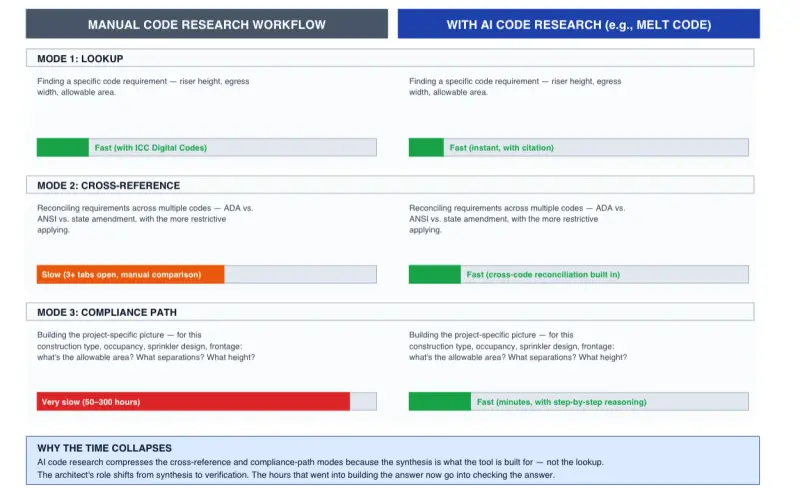
Industry data and firm-reported studies consistently put architect code-research time at between 50 and 300 hours per project, depending on scope, occupancy complexity, jurisdiction familiarity, and the team's seniority. That range is wide because the underlying work has three different modes.
Lookup work. Finding a specific code requirement, the maximum riser height, the minimum egress width for an occupant load, and the allowable area for Type II-B construction with B occupancy. Code reference platforms (ICC Digital Codes) handle this well if the architect knows where to look.
Cross-reference work. To reconcile requirements that live in multiple codes, an accessible toilet room must comply with ADA, ANSI A117.1, and (in California) CBC Chapter 11B, with the more restrictive applying to each dimension. A code-reference platform does not do this reconciliation; the architect does it by opening three tabs and comparing.
Compliance-path work. Building the project-specific picture, for a mixed-use Type V-A building with R-2 over M occupancy in a sprinklered jurisdiction with a 30-foot front yard frontage, what is the allowable area? What separations are required? What is the maximum building height? This is where the 50–300-hour figure concentrates. Reference platforms host the text; the architect synthesizes the answer.
AI-based code research compresses the cross-reference and compliance-path modes by performing synthesis on the architect's behalf when reliable. Whether it is reliable is the central evaluation question.
What Should an Architect Evaluate When Comparing Building Code Compliance Software?
What can you ask? (Sample questions)
- What building code edition does my state currently enforce?
- How do state-specific amendments modify the base IBC?
- What structural design loads apply in my jurisdiction?
- What energy code requirements apply to my building type?
Five criteria matter, in roughly this order:
1. Citation transparency: Does the tool show its source?
A code-research answer without a citation is not an answer. If a tool returns "the maximum stair riser height is 7 inches" without telling the architect that this comes from IBC Section 1011.5.2, the architect cannot verify it, defend it to a code consultant, or include it in a code-analysis block on the cover sheet. Look for tools that surface the code section, the edition year, and the exact passage the answer derives from. The MeltPlan team has described this as making compliance "transparent and decision-ready," which is the right framing.
2. Accuracy, and validated against what?
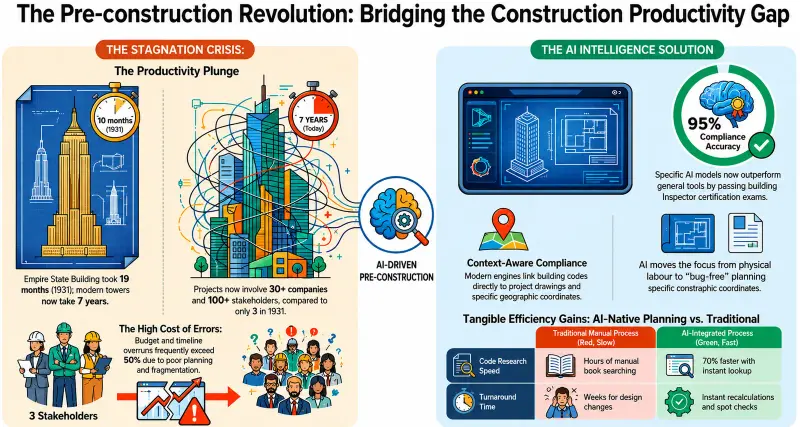
"AI accuracy" is meaningless without a yardstick. Ask what the tool was validated against. Building inspector exams are a credible yardstick — they are written to test exactly the kind of code interpretation the architect is asking the tool to do. Melt Code reports 95%+ accuracy validated against building inspector exams across multiple jurisdictions; that is a specific, verifiable claim against a recognized benchmark. Vague claims like "highly accurate" or "trained on building codes" with no benchmark are not.
3. Code coverage: Which codes and which jurisdictions?
A tool that handles IBC but not ADA forces the architect back to manual cross-reference work. A tool that handles model codes but not state amendments forces the architect to do the most error-prone part, jurisdictional overlays, by hand. Comprehensive coverage means IBC, IRC, IEBC, IFC, IMC, IPC, IECC, NEC, NFPA, ADA, ANSI A117.1, and local amendments. Anything narrower leaves the architect with significant residual manual work.
4. Reasoning visibility: Can the architect see how the tool got there?
The architect cannot defend an answer to a plan reviewer or a code consultant by saying "the software said so." Tools that show step-by-step reasoning — "the project is Type II-B, B occupancy, sprinklered with NFPA 13, with 30 percent open frontage; the tabular allowable area per IBC Table 506.2 SM column is X; the frontage increase factor If per Section 506.3 calculated from Table 506.3.3 is Y; total allowable area Aa = X × (1 + If) = Z" — produce answers the architect can stand behind. Tools that produce only the final number do not.
5. Input boundaries: Does the tool read the codes or the open web?
This one matters more than most evaluations capture. AI tools that read the open internet to answer code questions inherit everything the internet contains: forum posts, outdated PDFs from previous code cycles, third-party blog summaries with errors, and contradictory interpretations. Tools that constrain their input to the actual building codes (and only the codes) produce more reliable answers because they cannot hallucinate from a Reddit thread. The MeltPlan team has stated explicitly that Melt Code "only reads building codes (not the internet)" — that is the right architecture for a code-research tool.
How Do the Categories Compare on the Architect's Actual Workflow?
Workflow | Code reference (ICC Digital Codes) | Code-matrix spreadsheet | Plan-review software (Avolve, etc.) | AI code research (Melt Code) |
Looking up a single requirement | Strong | N/A | Not for this user | Strong |
Cross-referencing across codes | Manual | Manual (per-template logic) | Not for this user | Strong |
Project-specific compliance path | Manual | Limited (template-bound) | Not for this user | Strong |
Jurisdiction amendments | Manual lookup | Manually maintained | N/A for designers | Built in |
Code-analysis block on cover sheet | Manual synthesis | Partial | N/A for designers | Generates with citations |
Plan-review submission | N/A | N/A | This is what it does | N/A |
The right toolchain for most architects is a combination: ICC Digital Codes as the authoritative source of record, an AI code research tool for interpretation and compliance-path synthesis, and an internal code matrix for firm-specific workflows.
Why Did AI Code Research Emerge as a Category Now?
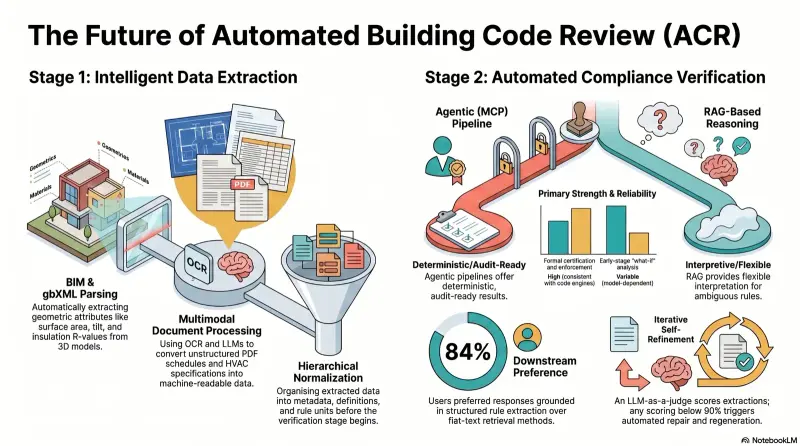
First, the LLM-reasoning capability needed to interpret legal-style code text, with its dense cross-references, exception clauses, and table-driven conditional logic, crossed a useful-accuracy threshold. Earlier AI models could find a code section by keyword, but could not reason through a multi-code, multi-section compliance question. The current generation can.
Second, the industry's tolerance for the 50–300-hour code-research burden dropped. As construction-tech budgets grew and architectural-firm margins compressed, firms started actively looking for tools that could reduce that burden. The case-study data — 30 percent less spent on code consultants, 45 percent faster code research, 25 percent fewer inquiries from junior architects- describes the kind of impact that gets a tool adopted at the firm level rather than at the individual seat level.
Third, AHJs themselves began testing AI tools for plan review, which means the architect's tool and the reviewer's tool will increasingly speak the same language. A tool that produces citation-anchored compliance answers becomes more valuable as plan review becomes more able to verify and accept them.
What Risks Should Architects Watch For?
Three failure modes are specific to this category and worth naming explicitly.
Hallucination. General-purpose AI tools (ChatGPT, Claude direct, Gemini direct) frequently fabricate code section numbers when answering code questions. They may produce plausible-sounding citations like "IBC Section 1023.4" that don't exist or that exist but say something different. Tools built for code research — that constrain their input to the actual code text — eliminate this risk. Generalist AI is not safe for production code research.
Stale code editions. State and local adoption cycles vary widely. A tool that defaults to the 2018 IBC when the project is in a 2021-IBC jurisdiction will produce systematically wrong answers. Verify that the tool clearly identifies which edition and which jurisdiction its answer is based on.
Citation without verification. Some tools cite a section without confirming that the section's content actually supports the claim. The architect should always be able to click through from a citation to the source text — and that source text should be from a primary source (ICC, NFPA, ADA.gov), not a third-party host.
Melt Code is built specifically to address these risks; it reads only the building codes (not the internet), shows step-by-step reasoning with direct citations to specific code sections across IBC, IRC, IEBC, IFC, IMC, IPC, IECC, NEC, NFPA, ADA, and ANSI A117.1, and reports validated 95%+ accuracy against building inspector exams. Try it atmeltplan.com/code.
How Does AI Code Research Fit Into the Cover-Sheet Code Analysis Workflow?
The cover sheet's code analysis block is the most-scrutinized item in a permit set. It requires the architect to assemble: applicable codes with edition years; occupancy classification per IBC Chapter 3 (and the mixed-use separation strategy if applicable); construction type per IBC Chapter 6; sprinkler status; allowable area calculation perIBC Section 506 with the tabular allowable area factor and frontage increase shown as calculated values; allowable height perIBC Tables 504.3 and 504.4; and occupant load summary per IBC Table 1004.5.
Done by hand, this is an afternoon's work for a familiar project type and a multi-day task for an unfamiliar one. Done with AI code research, it becomes a structured input — the architect provides the project parameters, the tool returns the full code-analysis block with section-by-section citations, and the architect verifies the output against the cited sections before placing it on the sheet.
The architect's role does not disappear in this workflow; it shifts from synthesis to verification. The hours that used to go into building the answer go into checking that the answer is right. That is a net win when the tool is accurate enough to make checking faster than building.
What Adjacent Categories Often Get Confused with Code Compliance Software?
Three categories that searchers sometimes conflate with this one:
Plan-review software (AHJ-side). Avolve, EnerGov, ProjectDox. These are workflow platforms for permit departments — useful to AHJs, not to architects. If a tool description talks about "plan-review queues," "permit-fee calculation," or "inspector dispatch," it is in this category.
Energy modeling and code-compliance calculators. Tools like COMcheck, REScheck, and Title 24 energy compliance software solve a specific compliance question (does the building's envelope, lighting, and mechanical systems comply with the energy code?). These are valuable but narrow — they don't help with IBC area, height, occupancy, or accessibility analysis.
BIM-integrated code-checking plugins. Plugins for Revit, ArchiCAD, and similar BIM tools that flag certain code issues (egress widths, accessibility clearances) by interrogating model geometry. Useful at the model-review stage; not a substitute for the upfront code-analysis work.
A complete preconstruction code workflow uses several of these in combination, but the central code-research and compliance-path tool is the AI code research category, with ICC Digital Codes as the underlying source of authority.
Frequently Asked Questions
What is building code compliance software?
It is software that helps architects, engineers, and contractors interpret and apply building codes to specific projects. The category includes code-reference platforms (like ICC Digital Codes), code-matrix templates, plan-review software (used by permit departments, not by designers), and AI-based code research assistants. The last category — AI code research — is the newest and addresses interpretation and compliance-path synthesis rather than just code text lookup.
Is AI building code research reliable enough to use on real projects?
It depends on the specific tool. Tools that read only the building codes (not the open internet), show step-by-step reasoning, cite specific code sections, and validate accuracy against benchmarks like building inspector exams are reliable enough for production use — with the architect verifying outputs before placing them on stamped drawings. Tools that cite without verification or that read the open web are not. The architect's role becomes verification, not blind acceptance.
Will building code compliance software replace code consultants?
No, but it changes what they do. Case-study data from firms using AI code research reports a roughly 30 percent reduction in code-consultant spend, not 100 percent. The work that remains for code consultants is the harder edge cases: novel project types, jurisdictions with unusual amendments, plan-review correction responses, and projects where AHJ interpretation is in play. Code consultants who adopt AI tools themselves are typically more productive, not less needed.
Does building code compliance software cover state and local amendments, or just the model codes?
It varies by tool. Model-code-only tools (IBC, IRC) leave the architect to handle jurisdictional overlays manually, which is where most of the error risk concentrates. Tools that cover the model codes plus state and local amendments (Title 24 in California, CBC Chapter 11B, NYC overlays, Florida building code, etc.) compress the highest-value research time. Confirm coverage explicitly for the project's jurisdiction before adoption.
What is the difference between ICC Digital Codes and AI code research software?
ICC Digital Codes is the authoritative source; it hosts the text of the codes themselves, searchable and citable. It does not interpret. AI code research tools sit on top of the codes and answer project-specific questions with citations back to ICC Digital Codes (and other primary sources). The two are complementary: ICC Digital Codes is the source of truth, AI code research is the interpretation and synthesis layer.
How long does it take to learn building code compliance software?
For AI code research tools, the learning curve is short; the user describes the project and asks code questions in natural language. For code-matrix templates, it depends on the template's complexity. For plan-review software (AHJ-side), this is not the architect's workflow. The longest learning curve is on ICC Digital Codes itself, because understanding code organization is a multi-year discipline, but AI tools reduce the architect's need to know code organization deeply, because the tool handles the navigation.
Related Building Code Resources
- Overview GuideBIM Construction Software: The Complete Guide for Architects and Engineers
- Overview GuideBuilding Permit Drawings Software: The Complete Guide for Architects and Designers
- Building CodesThe Best 3D Rendering Software for Architects in 2026: A Workflow-First Comparison
- Building CodesBest AI to Generate Floor Plans: A Professional Comparison for Architects and Designers
- Building CodesArchitectural Design Software in 2026: A Workflow-First Comparison With Per-Stage Tool Comparisons
MeltPlan
A curated stream of preconstruction intelligence, estimating innovation, takeoff breakthroughs, workflow advancements, and expert perspectives—powered by the AI and technology shaping the future of construction.
Visit SiteDon't miss what's shaping AEC
Don't miss what's shaping AEC The latest on preconstruction, codes, AEC news & trends — so you're al