Building Permit Drawing Samples: Annotated Examples of Every Sheet in a Permit Set
A permit-ready drawing set is not a stack of pretty drawings. It is eight to twelve specific sheet types arranged in a specific submittal order, each one carryi..
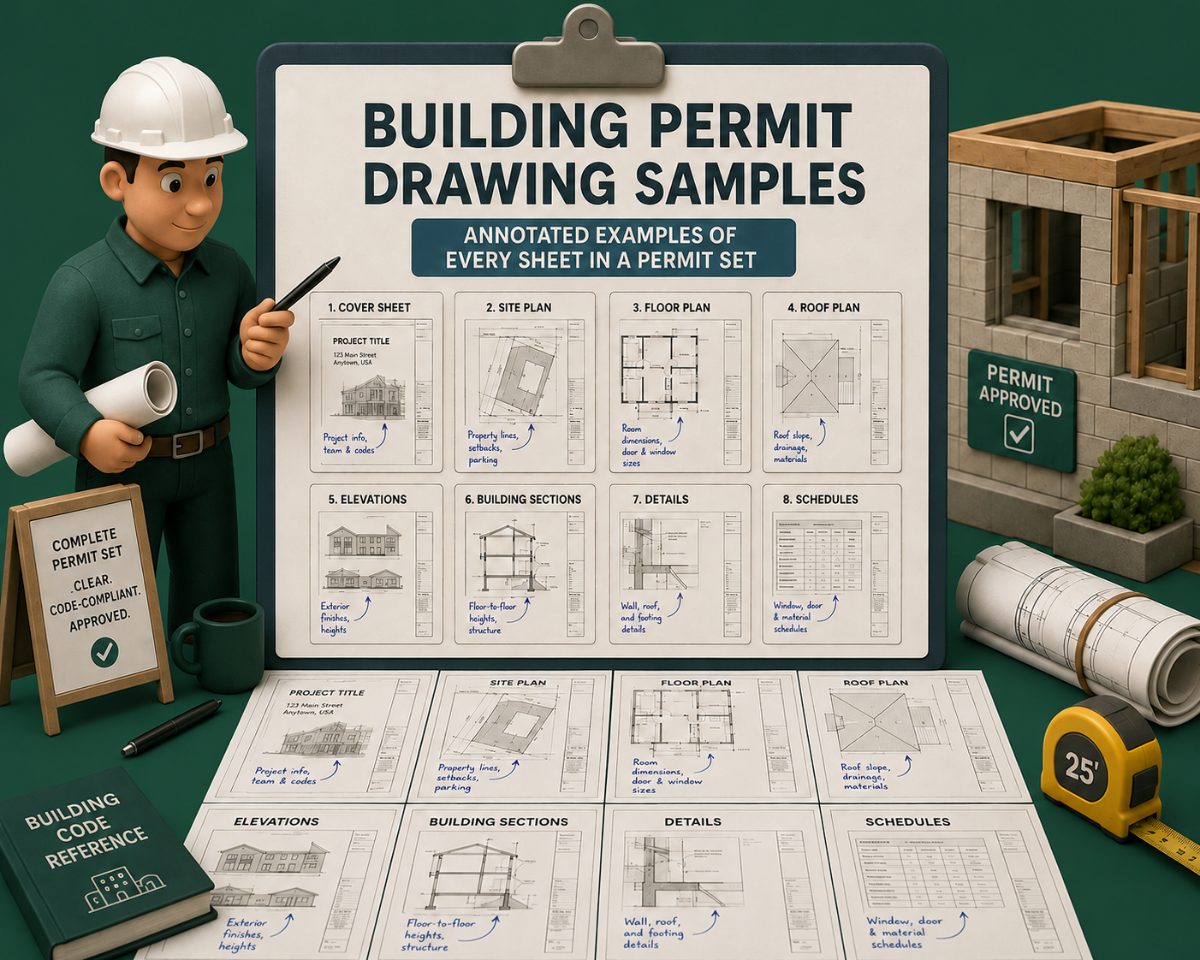
A permit-ready drawing set is not a stack of pretty drawings. It is eight to twelve specific sheet types arranged in a specific submittal order, each one carrying specific content that plan review verifies against specific code sections. The fastest way to learn what each sheet must contain is to look at one, annotated, with the code-anchored elements called out by name.
This article walks through every sheet category in a typical commercial permit set under the2021 International Building Code, showing what each sheet must contain and what plan review will look for. Each section includes an annotated schematic sample. A consolidated PDF of all sample sheets is available at the end as a downloadable reference.
What Sheets Make Up a Complete Permit Set?
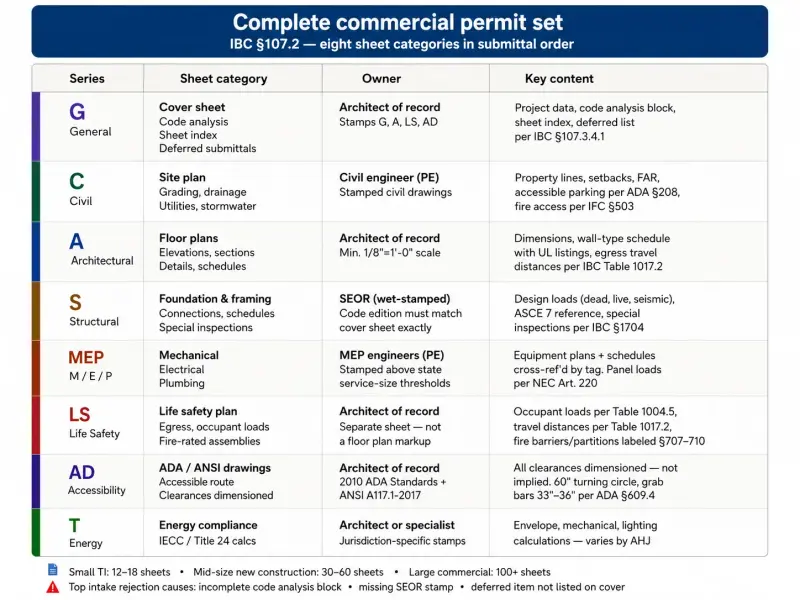
Every AHJ in the U.S. interpretsIBC Section 107.2, "construction documents of sufficient clarity", as the following sheet categories, in this submittal order:
The architect of record produces the G, A, LS, and AD series and coordinates the rest. Each section below shows what the corresponding sheet should contain.
What Does a Permit-Ready Cover Sheet Look Like?
The cover sheet is the reviewer's lens for the entire set. If the cover sheet is incomplete, the package may not enter intake review at all.
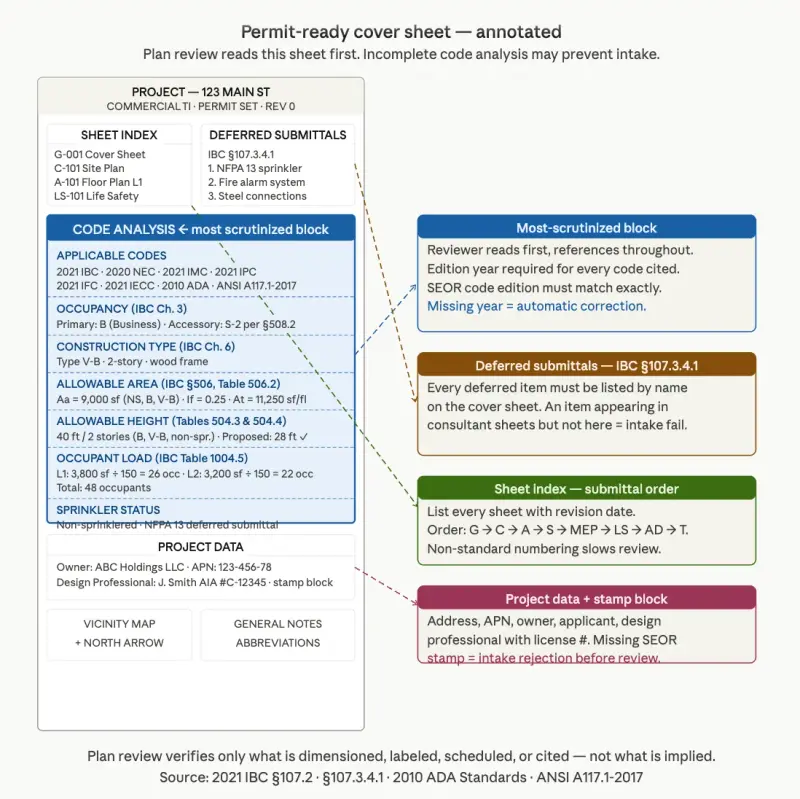
A permit-ready cover sheet contains six required blocks:
Project Data — address, APN, legal description, owner, applicant, design professional with license number and stamp
Code Analysis — the most-scrutinized block in the entire set (detailed below)
Sheet Index — every sheet in submittal order, with revision dates
Deferred Submittal List — named items per IBC Section 107.3.4.1
General Notes — dimension conventions, abbreviations, drawing standards
Vicinity Map and North Arrow — required by nearly every AHJ
What goes in the code analysis block?
This is the block plan review that reads first and refers back to throughout the set. At minimum, it must show:
Applicable codes with edition year — e.g., "2021 IBC, 2020 NEC, 2021 IMC, 2021 IPC, 2021 IFC, 2021 IECC, 2010 ADA Standards, ANSI A117.1-2017"
Occupancy classification per IBC Chapter 3 (primary and accessory)
Mixed-use separation strategy — non-separated per Section 508.3, separated per Section 508.4, or accessory per Section 508.2
Construction type per IBC Chapter 6 (Types I through V, A or B)
Sprinkler status — NFPA 13, 13R, 13D, or non-sprinklered
Allowable area calculation perIBC Section 506 — showing the tabular allowable area factor from Table 506.2 (NS, S1, S13R, or SM column) and the frontage increase (If) perSection 506.3 as calculated values, not formulas
Allowable height in feet and stories perIBC Tables 504.3 and 504.4
Occupant load summary per IBC Table 1004.5, totaled by floor and overall
Required separations per IBC Section 508 and Table 508.4
What Does a Permit-Ready Site Plan Look Like?
Ask any code questions on building permit drawing samples & get instant answers with cited sections ▶ Learn How it works (1 min)
What can you ask? (Sample questions)
How do local code amendments modify the base IBC requirements?
What triggers the need for a building permit?
What plan review documents are typically required?
How do jurisdictional amendments affect fire and structural codes?
Site plans fail plan review more often than any other sheet because requirements come from zoning and the AHJ rather than the IBC itself, and architects focus on the building, forgetting the site.
A permit-ready site plan shows property lines dimensioned with bearings and distances matching the survey, all setbacks dimensioned to the nearest building face, existing and proposed structures with footprint dimensions, easements with recording document references, FAR and site coverage calculations against zoning maximums, parking with accessible stalls per2010 ADA Standards Section 208, grade contours and drainage arrows, and fire department access including hydrant and FDC locations per IFC Section 503.
For projects with stormwater regulations in most of the U.S., a separate stamped civil set is required and listed as a deferred submittal only when civil engineering is contracted after permit application.
Download the Permit Sheet Sample Reference
A consolidated document of all sample sheet types shown above, cover sheet, site plan, floor plan, life safety plan, accessibility sheet, with annotations identifying every required block, schedule, and code reference, is available below. Print the reference and use it as a pre-submittal checklist against the actual permit set.
What Does a Permit-Ready Floor Plan Look Like?
Floor plans are the most-reviewed sheets and the easiest place to lose two weeks at plan check. At a minimum 1/8" = 1'-0" scale, every floor plan must show:
Overall and interior dimensions with consistent string hierarchy: overall → bay → opening
Room names and use designations that match the cover sheet occupancy classification (a "Storage" room labeled in an area calculated as B occupancy is a fail)
Door and window schedules referenced at every opening with a tag (D-01, W-01, etc.)
Wall types referenced to a schedule, with rated assemblies (1-hour, 2-hour) hatched or color-coded, and the UL listing or IBC Section 721 reference shown in the wall-type schedule
Plumbing fixtures located with dimensions to the centerline
Means of egress — exit doors labeled, exit access travel distance dimensioned againstIBC Table 1017.2, common path of egress shown against IBC Table 1006.2.1
Accessible clearances dimensioned, not implied; if a clearance is not on the sheet, plan review presumes it is non-compliant
For commercial work, dimension face-of-stud or face-of-concrete with the convention stated on the cover sheet.
What Does a Permit-Ready Life Safety Plan Look Like?
A life safety plan is required for any project of Use Group A, B, E, F, H, I, M, R-1, R-2, or R-4, and for any commercial tenant improvement. It is its own sheet — not a markup of the architectural floor plan, and shows:
Occupant load by room and floor, calculated per IBC Table 1004.5 with the factor used (e.g., "Business areas: 150 sf gross")
Exit access travel distance from the most remote point in each space to the nearest exit, dimensioned, against the IBC Table 1017.2 limit
Common path of egress travel dimensioned where it applies, against the IBC Table 1006.2.1 limit
Dead-end corridors dimensioned against theIBC Section 1020.5 limit
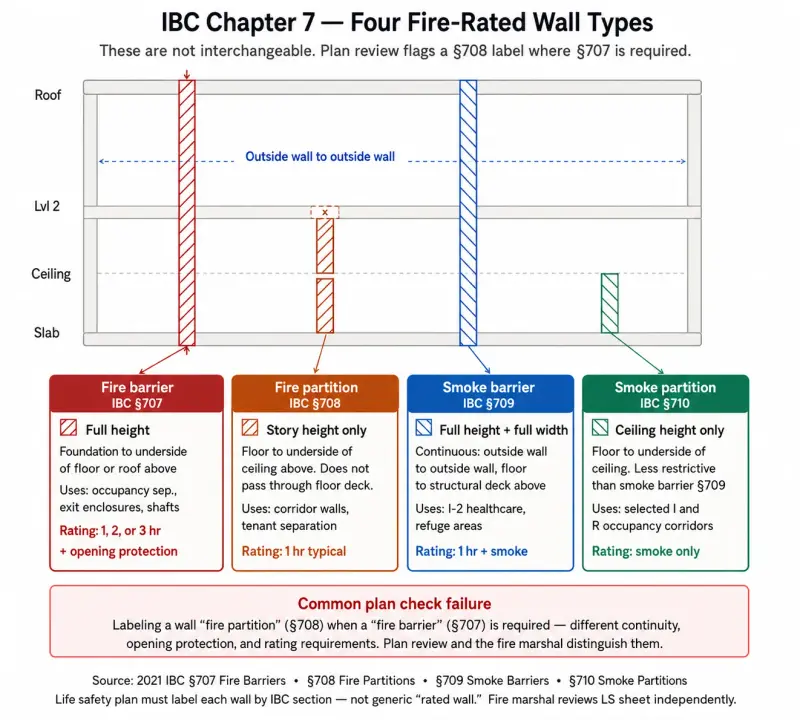
Fire-rated assemblies color-coded or hatched by rating — with the rating type called out explicitly: fire barrier per IBC Section 707, fire partition per Section 708, smoke barrier per Section 709, smoke partition per Section 710. These categories are not interchangeable, and plan review distinguishes them.
Exit signage and emergency lighting locations
Fire extinguisher locations per IFC Section 906
The life safety plan is what the fire marshal reviews. In jurisdictions with separate building and fire review, this sheet is often the only one the fire marshal opens, make it complete and self-contained.
What Does a Permit-Ready Accessibility Sheet Look Like?
Accessibility drawings fail plan review more often than any category other than the site plan, typically because clearances are shown without dimensions. The2010 ADA Standards apply as a federal civil-rights requirement; ANSI A117.1-2017 is referenced by the IBC as the technical built standard. The U.S. Access Board'sGuide to the ADA Standards: Toilet Rooms andGuide to the ADA Standards: Entrances, Doors, and Gates are the authoritative interpretive resources.
A permit-ready accessibility sheet contains:
Accessible route plan at a small scale, showing the path from the public way through the parking to the accessible entrance and through the building to every required accessible space
Toilet room enlarged plans at 1/4" = 1'-0" minimum with every clearance dimensioned: 60" turning circle or T-turn, 60" × 56" clear floor space at the water closet, grab bar geometry (33"–36" mounting height per 2010 ADA Section 609.4, where the standard explicitly states no tolerance outside the range)
Door details showing maneuvering clearance diagrams per 2010 ADA Section 404, with the table reference and the specific approach condition (front, latch side, hinge side, push/pull)
Accessible parking detail with stall and access aisle dimensions, signage height (60" min to bottom of sign), and slope limits (1:48 max in all directions)
Counter, drinking fountain, signage, and reach-range details with mounting heights dimensioned, not implied
State the cross-code resolution rule in the accessibility general notes: "Where the 2010 ADA Standards and ANSI A117.1-2017 differ, the more restrictive applies."
What Does a Permit-Ready Structural Sheet Look Like?
Architects don't draw S-series sheets, but they coordinate them. From the architect's perspective, a permit-ready structural sheet, produced and wet-stamped by the SEOR, contains:
Foundation plan with footing sizes, reinforcement, anchor bolt schedule, and holdown schedule
Framing plans at every level and roof, with member sizes, species and grade (or steel designation), spans, and connection callouts
Structural sections through critical conditions
Schedules — column, beam, holdown, shear wall, nailing
General structural notes — design loads (dead, live, snow, wind, seismic), governing code edition, ASCE 7 reference, soil bearing capacity, concrete and steel strengths
Special inspection requirements per IBC Section 1704, with the statement of special inspections referenced on the cover sheet
The architect's coordination job at permit: confirm the SEOR's code editions match the cover-sheet code analysis exactly, and confirm holdown and shear wall locations don't conflict with architectural openings. Discrepancies between the architect's cited IBC edition and the SEOR's cited IBC edition are an automatic correction.
Confirming which IBC and ASCE 7 provisions apply to a specific project, and whether a state has amended them, is where many submittals stall at the cover-sheet stage.Melt Code returns the applicable sections with citations and reasoning shown, so the code analysis block on the cover sheet can be documented to a primary source.
What Does a Permit-Ready MEP Sheet Look Like?
MEP sheets are stamped where state law requires (most states require PE stamps above defined service-size, tonnage, or fixture-count thresholds; the thresholds vary). A permit-ready MEP set shows:
Mechanical (M-series): equipment plan with tagged units; ductwork single-line or double-line; equipment schedule with model numbers, capacities, electrical characteristics; ventilation calculations per IMC Chapter 4 or ASHRAE 62.1
Electrical (E-series): power plan; lighting plan; panel schedules with load calculations per NEC Article 220; one-line diagram for services over 400 amps
Plumbing (P-series): fixture plan with all fixtures shown; supply and waste riser diagrams; fixture schedule; fixture count compared against required count perIBC Table 2902.1
Failure mode at plan review for MEP sheets is identical across disciplines: equipment shown without schedules, or schedules shown without locating equipment on the plan. Both must appear on the same sheet, cross-referenced by tag.
What Conventions Drive Plan-Review Speed Across All Sheets?
Conventions that don't appear in the IBC but consistently determine how fast a set moves through plan check:
U.S. National CAD Standard sheet numbering (A-101 for first-floor plan, A-201 for elevations, A-301 for sections, A-501 for details) is the most widely recognized format. State the convention on the cover sheet if you deviate.
Title block standard with consistent location for sheet number, sheet title, project name, date, revision date, revision number, architect's stamp, scale, and key plan across every sheet.
North arrow consistency — the plan north should point the same direction on every architectural plan sheet. If a building's plan north differs from true north by more than 15 degrees, show both.
Dimension string hierarchy — overall on the outermost string, bay-to-bay on the next, opening-to-opening on the innermost. Mixed hierarchies on a single elevation or plan are a common correction.
Fire-rated wall graphic standard — hatch or color-code by rating, with the legend on every sheet that shows rated walls, not just the cover sheet.
Revision protocol — cloud bubbles, delta tags, revision date in the title block, and a revision summary on the cover sheet. Set the standard before the first revision lands.
Plan reviewers process dozens of sets per week. A set that follows convention is read; a set that doesn't gets corrections written against it for procedural issues that aren't substantive but are inefficient.
Frequently Asked Questions
Where can I find real permit drawing samples to study?
Most AHJ websites publish approved sample permit sets for common project types — single-family residential, ADU, and simple TI. Search "[city name] sample permit drawings" or "[city name] plan check guide." The City of Los Angeles, City of San Francisco, City of Seattle, and many county building departments publish redacted approved sets specifically as references. These show real, approved documentation conventions for the local AHJ.
How many sheets are in a typical commercial permit set?
A small commercial tenant improvement (under 5,000 sf) typically runs 12 to 18 sheets across all disciplines. A mid-size commercial new construction (5,000 to 50,000 sf) runs 30 to 60 sheets. Large commercial projects routinely exceed 100 sheets. The sheet count is driven by project complexity, not sheet padding. A reviewer reading a 200-sheet set for a 4,000 sq ft TI immediately flags it as over-documented.
What is the difference between a fire barrier, a fire partition, a smoke barrier, and a smoke partition?
These are four distinct IBC Chapter 7 wall categories with different scope and continuity requirements. Fire barriers (Section 707) are continuous from the foundation to the underside of the floor or roof above. Fire partitions (Section 708) are continuous from the floor to the underside of the ceiling above. Smoke barriers (Section 709) restrict smoke movement and are continuous from outside wall to outside wall and from floor to deck. Smoke partitions (Section 710) are less restrictive than smoke barriers. Plan review distinguishes them, labeling a wall "fire partition" when the application requires a fire barrier is a failure.
Do all sheets in the set need to be stamped?
Most U.S. states require the architect's stamp on the architectural sheets (G, A, LS, AD series), the structural engineer's stamp on the S-series, and the MEP engineer's stamps on M, E, and P-series sheets where the project exceeds state-defined size or service thresholds. Energy-compliance documentation may be stamped by a separate accredited specialist, depending on jurisdiction. The cover sheet typically carries all required stamps in a stamp block, with each consultant stamping the sheets they produced. Confirm against state licensing law before submittal.
What scale should permit drawings be drawn at?
Floor plans at 1/8" = 1'-0" minimum; enlarged plans (toilet rooms, kitchens, stairs) at 1/4" = 1'-0" or larger; wall sections typically 3/4" = 1'-0"; construction details at 1-1/2" = 1'-0" or larger. Most AHJs reject sheets drawn smaller than these for illegibility. For large buildings, the standard solution is to draw the building in keyed sections at 1/8" = 1'-0" with a key plan on each sheet, not to reduce the scale to 1/16" = 1'-0".
What is the most common reason a permit set is rejected at intake?
A missing or incomplete cover sheet code analysis block, a missing structural stamp, or a deferred submittal item that appears in the consultant sheets but is not listed on the cover sheet's deferred submittal list. All three are caught at intake before the package enters substantive plan review, and all three are checklist-level catches that can be verified before the set leaves the architect's office.
Related Building Code Resources
MeltPlan
A curated stream of preconstruction intelligence, estimating innovation, takeoff breakthroughs, workflow advancements, and expert perspectives—powered by the AI and technology shaping the future of construction.
Visit SiteDon't miss what's shaping AEC
Don't miss what's shaping AEC The latest on preconstruction, codes, AEC news & trends — so you're al
.jpg?alt=media&token=8ec51d53-b490-4fd8-acb8-2c5cdd559afb)