Idaho Commercial Design: IBC Rules for Height, Area, Occupancy, & Fire-Resistance
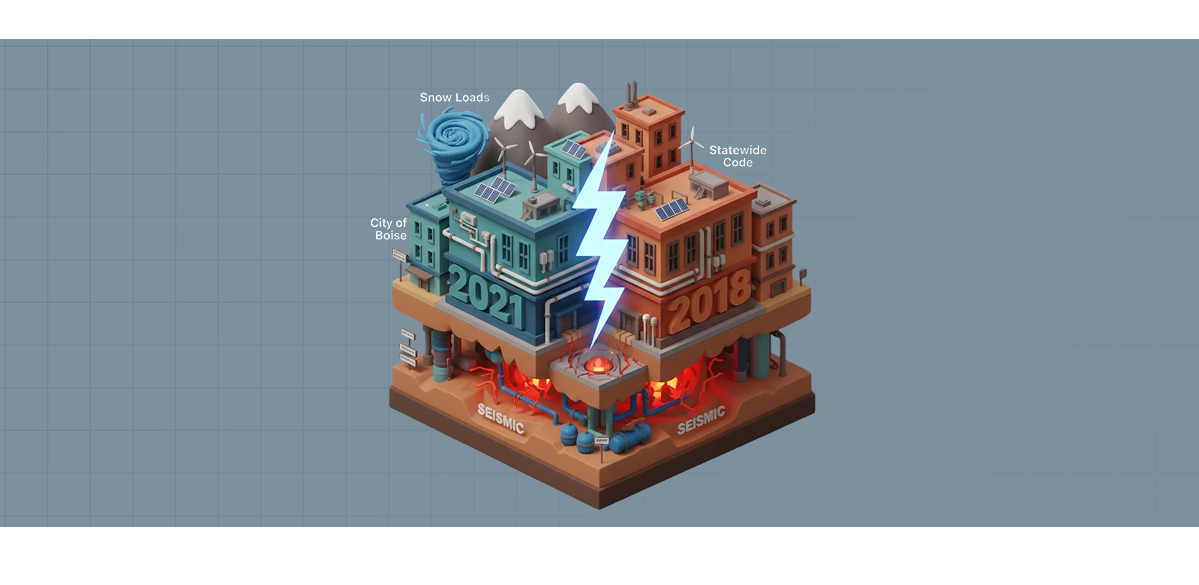
Idaho's building codes, based on the 2018 International Code Council (I-Codes) with state-specific amendments, present a detailed framework for commercial desig..
Navigating Idaho's Commercial Building Code: A Guide to Height, Area, Occupancy, and Fire-Resistance
Core Code Requirements for Commercial Design in Idaho
Idaho's building codes, based on the 2018 International Code Council (I-Codes) with state-specific amendments, present a detailed framework for commercial design. For architects, engineers, and contractors, understanding these nuances is critical for project approval.
Key takeaways for common design challenges in Idaho include:
- Podium Construction (Mixed-Use): For designs like R-2 residential over an S-2 parking garage, Idaho follows the International Building Code (IBC) provisions for podiums. This requires a 3-hour fire-resistance-rated horizontal assembly separating the occupancies. Allowable height and area increases for NFPA 13 sprinkler systems are calculated per standard IBC formulas, treating the building portions above and below the podium as separate structures for these calculations.
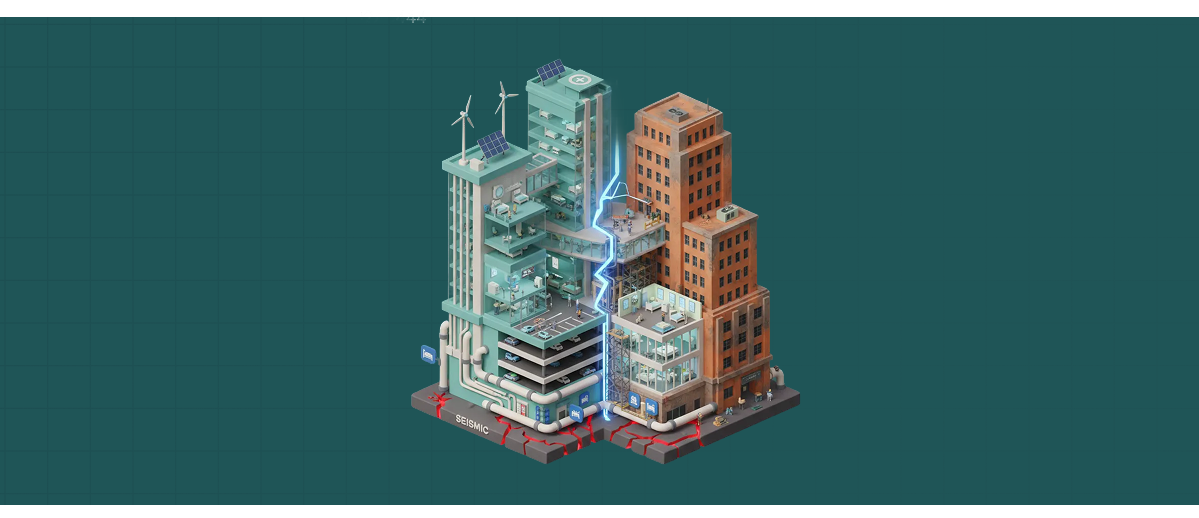
- Change of Occupancy: Converting an existing building, such as from a Group B office to a Group I-2 hospital wing, is governed by the Idaho-adopted International Existing Building Code (IEBC). This triggers a comprehensive evaluation and mandatory upgrades to meet the stricter requirements of the new occupancy. Expect significant modifications to means of egress, fire protection systems (sprinklers/alarms), structural systems (especially for seismic loads), and accessibility.
- Corridor Fire Ratings: In a typical Group B business occupancy that is fully protected by an NFPA 13 automatic sprinkler system, the Idaho Building Code does not require a fire-resistance rating for corridor walls (i.e., a 0-hour rating is permitted). However, these walls must still be constructed as smoke partitions, extending from the floor to the structure above the ceiling to prevent smoke migration.
Context + Why This Topic Matters
Successfully navigating a commercial building project in Idaho requires more than just a surface-level understanding of the International Building Code. The State of Idaho, through the Idaho Building Code Board and the Division of Building Safety (DBS), adopts and amends the model I-Codes, creating a unique regulatory landscape. Furthermore, local jurisdictions like Boise, Meridian, and Idaho Falls often enact their own amendments, adding another layer of complexity.
Understanding these specific requirements is crucial for:
- Accurate Planning: Correctly applying height, area, and occupancy separation rules during schematic design prevents costly redesigns later.
- Permitting Success: A code-compliant design streamlines the plan review process with the local Authority Having Jurisdiction (AHJ), avoiding delays and re-submittals.
- Life Safety: Fire-resistance ratings, egress path requirements, and fire protection system specifications are fundamental to occupant safety and are scrutinized by fire marshals and building officials.
- Existing Buildings: Alterations and changes of occupancy are particularly challenging. The IEBC provides the roadmap for how much of an existing structure must be upgraded to meet current standards, impacting project scope and budget significantly.
Common misunderstandings often arise from assuming the model IBC applies without modification or failing to verify local rules. A deep understanding of the interplay between the IBC, IEBC, state amendments, and local ordinances is the hallmark of a successful design professional in Idaho.
I am designing a 5-story mixed-use building in Meridian with R-2 over S-2 podium construction. How do the Idaho Building Code amendments affect the calculation of allowable height and area increases for NFPA 13 sprinkler systems, and what are the specific requirements for the horizontal assembly fire rating between occupancies?
What can you ask? (Sample questions)
- When are automatic sprinklers required by IBC?
- What fire-resistance ratings are required for party walls?
- How do IBC fire separation requirements work for mixed-use buildings?
- What are the smoke barrier requirements in Group I occupancies?
Your podium building design is governed primarily by the Idaho Building Code (2018 IBC with state amendments) and any local amendments from the City of Meridian. The State of Idaho has not significantly amended the core IBC provisions for podium construction, so the model code requirements are the primary guide. A 3-hour fire-resistance-rated horizontal assembly is required between the S-2 and R-2 occupancies, and standard IBC formulas for sprinkler-related height and area increases apply.
Deeper Explanation
Horizontal Assembly Fire Rating: The design you describe is a classic "podium" or "pedestal" building, specifically addressed in IBC 2018 §510.2. This section allows the portion of the building above the horizontal assembly to be considered a separate and distinct building for the purpose of calculating allowable area, height, and number of stories.
- Required Rating: Per IBC §510.2(1), the horizontal assembly creating the podium must have a minimum 3-hour fire-resistance rating.
- Occupancy Limitations: For this provision, the building below the horizontal assembly is limited to Group A, B, M, R, S, or U occupancies. Your S-2 open parking garage is permitted. The building above the horizontal assembly can be of any occupancy except Group H (High Hazard). Your R-2 residential use is permitted.
- Continuity: The 3-hour horizontal assembly must be continuous from exterior wall to exterior wall and provide a complete separation. Openings through it must be protected in accordance with IBC Chapter 7.
Allowable Height & Area Increases: Because the podium design allows you to treat the R-2 portion as a separate building, you calculate its allowable height and area based on its own construction type, as if it were sitting on the ground. The presence of a building-wide NFPA 13 automatic sprinkler system allows for significant increases. Idaho follows the IBC's methodology:
Height Increase (IBC §504.2): A building equipped with an NFPA 13 sprinkler system is permitted a height increase of 20 feet and one additional story above the limits specified in IBC Table 504.3.
- For example, if your R-2 portion is Type V-A construction, the base allowable height is 50 feet and 4 stories. With sprinklers, this increases to 70 feet and 5 stories.
Area Increase (IBC §506.3): The allowable area per story can be increased for the presence of a sprinkler system. The formula is:
Allowable Area = Base Tabular Area + (Base Tabular Area * Sprinkler Increase Factor)- For a multi-story building (more than one story above grade plane) with an NFPA 13 system, the sprinkler increase factor (Is) is 200% (or a multiplier of 3).
As = At * 3(whereAsis the allowable sprinklered area andAtis the tabular area from IBC Table 506.2).
Meridian-Specific Requirements: While the state amendments are minimal in this area, it is critical to verify with the City of Meridian Building Department. Local jurisdictions have the authority to adopt more restrictive amendments. Always check their published ordinances or contact a plan reviewer directly to confirm requirements for podium buildings, fire department access, and any local fire code interpretations.
For a change of occupancy from a Group B office to a Group I-2 hospital wing in an existing building in Idaho Falls, what specific provisions of the Idaho-adopted IEBC are triggered? Outline the required upgrades for means of egress, fire protection systems, structural integrity, and accessibility.
A change of occupancy from a Group B (Business) to a Group I-2 (Institutional - Hospital) is a significant undertaking that triggers extensive upgrades under the Idaho-adopted 2018 International Existing Building Code (IEBC). This change represents a move to a much higher hazard category regarding life safety and fire risk. Consequently, the IEBC mandates that the building be upgraded to meet many of the requirements for a new Group I-2 building.
Here are the key provisions and required upgrades:
Deeper Explanation
The project is classified as a "Change of Occupancy" under IEBC Chapter 4, which then directs compliance through one of the code's primary methods. The Work Area Method (IEBC Chapters 6-12) is commonly used for such substantial projects.
1. Means of Egress (IEBC §905): The egress system must be upgraded to comply with the requirements of the current IBC for a new Group I-2 occupancy. This is a non-negotiable life safety requirement.
- Corridor Width: I-2 corridors used for patient movement must have a minimum clear width of 96 inches (IBC §1020.2). This is double the typical 48-inch requirement for Group B.
- Travel Distance & Exits: Exit access travel distances and the number/location of exits must meet the stringent rules of IBC §1017 and §1006 for Group I-2.
- Door Hardware: Patient room doors must be readily openable from both sides and may require special hardware. Egress doors may need panic hardware.
- Emergency Lighting & Exit Signs: The entire means of egress, including corridors and exits, must be equipped with emergency lighting and illuminated exit signs per IBC §1008.
2. Fire Protection Systems (IEBC §903): The building must be brought into compliance with the fire protection requirements of the IBC for a new Group I-2 facility.
- Automatic Sprinkler System: A full NFPA 13 automatic sprinkler system is mandatory for all Group I-2 occupancies (IBC §903.2.6). This will almost certainly be a new system installation.
- Fire Alarm and Detection System: A comprehensive, automatic fire alarm system with voice/alarm communication capabilities is required per IBC §907.2.6. This includes manual pull stations, automatic smoke detection in patient rooms and corridors, and integration with the sprinkler system.
3. Structural Integrity (IEBC §907): This is a critical and often costly upgrade, especially in Idaho's seismic zones.
- Gravity Loads: A structural analysis is required to verify that the existing structure can support the live loads associated with a hospital, which may be higher than an office use (IBC Chapter 16).
- Lateral Loads (Seismic & Wind): The IEBC requires that when an occupancy changes to a higher Risk Category, the entire structure must be analyzed and potentially strengthened to resist the lateral loads specified in the current IBC. Group B is typically Risk Category II, while a hospital (Group I-2) is Risk Category IV (IBC Table 1604.5). This is a major upgrade and will require significant structural engineering and reinforcement to comply with current seismic design provisions of ASCE 7.
4. Accessibility (IEBC §906): All altered areas must be made fully compliant with the accessibility provisions of IBC Chapter 11 and the referenced ANSI A117.1 standard.
- Patient Areas: Patient rooms, bathing facilities, and examination rooms must meet the specific accessibility requirements for medical care facilities.
- Accessible Route: A continuous, accessible route must be provided to all accessible spaces.
- Parking and Site Arrival: Accessible parking, passenger loading zones, and site arrival points must be brought into compliance.
You must work closely with the City of Idaho Falls Building Department and the Idaho Falls Fire Department from the earliest stages of design to ensure all local interpretations and requirements are met.
According to the Idaho-adopted IBC, what is the minimum required fire-resistance rating for a corridor in a Group B occupancy with a full NFPA 13 sprinkler system, and does that rating have to extend to the floor or ceiling assembly?
In a Group B occupancy fully protected by an NFPA 13 automatic sprinkler system, the Idaho-adopted IBC (2018 IBC) requires a 0-hour fire-resistance rating for corridor walls. While the walls do not need to be fire-rated, they must be constructed as smoke partitions that extend from the top of the floor assembly to the underside of the structural deck or fire-rated ceiling above.
Deeper Explanation
Corridor Fire-Resistance Rating: The requirements for corridor fire-resistance ratings are found in IBC 2018 §1020.1 and the accompanying Table 1020.1.
- Table 1020.1 "Corridor Fire-Resistance Rating": This table explicitly lists the required rating based on occupancy group and whether an automatic sprinkler system is provided.
- For Occupancy Group B with a sprinkler system, the "Required Fire-Resistance Rating (hours)" is 0.
- Rationale: The IBC allows this reduction from a 1-hour rating (for non-sprinklered buildings) as a trade-off. The active fire suppression provided by the sprinkler system is deemed to provide an equivalent level of life safety to the passive fire resistance of rated corridor walls.
Corridor Wall Construction Requirements: Even with a 0-hour rating, the walls forming the corridor are not unregulated. IBC §1020.1 states that where a 0-hour rating is permitted, the corridor walls must still be constructed as smoke partitions in accordance with IBC §710.
- Smoke Partition Construction (IBC §710.3): Smoke partitions must form a continuous membrane that is sealed to prevent the passage of smoke.
- Vertical Extension (IBC §710.4): This is the key detail regarding your question about extending to the floor or ceiling. Smoke partitions must extend from the top of the floor assembly to one of the following:
- The underside of the floor or roof deck above.
- The underside of a ceiling that is part of a fire-resistance-rated floor/ceiling or roof/ceiling assembly.
Practical Application: In a typical commercial office building with a suspended acoustical tile (ACT) ceiling, the non-rated corridor walls must extend vertically through the ceiling space and terminate at the underside of the structural floor or roof deck above. Simply stopping the walls at the ACT ceiling grid is not compliant, as smoke could easily travel over the wall through the open plenum. Any joints and penetrations in these smoke partitions must be sealed with a firecaulking or other approved material that limits air and smoke leakage.
Common Mistakes and Misinterpretations in Idaho
- Ignoring Local Amendments: The most common error is assuming the base 2018 I-Codes apply everywhere. Cities like Boise, Meridian, and Nampa have specific amendments (e.g., Boise's energy code stretch provisions). Always start a project by reviewing the ordinances of the local jurisdiction.
- Miscalculating Sprinkler Increases: While the formulas in IBC Chapter 5 are straightforward, designers sometimes misapply them, especially in mixed-occupancy buildings that are not utilizing the podium provision. Each fire area must be calculated correctly.
- Underestimating IEBC Triggers: In renovation projects, designers often underestimate how a change in use or a significant alteration can trigger major, code-mandated upgrades to structure, accessibility, and energy systems. The IEBC's "25% / 50%" rules for structural upgrades (IEBC §907.4) are a frequent source of budget issues if not planned for.
- Incorrect Corridor Termination: As discussed above, failing to extend 0-rated corridor (smoke partition) walls to the deck above a non-rated ceiling is a common mistake caught during inspections.
Jurisdictional Variations and the AHJ
While the Idaho Division of Building Safety (DBS) sets the statewide minimum codes, the Authority Having Jurisdiction (AHJ) for plan review and inspection is almost always the local city or county building department.
- State Role: The DBS adopts the IBC, IRC, IEBC, IMC, IFC, etc., along with state-specific amendments. These form the "Idaho Building Code."
- Local Role: Municipalities like Coeur d'Alene, Pocatello, and Twin Falls enforce these codes. They have the power to adopt and enforce amendments that are more restrictive than the state code.
- Best Practice: Before starting design, contact the local building department to:
- Confirm the exact code versions and amendments in effect.
- Inquire about local interpretations, policies, or design guides.
- Schedule a pre-design or pre-submittal meeting for complex projects like a change of occupancy or a podium building.
Coordination Considerations for Design and Permitting
The code issues discussed require seamless coordination between disciplines:
- Architectural & Structural: For podium buildings, the location of columns, shear walls, and transfer slabs in the S-2 garage directly impacts the R-2 layout above. The 3-hour horizontal assembly's thickness and composition affect floor-to-floor heights.
- Architectural & MEP/FP: For an I-2 conversion, the architect must accommodate massive mechanical systems, wider egress corridors, and full sprinkler/fire alarm coverage designed by MEP and Fire Protection engineers. Accessibility requirements impact plumbing fixture locations and clearances.
- Permitting: Your permit application must clearly demonstrate compliance. Provide a "code sheet" that lists the occupancy groups, construction type, allowable vs. actual height/area calculations, sprinkler and alarm systems provided, and a summary of how IEBC requirements are being met for renovation projects. This helps the plan reviewer understand your design intent and speeds up the approval process.
Frequently Asked Questions (FAQ)
What is the current Idaho Energy Code for commercial buildings? Idaho has adopted the 2018 International Energy Conservation Code (IECC) with state amendments. Some cities, like Boise, have adopted stricter "stretch" codes that require higher performance levels.
Are special inspections required for commercial projects in Idaho? Yes. Idaho follows the requirements of IBC Chapter 17, which mandates special inspections for critical structural components like concrete, structural steel welding and bolting, masonry, and seismic force-resisting systems.
How do I find local code amendments for a city like Boise or Nampa? The best source is the city's official government website, usually under the Building Department or Planning & Development Services section. They typically publish their code adoptions and amendments as municipal ordinances.
What accessibility standard is enforced in Idaho? Idaho enforces the accessibility provisions of IBC Chapter 11, which in the 2018 edition references the ICC A117.1-2017 standard for technical requirements. The federal Americans with Disabilities Act (ADA) also applies.
What are the basic seismic design requirements in Idaho? Seismic design requirements vary significantly across the state due to differing fault lines. All designs must comply with IBC Chapter 16 and the referenced ASCE 7 standard. A geotechnical report and a structural engineer are required to determine the site-specific Seismic Design Category and design the lateral force-resisting system accordingly.
Does a simple tenant improvement (TI) project trigger a full building code upgrade? Not usually. The IEBC uses a "Work Area" method. For a simple TI within an existing tenant space (Level 1 or 2 Alteration), upgrades are typically limited to the scope of work itself. A major renovation or change of occupancy (Level 3 Alteration) triggers more extensive upgrades.
Are fire sprinklers required in all new commercial buildings in Idaho? No, not all. Sprinkler requirements in IBC Chapter 9 are based on a combination of the building's Occupancy Group, the size of its "fire area," and other specific conditions. However, most large or high-occupancy commercial buildings will require them.
What is the frost depth requirement for foundations in Idaho? Frost depth varies by location, from 24 inches in warmer areas like the Treasure Valley to 48 inches or more in colder, high-altitude regions. The local building department maintains the official frost depth map for its jurisdiction.
More Idaho Building Code Guides
- MEP CodesIdaho MEP Codes: Electrical Panel Clearance, Plumbing Vents, and GFCI/AFCI Rules
- Wildfire / WUI CodesIdaho Fire Code Explained: WUI, Sprinklers, Alarms, and High-Piled Storage
- Building CodesIdaho Building Rules for ADUs, Tiny Homes, and Agricultural Buildings (Pole Barns)
- Permits & AmendmentsIdaho Building Codes: Finding Jurisdiction, Permits, and Current 2024 Code
- Energy Code (IECC)Idaho Energy Code Compliance: R-Values, Blower Door Tests, and Performance Paths
MeltPlan
A curated stream of preconstruction intelligence, estimating innovation, takeoff breakthroughs, workflow advancements, and expert perspectives—powered by the AI and technology shaping the future of construction.
Visit SiteDon't miss what's shaping AEC
The latest on preconstruction, codes, AEC news & trends — so you're always in the know.