Idaho Energy Code Compliance: R-Values, Blower Door Tests, and Performance Paths
The State of Idaho enforces energy efficiency standards to ensure buildings are constructed to be comfortable, durable, and cost-effective to operate. However, ..
Navigating the Idaho Energy Code: A Guide for Residential & Commercial Projects
The State of Idaho enforces energy efficiency standards to ensure buildings are constructed to be comfortable, durable, and cost-effective to operate. However, with a statewide code and the ability for local jurisdictions like Boise to adopt more recent versions, designers, builders, and inspectors must pay close attention to the specific requirements for their project's location.
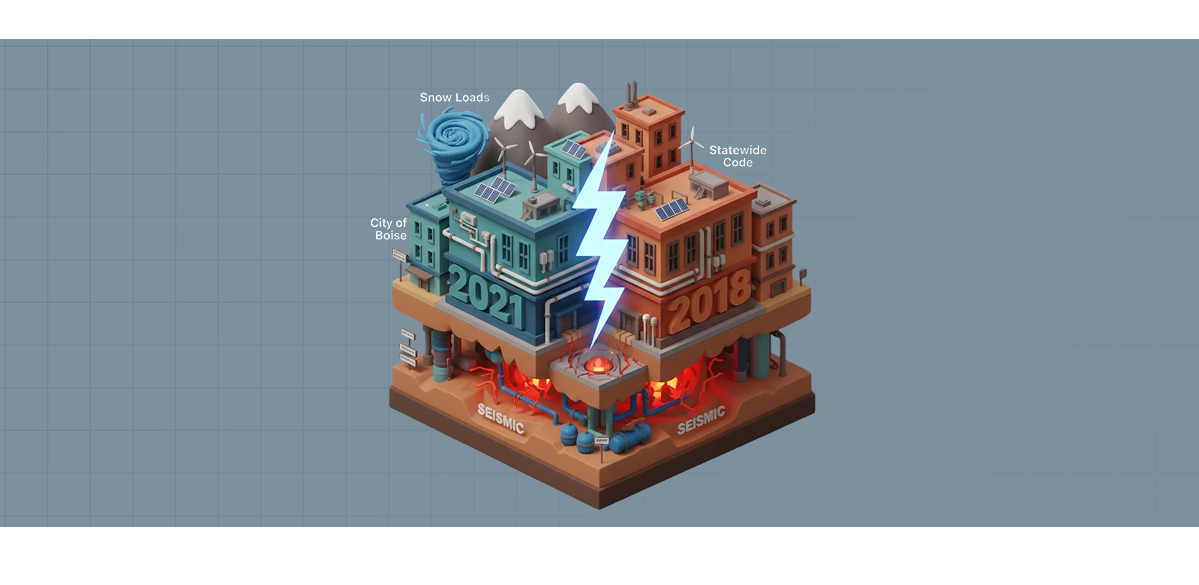
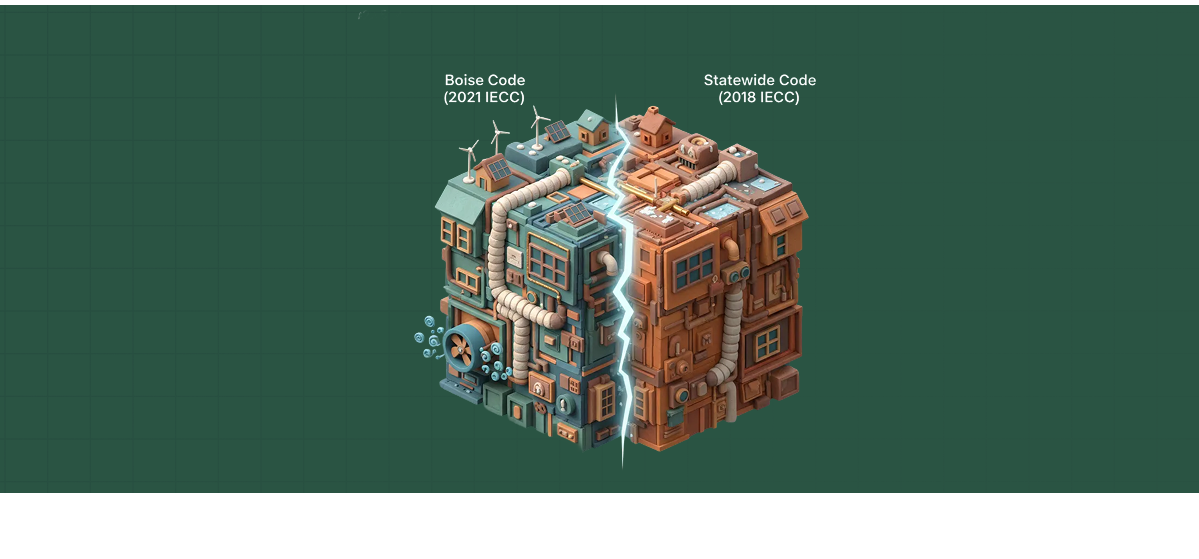
Idaho has adopted the 2018 International Energy Conservation Code (IECC) as the statewide standard. This governs most new construction, additions, and major renovations. A critical exception is the City of Boise, which has adopted the more stringent 2021 IECC. This guide provides clarity on key compliance topics under both sets of regulations.
Key takeaways for Idaho energy code compliance include:
- Dual Codes: Always verify if your project falls under the statewide 2018 IECC or a local adoption, such as Boise's 2021 IECC. Requirements for insulation, air leakage, and system efficiency can vary significantly.
- Performance Path Documentation: For commercial projects using the performance path (IECC Section C407), detailed energy modeling documentation is mandatory. This includes reports from approved software showing the proposed design's annual energy cost is less than or equal to a baseline building built to the code's prescriptive standards.
- Blower Door Testing: For new residential dwellings, a blower door test is required to verify air tightness. The maximum leakage rate under the 2018 IECC is 3.0 Air Changes per Hour at 50 Pascals (ACH50) in Climate Zones 3-8. This requirement generally applies to new dwelling units, not additions to existing homes.
- Insulation Requirements: Insulation R-values are climate zone-dependent. For an attic in Boise (Climate Zone 5B), the requirement is R-60 under the city's 2021 IECC, which is higher than the statewide 2018 IECC requirement of R-49 for the same climate zone.
Why Energy Code Compliance Matters
Navigating energy code requirements is a fundamental aspect of modern building design and construction. These codes directly impact architectural detailing, mechanical and electrical system specification, and overall project costs. Proper implementation is not just about passing a plan review or inspection; it's about delivering a high-performing building that meets modern standards for efficiency and occupant comfort.
- Project Workflow: Energy code compliance begins in schematic design with decisions about building orientation, massing, and window-to-wall ratios. It heavily influences construction documents, requiring detailed specifications for insulation, air barriers, window performance (U-factor and SHGC), HVAC equipment efficiency, and lighting controls.
- Interdisciplinary Coordination: Compliance is a team effort. Architects define the thermal envelope, mechanical engineers design efficient HVAC systems and ductwork, electrical engineers specify lighting and controls, and contractors are responsible for correct installation and air sealing.
- Common Pitfalls: A frequent misstep is assuming the state code applies uniformly. The difference between the 2018 IECC (statewide) and the 2021 IECC (Boise) can lead to failed inspections if not addressed. Another common issue is incomplete documentation for performance-based compliance paths, causing delays during permitting.
Understanding these nuances is essential for avoiding costly redesigns, change orders, and permit delays in Idaho.
What are the precise documentation requirements to demonstrate compliance with the Idaho Energy Code's performance path (Section C407) for a large commercial project, including software modeling inputs, baseline comparisons, and trade-off calculations for building envelope and mechanical system efficiencies?
To demonstrate compliance using the Total Building Performance Path (Section C407 of the 2018 or 2021 IECC), you must provide a comprehensive report from an approved energy simulation software (like eQUEST, EnergyPlus, or Trane TRACE). This report must prove that the calculated annual energy cost of the proposed design is less than or equal to the annual energy cost of a "standard reference design" or baseline building.
The compliance documentation, as outlined in IECC 2018 Section C407.5.1, must include the following:
- Project and Report Information: Project title, location, and the date of the report.
- Compliance Statement: A clear statement indicating the project complies with IECC Section C407.
- Building Characteristics: A detailed comparison of the building characteristics for both the proposed design and the baseline building. 4t. Annual Energy Cost Summary: A breakdown of the annual energy cost for both designs, categorized by energy end-use (e.g., heating, cooling, fans, lighting, receptacles, service water heating).
- Input and Output Reports: A list of the key input data for the simulation and the detailed output reports from the software.
Detailed Breakdown of Documentation Requirements:
- Software Modeling Inputs: The report must clearly list the inputs used to model the proposed design. This includes:
- Building Envelope: Opaque wall, floor, and roof assembly U-factors; fenestration (window/door) U-factors, Solar Heat Gain Coefficients (SHGC), and Visible Transmittance (VT); details on air barrier continuity and testing values.
- Lighting Systems: Interior and exterior Lighting Power Densities (LPDs), luminaire specifications, and details on all lighting controls (e.g., occupancy sensors, daylight harvesting).
- Mechanical Systems: Type and efficiency of all HVAC equipment (EER, SEER, COP, AFUE); ventilation and exhaust rates; economizer details; duct insulation and sealing levels.
- Service Water Heating: Equipment type, efficiency ratings, and controls.
- Baseline Building Comparison: The "standard reference design" is a crucial concept. It is a hypothetical version of your building with the exact same size, shape, orientation, and climate data but designed to meet the minimum prescriptive requirements of the IECC (found in Section C405). The compliance software automatically generates this baseline for comparison. Your documentation must show this side-by-side comparison.
- Trade-Off Calculations: The performance path's main advantage is allowing trade-offs. Your report implicitly shows these trade-offs. For example:
- If your design uses more glass than the 30% wall area limit in the prescriptive path, you might compensate by specifying a high-efficiency geothermal HVAC system.
- The software calculates the energy penalty from the extra glass and the energy credit from the superior HVAC system.
- The final report demonstrates that despite the less-efficient envelope component, the overall annual energy cost is lower than the baseline, proving compliance.
The plan reviewer or building official must be able to follow the logic and verify that the proposed design's performance is accurately modeled and correctly compared against the code-defined baseline.
Does the Idaho Energy Code require a blower door test for a substantial residential addition, or does it only apply to new construction? What is the maximum air leakage rate (ACH50) allowed in Climate Zone 6?
What can you ask? (Sample questions)
- Where do I find the applicable energy code for my jurisdiction?
- What IMC requirements apply to commercial HVAC systems?
- How do IPC plumbing fixture count requirements work?
- What NEC electrical code provisions apply to my building type?
A blower door test is required for new dwelling units, but it is generally not required for additions to existing homes, regardless of their size. The language in the code focuses on the creation of a new, complete thermal envelope for a residence.
According to IECC 2018 Section R402.4.1.2 (Testing), "The building or dwelling unit shall be tested and verified as having an air leakage rate not exceeding…" This section and its application are interpreted to apply to the construction of a whole new home or a new, separate dwelling unit (like an ADU). While an addition must meet all other relevant energy code provisions for insulation, windows, and air sealing practices (IECC 2018 Section R503.2), the final verification test of the entire structure is not typically triggered.
However, it is a best practice to ensure robust air sealing between the addition and the existing home to maintain the performance of both parts of the structure. Always confirm this interpretation with the local building official, as they have the final authority.
The maximum air leakage rate allowed in Climate Zone 6 is 3 air changes per hour at 50 Pascals (3 ACH50). This requirement is specified in IECC 2018 Table R402.4.1.2 and applies to all climate zones from 3 through 8. This is a more stringent requirement than in older codes, which allowed 5 ACH50.
What is the minimum insulation R-value for an attic in Boise?
The minimum insulation R-value for an attic in Boise is R-60. This is because the City of Boise has adopted the 2021 IECC, which has stricter insulation requirements than the statewide code.
Boise is located in Climate Zone 5B. According to the 2021 IECC Table R402.1.3 (Insulation and Fenestration Requirements by Component), the prescriptive requirement for ceilings in Climate Zone 5 is R-60.
For projects located outside of Boise's city limits but still in Climate Zone 5 (e.g., in unincorporated Ada or Canyon County), the statewide 2018 IECC would apply. Under that code, Table R402.1.2 requires a minimum attic R-value of R-49.
| Jurisdiction | Applicable Code | Climate Zone | Minimum Attic R-Value | Code Reference |
|---|---|---|---|---|
| City of Boise | 2021 IECC | 5B | R-60 | 2021 IECC, Table R402.1.3 |
| State of Idaho (outside Boise) | 2018 IECC | 5B | R-49 | 2018 IECC, Table R402.1.2 |
This difference highlights the critical importance of verifying the locally adopted code at the start of any project.
Is Boise on a different energy code than the rest of Idaho?
Yes, the City of Boise is on a different and more recent energy code than the rest of Idaho. This is a crucial distinction for anyone designing or building in the Treasure Valley.
- State of Idaho: The Idaho Building Code Board, through the Division of Building Safety (DBS), has adopted the 2018 International Energy Conservation Code (IECC) with state-specific amendments. This code applies to all areas of the state unless a local jurisdiction has legally adopted a different version.
- City of Boise: The City of Boise uses its authority as a local jurisdiction to adopt more current building codes. It has adopted the 2021 International Energy Conservation Code (IECC), along with other 2021 I-Codes. This is codified in Boise City Code Title 9, Chapter 1.
This means a commercial or residential project located inside the city limits of Boise must comply with the more stringent requirements of the 2021 IECC, while a nearly identical project just a few miles away in Meridian, Nampa, or unincorporated Ada County would fall under the 2018 IECC. These differences impact requirements for insulation, window performance, lighting controls, and available compliance paths.
Jurisdictional Variations and Why They Matter
The split between the state-adopted 2018 IECC and Boise's 2021 IECC is the most prominent example of jurisdictional variation in Idaho, but it's not the only one. While most smaller cities and counties default to the state code, larger municipalities may have their own amendments or interpretations.
Best Practice: Before beginning design, always contact the local building department for the city or county where the project is located. Ask for:
- The currently adopted version of the IECC.
- A copy of any local amendments to the code.
- Specific submittal requirements (e.g., mandatory REScheck/COMcheck reports, preferred energy modeling software).
This simple step can prevent significant redesigns and permitting delays. For example, jurisdictions in Idaho's colder mountain regions (Climate Zones 6 and 7) may have specific guidance or enforcement priorities related to snow loads and thermal bridging that go beyond the base code.
Coordinating for Energy Code Compliance
Achieving compliance is an integrated process that requires close coordination between all design and construction disciplines.
- Architect: Establishes the building's form, orientation, and thermal envelope. Responsible for specifying insulation R-values, window/door U-factors and SHGC, and detailing the continuous air barrier.
- Mechanical Engineer: Designs the HVAC system to meet or exceed the efficiency requirements of IECC Sections R403 or C403. This includes sizing equipment correctly, designing an efficient duct system located within the conditioned space where possible, and specifying duct sealing and insulation.
- Electrical Engineer: Ensures all lighting meets the Lighting Power Density (LPD) limits in IECC Section C405.4. They are also responsible for designing and specifying required lighting controls, such as occupancy sensors and daylight responsive controls.
- Contractor/Builder: Responsible for the correct installation of all components. This is especially critical for the air barrier and insulation. Poor installation can negate the performance of high-quality materials, leading to failed inspections (e.g., a failed blower door test).
Regular coordination meetings and a thorough review of construction documents are essential to ensure all components work together to create a compliant, high-performance building.
Common Compliance Mistakes and Pitfalls
- Assuming the State Code Applies: As noted with Boise, designing to the 2018 IECC for a project within city limits will result in a non-compliant plan.
- Incomplete COMcheck/REScheck Reports: Many jurisdictions require these U.S. Department of Energy software reports for prescriptive compliance. Failing to fill them out completely and accurately is a common reason for plan rejection.
- Ignoring the "Mandatory" Sections: The IECC has mandatory provisions that apply regardless of the chosen compliance path (prescriptive, performance, etc.). These include rules for air sealing, lighting controls, and HVAC system controls (IECC C402.5, C405.2, C403.7). You cannot "trade-off" these requirements.
- Poor Air Sealing Details: The final blower door test result is a direct reflection of construction quality. Common leakage points include transitions between materials, unsealed penetrations for wiring and plumbing, and poorly installed windows and doors. These details must be clearly drawn and specified.
Idaho Energy Code FAQ
1. What is the current statewide energy code in Idaho? The State of Idaho has adopted the 2018 International Energy Conservation Code (IECC) with state amendments administered by the Idaho Division of Building Safety (DBS).
2. Is a REScheck or COMcheck report required for a building permit in Idaho? Most Idaho jurisdictions require a REScheck (for residential) or COMcheck (for commercial) compliance report to be submitted with the permit documents when using the prescriptive path. It provides a straightforward summary of compliance for plan reviewers.
3. What are Idaho's climate zones for the energy code? Idaho is divided into three primary climate zones: Zone 5 (including the Treasure Valley), Zone 6 (central and southeastern mountains), and Zone 7 (highest elevation areas like Stanley). Your project's specific zone dictates insulation and fenestration requirements.
4. What is the minimum window U-factor in Idaho? Under the statewide 2018 IECC, the prescriptive maximum U-factor for fenestration is 0.30 in Climate Zones 5 and 6. In Boise (2021 IECC), the requirement is also U-0.30 for Climate Zone 5.
5. Does the Idaho energy code apply to remodels or just new construction? The energy code applies to alterations and renovations. Per IECC Section R503.2, any altered components (like new windows or a new roof) must meet the current code. The alterations cannot result in the building being less energy-efficient than it was before the project.
6. Are programmable thermostats required for homes in Idaho? Yes. IECC 2018 Section R403.1.1 requires a programmable thermostat for the primary heating and cooling system in a new dwelling.
7. What are the duct testing requirements? For residential projects, IECC 2018 Section R403.3.3 requires duct systems to be tested for air leakage when any part of the system is located outside of the conditioned space (e.g., in an unconditioned attic or crawlspace).
8. Can I install recessed can lights in an insulated ceiling? Yes, but they must be "insulation contact" (IC) rated and must be sealed to the ceiling drywall to form an air barrier. This is a mandatory requirement under IECC Table R402.4.1.1.
9. Do log homes have special energy code requirements? Yes. The IECC contains specific provisions for log walls. Section R402.6 of the 2018 IECC provides compliance requirements for the thermal mass of log walls as an alternative to the standard prescriptive R-values.
10. Where can I find the official Idaho building codes and amendments? The official Idaho-adopted codes and state amendments are published by the Idaho Division of Building Safety (DBS) and are available on their website. For local codes, you must consult the city or county building department directly.
More Idaho Building Code Guides
- MEP CodesIdaho MEP Codes: Electrical Panel Clearance, Plumbing Vents, and GFCI/AFCI Rules
- Wildfire / WUI CodesIdaho Fire Code Explained: WUI, Sprinklers, Alarms, and High-Piled Storage
- Building CodesIdaho Building Rules for ADUs, Tiny Homes, and Agricultural Buildings (Pole Barns)
- Commercial Code (IBC)Idaho Commercial Design: IBC Rules for Height, Area, Occupancy, & Fire-Resistance
- Permits & AmendmentsIdaho Building Codes: Finding Jurisdiction, Permits, and Current 2024 Code
MeltPlan
A curated stream of preconstruction intelligence, estimating innovation, takeoff breakthroughs, workflow advancements, and expert perspectives—powered by the AI and technology shaping the future of construction.
Visit SiteDon't miss what's shaping AEC
The latest on preconstruction, codes, AEC news & trends — so you're always in the know.