Permit Drawings: What Happens After You Hit Submit
The work an architect puts into a permit drawing set ends at the submittal portal. The work an architect does with the permit drawing set is just beginning. Pla..
Contents
The work an architect puts into a permit drawing set ends at the submittal portal. The work an architect does with the permit drawing set is just beginning. Plan review intake, correction notices, revision packages, deferred submittals, change-of-record amendments, and the final stamped-approved set that becomes the contractor's reference drawing; all of this happens after the architect has produced what they consider a finished drawing. And all of it produces its own documentation work, much of which gets attributed back to the architect of record.
This article walks through the plan review lifecycle from the moment a permit drawing set leaves the architect's office to the moment the contractor breaks ground with a stamped, approved set in hand. It covers what plan review actually does with the drawings, how correction notices work, the difference between a revision and an amendment, and when deferred submittals get reviewed. The audience is the architect of record handling a real project, not the architect drawing their first permit set.
What Does Plan Review Actually Do With a Permit Drawing Set?
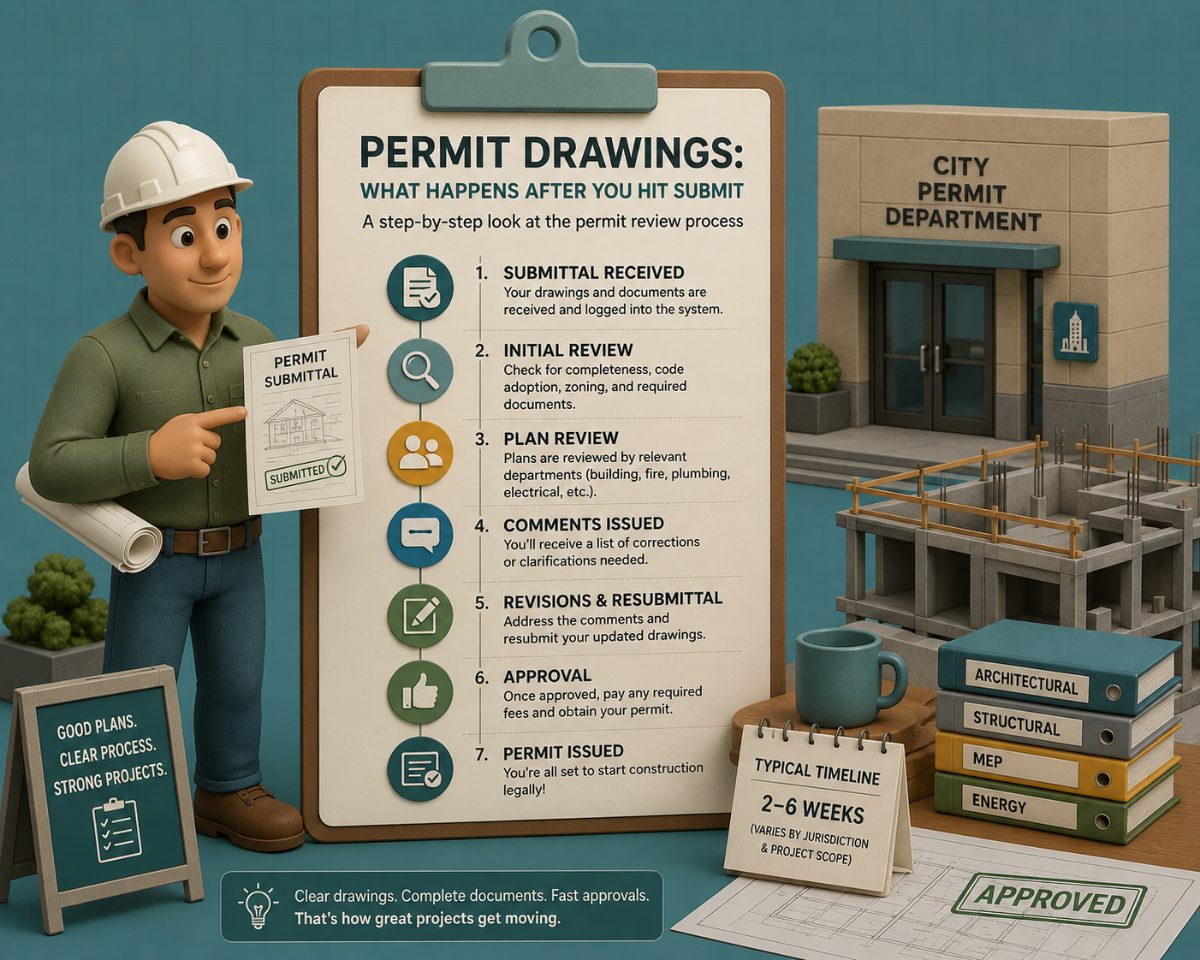
Plan review is not one process; it is three sequential processes that happen at different desks in the building department:
Intake review. The first desk the package hits. Intake verifies that the submittal is administratively complete: cover sheet present, sheet index matches the package contents, required stamps present (architect, structural engineer, MEP where applicable), permit application data matches the cover sheet, deferred submittal list present, and fees paid. Intake does not review the drawings for code compliance; it verifies the package is ready for review. Most first-submittal rejections happen here, before the package enters substantive review at all.
Substantive plan review. Once intake passes, the package routes to the actual plan reviewers, typically split by discipline (building, structural, MEP, fire/life-safety). Each reviewer works through the package against their domain of the code, marking corrections directly on the drawings or in a separate correction notice. Substantive review is where the code-analysis work the architect did on the cover sheet gets verified, where dimensional accessibility clearances get checked, and where the egress diagram on the life-safety plan gets walked.
Approval and permit issuance. When all corrections are resolved and all reviewers sign off, the building official issues the permit and stamps the construction documents as approved perIBC Section 107.3.1. One set of approved documents is retained by the building department; one is returned to the applicant. The stamped, approved set is what the contractor will work from in the field. From this point forward, the drawings are governed by IBC Section 107.4 — any changes require formal amendment.
Plan review timelines vary widely by jurisdiction. Small jurisdictions may turn around a residential permit in two to four weeks. Large jurisdictions with high volume can take eight to twelve weeks for a commercial review, longer for complex projects. Expedited review programs exist in most major U.S. jurisdictions for additional fees.
What Is a Correction Notice and How Should the Architect Respond?
A correction notice is the formal output of the substantive plan review process, a list of items the AHJ has identified as non-compliant or insufficiently documented in the submitted permit set. The correction notice is not a rejection. It is a list of conditions the reviewer needs to address before approval can be issued.
Most jurisdictions issue correction notices in one of three formats:
Marked-up PDF set: The reviewer's annotations appear directly on the drawing sheets, with text comments referencing IBC sections or specific issues.
Separate correction letter: A document listing each correction by number, sheet reference, and code citation, separate from the drawings.
Online correction tracking: Modern AHJs (Los Angeles, San Francisco, Seattle, many large counties) issue corrections through their permit-management portal, often with structured fields for sheet, code section, comment text, and architect response.
The architect's response to each correction has three valid forms:
Revise the drawings to match the correction. Cloud the revised area, add a delta tag with the revision number, update the revision date in the title block, and add a revision note on the cover sheet.
Provide a code-based justification that the existing drawing already complies. The reviewer is asserting non-compliance; the architect can rebut with the specific code section that supports the drawing as drawn. This is where Melt Code-style research workflows compress the most time — finding the section, the exception, or the table cell that justifies the existing condition.
Request reviewer clarification if the correction is ambiguous. Some corrections are written in shorthand ("Verify egress.") that require a phone call or email to the specific reviewer to understand what they're asking for. This is acceptable; the reviewer would rather clarify than re-review a misunderstood correction.
Many correction responses come down to one question: what does this specific code section actually require, and is my drawing already compliant?Melt Code returns the applicable sections with citations and step-by-step reasoning shown, so the architect can document the compliance basis for a justified-without-change correction response in minutes rather than hours.
Most jurisdictions allow two to three correction cycles included in the original permit fee. Subsequent cycles typically carry a re-review fee per cycle. The clock on the original review pauses each time a correction is issued and resumes when the response is submitted — meaning a permit set with three rounds of corrections can easily double the original review timeline.
What Is the Difference Between a Revision and an Amendment?
What can you ask? (Sample questions)
- How do local code amendments modify the base IBC requirements?
- What triggers the need for a building permit?
- What plan review documents are typically required?
- How do jurisdictional amendments affect fire and structural codes?
The terms are commonly used interchangeably but have different legal meanings under IBC Section 107.
Revision: A change to the permit drawing set made during plan review, before the permit is issued. Revisions are part of the normal correction-response workflow. They do not require a separate application or fee; they are submitted as updated drawings within the open review.
Amendment: Change to the construction documents made after the permit is issued, governed byIBC Section 107.4. Per the code: "Work shall be installed in accordance with the approved construction documents, and any changes made during construction that are not in compliance with the approved construction documents shall be resubmitted for approval as an amended set of construction documents." Amendments require:
A separate amendment submittal (most AHJs use a different application form)
An amendment fee, typically based on the scope of change
Re-review of the changed sheets, and any sheets affected by the change, through the same plan-review process that the original set went through
The changed work cannot be installed until the amended documents are approved
The practical distinction is timing relative to permit issuance, but the consequences are different. Revisions cost time. Amendments cost time, fees, and potentially construction schedule (if the contractor is waiting on amendment approval to proceed with the changed scope).
The most common cause of amendments: scope changes from the owner or the contractor's value engineering process after the permit has been issued. The architect's exposure here is real; if an amendment is needed because the original drawings missed something, the architect typically eats the documentation cost. If an amendment is needed because the owner changed the scope, that should be a billable additional service. Document the trigger.
How Do Deferred Submittals Get Reviewed After Permit Issuance?
Deferred submittals are the parts of the permit set that the architect declared on the cover sheet at initial submittal per IBC Section 107.3.4.1 — typically pre-engineered wood trusses, cold-formed metal stairs, fire sprinklers, fire alarm, storefront systems, and photovoltaic systems. These items are not reviewed at the time of original permit issuance. They are submitted separately, after the permit, and reviewed independently.
The deferred submittal process under IBC Section 107.3.4.1 follows a defined sequence:
The specialty engineer or supplier produces the deferred submittal package — stamped, sealed, and complete to the standard of an independent permit submittal for that system.
The architect of record reviews the deferred submittal for general conformance with the design intent of the building. This is a code-required review, not a courtesy. The architect's review confirms that the deferred package coordinates with the architectural set.
The architect submits the reviewed deferred package to the AHJ with the architect's review documentation attached.
The AHJ reviews the deferred submittal as a discrete review, with its own correction cycle if needed.
The deferred submittal is approved, and only then can the work it covers proceed in the field.
The most common failure mode in this process: a deferred submittal item is not declared on the original cover sheet, and the project tries to add it later. Per Section 107.3.4.1, items not declared at initial submittal cannot be deferred — they require a formal amendment to the original permit. This is the reason the "Permit Drawing Samples" article's cover sheet recommendation is to over-declare deferred items at initial submittal; the penalty for declaring an item that ultimately doesn't get deferred is zero, while the penalty for under-declaring can mean a stop-work order on the specific scope.
What Are the Architect of Record's Continuing Stamping Obligations?
The architect's stamp on the original permit set is the most visible stamping moment, but it is not the only one. Continuing obligations through the project lifecycle:
Each revision package submitted during plan review must carry the architect's stamp on the revised sheets, with the revision date in the title block matching the revision package date.
Each amendment package submitted after permit issuance must carry the architect's stamp on the amended sheets, with the amendment number, amendment date, and a revision summary on the cover sheet.
Each deferred submittal package, when reviewed and forwarded to the AHJ by the architect, must include the architect's documentation of the review, typically a transmittal letter, but some jurisdictions require a stamped review sheet.
Special inspections required per IBC Section 1704 are coordinated by the architect through the Statement of Special Inspections referenced on the cover sheet. The architect does not perform the inspections, but the architect maintains the statement and confirms that the project's special inspector is documented.
Most state architectural practice acts make these continuing obligations a condition of the architect's responsible charge under IBC Section 107.3.4. An architect who stamps an original permit set and then disengages from the project before the deferred submittals and amendments are complete may have a practice-act exposure that is separate from any contractual liability.
How Long Should Plan Review Take?
There is no universal answer, but a useful rule of thumb based on jurisdiction type:
Small municipal AHJs (population under 50,000): 2–4 weeks for a residential permit, 4–8 weeks for a small commercial permit. Often, a single reviewer handles all disciplines.
Mid-size municipal AHJs: 4–6 weeks residential, 6–10 weeks commercial. Reviews may be split between building and fire departments.
Large municipal AHJs (Los Angeles, NYC, San Francisco, Seattle, Chicago, Houston, etc.): 6–12 weeks for standard review on a commercial project; 4–6 weeks for residential; expedited review programs offered at 2–4 weeks for additional fees.
State-level review (where applicable): typically slower — 8–16 weeks for projects requiring state-level licensure board, accessibility commission, or environmental review.
These timelines assume a first-submittal package with minimal corrections. Each correction cycle typically adds two to four weeks to the total elapsed time, because the review clock pauses during the architect's response period and the re-review enters the reviewer's queue rather than jumping the line.
The architect's leverage on the review timeline is concentrated in the first submittal. A package that clears intake on the first attempt and generates a single correction cycle clears review in roughly the standard timeline. A package that fails intake (incomplete cover sheet, missing structural stamp, undeclared deferred submittal) loses one to two weeks at the front end. A package that generates three or four correction cycles in substantive review can take three to four times the standard timeline.
This is why the pre-submittal work, verifying every cover sheet block, every code citation, every accessibility clearance, every deferred submittal declaration, has an outsized impact on the project's overall permit timeline.
When Does the Architect's Responsibility End?
The legal answer varies by state, but a useful practical framework:
The architect's responsibility for the permit drawing set itself continues through permit issuance, all revisions, all amendments, and all deferred submittal reviews.
The architect's responsibility for construction observation, including field visits to confirm that work is being installed in accordance with the approved documents, is a separate contractual scope. Most projects include some level of construction observation; the depth varies.
The architect's responsibility for the certificate of occupancy is procedural: the architect typically signs off that the work was completed in substantial conformance with the approved documents, after which the AHJ inspector verifies and issues the CO.
The architect's record-keeping responsibility continues beyond project completion. Most state practice acts require the architect to retain stamped permit drawings for a defined period (often seven to ten years) for potential professional liability review.
The shortest answer: the architect's responsibility for the permit drawing set ends when the building is built, and the CO is issued, and continues, in record-keeping form, for years after.
FREQUENTLY ASKED QUESTIONS
How long does plan review take for a typical commercial permit?
Six to twelve weeks at most large municipal AHJs for a standard first review, with expedited programs available at an additional fee for a two- to four-week turnaround. Each correction cycle adds roughly two to four weeks of elapsed time. Small jurisdictions may run faster, three to six weeks, but with less specialized review and a higher likelihood of broad rather than deep corrections.
What is a correction notice on permit drawings?
A correction notice is the AHJ's formal output of the substantive plan review process, a list of items the reviewer has identified as non-compliant or insufficiently documented. The notice is not a rejection; it is a list of conditions to address before approval. Most jurisdictions allow two to three correction cycles included in the original permit fee, with re-review fees applying to subsequent cycles.
What's the difference between a revision and an amendment under the IBC?
A revision is a change to the permit set during plan review, before permit issuance; it does not require a separate application or fee. An amendment is a change after permit issuance, governed by IBC Section 107.4. Amendments require a separate submittal, a fee, and re-review by the AHJ before the changed work can be installed. The legal distinction is the timing relative to permit issuance; the practical distinction is that amendments cost both time and money, whereas revisions only cost time.
Can I add a deferred submittal item to a project after the permit has been issued?
Generally, no, at least not through the deferred submittal process. Under IBC Section 107.3.4.1, deferred items must be declared on the cover sheet at initial submittal. Adding a new item later requires a formal amendment to the original permit, which is treated as a substantive change and reviewed accordingly. This is why pre-submittal best practice is to over-declare deferred items rather than risk having to amend later.
Who signs off on deferred submittal packages?
Three parties in sequence. First, the specialty engineer or supplier produces a stamped and sealed deferred submittal package. Second, the architect of record reviews the package for general conformance with the design intent of the building; this review is required by IBC Section 107.3.4.1, not optional. Third, the architect submits the reviewed package to the AHJ with the architect's review documentation, and the AHJ reviews and approves it as a discrete submittal before the covered work can proceed.
What happens if the contractor builds something that doesn't match the approved drawings?
IBC Section 107.4 explicitly addresses this: "any changes made during construction that are not in compliance with the approved construction documents shall be resubmitted for approval as an amended set of construction documents." The work has to be documented as an amendment, reviewed by the AHJ, and approved before it can be considered compliant. In practice, this often happens reactively: an inspector finds an as-built condition that doesn't match the drawings, and the contractor and architect must produce an amendment to document the field change. The architect's contractual exposure here depends on whether the change was directed by the owner, requested by the contractor, or resulted from an error in the original drawings.
Does the architect have to do anything after the permit is issued?
Yes, and this is the most commonly underestimated part of the architect's lifecycle obligations. Continuing responsibilities include reviewing deferred submittals before AHJ submission, stamping amendment packages if scope changes during construction, coordinating special inspections referenced on the original Statement of Special Inspections, and signing off on substantial conformance prior to Certificate of Occupancy. Most state practice acts treat these as conditions of the architect's responsible-charge designation, not as optional courtesies.
Primary Sources
The code citations in this article reference the following authoritative sources. Where a reader needs to verify a specific requirement against the original, these are the references AHJs and code consultants work from.
2021 International Building Code (IBC) — Part 1 — International Code Council, ICC Digital Codes. Includes Chapter 1 (Scope and Administration), which contains Sections 107.2 (Construction Documents), 107.3 (Examination), 107.3.1 (Approval), 107.3.4 (Registered Design Professional), 107.3.4.1 (Deferred Submittals), and 107.4 (Amended Construction Documents).
2021 International Building Code (IBC) — Part 2 — International Code Council, ICC Digital Codes. Both parts are required for full code coverage.
ICC Digital Codes — Section 107 Construction Documents (direct link) — section-level anchor for the full Section 107 text.
State amendments to IBC Chapter 1 are common; many jurisdictions modify intake requirements, fee structures, and review timelines. Always verify the project's adopting jurisdiction's amendments alongside the model code.
Related Reading
North Dakota Energy & MEP Codes: A Compliance Guide for IECC, NEC, IMC & IPC
What Are the Major Changes in the 2025 California Building Code Volume 2?
What Is Subcontractor Prequalification? — A GC's Guide to Vetting Trade Contractors
Related Building Code Resources
- Overview GuideBIM Construction Software: The Complete Guide for Architects and Engineers
- Overview GuideBuilding Permit Drawings Software: The Complete Guide for Architects and Designers
- Building CodesThe Best 3D Rendering Software for Architects in 2026: A Workflow-First Comparison
- Building CodesBest AI to Generate Floor Plans: A Professional Comparison for Architects and Designers
- Building CodesArchitectural Design Software in 2026: A Workflow-First Comparison With Per-Stage Tool Comparisons
Don't miss what's shaping AEC
The latest on preconstruction, codes, AEC news & trends — so you're always in the know.
MeltPlan
A curated stream of preconstruction intelligence, estimating innovation, takeoff breakthroughs, workflow advancements, and expert perspectives—powered by the AI and technology shaping the future of construction.
Visit Site